

More

best supply chain podcasts
August 27, 2024
Breaking Through: Supply Chain Podcasts Cut Through the Noise in a Crowded Field
Back in the day, business news and ideas often flowed from office watercooler conversations. Then company figureheads started popping up on cable TV news programs, lecturing on stock market drops, trade increases, industry gains, and, during the COVID-19 pandemic, supply chain shortfalls. Now, podcasts are all the rage, and it can be difficult to stand out in a crowded field. There’s a lot of noise in supply chain podcasts, in particular. How do you break through to share your supply chain insights with potentially millions of listeners? Supply Chain Podcasts: Meeting Industry Leaders Where They Are It’s said that public radio host Christopher Lydon used an audio RSS feed developed by software engineer Dave Winer to provide audio content of interviews on his blog in 2003. A year later, iPodder was created to enable users to download audio content to their iPods, and the word podcast was born. This year, the number of podcast listeners is forecast to reach a whopping 254.3 million. Podcasts have become the place for industry leaders to find an eager audience. Breaking Through: 3 Ways Supply Chain Podcasts Cut Through the Noise Today, there are thousands of podcasts that are touted as supply chain-focused. In…
MODEX 2026
May 11, 2026
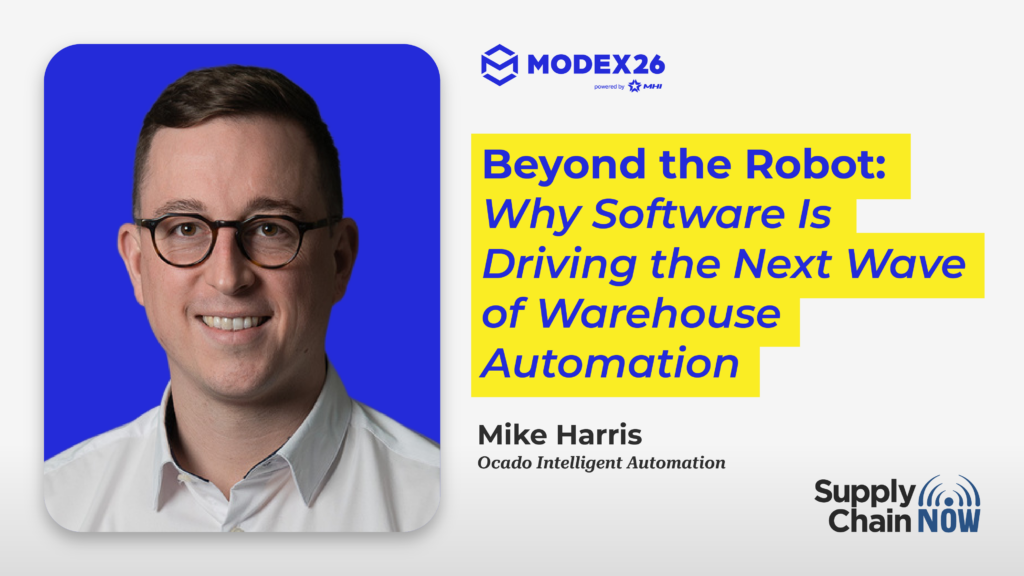
Beyond the Robot: Why Software Is Driving the Next Wave of Warehouse Automation
At MODEX 2026 in Atlanta, Scott Luton caught up with Mike Harris, VP of OMRS at Ocado Intelligent Automation, to explore how robotics, software, and evolving customer expectations are reshaping modern warehouse operations. While robots may grab the spotlight, Harris makes it clear: the real value lies beneath the surface, as in the intelligence that powers them. Rising Expectations and the Cost-to-Serve Challenge Warehouse operators are under increasing pressure from both ends of the supply chain. Costs continue to climb, while customer expectations are rising just as quickly. “Cost to serve is continuing to increase and customers expect things faster and completely accurate” Harris explains. This dynamic creates a constant balancing act. Organizations must improve speed and accuracy while controlling costs, a challenge that requires more than incremental improvements. It demands smarter, more adaptive systems. Flexibility and Long-Term Thinking Take Center Stage In today’s volatile environment, Harris sees a clear shift in how companies approach automation investments. “We’re finding that customers are looking to invest in technologies and partners that they want to stay with for a while,” he notes. Rather than chasing one-off solutions, organizations are prioritizing long-term partnerships and scalable platforms that can evolve with their…