

More

May 15, 2020
This Week in Supply Chain Now: May 9th-15th
Another great week here at Supply Chain Now! Have you listened to all the episodes? If not, no worries! Check them all out here: We added a special Saturday episode on May 9th and featured another speaker from the 2020 AIAG CR Summit, Eric Kane with Bloomberg, and his insights from the conference. On Monday, we continued our Supply Chain Super Trends series with Sarah Barnes-Humphrey with Let’s Talk Supply Chain. Supply Chain Super Trend #3 focused on a holistic approach to supply chain TALENT. Mike Griswold with Gartner joined us for another excellent livestream last week, and we published it as a podcast episode on Tuesday. He shared his latest observations on how COVID-19 is impacting global supply chains. A MUST-listen! We continued our interviews with the speakers from the AIAG CR Summit on Wednesday, with great insights from Dr. Assheton Carter with TDI Sustainability. Thursday we published our popular Supply Chain Buzz, with Scott and Greg sharing and discussing the latest news and events in Supply Chain and beyond. And on Friday, we wrapped up the interviews with the extrordinary speakers from the AIAG CR Summit, with Brian Rich…
August 28, 2025
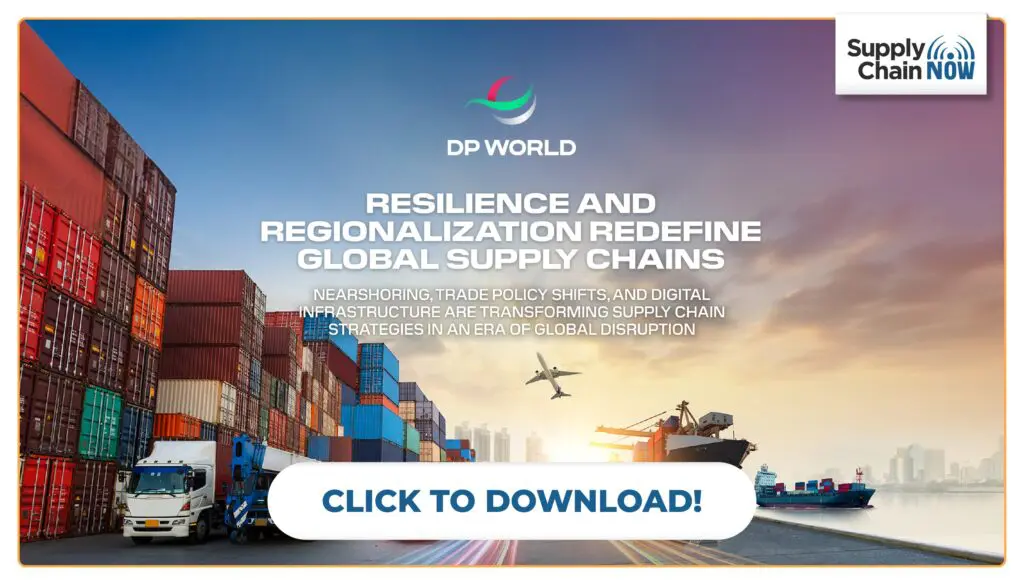
Resilience and Regionalization Redefine Global Supply Chains
How nearshoring, trade policy shifts, and digital infrastructure are transforming strategies in an era of disruption Global supply chains are being tested like never before. Rising tariffs, shifting trade policies, and the push for sustainability have accelerated a new era of resilience. Businesses are no longer simply reacting to disruptions—they’re proactively reconfiguring their networks with nearshoring, diversification, and advanced technology. The latest white paper from DP World explores how companies across the Americas are turning volatility into opportunity by investing in regional supply chains, leveraging economic zones, and adopting digital innovation to stay competitive in a fragmented global market. Download your copy today to see how you can position your business for strength and agility. What You’ll Learn: This white paper provides actionable insights for supply chain leaders navigating geopolitical, economic, and technological change. Inside, you’ll discover: ✔ Why resilience now outweighs efficiency: 88% of businesses plan to reconfigure supply chains in 2025. ✔ How trade policies are driving regionalization: New U.S. tariffs are reshaping sourcing strategies and opening opportunities in Latin America. ✔ Where investment is accelerating growth: Nearshoring fueled $36B in foreign investment in Mexico in 2024, with DP World investing $2.5B in logistics infrastructure across Latin…