

More

supply chain podcast
April 8, 2025
Meet the Supply Chain Now Host: Jake Barr
Supply Chain Now is the voice of the supply chain industry, and our hosts are experts in the field. Podcast listeners and webinar viewers tune in to hear the sage advice of host Jake Barr, heralded as an architect of global supply chain strategy and creator of “profit powerhouses.” Earning His Spot on Stage Barr today is the CEO of BlueWorld Supply Chain Consulting, which provides support to such Fortune 500 companies as Cargill, Caterpillar, 3M, PepsiCo, and Pfizer and helps them bring products to market. “We place a premium on accelerating speed to market by leveraging supply chain transformation,” he says. “The result is better operating margin performance and the opportunity to drive faster growth in revenue.” During his more than 33 years with Procter & Gamble, Barr served as the global director of supply network operations and led the end-to-end planning transformation project, which created control towers that now manage the daily business globally and earned him recognition as the architect for the company’s demand-driven supply chain strategy. He served on the MIT Center for Transportation & Logistics advisory council for its Supply Chain 2020 Project, was named to the League of Leaders for retail and consumer goods…
agentic AI
December 19, 2025
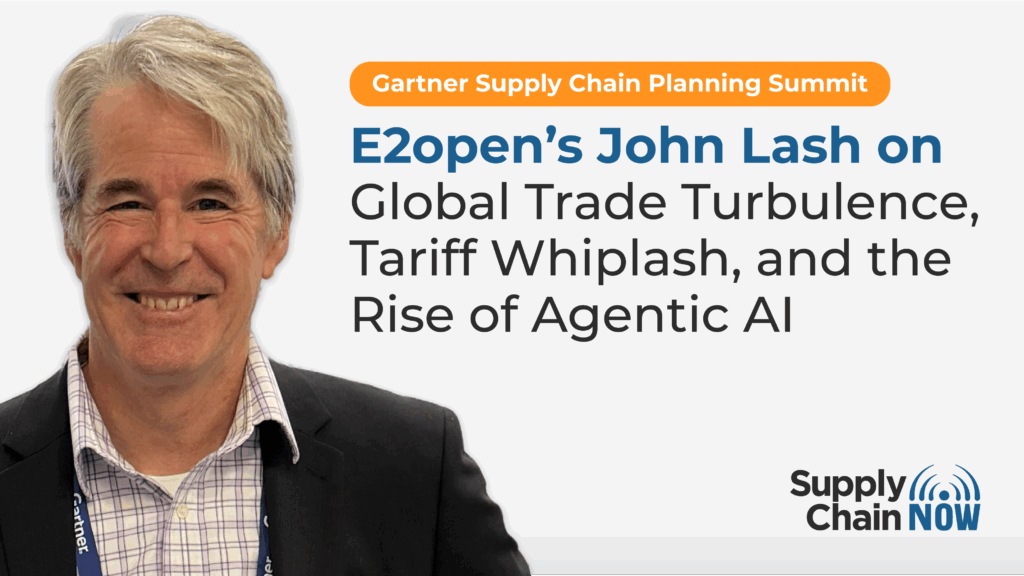
E2open’s John Lash on Global Trade Turbulence, Tariff Whiplash, and the Rise of Agentic AI
At the 2025 Gartner Supply Chain Planning Summit in Denver, Scott Luton met with John Lash, who leads strategy and vision at e2open, a WiseTech Global Group company. E2open is a global platform powering the entire lifecycle of making, moving, and selling goods, with capabilities spanning planning, logistics, global trade, supply management, and procurement. The platform is designed not just for enterprise visibility but for true end-to-end coordination across extended supply chain ecosystems. Lash emphasized that disruptions rarely originate within a company’s four walls. “Your sub-tiers are where most of the risk lives,” he explained. “That’s where your day-to-day operations—and your long-term strategy—are truly shaped.” It’s a lesson sharply reinforced during the pandemic, which reminded leaders worldwide that no one does supply chain alone. Old Challenges Intensified by New Realities When Luton asked about the biggest challenges facing planning teams today, Lash pointed immediately to constraints—supply constraints, manufacturing constraints, and now, the added layer of global trade volatility. Trade policies that once shifted every few years now change weekly, daily, or even hourly. Lash offered a striking example: Brazilian coffee duties jumped from 10% to 50% this summer—before returning to 0%. “How do you plan through that?” he asked.…