

More
military
January 12, 2023
Veteran Voices Launches New Partnership
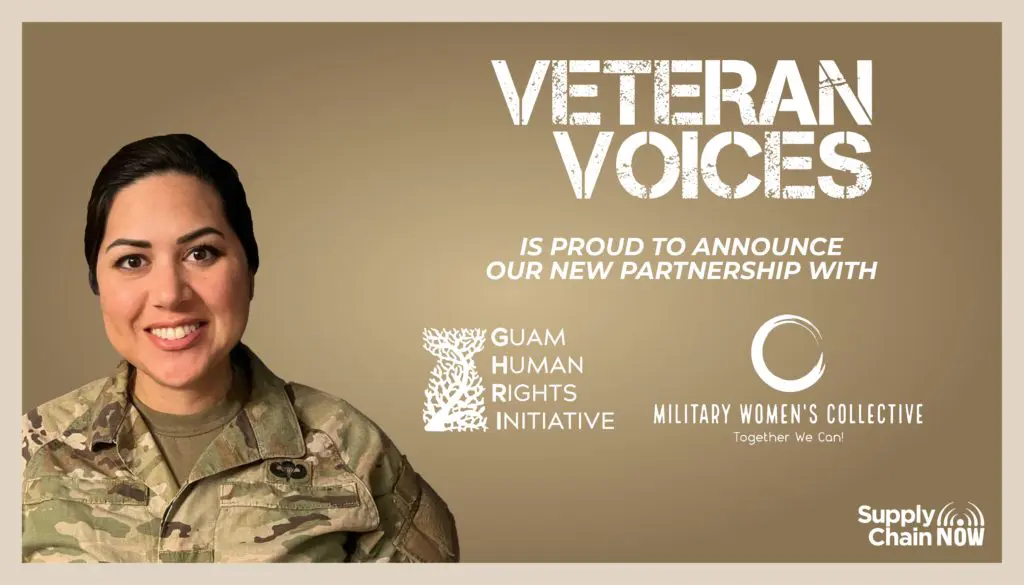
Supply Chain Now Founder and CEO Scott Luton announced that its “Veteran Voices” podcast will re-launch this year in partnership with two non-profit organizations: The Guam Human Rights Initiative and the Military Women’s Collective. “We’re proud to promote the efforts of these two organizations, as we are all highly aligned in our dedicated mission to serve our veteran community. Both organizations are veteran-led, start-up nonprofits that are doing big things out in the market. They are the perfect partners for ‘Veteran Voices,’” said Luton. As noted on its website, the Guam Human Rights Initiative “is a collaborative research nonprofit seeking to advance human rights on Guam and throughout the Pacific through meaningful and impactful research efforts.” Since its founding in 2021, the Military Women’s Collective is determined “to make an impact in the military nonprofit space by focusing on our women veteran population.” Its mission focuses on empowering homeless and food-insecure women veterans as well as providing coaching, mentorship and support for women veterans who are transitioning out of the military. Mary Kate Soliva, host of “Veteran Voices,” said that she has a special place in her heart for both organizations and the good works they do. She is excited…
collaborative planning
February 18, 2026
Collaboration That Actually Pays Off
Special Guest Blog Post written by Dyci Sfregola Why planning, procurement, and leadership must move beyond coordination theater Collaboration is one of the most overused (and misunderstood) words in both modern supply chain and construction management. Everyone claims to value it. Few organizations design their operating models to make it work. In a recent conversation, Scott Luton sat down with Dyci Sfregola, author of Next Level Construction Management, to unpack what real collaboration looks like in practice; and why so many well-intentioned efforts fail to deliver measurable results. What “True” Collaborative Planning Really Means According to Sfregola, real collaboration isn’t about more meetings or more dashboards. It’s about working together to create one plan, one set of assumptions, and real tradeoff analysis – – all owned collectively across functions. That includes finance, commercial, marketing, manufacturing, planning, and procurement all working from the same reality. Capacity, labor, cash flow, and constraints are visible. Decisions are documented. Actions actually change what happens next. The most common failure? Confusing information sharing with alignment. Teams often circulate data and emails and call it alignment, but no one in the room has clear decision rights – – or the authority to commit resources…