

More
automation
April 27, 2026
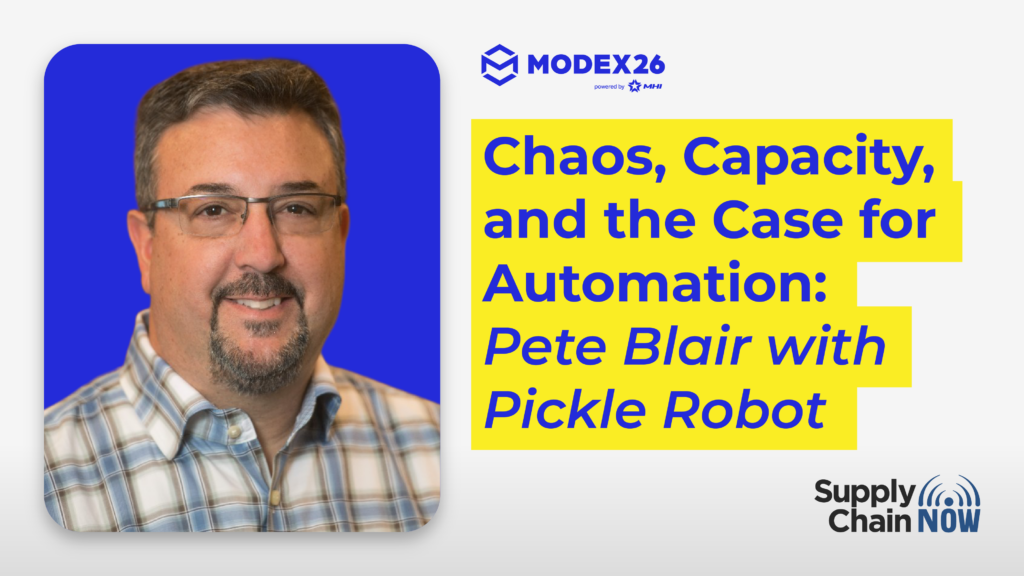
Chaos, Capacity, and the Case for Automation: Pete Blair with Pickle Robot
At MODEX 2026 in Atlanta, the energy was unmistakable. With thousands of supply chain professionals gathered, one theme echoed across conversations: uncertainty is no longer episodic. It’s constant and seemingly endless. In a candid discussion with Scott Luton, Pete Blair, VP of Product & Marketing at Pickle Robot, unpacked how organizations are navigating volatility, workforce challenges, and the growing role of automation in keeping operations moving. Navigating Tariffs and a Moving Target If there’s one word defining today’s global supply chain environment, it’s unpredictability. Blair points to tariffs as a prime example; and not just their presence, but their volatility. “The biggest thing we see… is the chaos of tariffs. It’s not so much that customers have to pay tariffs or not pay tariffs, it’s that they don’t know how to plan,” Blair explains. That lack of predictability is forcing organizations to rethink their networks in real time. Companies are shifting sourcing strategies, standing up temporary distribution centers in new geographies, and even making drastic decisions about whether importing goods makes financial sense at all. What’s particularly challenging isn’t the cost itself. But rather, it’s the inability to forecast. Supply chains, while resilient, aren’t designed for abrupt swings like…
Journal of Business Logistics
June 26, 2026
AI Is Good at Picking Qualified Suppliers. It Still Struggles to Pick the Best One.
Companies are rapidly integrating generative AI into procurement and sourcing decisions. The promise is obvious. AI can read thousands of pages of supplier proposals faster than any human team, summarize technical requirements in seconds, and create the appearance of consistency and objectivity in evaluation. But there is an important distinction managers are starting to overlook. The same AI system that performs extremely well at identifying whether a supplier meets minimum requirements may perform much less reliably when judging which supplier is truly better. Recent research published in the Journal of Business Logistics examined this issue by comparing how large language models evaluated supplier bids against evaluations completed by experienced procurement professionals. It analyzed 123 supplier proposals tied to 31 public procurement projects conducted by the State of Ohio between 2023 and 2024. The projects involved complex IT services contracts, many containing large, text-heavy bid packages requiring evaluative judgment rather than simple arithmetic comparisons. The researchers tested three reasoning-oriented AI models: OpenAI o3, Grok-3-Mini, and DeepSeek R1. They then compared their evaluations against human procurement scores. The findings revealed a surprisingly clear pattern. AI performed well when evaluating compliance signals. These are signals tied to baseline qualifications and technical requirements. Does…