

More
fulfillment automation
February 20, 2026
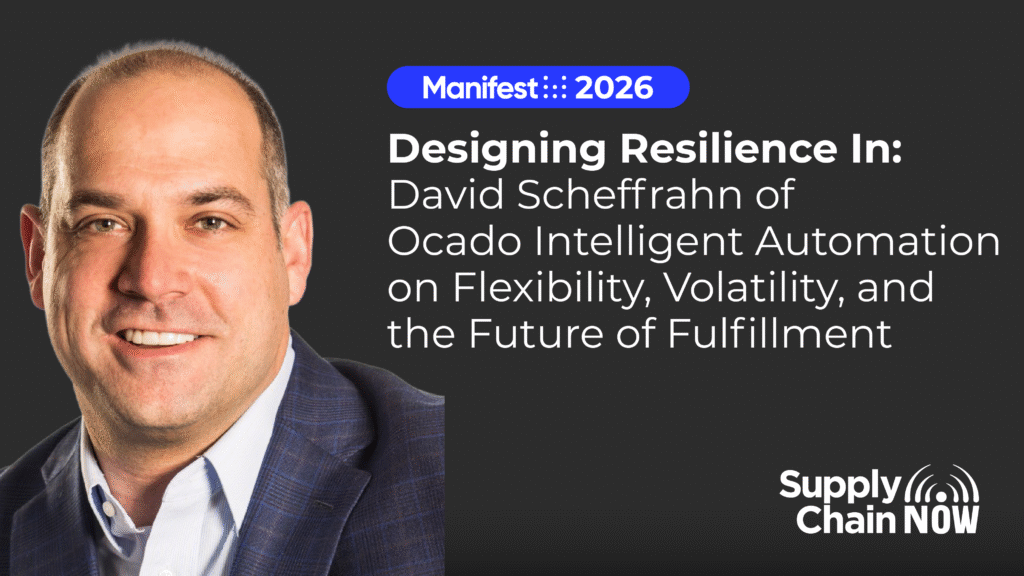
Designing Resilience In: David Scheffrahn of Ocado Intelligent Automation on Flexibility, Volatility, and the Future of Fulfillment
From Grocery Innovator to Global Tech Enabler At Manifest 2026, Scott Luton spent time with David Scheffrahn, Vice President of Sales with Ocado Intelligent Automation, to explore how fulfillment technology is evolving in an era defined by volatility. While Ocado is widely known in the UK and Europe for its e-commerce grocery leadership, Scheffrahn explained that the company’s North American focus is different. Over 25 years of building its own advanced grocery e-commerce and fulfillment operations, Ocado developed a powerful technology stack to drive efficiency. “What we’ve done in the last five years,” he shared, “has taken the tech stack that we built for our own use, and now we’re offering it to other companies to buy and use for their operations.” Today, Ocado supports 3PLs and global brands with end-to-end automation solutions that enable companies to maintain greater control over their omnichannel fulfillment, especially those looking for alternatives to marketplace giants. Volatility Hasn’t Gone Away When asked about dominant supply chain themes heading into 2026, Scheffrahn was direct: “Volatility has not gone away.” He described 2025 as “a massive shock in the system,” with tariffs and shifting trade policies forcing customers to pause projects and reassess strategy. “Almost…

supply chain war room strategy
February 26, 2026
Inside the Supply Chain War Room: Max Garland on Backup Plans, Delivery Costs & the Human Side of Innovation
At Manifest 2026, Scott Luton shared a cup of coffee with Max Garland, Senior Reporter at Supply Chain Dive, an Informa TechTarget publication, for a boots-on-the-ground perspective from one of the industry’s most plugged-in observers. Garland covers freight, logistics, retail fulfillment, and parcel delivery: the parts of the supply chain where strategy meets reality. And after a bruising 2025, he sees an industry that’s not just reacting anymore. It’s recalibrating. From Plan B to Plan D If 2025 had a theme, Garland says it was contingency planning. “Last year was when a lot of companies were putting together those Plan B’s, Plan C’s, and Plan D’s,” he explained, pointing to tariff upheaval and shifting trade policy that forced leaders into constant reaction mode. Companies prioritized flexibility: diversifying sourcing, adjusting procurement strategies, and preparing for fires wherever they might spark. In 2026, that flexibility remains. But the tone has shifted. Now companies are “firming up their plans, fine-tuning, making sure those back-up plans are cost-effective as well.” It’s no longer just about avoiding disruption; it’s about operating efficiently within it. In other words, supply chain leaders aren’t just jumping over candlesticks anymore (like Jack from the old nursery rhyme). They’re…