

More
foundational industries investment
February 23, 2026
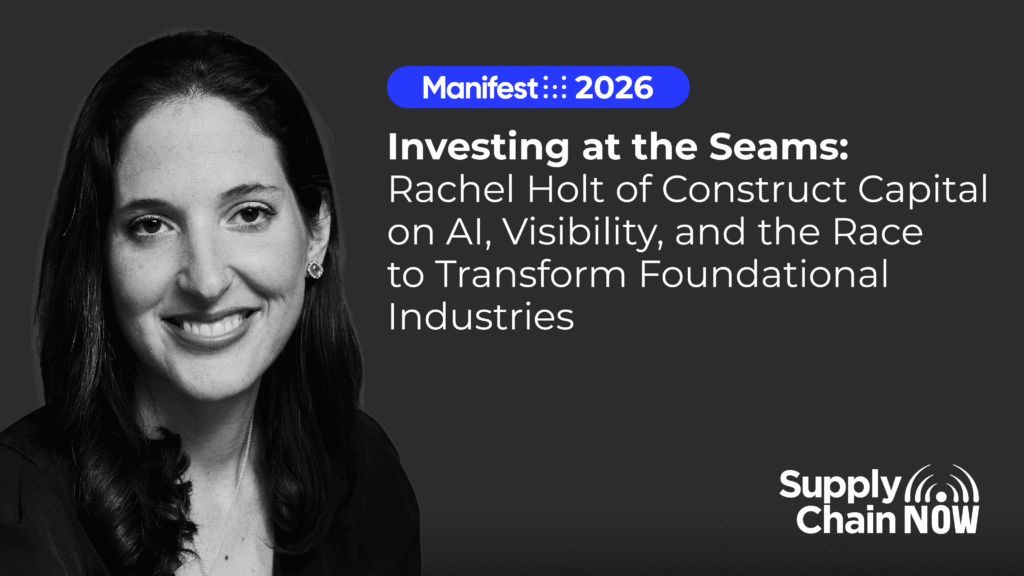
Investing at the Seams: Rachel Holt of Construct Capital on AI, Visibility, and the Race to Transform Foundational Industries
From Uber to Foundational Industries At Manifest 2026, Scott Luton sat down with Rachel Holt, Co-Founder and Managing Partner of Construct Capital, to explore how venture capital is fueling the next era of supply chain innovation. Construct Capital, now six years old, was founded in early 2020 with a bold thesis: transform foundational industries that represent nearly half of GDP: supply chain, logistics, manufacturing, mobility, infrastructure, and defense. When the fund launched, Holt recalls many skeptics asking whether supply chain and logistics were truly venture-scale opportunities. It echoed what she heard when she joined Uber in 2011, when transportation was considered slow moving and heavily regulated. Yet Uber went on to redefine personal logistics. Her final years at Uber brought a pivotal lesson. While the rides business operated with second-by-second visibility, the company’s e-bike and scooter supply chain operated in near darkness. Products shipped from China would disappear for weeks at sea, briefly reappear at ports, then stall again in customs. “We had no visibility, we had no ability to reroute,” Holt shared, as this Eureka moment would go on to help shape her investment focus. The Visibility Gap at the Seams Supply chain, Holt emphasized, is not monolithic.…
demand sensing
March 3, 2026
Key Demand Sensing and Forecasting Use Cases Across Industries
Special Guest Blog Post written by Chris Cunnane with InterSystems In a world defined by rapid market shifts, volatile supply chains, and unpredictable customer behavior, traditional forecasting methods often fall short. Relying primarily on historical data is no longer enough. To stay competitive, organizations are increasingly turning to demand sensing and forecasting, an approach that blends real-time data, advanced analytics, and AI to anticipate demand more accurately and respond faster to change. This shift is not limited to retail or manufacturing. Demand sensing is transforming how organizations across industries plan operations, allocate resources, and improve service levels. Below, we explore key industry use cases where demand sensing is delivering measurable value, and why businesses should care. Why Demand Sensing Matters Demand sensing moves beyond static historical trends. It incorporates current, high-velocity data signals such as sales transactions, weather patterns, logistics feeds, economic indicators, and even social sentiment to generate short-term demand forecasts that reflect real-world conditions. The benefit is clear. Organizations gain better visibility and responsiveness across procurement, production, inventory, and distribution. Instead of reacting to outdated forecasts, they can make timely decisions that reduce costs, prevent stockouts, and improve customer satisfaction. FMCG, CPG, Retail, & E-Commerce Fast-moving…