

More
execution
May 4, 2026
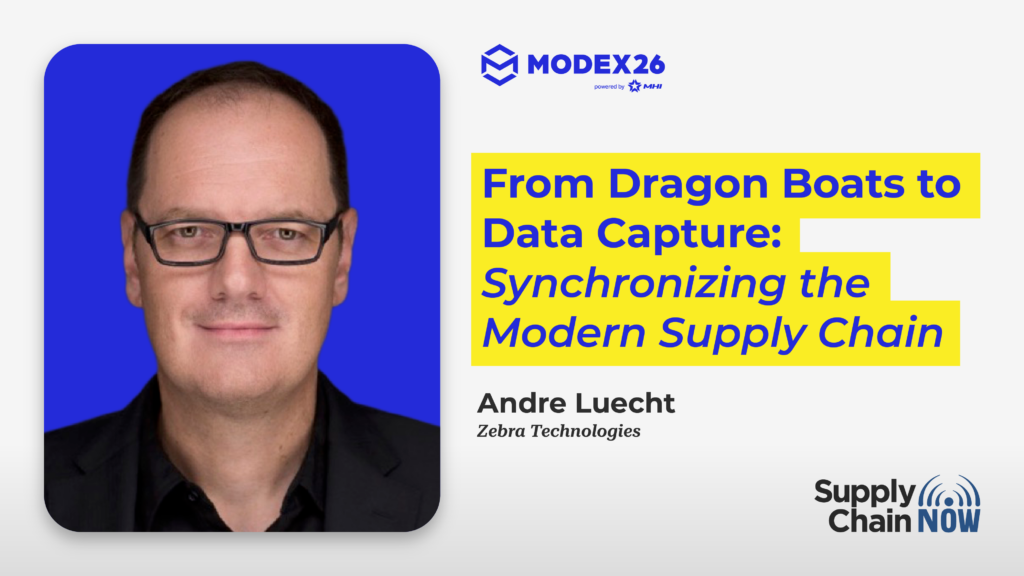
From Dragon Boats to Data Capture: Synchronizing the Modern Supply Chain
At MODEX 2026 in Atlanta, Scott Luton sat down with Andre Luecht, Global Strategy Lead for Transportation, Logistics & Warehousing at Zebra Technologies, to explore how synchronization, visibility, and practical innovation are shaping the next phase of supply chain performance. Interestingly, the conversation began not with technology, but with competitive dragon boat racing, a hobby of Andre Luecht’s that he enjoys in his free time. For Luecht, the analogy is clear: success depends on alignment. “The team that is the most synchronized team is the one that wins,” he explains, a principle that applies just as much to supply chains as it does to sport. Turning Data Into Decisions At the Edge Zebra Technologies has long been known for enabling visibility across supply chains, from barcode scanning to RFID and beyond. But today, the focus is evolving toward something more powerful: decision-making at the edge. Luecht describes a world where frontline workers are empowered with real-time intelligence directly on their devices. “AI… is what you can build into a device in the hand of someone who has to decide what truck a certain pallet goes onto,” he says. This concept, what Zebra calls “frontline AI”, brings intelligence closer to…
decision intelligence
October 1, 2026
Leading Through Disruption: How Supply Chain Leaders Are Adapting to the “Never Normal”
A shipment delayed at sea can become a financial problem before it ever reaches the warehouse. A routing decision can change exposure to cargo theft. A technology investment can improve visibility while raising expectations for how quickly teams should respond. For supply chain leaders, geopolitical, technological, and economic disruption rarely arrive as separate challenges. They overlap, creating decisions that affect transportation, compliance, customer service, and profitability all at once. In the recent Supply Chain Now webinar, hosts Scott Luton and Jake Barr were joined by Henrik Holm, Vice President of Ocean Freight for the Americas at Apex Logistics International, and Linda Moran, Customs Compliance Senior Manager at Apex Logistics International, to explore how companies can adapt. Their discussion offered a practical perspective on what Barr calls the “never normal”: leaders need strategies that help them operate confidently even when the conditions around them keep changing. Building Stability Through Preparedness Stability can feel like an ambitious goal when trade policies shift, shipping routes change, and transportation capacity becomes unpredictable. Yet the panel’s discussion suggests that companies can create greater stability through the decisions they make before disruption occurs. Holm emphasized understanding when and where goods are needed, planning earlier, and…