

More
AI-powered supply chain solutions
March 5, 2026
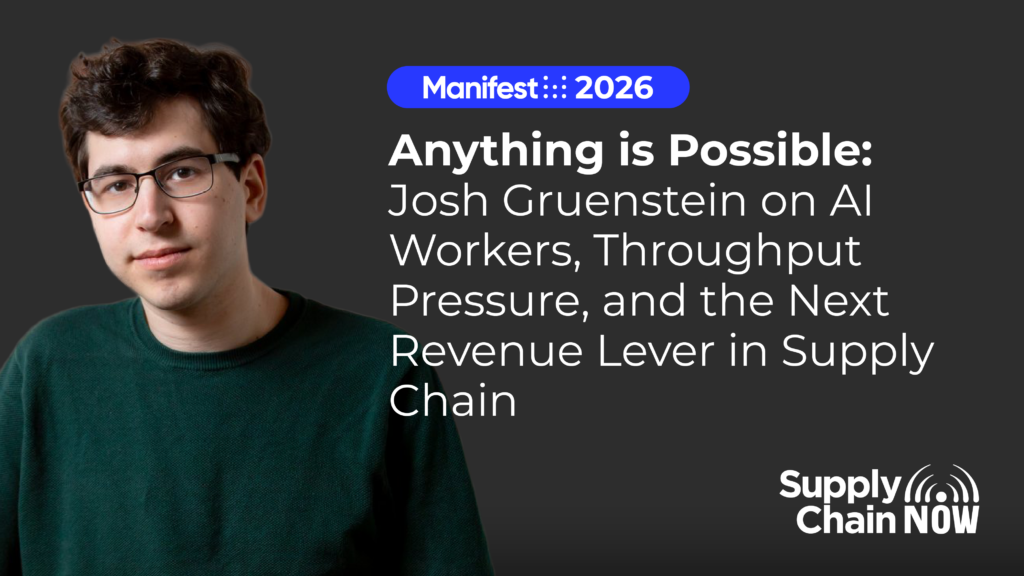
Anything is Possible: Josh Gruenstein on AI Workers, Throughput Pressure, and the Next Revenue Lever in Supply Chain
At Manifest 2026, Scott Luton spent time with Josh Gruenstein, Co-Founder and CEO of Tutor Intelligence, to talk about a future that’s no longer theoretical: AI-powered robot workers operating inside America’s warehouses and factories. And this isn’t a science experiment. It’s already happening. From MIT to the Warehouse Floor Gruenstein and his team came out of MIT’s Computer Science and AI Lab with a bold idea: build AI-powered robot workers that can handle the manual labor people don’t want to do. “We build physical robots,” Gruenstein explained. “We build AI models that enable robots to perceive their environments, and then we deploy those robots into factories and warehouses across the United States to do manual labor that people don’t want to do.” Unlike traditional automation projects that require massive capital outlays, Tutor Intelligence operates on a robots-as-a-service model. Companies can engage a Tutor robot for roughly $14–$18 an hour, creating a flexible, scalable path to automation without multimillion-dollar implementation risk. Automation Isn’t New. AI Is Changing the Playbook. When asked about dominant supply chain themes, Gruenstein pointed to a constant drumbeat: automation. But 2026 feels different. “Automation is obviously a constant theme,” he said. “What really seems different…
demand spikes
May 26, 2026
When Demand Spikes Overnight: A Practical Guide to Demand Signal Management
Demand can change in an instant. A flash promotion takes off faster than expected. An influencer post sends a niche SKU into the stratosphere. A heat wave flips seasonal demand on its head. And suddenly, your forecast—carefully crafted weeks ago—feels like yesterday’s weather report. This is where demand signal management earns its keep. Instead of reacting too late or overreacting too early, it helps supply chain teams interpret what’s really happening and respond with confidence. For retailers and consumer brands navigating constant demand volatility, it’s the difference between chasing noise and acting on insight. The problem: demand forecasts lag reality Traditional forecasting has a fundamental challenge: timing. Forecasts are built on historical patterns and planning cadences that move at a measured pace, but demand levels today won’t wait for the next planning cycle. Modern demand shocks often arrive without warning: a promotional discount goes viral, a competitor runs out of stock, weather drives sudden regional swings, or a trend outpaces merchandising plans. In these moments, planners face a familiar tension. React too slowly, and shelves go empty. React too aggressively, and you’re stuck with excess inventory once the spike fades. What demand signals are (and what they aren’t)…