

More
AI
January 9, 2026
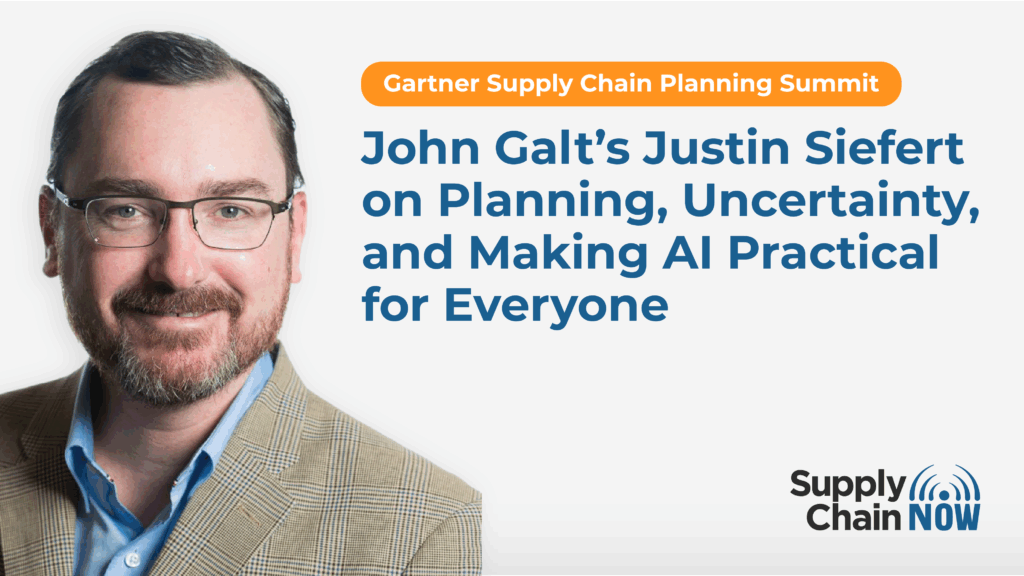
John Galt’s Justin Siefert on Planning, Uncertainty, and Making AI Practical for Everyone
At the 2025 Gartner Supply Chain Planning Summit in Denver, Scott Luton caught up with Justin Siefert, a familiar face in the supply chain community and a leader at John Galt Solutions, a global provider of end-to-end supply chain planning software. From demand and supply planning to inventory and S&OP, John Galt supports organizations across industries with the holistic capabilities needed to thrive in an increasingly unpredictable landscape. A Company Investing in the Next Generation Before diving into industry trends, Siefert shared an update on one of the programs that sets John Galt apart: its supply chain scholarship program, which awards $10,000 to students pursuing supply chain degrees. This year’s cycle brought in a record number of nominations, with new winners set to be announced in January. It’s an initiative Siefert is proud of—and one that reflects John Galt’s belief in cultivating tomorrow’s leaders. Old Problems, New Pressures: Planning in a World of Uncertainty When asked about the biggest challenges facing planners today, Siefert didn’t hesitate: uncertainty. While the forms of disruption change—pandemics, geopolitical shifts, demand shocks, evolving portfolios—the underlying challenge remains the same. Planners must anticipate what’s next and respond quickly, often in real time. “No day…
supply chain
March 6, 2026
The Retail TCO Playbook: Strategies for Supply Chain Savings
Retail margins rarely disappear all at once, they leak out quietly across transportation, inventory, and returns. As ecommerce grows and return rates rise, retailers are facing higher logistics costs, volatile freight spend, and inventory positioned in the wrong places at the wrong time. Many organizations still operate without true end-to-end visibility, making it difficult to control cost or respond proactively to disruption. This playbook shows how leading retailers are addressing total cost of ownership (TCO) as a strategic priority, not just an operational metric. Instead of massive transformation programs, it outlines practical actions that can uncover measurable savings in as little as 90 days through better purchase order control, improved visibility, and smarter network design. Why download this white paper: Identify where margin is leaking across transportation, inventory, and returns Understand the three most effective levers for reducing supply chain cost Learn how to reduce premium freight, improve utilization, and avoid markdowns See how real-time visibility improves planning and service levels Get a step-by-step 90-day pilot roadmap to validate savings Build a finance-ready business case for scalable TCO improvement By the end, you’ll have a clear framework to evaluate your current operations, prioritize improvements, and turn hidden supply chain inefficiencies…