

More
July 10, 2020
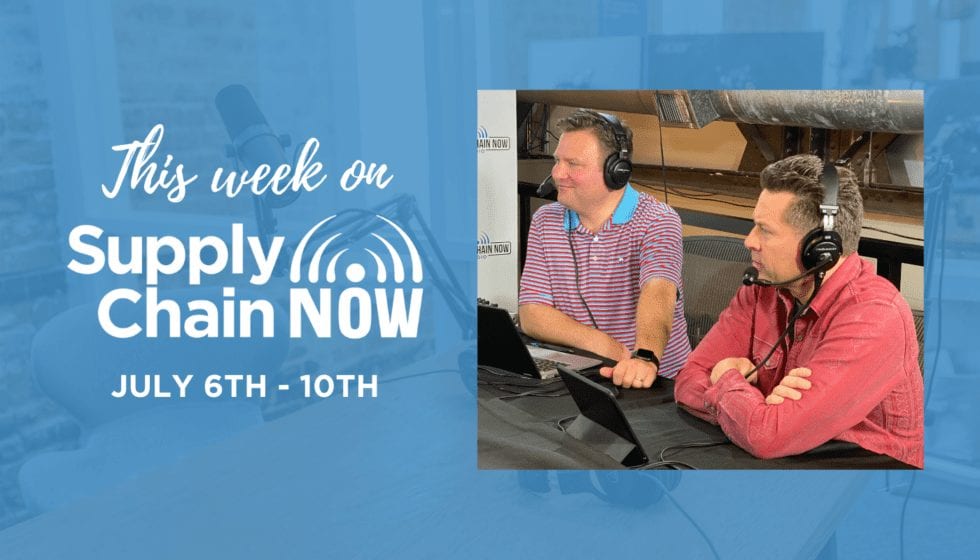
This Week on Supply Chain Now- July 6th – 10th
Another great week here at Supply Chain Now! Did you catch all the episodes? If not, you can check them all out here: We kicked off the week with This Week in Business History, where Scott looks back at some of the biggest historical events in business history for the week ahead, including the birth of the Coca-Cola Company. Supply Chain Now · “This Week in Business History for July 6th: The Birth of the Coca-Cola Company” Then on Tuesday, Scott and Greg welcomed John Buglino with Optessa to the podcast to discuss simplifying and streamlining operations. Supply Chain Now · “Simplifying & Streamlining Operations: John Buglino with Optessa” On Wednesday we published the Supply Chain Buzz, where Greg and Scott discussed the top supply chain news of the week, and were joined by special guest Tevon Taylor, with FedEx Supply Chain. Supply Chain Now · “Supply Chain Buzz for July 6th: Featuring Tevon Taylor with FedEx Supply Chain” On Thursday, we continued our new series, TECHquila Sunrise with Greg White, where Greg shares the latest investments, acquisitions, innovations, and glorious implosions in Supply Chain Tech every week. Supply Chain Now…
supplier qualification
June 26, 2026
AI Is Good at Picking Qualified Suppliers. It Still Struggles to Pick the Best One.
Companies are rapidly integrating generative AI into procurement and sourcing decisions. The promise is obvious. AI can read thousands of pages of supplier proposals faster than any human team, summarize technical requirements in seconds, and create the appearance of consistency and objectivity in evaluation. But there is an important distinction managers are starting to overlook. The same AI system that performs extremely well at identifying whether a supplier meets minimum requirements may perform much less reliably when judging which supplier is truly better. Recent research published in the Journal of Business Logistics examined this issue by comparing how large language models evaluated supplier bids against evaluations completed by experienced procurement professionals. It analyzed 123 supplier proposals tied to 31 public procurement projects conducted by the State of Ohio between 2023 and 2024. The projects involved complex IT services contracts, many containing large, text-heavy bid packages requiring evaluative judgment rather than simple arithmetic comparisons. The researchers tested three reasoning-oriented AI models: OpenAI o3, Grok-3-Mini, and DeepSeek R1. They then compared their evaluations against human procurement scores. The findings revealed a surprisingly clear pattern. AI performed well when evaluating compliance signals. These are signals tied to baseline qualifications and technical requirements. Does…