
More
November 12, 2020
This Week on Supply Chain Now: November 1st – November 12th
This week on Supply Chain Now, we released our 500th episode, gained key insight into the latest industry news, & heard from featured guests who shared their journeys into supply chain. Make sure you’re up to date on all the latest episodes, interviews, conversations, and livestreams! On Saturday, Brandon Mason, a lead analyst for Eaton’s Global Market Intelligence group shares with Scott his insights into automotive industry trends, including emerging technologies & economic trends. On Monday, the Supply Chain Now team got together to celebrate 500 episodes and look back on the journey so far. On Tuesday’s podcast episode, Scott & Greg welcomed Hank Picken and Jeff Picken, the father-son team leading Beaumont Products. Listen up as they share what its like to be part of a family business as well as key insight into manufacturing. For Veteran’s Day on Wednesday, we featured the Veteran Voices podcast where Scott welcomed Rear Admiral Casey W. Coane, U.S. Navy (Retired) to talk about his military service and the mission he’s on now. On Thursday, Karin Bursa & Sofia Rivas Herrera joined Scott & Greg on the Supply Chain Buzz. Listen up as they dive into giving forward…
MODEX 2026
May 28, 2026
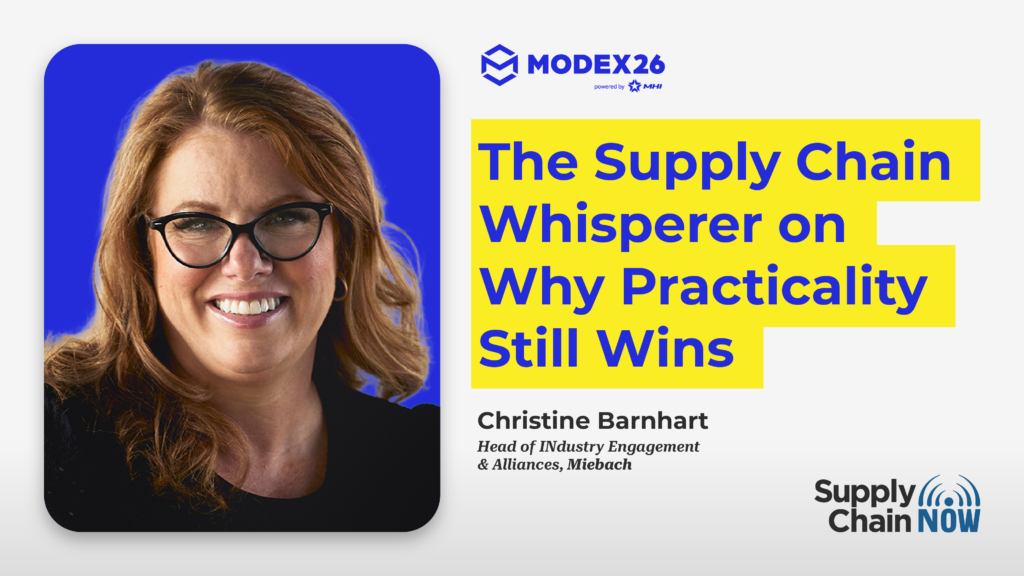
The Supply Chain Whisperer on Why Practicality Still Wins
At MODEX 2026 in Atlanta, Scott Luton sat down with Christine Barnhart, Head of Industry Engagement & Alliances at Miebach. She is known by many across industry as “The Supply Chain Whisperer.” Their conversation covered everything from AI and supply chain maturity to workforce evolution and the importance of practical execution. Through it all, Barnhart offered a grounded perspective shaped by years of operational leadership and transformation work. And if there’s one central takeaway from the discussion, it’s this: the companies that succeed won’t be the ones chasing hype. But they WILL be the ones building resilient, executable supply chains. There Is No “Normal” Anymore Supply chain leaders have spent years navigating disruption, but Barnhart believes the industry has finally reached an important realization. “People have finally come to this conclusion that there is no such thing as normal anymore,” she explains. That mindset shift is changing how organizations think about planning, investment, and agility. Network design exercises that once happened every three to five years are now being revisited continuously. Companies are investing in tools that shorten decision cycles and improve responsiveness in near real time. The old approach that focused on “design once, optimize later” – –…