

More
May 1, 2020
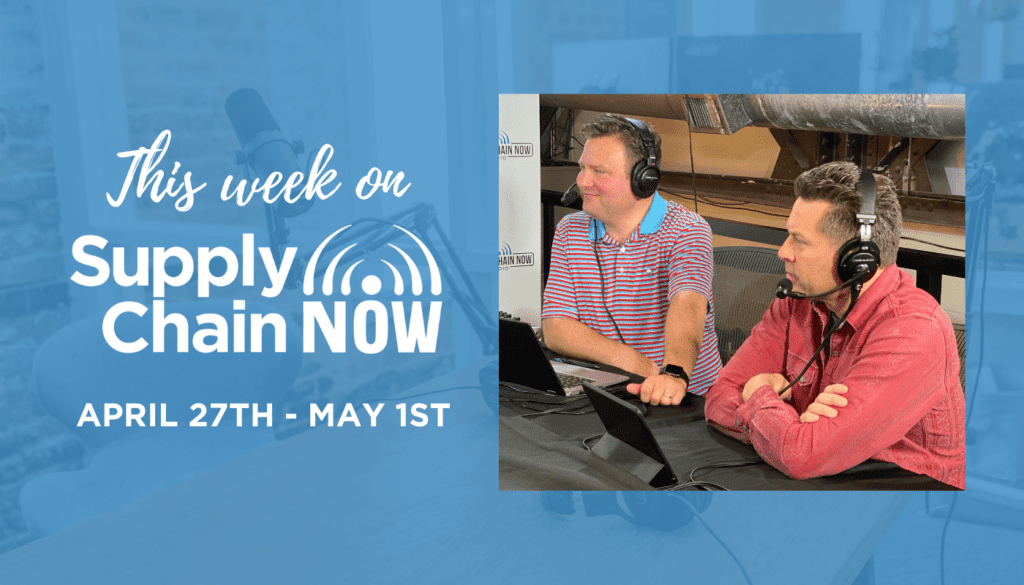
This Week at Supply Chain Now: April 27th – May 1st
BIG THINGS happening here at Supply Chain Now! Have you listened to all the episodes from this week? If not, no worries! Check them all out here: We started out the week wrapping up our last episode from MODEX 2020 with supply chain visionary Diego Pantoja-Navaja with Oracle. Supply Chain Now · “Supply Chain Visionary: Diego Pantoja-Navajas with Oracle” On Tuesday, Scott and Greg were joined by Enrique Alvarez and Adrian Purtill with Vector Global Logistics as they continued the Logistics with Purpose series with special guest Patrick Plonski with Books for Africa. Supply Chain Now · “Logistics with Purpose: Patrick Plonski, PhD with Books for Africa” Then we published the new and improved Supply Chain Buzz, with Scott and Greg sharing and discussing the latest news and events in Supply Chain and beyond. Supply Chain Now · “The Supply Chain Buzz: Week of April 27th” Scott and Greg were joined by Bobby Holland with U.S. Bank and Lee Klaskow with Bloomberg Intelligence on Thursday as they discussed the key takeaways from the Q1 2020 U.S. Bank Freight Payment Index. Supply Chain Now · “Analysis of Q1 2020 U.S. Bank Freight Payment…

supply chain war room strategy
February 26, 2026
Inside the Supply Chain War Room: Max Garland on Backup Plans, Delivery Costs & the Human Side of Innovation
At Manifest 2026, Scott Luton shared a cup of coffee with Max Garland, Senior Reporter at Supply Chain Dive, an Informa TechTarget publication, for a boots-on-the-ground perspective from one of the industry’s most plugged-in observers. Garland covers freight, logistics, retail fulfillment, and parcel delivery: the parts of the supply chain where strategy meets reality. And after a bruising 2025, he sees an industry that’s not just reacting anymore. It’s recalibrating. From Plan B to Plan D If 2025 had a theme, Garland says it was contingency planning. “Last year was when a lot of companies were putting together those Plan B’s, Plan C’s, and Plan D’s,” he explained, pointing to tariff upheaval and shifting trade policy that forced leaders into constant reaction mode. Companies prioritized flexibility: diversifying sourcing, adjusting procurement strategies, and preparing for fires wherever they might spark. In 2026, that flexibility remains. But the tone has shifted. Now companies are “firming up their plans, fine-tuning, making sure those back-up plans are cost-effective as well.” It’s no longer just about avoiding disruption; it’s about operating efficiently within it. In other words, supply chain leaders aren’t just jumping over candlesticks anymore (like Jack from the old nursery rhyme). They’re…