

More
book club
February 2, 2026
First Edition: Between the Lines by Supply Chain Now
At Supply Chain Now, we talk a lot about innovation, resilience, and what’s next for our industry. But behind every great conversation, great idea, and great community is something even more fundamental: curiosity. We read because we’re curious. We read to learn. We read to grow. And sometimes, we read simply because it’s fun! That’s why we created Between the Lines by Supply Chain Now, a space for our community to share what we’re reading, what’s making us think, and what we’re excited to recommend to others. This isn’t a traditional book club where everyone follows the same reading list. Instead, it’s a shared shelf, built by the Supply Chain Now team and our broader community. You’ll find business books and personal development reads alongside novels, memoirs, histories, and unexpected favorites. No required genres. No assigned chapters. Just real people sharing real recommendations. Because great books shape us in different ways. Some help us sharpen our skills. Some challenge how we see the world. Some help us slow down, escape, or recharge. And often, the most meaningful growth comes from reading something we never would have picked up on our own. With Between the Lines, our goal is to create…
MODEX 2026
May 27, 2026
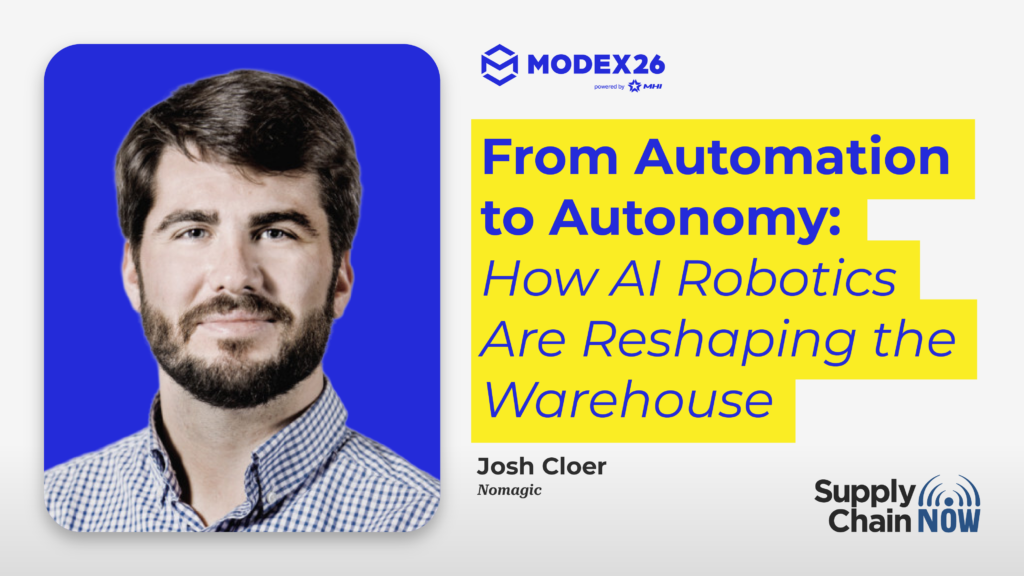
From Automation to Autonomy: How AI Robotics Are Reshaping the Warehouse
At MODEX 2026 in Atlanta, Scott Luton sat down with Josh Cloer, General Manager, North America for Nomagic, to discuss the next phase of warehouse robotics and the growing role of AI-driven automation inside modern fulfillment operations. While transportation costs and economic uncertainty continue to pressure supply chains globally, Cloer sees a major opportunity emerging inside the four walls of the warehouse. The Next Wave of Warehouse Investment According to Cloer, many organizations spent the last decade investing heavily in core warehouse infrastructure: automated storage systems, shuttles, and tote-moving technologies. Now, the focus is shifting toward connecting and expanding those systems. “What they’re moving forward with now is doing the rest of their warehouse,” Cloer explains. That includes: automated forklifts, robotic picking systems, mobile robots and AI-driven item handling. At the same time, smaller operators that may not have justified large-scale automation investments in the past are increasingly turning to more flexible robotic solutions. This evolution reflects a broader industry trend: warehouse automation is no longer reserved only for massive enterprises. More scalable and adaptable technologies are opening the door for a wider range of operators. A Different Approach to Robotics One of the most interesting parts of…