

More
supply chain
February 6, 2026
Supply Chain Decision Velocity Starts with Data Agility
Six industry leaders reveal how to build data agility—and why it’s the key to competitive advantage. Most teams spend 70–90% of their time preparing data—not analyzing it. By the time data is ready for analysis, the market has moved. Opportunities vanish. Competitors act. One company nearly built a $400M facility 550 miles from the optimal location. The cost of that mistake would have been $2 billion over the plant’s lifetime. They caught it with always-on data analytics. Would you? “In uncertainty-driven environments, expanded analytical capacity translates directly to resilience. Organizations that can model more futures make more informed commitments.” Download the white paper to discover: Why data—not talent or technology—is the real bottleneck How leading organizations are building reusable data infrastructure that cuts prep time by 80% What data agility unlocks: faster refreshes that deliver savings now, coverage across every business and region, and the capacity to finally tackle cost-to-serve, risk analysis, and inventory optimization The shift from ad-hoc projects to always-on decision-making capability Featuring insights from veterans of Cargill, Nestlé, McKinsey, and more. DOWNLOAD NOW
workforce
April 28, 2026
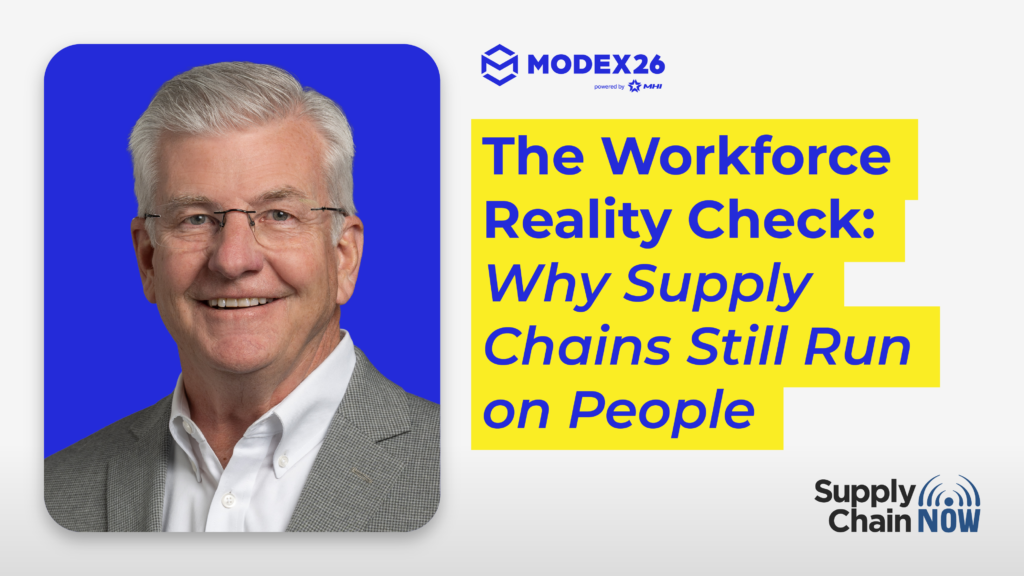
The Workforce Reality Check: Why Supply Chains Still Run on People
At the jampacked MODEX 2026 in Atlanta, Scott Luton sat down with Brian Devine, President & CEO of Ignite Industrial Professionals, for a grounded and timely conversation about one of the most pressing issues in global supply chain: the workforce. While automation continues to dominate headlines, Devine makes one thing clear: people are still at the center of it all. And finding them is getting harder by the day. “Fingerprints on Every Box” Despite rapid advancements in robotics and automation, Devine emphasizes a fundamental truth that often gets overlooked. “There’s still… fingerprints on boxes. Somebody’s putting their fingerprints on tons of boxes to move it to the next phase of the supply chain,” he explains. Even in many highly automated environments, human labor remains essential. Devine shares an example of a cutting-edge facility where autonomous forklifts handle part of the process, but still rely on human operators to complete the job. The takeaway? Automation is largely augmenting, rather than replacing, the workforce. And that makes the labor shortage even more critical to address. A Shrinking Labor Pool One of the most compelling parts of the discussion centers on simple supply-and-demand economics. The labor pool isn’t just tight. It’s…