
More
August 21, 2020
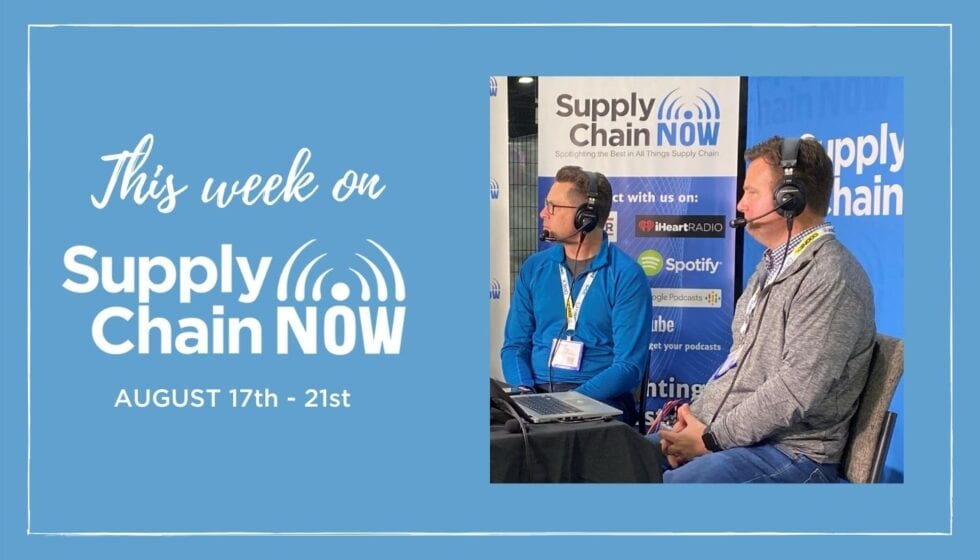
This Week on Supply Chain Now: August 17th – 21st
Another BIG week at Supply Chain Now! If you missed an episode, get a quick summary and listen here! On Monday, we published a new episode in This Week in Business History. Scott shared the stories of a few retail legends, the birth of Motown, and more! Supply Chain Now · “This Week in Business History for August 17th: Retail & Radio Legends are Born” We continued the Today in Manufacturing series on Tuesday as Kelly Scheib with Proterra joined Laura Madajewski, Jason Moss, and Scott on the podcast on Tuesday. Supply Chain Now · “Serving the People Behind the Numbers: Kelly Scheib with Proterra” On Wednesday, we published this week’s Supply Chain Buzz, where Scott and Greg shared the top supply chain stories of the week. Supply Chain Now · “The Supply Chain Buzz for August 17th: Imports Up, Cold Chain Explosion, & Good News” On Thursday, we shared an excellent interview on supply chain leadership as Scott & Greg spoke with Rick Blasgen, the President & CEO of CSCMP. Supply Chain Now · “Leading the Supply Chain Industry Forward: Rick Blasgen with CSCMP” And we wrapped up the week a little…
automation
April 27, 2026
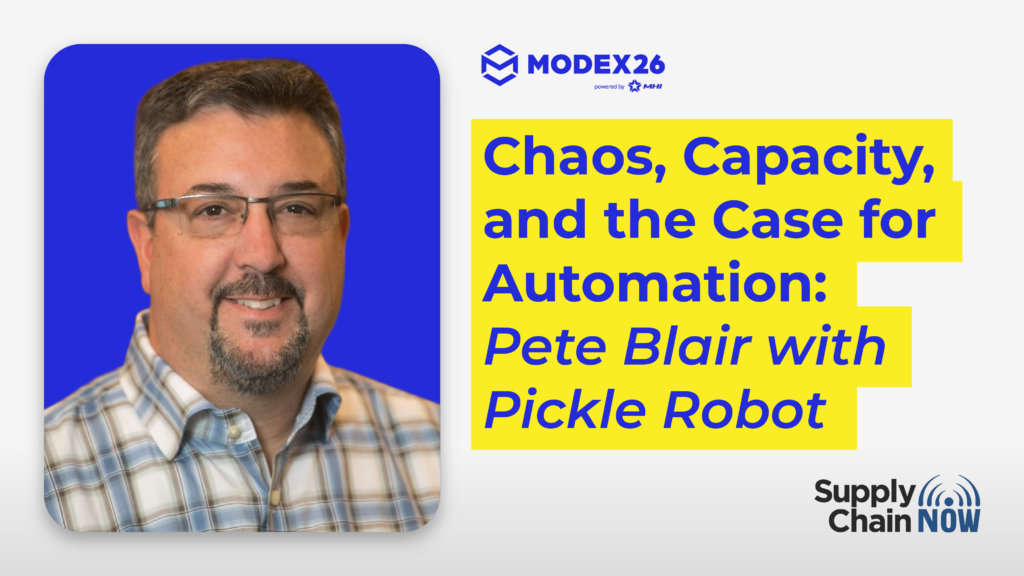
Chaos, Capacity, and the Case for Automation: Pete Blair with Pickle Robot
At MODEX 2026 in Atlanta, the energy was unmistakable. With thousands of supply chain professionals gathered, one theme echoed across conversations: uncertainty is no longer episodic. It’s constant and seemingly endless. In a candid discussion with Scott Luton, Pete Blair, VP of Product & Marketing at Pickle Robot, unpacked how organizations are navigating volatility, workforce challenges, and the growing role of automation in keeping operations moving. Navigating Tariffs and a Moving Target If there’s one word defining today’s global supply chain environment, it’s unpredictability. Blair points to tariffs as a prime example; and not just their presence, but their volatility. “The biggest thing we see… is the chaos of tariffs. It’s not so much that customers have to pay tariffs or not pay tariffs, it’s that they don’t know how to plan,” Blair explains. That lack of predictability is forcing organizations to rethink their networks in real time. Companies are shifting sourcing strategies, standing up temporary distribution centers in new geographies, and even making drastic decisions about whether importing goods makes financial sense at all. What’s particularly challenging isn’t the cost itself. But rather, it’s the inability to forecast. Supply chains, while resilient, aren’t designed for abrupt swings like…