

More
supply chain analytics
August 25, 2026
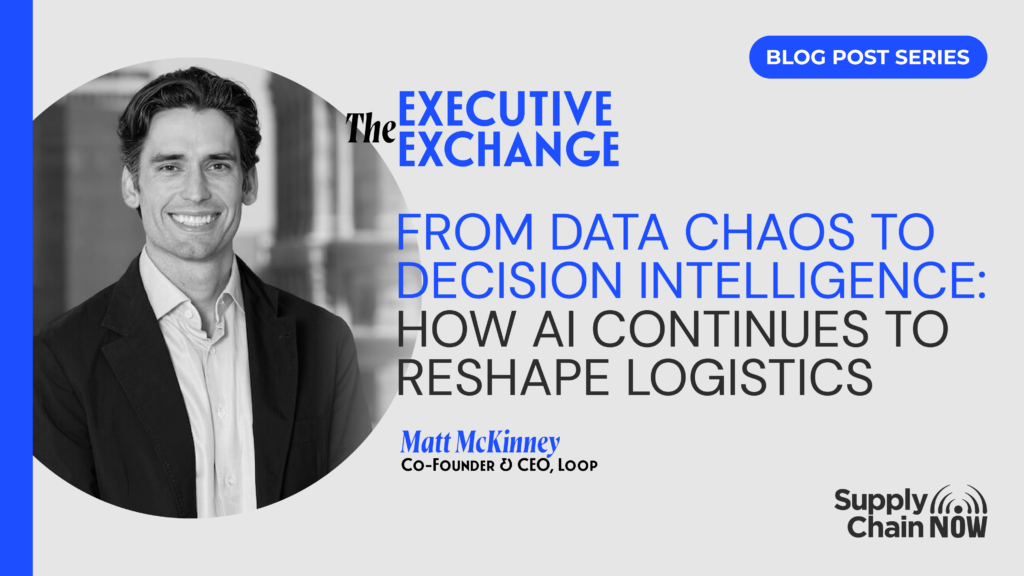
From Data Chaos To Decision Intelligence: How AI Continues To Reshape Logistics
Supply chain organizations have never lacked data. What they have often lacked is the ability to connect it, normalize it, trust it, and turn it into better decisions. That was one of the central themes in a recent conversation between Scott Luton and Matt McKinney, Co-Founder and CEO of Loop. Drawing on his experience helping build Uber Freight and now leading a logistics technology company, McKinney offered a clear-eyed view of where AI is already creating value, as well as why the data foundation still matters more than the model itself. The Real Problem Is Not Data Volume McKinney traces Loop’s origins back to a recurring problem he and his co-founder (Shaosu Liu) saw at Uber Freight: rapid growth on the revenue side paired with a back office still dependent on people manually reconciling invoices, contracts, proofs of delivery, and surcharges. The bigger realization was that this was not unique to Uber. “The thing people miss is that the value isn’t in the quantity of data, it’s in the utility of it,” McKinney explained. “Most companies have plenty of data. What they don’t have is data that connects.” That disconnect is especially painful in logistics, where data is scattered across…
generative AI
June 26, 2026
AI Is Good at Picking Qualified Suppliers. It Still Struggles to Pick the Best One.
Companies are rapidly integrating generative AI into procurement and sourcing decisions. The promise is obvious. AI can read thousands of pages of supplier proposals faster than any human team, summarize technical requirements in seconds, and create the appearance of consistency and objectivity in evaluation. But there is an important distinction managers are starting to overlook. The same AI system that performs extremely well at identifying whether a supplier meets minimum requirements may perform much less reliably when judging which supplier is truly better. Recent research published in the Journal of Business Logistics examined this issue by comparing how large language models evaluated supplier bids against evaluations completed by experienced procurement professionals. It analyzed 123 supplier proposals tied to 31 public procurement projects conducted by the State of Ohio between 2023 and 2024. The projects involved complex IT services contracts, many containing large, text-heavy bid packages requiring evaluative judgment rather than simple arithmetic comparisons. The researchers tested three reasoning-oriented AI models: OpenAI o3, Grok-3-Mini, and DeepSeek R1. They then compared their evaluations against human procurement scores. The findings revealed a surprisingly clear pattern. AI performed well when evaluating compliance signals. These are signals tied to baseline qualifications and technical requirements. Does…