
More
foundational industries investment
February 23, 2026
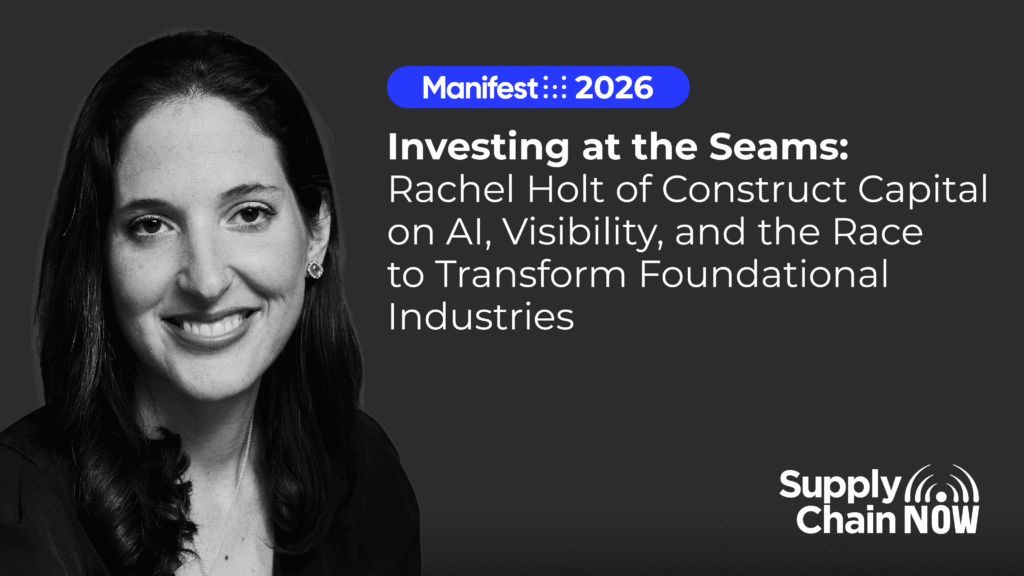
Investing at the Seams: Rachel Holt of Construct Capital on AI, Visibility, and the Race to Transform Foundational Industries
From Uber to Foundational Industries At Manifest 2026, Scott Luton sat down with Rachel Holt, Co-Founder and Managing Partner of Construct Capital, to explore how venture capital is fueling the next era of supply chain innovation. Construct Capital, now six years old, was founded in early 2020 with a bold thesis: transform foundational industries that represent nearly half of GDP: supply chain, logistics, manufacturing, mobility, infrastructure, and defense. When the fund launched, Holt recalls many skeptics asking whether supply chain and logistics were truly venture-scale opportunities. It echoed what she heard when she joined Uber in 2011, when transportation was considered slow moving and heavily regulated. Yet Uber went on to redefine personal logistics. Her final years at Uber brought a pivotal lesson. While the rides business operated with second-by-second visibility, the company’s e-bike and scooter supply chain operated in near darkness. Products shipped from China would disappear for weeks at sea, briefly reappear at ports, then stall again in customs. “We had no visibility, we had no ability to reroute,” Holt shared, as this Eureka moment would go on to help shape her investment focus. The Visibility Gap at the Seams Supply chain, Holt emphasized, is not monolithic.…

supply chain sustainability
August 29, 2024
Eco-Friendly Innovations: How Sustainable Practices Are Reshaping Supply Chains
Scope 3 emissions reportedly account for more than 70% of businesses’ carbon footprints. That huge percentage gives an indication of just how critical supply chain sustainability efforts are to the planet. Thankfully, a growing number of eco-friendly innovations are helping reshape global supply chains. Supply Chain Sustainability: An Industry Imperative in a Changing World It is becoming increasingly important for companies to accurately calculate their supply chain emissions and create an information-sharing ecosystem, according to Matthew Gardner, co-founder and managing partner of Sustainserv, a consulting firm that helps businesses implement sustainability strategies. Gardner said accounting for supply chain-related greenhouse gas emissions includes such challenges as: Data gathering of “materials, manufacturing processes, activities of second- and third-tier suppliers, and overall data governance and quality.” Calculation methodology that “reflects the realities of raw material sourcing, product manufacturing, transportation and distribution, and other life-cycle impacts that may affect reported greenhouse gas totals.” Supplier relationships, which can be strained as a result of emissions assessments. Businesses also need to keep in mind their relationships with consumers. PDI Technologies said 80% of U.S. consumers it surveyed were willing to pay more for sustainable products. “Between these statistics and the regulatory conversations that are happening in…