
The High Cost of Labor Firefighting and Systemic Attrition
Warehouses are not running out of labor. They are running out of labor that can sustain the pace. Manual firefighting, overtime, and constant reassignment push skilled associates to burn out faster than they can be replaced. The result is a cycle of turnover, training, and rising labor costs that slow performance and strain budgets.
This whitepaper breaks down the current state of labor in distribution, including turnover trends, overtime risk, burnout dynamics, and the true cost of churn.
Click here to download and see how labor forces impact throughput, planning, and workforce strategy today.
More Blogs
AI
Blogs
September 25, 2025
The 3 Critical Questions Enterprise Shippers Ask Me About AI
Special Guest Blog Post written by Matt McKinney, Co-Founder and CEO of Loop I spend most of my time with supply chain and innovation leaders at major enterprises who are sitting on significant AI budgets but struggling to show measurable business impact in an increasingly complex and volatile supply chain environment. These conversations have evolved dramatically. A year ago, executives were asking basic questions about AI feasibility. Today, the questions have shifted to strategic implementation at enterprise scale. Based on hundreds of these discussions, three questions consistently emerge that separate companies making transformational progress from those stuck in pilot purgatory. How do we move from AI experiments to enterprise-scale impact? Most organizations have yet to see organization-wide, bottom-line impact from AI use. This is the strategic challenge keeping C-suite leaders awake at night. The problem isn’t the technology. It’s the application of the technology. Too many enterprises are trying to treat AI like a magic wand they can bolt onto existing systems. But garbage in, garbage out. If your underlying data is fragmented and inconsistent, AI won’t solve your problems; in fact they’ll get worse. At its core, anything automated is powered by…
human factor in supply chain
Blogs
March 4, 2026
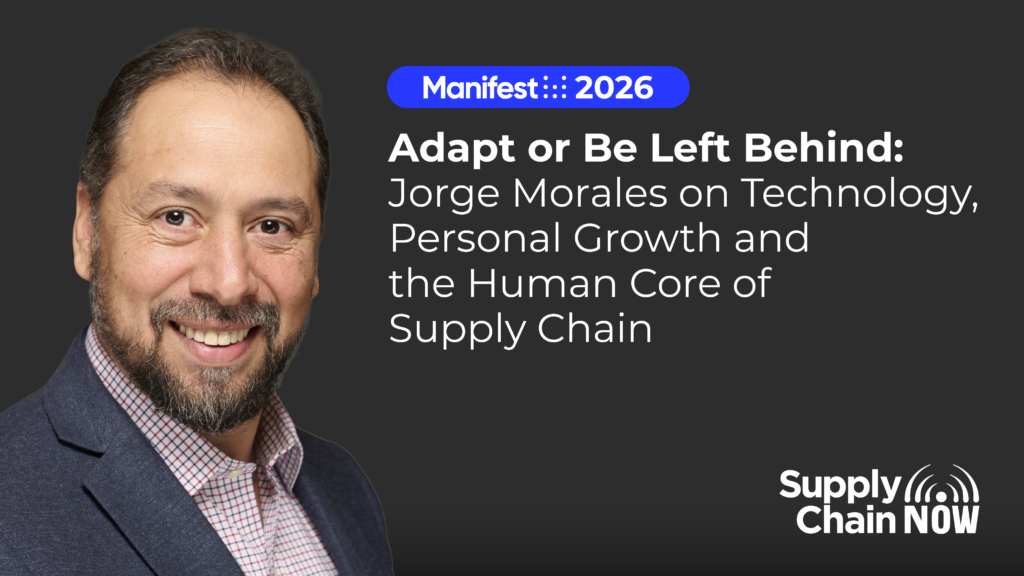
Adapt or Be Left Behind: Jorge Morales on Technology, Personal Growth and the Human Core of Supply Chain
At Manifest 2026, Scott Luton spent time with his friend, Jorge Morales, Global Chief Operating Officer of the International Supply Chain Education Alliance (ISCEA), for a conversation that centered not on hype, but on growth. ISCEA is a global certification body serving supply chain professionals around the world. But as Morales put it, “We’re in the knowledge business; but most of all, we’re in the personal growth business.” Through certifications, membership programs, advisory boards, and global events, ISCEA empowers professionals to stay current, expand their networks, and advance their careers. In a volatile era, that mission has never been more relevant. Beyond the AI Hype Cycle When asked about dominant themes from 2025 to 2026, Morales pointed to a shift in how the industry views technology. “Last year we were still in the bubble of the hype of AI,” he said. Many professionals feared being replaced or assumed AI would solve everything overnight. That perspective has matured. “Technology by itself is not what determines your level of success,” Morales explained. “Understanding the basics, knowing how things work; THAT is key.” AI and data tools remain critical across procurement, logistics, manufacturing, planning and more. But success depends on how organizations…