

Share:

Scott DeGroot

At Kimberly-Clark, Scott served as the Vice President of Global Planning and Logistics. The team’s success in transforming the supply chain’s Planning and Logistics network is a testament to a strategic approach that balances cost improvement and service excellence. Together they drove a record improvement in OTIF service, substantial inventory reductions, new approaches to customer collaboration all while delivering top-tier cost savings.

Now, as the Executive Director of the Global Supply Chain Institute at the Haslam College of Business at the University of Tennessee, Scott imparts the insights and strategies honed over years of executive leadership. His focus on cultivating talent and driving operational excellence continues to inform his teaching and research, ensuring that the next generation of leaders is equipped to innovate in the dynamic field of supply chain management.

More

Africa
July 25, 2025

The Future of Supply Chains Starts With Better Questions
Special Guest Blog Post written by Stela Jaqueta   In today’s fast-changing world, Africa’s role in global supply chains is at a tipping point. For too long, the continent has been viewed primarily as a source of raw materials rather than as a strategic partner in value creation. But what if we reimagined everything, from policies and technologies to mindsets and sustainability practices, through an Africa-centered lens? In this blog post, I explore five questions that challenge conventional supply chain thinking. From redefining Africa’s place at the global negotiation table, to elevating cultural intelligence from “soft skill” to strategic necessity, to designing climate-restorative logistics and embracing the digital revolution in a way that includes youth-led and informal businesses, each question is a call to rethink, redesign, and re-center. 1. What would a truly Africa-centered global supply chain look like? A truly Africa-centered global supply chain would shift from a model of extraction to one of empowerment and value creation. It would prioritize investment in local manufacturing, infrastructure, and knowledge transfer, ensuring that raw materials sourced from Africa are processed, packaged, and innovated on the continent. African-led businesses are seen as power players, with a voice and authority at the negotiation…
AI shipping
August 6, 2026

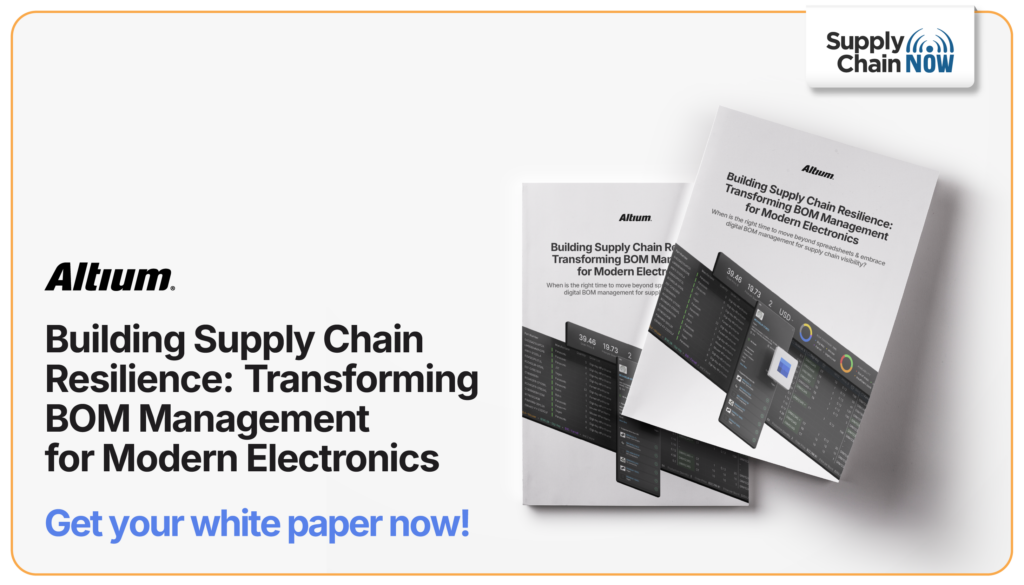
Building Supply Chain Resilience: Transforming BOM Management for Modern Electronics

The whitepaper explores why leading electronics companies are moving beyond spreadsheets to implement dedicated BOM management solutions that strengthen supply chain resilience, reduce costs, and accelerate time-to-market. What’s Inside This Whitepaper? Readiness checklist: When is it time to move away from spreadsheets? (hint: if you’ve had a costly redesign due to component availability, it’s time) Best practices for effective BOM management for electronics teams Key use cases of a BOM management system Overview of Altium BOM Portal ROI calculation examples with real-world savings Key Benefits of Altium BOM Portal Faster BOM completion with enriched supply chain data Data-driven BOM analysis for supply chain risk mitigation Comprehensive part library with full traceability Streamlined collaboration between engineering and procurement Cost savings on every BOM with automated saving opportunities Why Engineers Trust BOM Portal Nowadays, there are so many supply chain disruptions, maybe the PCB boards take weeks to come back. When you have an error there, the real cost is burning those 6-8 weeks. Because you’re using Altium 365 tools, you’re looking at maybe an 80% reduction in time to market. — Brandon Gilles, Founder/CEO, Luxonis