Intro/Outro (00:00:02):
Welcome to Logistics With Purpose, presented by Vector Global Logistics in partnership with Supply Chain Now. We spotlight and celebrate organizations who are dedicated to creating a positive impact. Join us for this behind the scenes glimpse of the origin stories, change making progress and future plans of organizations who are actively making a difference. Our goal isn’t just to entertain you, but to inspire you to go out and change the world. And now here’s today’s episode of Logistics with Purpose.
Kristi Porter (00:00:34):
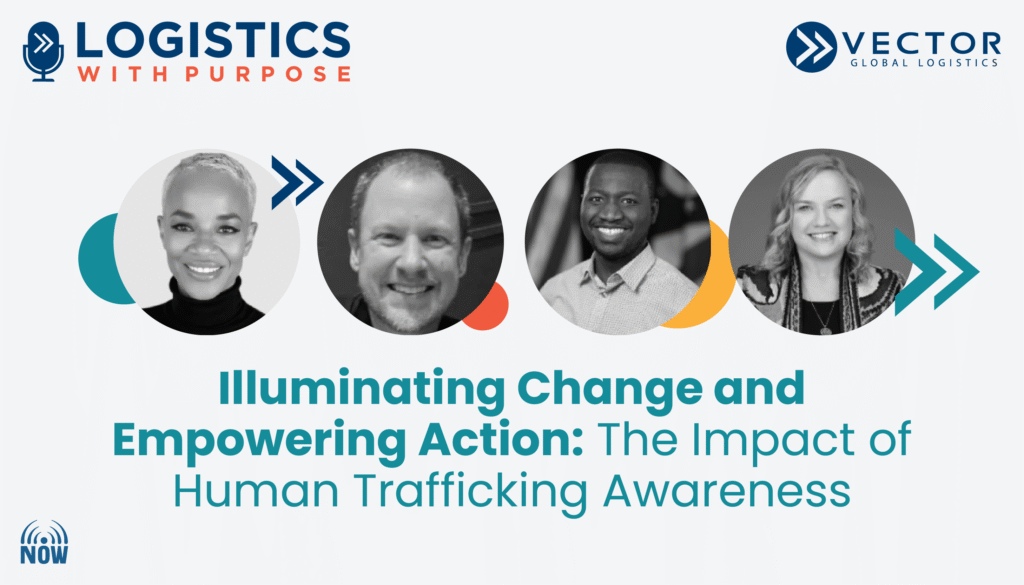
Thank you so much for joining me today. I am Christie Porter, the Chief Impact Officer of Vector Global Logistics, and this is Logistics with Podcast, the only podcast focused on supply chain’s positive impact. And boy, are we going to get into impact today? I have old friends, new friends. If you’ve been around this podcast for a while, you know that this is an issue I’m really passionate about. And so I am delighted to bring all these experts, their expertise, their individuality, their experience to the conversation. And for those of you who are unaware, January in the US is National Anti-Trafficking Awareness Month. And so we have a panel here to talk about this very important issue. If you’re brand new to the conversation of anti-trafficking and what human trafficking and modern slavery looks like, you’re going to get an education today. If you have been around this world for a while like some of us have, then you’re still going to learn, you’re still going to grow.
(00:01:32):
And I promise that you will leave this conversation with new questions, fresh insights, and I hope you’ll connect individually with our panelists afterward. And just be open to this idea. It is still, here we are 2026. The issue of modern slavery, anti-trafficking is not a 250-year-old or 400-year-old issue. This is today, this is every zip code. And so it’s really important for you to understand not only the issue, but the people behind it. I want you to see this is a really difficult issue. We bring a lot of issues to this table and to this conversation, some really uplifting ones, some really challenging ones. This is a difficult one. And yet these people, as you’ll continue to see, are hopeful. They are inspiring. They are passionate about what they do and you’re going to hear that from them. So today I’m delighted to bring to you Laura Cyrus, Senior Director of Industry Training and Outreach at TAT, which is formerly Trickers Against Trafficking.
(00:02:32):
If you heard her previous episode, Jeff Shaw, my longtime friend, abolitionist and founder of the Freedom Collective, Kwame Adobe Herrera, founder and CEO of Telios, Inc. He is a male survivor of labor trafficking and a former server on the US Advisory Council on Human Trafficking from 2021 to 2023. And Dr. Brooke Bello, founding CEO and vice chair at Moore to Life Inc, which I love that title. Thank you all for being here, grateful for all you do and for introducing me to each other as well. So really grateful for everything that you do. This is a difficult issue, but like I said, you’re some of the happiest, most joyous people I know as well. So people will certainly get that from this conversation too. So let me just dive in. I’ll call on you one at a time, but how did you become aware of this issue, part one, and then how did you become involved?
(00:03:27):
So Laura, I’m going to start with you.
Laura Cyrus (00:03:28):
Great. All right. Jump in. Yeah. So I’m going to try to keep it brief. I had heard about human trafficking, but I was an undergrad at Michigan State University and I was studying criminal justice. And I didn’t actually hear anything about it in my coursework. It wasn’t until I went to see a missionary present on her work actually overseas in Greece was mostly the topic of her presentation that I went to see. I was shocked that I hadn’t heard about any of this in my coursework. And this was 20 plus years ago. And she sort of brought it back to the folks in the audience from a US perspective and referenced a case out of California where there was a sweatshop found to be using exploitative labor practices and some of the garments that were made in that location ended up being sold in the United States.
(00:04:14):
And I had this moment of like, “What? What?” And I had just purchased two dresses at a major department store to go out on internship interviews. And I just had this overwhelming, convicting moment of how have I never considered who produced my clothing or the coffee that I drink every morning or the chocolate that I enjoy or the rubber in my tires, right? All these things, I just realized what an unconscious consumer I had been. And of course, had known about sex trafficking a little bit, but just it really was that night that I felt compelled and called to do something. I didn’t know what that was going to look like. Flash forward a few years, worked sort of in the quasi-business realm, not in my field and ended up finding a graduate program at the University of Denver. There was a internationational human rights and forced labor and human trafficking masters.
(00:05:04):
And I thought, if I can get this into this school, I can do something. Not sure that was the right decision, but ultimately it probably was because it was during that time that I saw an internship posting for TAT or Truckers Against Trafficking at the time, applied for that internship, got it, finished the internship and then ended up just staying on. And now I’ve been with the organization for 13 years. Thank you. Thank you for the great work that you do. Jeff, I will
Kristi Porter (00:05:27):
Call on you next.
Jeff Shaw (00:05:28):
Yeah. So the journey for me started back in 2011 and something that’ll be a common thread throughout is it’s all been a product of my relationship with Jesus. And so it was very much a faith journey for me. I was working as an attorney in Atlanta at the time, and I was part of a small church in Atlanta where a group of us decided that we wanted to read a book called Not For Sale together and process through it and read a couple chapters, come back and talk. And the author took the reader on a journey to different parts of the country, the world really. And instead of just focusing on the magnitude of the problem, he would tell a single story of modern day slavery or exploitation that he witnessed, and then a single story of someone who did what they could do within their own ability and skillset to make an impact on it.
(00:06:21):
And I remember reading through that book and feeling marked at a very deep level like I can’t live my life as usual after this. I am meant to give my life to this thing. And so of course, I didn’t have a background or education in it either. And that started a journey of discovery of conversations with other organizations, where are the gaps? What are the needs? Here’s an idea, will it work? And then that grew into an organization and still have the absolute joy and privilege to be in the work today.
Kristi Porter (00:06:54):
Thank you very much. Shout out to Dave Batstein, I think, who wrote Not For Sale. I think he definitely gave those of us who have been in this industry and around this issue for a long time, that book was certainly a revolution and super sweet guy too. So hey, Dave. And Brooke, let’s go with you next.
Dr. Brook Bello (00:07:10):
Yeah. Well, thanks for inviting me. I’ve worked and known Jeff for a long time, so it’s good to see him and good to meet you, Kami. I think I met you prior. So your story is extraordinary and good to meet you, Laura, and to be with you, Christie. Getting into this work is something that a small child would never, ever really think of. It’s not like a dream that I had or a goal that I had. Obviously, as a kid, I wanted to do everything, be a scientist, a doctor, a writer, an actor, and anything in between big visions and big dreams. And so I think that being a human trafficking survivor leader, for lack of a better term, I like to say vision to a survivor, survivor, a thriver. Thriver to champion is the coin phrase, but I didn’t know I was a victim growing up.
(00:07:49):
I didn’t know there was an issue of human trafficking. I didn’t know any of this or a labor trafficking, all the different forms. And so having lived past it, I call the other side of pain. I was indoctrinated into this idea around Los Angeles as an actress who was crashing and burning and substance abuse addiction and therapy. I went from being rescued to eight months later booking my first acting job. So with all of those funds and absolute healing and pretending that nothing had happened to me my whole life in this sort of massive sort of bust that was done by law enforcement, I just pushed it down. And I got born again. I didn’t grow up in church. And my pastor was so amazing between her and pastor Jack Hayford at Church on the way in Van Nuys and Dr. Bam and Inglewood, I started this healing journey and to make a long story short, as an actor, I was invited to parties and events.
(00:08:42):
And I started to see things that looked like what I had went through, but I couldn’t really identify it. I just thought those youth looked really vulnerable and I was still a youth myself, but I wasn’t a minor anymore. And that led me through just the revelation of freedom and justiceness and what that looks like. And I just saw vulnerable youth. So they started to move in with me and I felt like the Holy Spirit was saying, “There’s more to life.” And so I ended up leaving a very successful acting career that was kind of stolen from it because of the mental health issues I had at the time. And I started to just dive full into this issue around labor, trafficking, domestic servitude often and forms of self-trafficking and all the different names that we’ve called it through the years. And that’s kind of where the journey began.
Kwami Adoboe-Herrera (00:09:26):
Yeah, no, thank you for having us. This is, I’m just very grateful to be here with all my friends and that I worked with in the past and country to be working with me. Where do I begin? I became aware of this situation when I was in college. That’s when I began to realize what is going on around me is very much an evil force that’s at play here. And human beings are being used for the purpose of money for somebody who has gone through it. I never really knew that that was what I was going through. So therefore I just kind of ignored it and went to college and just hoping that everything would just stop. I would just forget about it. But that wasn’t the case. I was being drawn back to against me was calling me to this movement to bring light into the darkness that is plagued our country and across the globe to be a shiny star and trying to break through that darkness.
(00:10:19):
And it said, “This is happening here and this is also happening to boys and males and you are given opportunity to show the world that we have to establish evil need to stop. This evil has to stop.” And that was the beginning of my introduction to this movement. I was running away from it. I was running away from this movement. I didn’t want it to be part of who I am. I didn’t want to be attached to it because after going through it, it was so painful and I just want to forget about it and I move forward. I was keep drawing back to it. I keep coming back to this movement so I can help others to see the light, to see, to give them a second chance. That’s how I began this. That’s how I got involved in this movement.
Kristi Porter (00:11:00):
Thank you. Thank you for sharing. I would like to call attention to the fact of five individuals right now talking very different backgrounds, very different circumstances, very different ways of life. And there are definitely some commonalities here, but I think that anytime you’re talking about any issue, perhaps more specifically one like this, you kind of start grouping people, right? We kind of naturally, as people tend to want to put people in boxes and say, “This is what a survivor looks like. This is what a victim looks like. This is somebody who’s involved with this issue. It’s across the board.” But I think even just from our little panel, we’re seeing that that’s not true. There’s even things in our background that we do not have time to unpack. Perhaps I’ll have a therapy podcast at some point, but we all have things that brought us to this issue both personally, professionally, things we’ve heard of.
(00:11:56):
And then I think, Kwame, what you said is kind of something that probably maybe Laura and Brooke and Jeff can relate to as well is kind of that drawing factor. My mom once asked me, “This is a really difficult issue. How do you stay involved in learning about this and putting yourself in the middle of this? ” And I said, “I think that’s how you know you’re called to be in it because it isn’t something fun to learn about at all and it is a difficult situation and it is a hard walk for a lot of people. And I’m very on the outside of that. ” And so I think all of you have been called to it in one way or another in different paths how you got here. Let’s also set the stage for a second. One of you, anyone who feels more equipped at the moment, there are a variety of statistics on how many survivors there are, how many people are trafficked, whether it’s US, internationally, sex trafficking, labor trafficking.
(00:12:49):
Does somebody want to give us some of the current statistics just so people can understand what a wide ranging issue this is, not only the number of people involved, but the amount of money involved. Brooke, go ahead.
Dr. Brook Bello (00:13:02):
I’ll give one short one because I’m sure everyone has one. And then Kwame, your voice is so amazing. You probably need to speak even louder. So John Cotton Richmond, former TIP ambassador, he’s a colleague and a friend, and I’m sure we all know him well. He gets around. He put out a report through the Atlantic Council and the idea that less than half of 1% as it relates to victims of human trafficking are identified. And I think that before we transliterate into data, I think here’s the thing that the public should always understand that data is confrontational because ultimately we don’t actually have finite numbers because there are so many unidentified victims, there’s so much under reporting. And even in some of the work with Free the Slaves and Buchini and some of the stuff we’re doing in Asia and Europe and Africa, there’s so many people that have such a different understanding and a different number.
(00:13:57):
But if we just think about that, the data, the one that I will give again is less than half of 1% are identified that gives everyone the idea that there are people born into all forms of human trafficking, labor, domestic servitude, and physical sex trafficking that don’t have birth certificates and are unknowable humans based on bureaucratic record.
Kristi Porter (00:14:18):
And even to your earlier point, Brooke, of people who may be in those situations, but not even understand that they are, which is another difficulty. Laura, Jeff, Kwame, anything to add there before we move on?
Laura Cyrus (00:14:29):
I mean, I’ll share. This is probably some well-known statistics. This is what Tat uses when we’re presenting, but just thinking on a global level, the best estimates, which I agree. We could talk the issues with data and under-reporting and just all of that till we have to start somewhere. And so when we’re trying to contextualize this for people, sharing that estimated, there are 50 million victims of human trafficking across the globe that includes sex trafficking, labor trafficking, forced marriage, child soldiering, organ trafficking, state imposed labor, right? A huge sort of spectrum of what this means. And unfortunately, those victims are then helping to produce $236 billion a year in illicit profits for their traffickers. So this is a hugely profitable business, if you can call it that, for so many people. And we have to remember that it’s a crime of power, control, and greed, which I know we’re going to get into.
(00:15:27):
It’s unfathomable when you think about those numbers. And I think, Brooke, to your point, just trying to distill it down, we talk a lot about the power of one and just the understanding of not only what one person can do, but what will it mean when one person is brought out of this, when one person is able to survive and thrive? And just the difference that that can make on a personal level when you know someone, somehow the numbers, they’re still meaningful, but it’s different when you can sit face to face with strong people that are overcoming this situation and understand this is so much closer to any of us than we really want to believe. It’s easy to sort of get lost in the 50 million number, but bringing it back to the power of, here’s this one person that has made it out and has overcome and just the power that that has to then become a ripple effect.
Dr. Brook Bello (00:16:13):
If you look at the data with walk free, you’ll see that it’s 200 million if you look at that other number, which deals with different forms of child labor. And that was a data that came out beginning of last year. And then that 50 million at one point was 60 million. So as we say, it’s probably following the podcast. There’s really given a couple links so that people can actually look at different reports and try to wrap their head around it because I think ultimately it helps the issue to have a clearer picture. And then where are the gaps in our undulating misunderstanding of how someone vets in whatever nation of that number?
Kwami Adoboe-Herrera (00:16:48):
And recently I heard from the Bureau of Justice Statistic, they said that 36% of labor trafficking are males, I mean, that’s staggering. I mean, that is what we know we know right now. What about those who we don’t know anything about? I mean, we know that this number is bigger than that. It just, we don’t really have full understanding of how to find them, how they can come forward to self-identify. Therefore, these numbers as good as they are, they don’t do justice. It’s not do justice to what we are trying to do. Yeah.
Kristi Porter (00:17:21):
Right. Thank you. I’m curious, let’s talk a little bit deeper into each of your expertise, which is also varies greatly in each experts in your own field. So Laura, let’s start with Tat. We’ve, of course, got logistics with purpose, so we’ll dive into a little logistics here. What does human trafficking look like, particularly within logistics and transportation? Everybody listening here, most of us have a car, we’re driving around, we’ve seen the truckers, we’ve asked them to honk at us, the whole thing. So what does that mean and what does that look like? Will you kind of put some fresh eyes on human trafficking and logistics and transportation?
Laura Cyrus (00:17:58):
Sure. So we know both labor and sex trafficking, there are opportunities for folks in this industry to intersect with victims of both of these types of crimes. So from labor trafficking perspective, even across North America, which we know and we can get into, that is happening here, which I think still shocks people. It’s taking place in farms, factories, construction work, domestic servitude, bars, restaurants, all kinds of different job sites where truck drivers may be delivering or picking up loads. They may have an opportunity to see these potential victims in these locations. Would they know what to look for? Would they know what some of those red flags are? From the sex trafficking perspective, we know that traffickers are going to take their victims wherever they can to make money, and where are they going to take them in places where they know there’s a demand for what they’re selling?
(00:18:44):
And that is the demand for commercial sex, which we cannot ignore as one of the thing that is fueling the issue of sex trafficking. And so from a male predominantly dominated industry, we unfortunately see that these traffickers are taking their victims to rest areas, truck stops, hotels, motels, city, streets, places of business. Again, areas where from a local driver perspective, these folks are operating day in and day out and have an opportunity to see these red flags and to intervene for these victims. As it relates to professional drivers, they are seeing this potentially coast to coast from rural cities to urban areas, suburban areas, everywhere in between, and again, have an opportunity to be that person in the right place at the right time if they just know what to look for
Kristi Porter (00:19:33):
And what to do. Thank you. From the abolitionist lens, what are some of the … You’ve been training people for two and a half decades on this, including me. So in having conversations, we hope conversations are evolving, but there’s still a lot of conversations that, as we’ve discussed here today, just an awareness of this is happening and we want people to know that. But what are some of the misconceptions about trafficking that you’re still coming across that you’d like to address there?
Jeff Shaw (00:20:02):
Well, I think the starting point for me and for many, it’s over there. I live in developed, quote, unquote, civilized nation with lots of education, lots of opportunity. So if I want to make a difference, I’ve got to move over there. And of course, as anyone on this call or episode could attest to, it’s also happening in my kids’ school and it’s happening in church pews and it’s happening down the street and in the hotel and at the massage parlor and all over. And so that’s one thing because if you can put it over there, it can neatly be outside of your reach. So the second thing I would hit on is I can’t make a difference. I just heard 50 million, I heard 60 million, I heard more. And whichever million it is, I can’t make a difference. But I love what we’ve heard already, which is we do make a difference a life at a time, a system at a time.
(00:21:00):
And something that is a compass for me is watching the abolitionist movement in the transatlantic slave trade, things that were so embedded in economics, society, class systems, even religiously perpetuated, no one would’ve ever said, “Oh yeah, that can be abolished.” And yet it was. And so I hold that out when people say, “Oh, well, we’re always going to have trafficking in our midst.” I refuse to believe that because I want to live with the hope that we can make the difference one person and one system at a time. And then the last one, which I think is valid is a lot of people think it’s too dangerous to get involved. And you have to hold this carefully because there are certainly a million ways you can make an impact very safely. And then there are ways you can get involved that you assume a higher level of risk.
(00:21:56):
And within all of that, you can do it well with training, with people who are not just running out willy-nilly, doing whatever they think they should be doing, but they’ve taken the time to learn, develop a system and a process and create a way for you to engage in that at whatever level fits your personality, your abilities, your time capacity. And so yeah, I would add those three things. It’s not just over there. You can make a difference and it doesn’t have to be dangerous, but it can be if you wanted to.
Kristi Porter (00:22:28):
Absolutely. I’ll just build on that for a second. If you get interested in this issue, if you want to be involved, if you go to an organization and there’s not necessarily a way that fits your personality or lifestyle or something, keep looking because even amongst this group, they do some similar things, they do some different things and there’s room for everybody. When I started having chronic health issues, an organization that I used to volunteer for, they just needed somebody to write letters to people who are in programs or in jail or something like that to encourage them. And that was something I could do at home on the couch during my spare time. So there’s a way to get involved, so I’d encourage you to do that. And if it doesn’t, you don’t find that at the first organization you reach out to, keep going.
Jeff Shaw (00:23:11):
And Christie, if I can piggyback on that, what I know about the four faces on this screen is if you reach out to us and what we do is not your fit, you don’t have to go wild goose chase. I will happily refer you because a win for any of us is a win for all of us. Amen. All
Kristi Porter (00:23:28):
Right. Brooke, let’s talk about, we’ve already, just in our short interview so far, we’ve talked about kind of misconceptions, preconceptions, what people think of as a victim or even as the issue. I know for a long time, the thing that I kept hearing over and over again was just six trafficking. So even learning about labor trafficking was sort of a new side of the issue for me when I started learning. Of course, like many issues, there are people who are more vulnerable, whether it be gender, whether it be socioeconomic, whether it be location. What does some of the training look like when you give these talks? As far as gender vulnerarability, systemic and inequality, what should people be on the lookout for and what will be surprising to them?
Dr. Brook Bello (00:24:11):
Yeah, I think part of my issue, and Jeff knows this is not really an issue that I’m a bit of a wildcard and I’m extremely passionate and I’m such a follower of the Lord that I deal with sort of hard content and things around mental health and awareness of the atmospheres we’re in. And so the root causes of the issue, what are the root causes? Because that’s where we can prevent it. But I’ll say this in connecting sex trafficking and supply chain and understanding that what we do, when people think of supply chain, they often don’t think about sex trafficking. They think of things like products. And Laura was talking about that earlier a little bit when they think of ships and boats and red flagging transportation, but supply chain issues, whether it’s a labor trafficking or sex trafficking or domestic servitude, is really about human labor.
(00:24:55):
And sex trafficking, depending on where you are in the world, is a form of labor trafficking technically, even under federal law. And so when I look at, and I want to grow up and be like Jeff, I really do. I want to think that we can end this like a thousand percent, but I feel like people will always commit crimes. And so if we end human trafficking, then we’d have to end rape, we’d have to end murder, we’d have to end all the root causes. Can we do that? I believe we can put such a dent in it and make it so outlandishly illegal on whatever level. And so when I think of red flags, I think of sometimes like the laws in Virginia that propagate the issue of a man who impregnates a minor. If parent says yes, that child at 14 years old or 15 can marry that 50-year-old man who impregnated her, not really going to the investigative aspects that she was manipulated into sex.
(00:25:43):
She was violated, she was raped. And so she’s a victim and the door is closed on that. I think about the issues of many states having the ability. So when a young girl goes and gets an abortion, there is no parental notification. In my case, if my parents were notified when traffickers made me get an abortion, law enforcement and my parents would’ve found me. And so you can’t very well have dichotomies, be good parents, but yet you have a child who doesn’t have to tell you if they’re an abortion clinic. And I’m not talking about issues of life or pro- choice right now. I’m just talking about how are parents to parent laws that I feel are somewhat negative obscure their ability to do so. And so the issues of human trafficking really are related to the idea from a philosophical and biblical perspective is that because we’ve allowed us human beings, I feel as though we’re only coming out of calling children child prostitutes like in the last seven years, they were still doing it even five years ago and certain cases we were working on.
(00:26:42):
And in a recent case, organization has led five STEM ops, two we led with federal marshals. One recently was Operation Dragon Eye and Operation Home for the Holidays, 60 victims in one, 122 and another. And the stories of some of these youth are so, so extraordinary still today. And if you have a youth in a home root cause violated by dad or stepdad or brother, but mom says, “I had no idea, yet it was going on for two, three, four, five years.” What is that? And so when I think of red flags and challenges, I think that 80% or above 80% of youth still don’t tell. They still don’t feel safe enough to tell. So what does that say about us as society that sexual violence is chemifies in a highly sexualized society? And finally, the high percentage of boys don’t tell even more. And so what does that say about the continuum of care and the awareness within cultures and families that would limit a child’s ability to even understand that they’re a victim in the first place, not just 10 years ago, 15 year ago, but here, 2026.
(00:27:46):
And so I guess the last thing would be that so many red flags, especially with OSEC, online sexual expectation of a child or even the propagation into labor trafficking online. And so some of the safeguarding around that and this propensity and ability that people still don’t realize who their friends are as it relates to social media and really how to protect themselves even still. And so this and all the issues of mental health, we have our work cut out for us. And I hope to God answers your question.
Kristi Porter (00:28:15):
You did. And I appreciate your wildcard status. I’m here with you. Love it. Thank you. We’ve talked a lot about the issue and some of the warning red flags, things like that. Thank you for that, Brooke. I want to also talk about, again, as I mentioned, you’re all very joyful, hopeful human beings and are passionate about your work. So I want to also talk about prevention, healing, and what’s working. Kwame, a couple things for you. First, speaking to, we have lots of employees, employers, contractors, those people listening in. What are some of the warning signs that people should look out for? And let me start there and let you answer that first.
Kwami Adoboe-Herrera (00:28:49):
Yeah. And there are different ways and different warning signs there are. One doesn’t fit all. Personally, I can just tell you now, I mean, as a child who was trafficked domestic, I was domestic too as a young … I was an only seven when this happened to me. I didn’t have the word to describe what was going on with me, nor do I have the language to say to anybody, “Hey, this is happening to me. ” And so the only visible signs that anyone could see was the fact that I was acting up at school, the fact that I was malnourished, the fact that I’m coming to school all dressed in jeans and sweatpants and whatever and sitting in a corner, ice a little bit. All these other tell sign of like, “Oh, this child, there’s something wrong with this child. What can I do as a teacher to help this child?” Was really the only way for anybody to notice what was going on with me.
(00:29:46):
And so for an adult, that would be a different sign and that would be something that’s completely different for that person for us to recognize. And so it’s just one doesn’t fit all. And there were four of us who were being trafficked by My uncle and all of us show different signs of trauma and different sides of how we are dealing with this pain. And for me, I was withdrawn from my classmates. I was lonely, I was isolated and I just didn’t know what to do. And so that’s how my teacher was able to figure it out. Hey, maybe something’s wrong with this child. How can I help this child? How can I make sure that he’s been fed? How can I make sure that he’s not smelling? How can I help this child that he can feel like he’s included in the classroom? So those are the things that she was able to find a way to get me involved.
(00:30:38):
And so I always talk about myself first because to somebody else, I don’t know how their situation is and how they got to what they got and what they were going through and what that sign looks like for them. It’d be different for me because I wasn’t born in this country. If something was happening to them when they were born in this country, that’s completely different. For someone who was brought here, immigrant here, who actually learned the language and things that everything’s happening to them is normal. That’s for the longest time I thought this was normal. Again, I just don’t know if one sign is going to fit all. So it’s different for everybody. Everyone who has gone through this crime have different ways of describing what happened to them.
Kristi Porter (00:31:16):
Thank you. Yeah, thank you for saying that. Anybody else want to jump in on that? The groups that you talked to, the individuals that you talked to, again, we’re hitting a lot of generalities here, trying to drive some of these points home and educate the audience. But any warning signs? Probably you’re using a school situation, but as Brooke mentioned, there’s a lot of just mental health issues involved. And so a lot of those warning signs could apply to adults as well as children. Anybody else want to jump in on that before we move on?
Laura Cyrus (00:31:46):
I’ll say one thing. And just to piggyback off of Kwame’s comment, I know for me personally, one of the challenges that I often run up against is, and we train on this too, here are all these red flags. Here are all these potential signs. Every case, to Kwame’s point, is not going to have all of these. You might have one or two, and that might actually not mean that it’s trafficking. Maybe there’s some other horrific abuse that is taking place. And so I think we find, especially in the corporate world, people are just afraid. We teach on all these red flags, but then what if I’m wrong? Or what if I’m reading into this? And to your point, Kwame, I think coming back to just the hopeful piece in all of us and to really just distill it down, just be kind, be interested in the life of someone else.
(00:32:32):
And if you see that something isn’t right, it might not be human trafficking. To your point, Kristi, earlier, we love to put people, we love to put issues in a box, and maybe you’re not going to uncover a trafficking situation. Let’s hope you don’t. I mean, if it is, let’s hope you do. But I think the point is just operate from a level of kindness and compassion and just genuinely being interested in what is going on in other people’s lives. And if you see someone, whether they’re a stranger or someone you know a little bit more intimately, and you see something that’s going on just as gently and as genuinely as you can, press into that and, “Hey, can I help you? Can I buy you something to eat? Can I get you a drink of water? I noticed you were late or X, Y, or Z thing if it’s an adult, right?
(00:33:20):
It seems like you have stuff going on at home. I just want to let you know I’m here if you want to talk about it. ” Just even opening up that level of vulnerability of yourself to someone else, I think can go a long way. And that’s broader than anti-trafficking. That’s just trying to be a good human and to be interested in people. But I think to Kwame’s point, his teacher might not have known it was trafficking that was going on, but she saw that there was a need. And so she spoke into that and really tried to address that need and then look at the thread that was pulled from that.
Dr. Brook Bello (00:33:52):
Laura made me think, and you too, Kristie, and Quame as well, that I need to add something for your audience based on this really pertinent question. First of all, when I say whenever anyone shares their story, as far as myself, I can see their face and I can see that it’s never simple and it’s never easy. And so Kwame, thank you for being vulnerable, especially as a man. Thank you for that. I see you. I want to say that because there’s this journey and roadmap to trafficking, when the grooming stage is taking place and it’s not a federal or state or any logistical crime yet, that is there’s so many red flags in the grooming phase. And a lot of those red flags are propagated by some of the things we know. And that’s when a youth leaves a lot of their friends and has these sudden new friends that no one really knows who are they and where do they live and what school do they go through?
(00:34:46):
And do you know, are they online friends? Are they real friends in person? I think that that’s really, really important. There was a group of young boys, teenagers that were being groomed by. One was a city councilman. The others were businessmen and they started a mentoring group and it seemed very normal and parents didn’t know. They’d go to this mentoring group and they come home, brand new Jordans, brand new iPod, brand new stuff, but they had a good time. And when they got to this other exacerbated manipulation, they had taken them to a hotel room. And that was when the first touch happened. But the boys didn’t say anything because they didn’t want to lose this stuff. But the parents looked back, hindsight is 2020 and they saw some behavioral changes. So to Kami’s point, there are behavioral changes that parents really need to look at.
(00:35:33):
In today’s world, because of these issues, there’s no behavioral change that you can’t put off for something that you assume you have to really dig deep. And I would also say that because we know that a large percentage of victims come from the United States foster care system, whenever you have a youth in your class or in your community that lives in foster care, you have to go even deeper because unfortunately they’re extremely vulnerable. Last thing I would say is whenever a school counselor or an individual knows that a child has already been sexually violated, which sometimes is documented or they’ve been molested or they’ve been raped, they are highly more that over 80% of victims are sexually violated as children. And so when it comes to sex trafficking, labor trafficking is different, but there’s still abuse there. And so there’s already heightened sense of you have a very vulnerable child.
(00:36:22):
And then obviously they’re often in juvenile justice. We’ve restricted a ton of kids over 15,000 and 21 years, high percentage were in juvenile justice and committed programs and detention and not for trafficking until we discovered itself through a bunch of work and partners. Thank you.
Kristi Porter (00:36:38):
Kwame, I’m curious, what are you seeing right now where you feel like with programs, conversations? What’s something that gives you hope or helps you see that we’re on a better track or that is working well? What’s something that stands out for you?
Kwami Adoboe-Herrera (00:36:54):
Over the years that I’ve been part of this movement, I realized a lot of people are getting involved. There has been a lot of emphasis on awareness and training and education, both in the school systems and in the government and the police and all this community. To me, that’s the beginning. First, we have to know what’s going on. I know sometime we don’t want to see it, but it is happening and therefore we have to speak about it and make sure people are aware of it. And so that to me gave me hope that more people are talking about this now. I mean, this evil is being going on before I was born. For us to be talking about it, I think it’s very important. And so that gave me hope to know that here we are sitting together, having this dialogue. I think this is very important for our audience to be hearing this, for community members to be hearing this, employees and companies to be hearing this, it’s very important.
(00:37:52):
They have to see, they have to know, they have to make sure that they are educated on the topic so that they can go out there and be a different maker. It can just be us. We all have an obligation to help each other as humans. And like we all just discussed earlier, it’s all about showing somebody with respect to deserve. So to me, that’s a hope for me to know that a lot of people are getting involved and are listening and trying the best they can to fight against this evil. So yeah,
(00:38:19):
I’ll live it there. All
Kristi Porter (00:38:20):
Right. Brooke, same question to you. Prevention or healing models, awareness. What’s something that stands out to you that’s working well right now? One of the
Dr. Brook Bello (00:38:27):
First thing that stood out to me is when I met Jeff, he’s one of the first guys I met that was really passionate. And that’s one thing that I look to is men of honor. I’m sure you kind of remember Laura, maybe you Christie, where you’d go into rooms and it’d be mostly us gals, us females. And so you see so many more men. And we have a program that we started in 2011, restorative justice and a man education that’s still going strong. And we just created Kingdom Sons of Legacy of Fatherhood going into the blue portal to 140,000 churches a part of five curriculums. Why that’s important is because it’s all about men and prevention and it’s about the legacy of fatherhood and faith. And what does it mean to have healthy sexuality into, can you be in love with one woman? Can you walk into sobriety physically before God?
(00:39:13):
And is that even worth it? When you think of what some teens are dealing with today. And so I think there’s this exciting aspect from Christie that I love is that there’s more men in the counter trafficking movement and they’re really putting funding and protocol and strategies into it. There’s more programs behind prison walls about prevention around porn addiction. And we think of Clay Olson. I’m on the board of Consider Before Consuming with this like Lism Smart, Clay Olson and Maloof, and they’ve been doing prevention work for so many years. Even I just love this whole idea around prevention and boys and men. And I think some of the stuff around online sexual exploitation, some of the software going into looking at that and preventing that and the decoy ads and the AI and all of this stuff to catch a criminal and put them behind bars, I think that really excites me.
(00:40:06):
And lastly, there seems to be more movement around collective impact models. So the sustainability, one we’re working on not just our org, but many orgs are part of a campaign so that we can raise funds for other orgs that are struggling so they can keep doing this work. You have an organization been doing forever and now they’re having funding issues like, no, we can’t lose them. And so there’s this more supportive models to help each other. And I’m really excited about that. Thank
Kristi Porter (00:40:31):
You. Laura, in your role, you sit a lot at the intersection of educating companies, connecting with business owners. A lot of these are companies we all know. We may have their tires on our car. We may have their cars. We’ve heard of them regardless. And you’re out there talking to people about this, especially within the logistics industry. What is happening in your mind? You’ve been with TAP for a while now, so you’ve seen a lot of change. Even as we all discussed in the last decade, this issue has changed a lot as far as awareness, prevention, survivor-led training. What kind of conversations are you having and what is giving you hope about the industry and how they’re seeing this issue?
Laura Cyrus (00:41:12):
A lot. There’s so much good going on. I think it’s easy. And you, Chrissy, you know how passionate and excited I get when I start talking about this, but it is so easy to get bogged down by the bad, by the evil, by the overwhelmingness of the whole thing that we tried to articulate at the top of the episode. But the reality is there’s also so much good. And I think the underlying current is that people have to be educated. They have to just become aware. It’s not that people don’t care. It’s just that they’re ignorant to what is going on and that they can do something about it. And so I think one of the really neat things about what we have seen and what we are trying to do, we talk about collaboration. Just as an example, our coalition build model and our meetings that we bring together a very localized group of stakeholders from industry to government to law enforcement to NGOs, our trucking companies, our truck stop partners, some of those manufacturers, and we bring everybody in and say, “Look, y’all are in the same area.
(00:42:09):
Here’s what’s going on at a local context for you. ” You’re hearing from law enforcement, you’re hearing from a survivor leader sharing their perspective. And then the idea is, okay, we need to collaborate. You need to know what is going on over here from the law enforcement standpoint. You need to have somebody that you can call and talk about these concerns, build these collaborative models so that nobody feels like an island. And people have met face-to-face in person, other people within these organizations that really deeply care about this work and what their company could do. So that’s one thing. The other thing that’s been neat for us over the last several years is seeing, and I have a great example of a partner that just did this over the Christmas holiday, really trying to help our corporate partners who are working with us from a more global or international sort of broad scheme, really distill it down into, “Hey, partner with some local service organizations that are doing good work in your community and assist them.” Fund them, help them with different drives or campaigns or whatever they have going on.
(00:43:12):
And so we had one partner who reached out to us and utilized a service provider directory that we have for different organizations all across the country. And I said, “Well, hey, here’s a list of some folks that we know of that are doing good work. Check in with one of them and see how you can help.” And so they did this whole campaign in this one little geographic area of their company and over the course of a week generated enough products to fill 40 plus bags of supplies to go take to this local service provider. And I think that is what is neat about the work that we’re doing and that all these organizations are doing is that there can be this really highly motivated, highly systematic and global thought around tackling these issues from a systemic level. But then we’re also making sure that the local people in those communities are being impacted by this as well and are able to connect with this company that’s doing great stuff.
(00:44:09):
Look, okay, now go do it on the local level too. That’s what’s really important. And that’s, I think what is really cool about some of the trends that we have seen and just helping to be a part of that story is really fun.
Kristi Porter (00:44:20):
Very cool. Thank you. And Jeff, as we already mentioned, you were the optimist. What are you seeing right now that brings you hope? And as we talked about, it’s a huge issue. It’s a lot to tackle. There’s a lot of people, there’s a lot of under-reporting and it’s a hard issue to be in day in and day out as well. And so you guys are all bringing light to the darkness for sure. But what is something that stands out to you that’s giving you a lot of hope right now?
Jeff Shaw (00:44:47):
Always the testimonies when you encounter transformed lives. I mean, just I get goosebumps being on here again with Kwame and Brooke and just being reminded that God is moving and people are not bound by their past or what’s been done to them. There’s new life available. That gives me a ton of hope. And then just the innovation. I mean, all the things I think a lot of people are saying, “Okay, I’m not going to just keep doing things the way I’ve always done them because that’s what I know. What can we do different? What can we do better? What can we do new so that we can actually move the needle?” And every organization on here, I’ve personally followed and watched them innovate and it’s very exciting. And then lastly, I would just say seeing some system wins. And one I’ll point out, we’re just going to hit every controversial topic on your podcast, Kristie, is the issue of pornography.
(00:45:43):
And when we talk about supply and demand, to me, I’m primarily focused on sex trafficking and exploitation and pornography is training a generation how to view their identity, their sexuality, the people around them when children are developing sexual addiction and an idea of their counterparts that is I see you as a sexual object and then the whole notions of consent and rape culture and harassment and all of these things proliferate. And now we’re living in a moment too where people are willing to talk about it as a public health crisis and say, “Hey, religiously motivated or not, this is not good. This is not good for me. This is not good for my relationship. This is not good for my health. This is not good for society.” And so then to see legislation start to pass in states saying, “We are going to require age verification,” not where you click a button saying, “Yes, I’m 18,” but where you have to provide some legal form of ID that establishes that you are in fact an adult.
(00:46:49):
And if not, you cannot access this website. And if these websites fail to do that, then they can be sued, they can be fined by a state agency. A lot of them are just choosing not to do business in those states anymore, which is a huge victory. And that ultimately went to the Supreme Court over the summer of 2025. And the Supreme Court said, yes, these are valid restrictions. And to me, these are system changing moments that we’re seeing play out that will over the course of the next years and decades make a pronounced change on the issue of sex trafficking.
Kristi Porter (00:47:24):
Thank you. Yeah. Every day, another victory, right? So thank you all for that. I want to talk about, as we kind of near the end here, I could talk to you all day, but it was hard enough to get you scheduled because you’re doing such amazing, important things. So we’ll try and wrap this up soon. But I want to also kind of end on the World Cup large events. So this will debut at the end of January. I will be on a plane to the Winter Olympics. Jeff has trained the Super Bowl volunteers. We have the World Cup coming throughout the Americas. I know Laura and her team are preparing for that. Kwame and Brooke, that’s probably on your mind as well. So I guess, and I’ll just sort of whoever wants to jump in on this first, let’s talk about first just again to educate the audience why some of these major world events, whether it’s concerts, sporting events, all the big things you know and love and want to buy tickets for, why are those risky situations for trafficking spikes?
(00:48:23):
And then just from each of your perspectives, what’s something somebody can do to mentally prepare themselves, whether it’s looking out for somebody, looking out for themselves, trying to think about safety and prevention and protection, just one piece of advice you want to give to people about those kind of large events scenarios.
Dr. Brook Bello (00:48:42):
I can kind of share just a little bit. Probably Laura and Jeff have done this a lot as well as Kwame’s work on various Super Bowls, Sturgis events, conferences. One of the exciting things about being an innovator in this space and surviving something is I do want to encourage people that if there is someone watching who has just gotten out and doesn’t know what to do and doesn’t feel like life will be ever different, I was found on my own sort of vomit, if you will, having attempted suicide. And I think that there is an other side to pain. And so we do this working up of all the different massive events is because we do want to do everything we can to prevent it. But when we didn’t, there’s so many individuals that are in pain. And so we want to encourage you that there is another side of if you keep fighting because you’re alive and we have to have this understanding that most victims, typically if you talk to a lot of our cohort colleagues didn’t.
(00:49:42):
And so one of the exciting things in terms of how we address issues around large events is I happen to have two US patents and be this innovator, as Jeff talked about. And I never thought I could do anything like that. It was just something that happened through this perpetuation of continued healing because victims sometimes come out of it with foggy brain. You feel really dense and not smart, not because you’re not, but so much has happened to you, just you’re not clearheaded at all. You’re completely fragmented. And so that is like cominghome.ai. I’m the founder and CEO of a new tech platform with some incredible founders. And so we’ll utilize some of this in some of these events, God willing. But I think that when you think of the World Cup, those types of events are international, like stewardess, like the Super Bowl. You have international individuals away from home.
(00:50:29):
We already realized that sexual tourism, I hate that where the 2,500% men raised in the last decade of men leaving the United States to go to some other country like Cambodia, Nepal, Thailand, or wherever to purchase typically minors like under the age of 12. Individuals come from around the world to purchase victims at a variant of ages here in the United States and they do it at these massive events. And so the coordinated effort, if you happen to be in a town where an event is, there are a ton of organizations that you can Google that have pamphlets, information, red flag, understanding what to do, see something, say something. It’s still what we say, 88837, 88, 1-800-BLUE campaign. There is something for everyone to do when you think you see a vulnerable youth or vulnerable teen or even a vulnerable adult around all of these events as it relates to the coordinated care.
Jeff Shaw (00:51:22):
I’ll jump into, I think we’ve all dealt with the debates around people being concerned that when you talk about large events, then people only think trafficking happens at large events. And we all know better. We do this every day. We don’t just do this at the Super Bowl or at the World Cup and people are being exploited every single day. But it is real that when you draw, just like Brooke was saying, you draw people to a city. And let’s be honest, we’re predominantly talking about drawing men to a city who are coming to have fun, to be entertained. They’re going to have extra time on their hands. They’re going to have money to spare and they’re also going to bring their own ideas and worldviews about sex and the sex trade. And so that’s the reality. And when you have potential victims being brought to the areas where there’s this idea that they can make more money, and what we have seen, I’ll just say anecdotally, because again, stats are so hard to come by in this, but you can see the groups are starting to measure the uptick of online activity or in the cities when they’re hosting as they’re hosting.
(00:52:28):
But what we see, we do a lot of outreach at bus stations and the motels and what Laura was describing, truck stops and all that. But what has been most fascinating to me is what happens at the bus stations because there are women and teenage girls primarily that we’re seeing show up with backpacks that are being sent by an exploiter or who are coming to be met by an exploiter to make money. And they are coming from places where there may be no organization, there may be no outreach happening, and we want to ramp up our efforts because this may be that moment of opportunity where she finds out there’s a resource for her that doesn’t exist in her city or that she didn’t know about, that maybe this is the moment that she’s going to be able to start processing, thinking, considering, or actually make the decision to move toward freedom.
(00:53:23):
And so yeah, they’re hard to do. They’re big events, but absolutely worth it. Certainly even the ripple effect of someone potentially going back home and then telling other people that are also in exploitation like, “Hey, look at this card that someone gave me or this phone number, maybe there’s a way out for us.” So I know we all take it very seriously, but it’s certainly not the only way that trafficking takes place.
Laura Cyrus (00:53:46):
I’ll just jump in real quick, piggyback off of all of that fantastic commentary just to say, yeah, to Jeff’s point, let’s get coordinated. We have time, we have six months until this is going on. And so in all of these weeks and months leading up to these events, let’s be coordinated in our approach. And so I know there are other organizations that are doing this as well, but from Tatt’s perspective, how do we engage our public and our private sector partners to get on the same page that this is likely an issue that we’re going to have to tackle in these specific host cities and on the highways to and from all of these areas with people traveling. And so can we get victim-centered posters? Can we get all of those transportation companies that are delivering to the restaurants, to the stadiums, to helping to start and move the construction equipment in the construction of all of these fan sites and enhancements to stadiums and all these things, can we get our transit partners to make sure all of their bus drivers are trained to recognize some red flags?
(00:54:49):
Can we get some placement of these victim-centered posters at the bus terminals on the buses so that there can be this coordinated impact to reach people who not only may be from the victim standpoint, but then let’s educate the rest of this captive audience that we have around the fact that human trafficking is taking place, yes, every day. So we’ve got a whole slew of resources just to go along with our shutout human trafficking campaign. It’s really nothing new. It’s just sort of repackaged and soccer branded. But yeah, just totally agree on the coordinated effort and the fact that we can take some steps right now to help prepare for these games that are coming. Connie, anything
Kristi Porter (00:55:31):
From you? Don’t hide those good thoughts.
Kwami Adoboe-Herrera (00:55:33):
I personally just wanted to say, it’s all about collaboration partnership here. And as everybody have said, that’s the goal. And if you are out there and taking part of this event, just be vigilant. Be aware of your surrounding and look out for other people as well too. Be that shining lights while you are out there and just make sure that be a friend, be a good friend to somebody else if they need you. Yeah.
Kristi Porter (00:56:00):
Thank you. One of trainings many, many years ago, one of the, I feel like simple tasks we were given was just for those in the US. You’ll have to Google if you’re outside the US for the National Human Traffic Hotline, just to put that in your phone. Don’t know if you’ll ever need it or not, but if it’s in your phone, if you need it, it’s an English and Spanish available twenty four seven 8888, or you can text info at 233733, and we’ll put that in our show notes as well as just put it in your phone. If you need it, then you have it. If you don’t need it, then it’s there for safekeeping, but that’s a simple thing every individual can do and would encourage everybody to do that. And like I said, you can also Google National Trafficking Hotline and that information will come up at the top for you.
(00:56:52):
Well, I want to give everyone just thank you for all of that. I also, speaking to that in just everyday situations, I’m also more and more encouraged when I’ve passed through airports and see more posters hanging up and things like that. So I love seeing more and more acknowledgement and awareness. But let’s kind of, as we wrap up here, I’ve got a couple final questions for you. And so we’ll just spend this rapid fire question one minute each, if you would just jump in and tell me, Laura, I’ll start with you again, my constant guinea pig here. What is one concrete action that a company can implement immediately?
Laura Cyrus (00:57:28):
I’m actually going to give you two and they’ll be very quick. First of all-
Kristi Porter (00:57:30):
You’re a rule breaker, but you welcome it.
Laura Cyrus (00:57:33):
Support organizations doing great work. Look up Brooks organization. Look up Qualmy’s organization. Support these organizations that are doing fantastic work because it makes a huge, huge impact. Number two, assign anti-trafficking awareness training to your employees. I don’t care if they’re not truck drivers. If they are back office folks, if you’re all working behind a computer, there is training out there for you. You do not have to use Tats, but all of our materials are free. We have a corporate employee training that we would love for you to assign as well as a number of very transportation niche specific training as well that we would love for you to take and disseminate throughout your company.
Kristi Porter (00:58:14):
Thank you. Jeff, what is a mindset shift that our audience can start thinking about today?
Jeff Shaw (00:58:20):
Yeah, I would just say do hard things. And I think it ties into what Laura was just saying. Is it necessarily the most efficient to bring people in to do a training or to establish policies that you cannot go to illicit websites on your work devices or during work hours, or you can’t use your corporate credit card to do meetings at the strip club or to host women out of … It’s hard, but it’s worth it and it will protect your business. It will set a culture that makes people proud to work for your business. And yeah, in and out, it’ll just make you a better company, a better leader. So just it’s not easy, but do hard things.
Kristi Porter (00:59:01):
What is mental, physical, emotional investment that you’d like for people to start making today?
Dr. Brook Bello (00:59:08):
Okay. I would say to realize that human trafficking intrinsically starts in your home. It starts with your propensitability to be aware of the surroundings within your own atmosphere and to … I think that these days, every family should be trauma informed to understand the challenges that the kids face today that they’re never going to talk about. I think a lot of kids identify trafficking, but they don’t know what it is, as we’ve kind of talked about earlier, how did they identify it happening to their friends. And I think secondly, one mindset is that we have to be willing to tell on people that we might love if we know that they’ve hurt someone or might have, and we have to have courage, we have to be kind, but then we have to have courage. And that’s a tough kind of love that’s difficult and we have to be willing to make those tough decisions.
Kristi Porter (00:59:54):
Kwame, you have done an excellent job just reminding us all to be good humans, whether you’re in Involved in this issue or not, but just building a better people economy out there and building people who want to invest in the lives of others and make sure they’re taken care of and looked after. So if you also just want to leave us with some thoughts on how people can show kindness and goodness to others in their lives without … We’re all very busy, but just takes a minute to change somebody’s life for the better.
Kwami Adoboe-Herrera (01:00:23):
I want to leave everybody with this quote. When we fail to see God in people, we dehumanize them. Human trafficking is not just a crime. It is a violation against a human person made in the imaging likeness of God. We must never mistaken a person for a prophet.
Kristi Porter (01:00:38):
Thank you. Awesome. Well, as we wrap up, one final question for each of you. Tell us again who your organization is and tell me one thing that you think your organization is really good at. Brooke, I’ll start with you.
Dr. Brook Bello (01:00:52):
One thing we’re good at is staying open. It’s our 21st year anniversary last year.
Kristi Porter (01:00:56):
Amazing. That definitely deserves a celebration.
Dr. Brook Bello (01:00:59):
I want everyone to go see the song by John Rich called Righteous Hunter. Our organization is mentioned at the end of it, and I happen to play a part of a detective in the video, which was really important because I got to rescue bad guys. I think it’s important that people understand that we collaborate, we partner. We have hundreds of partners around the world and probably over a hundred nationally, and we couldn’t do it without all of them, whether it’s John Cotton Richmond or Klapham or Tim Teeble Foundation or Don Hawkins or everyone at Nikosi or Melissa Yao and Atlas Free or Jeff’s organization. Traffic’s Against Trafficking, Laura’s current organization, Tat. I mean, partnering and collaborating is one of the things we do well, and we probably wouldn’t have had our doors open for 21 years if we hadn’t done that. Thank you. Jeff.
Jeff Shaw (01:01:45):
Yeah. So I haven’t even mentioned it once, but I’m with the Freedom Collective. That’s the name of it. And what I believe we do really well that we want to just stay in this lane and keep scaling it is emergency residential for women. And so when a woman calls twenty four seven, 365 days a year, someone’s going to answer that call. A team is going to drive and pick her up and bring her to safety. And it’s 24-hour intake, 24-hour staffing, triage and stabilization.That is our sweet spot. That’s what we want to do really well. And we want to be everywhere in the country so that any woman that makes that call for help can be safe within 90 minutes.
Dr. Brook Bello (01:02:28):
Okay. I have to say this because I didn’t do what we actually do really well besides being philosophical. There I go again. We recovered over 15,000 victims in our 21 years. We do incredible mental health services, safe housing and transportation, my job readiness programs. We do the work, but the philosophical self on top of that is still really important.
Kristi Porter (01:02:48):
Yeah, it is.
Dr. Brook Bello (01:02:49):
Both matters.
Kristi Porter (01:02:50):
Kwame.
Kwami Adoboe-Herrera (01:02:50):
Yeah, no. I mean, like Jeff said, I forgot to mention what I’m working on is that this past two years, I’ve started a nonprofit called Talios. And Talios is main focus to serve male survivors, which there’s little to none out there in our country right now. And I live here in Ohio and we do not have any services for males. Therefore, it is my mission and given mission to do what I can to support my brother survivors who are known who are suffering of isolation. So my goal with Talios is to start a safe housing for males to help them reintegrate back to society and give them a second chance because I was given a second chance. And I want to be able to provide that to somebody as well as other males as well too. And boys who are left behind because right now as we see society, we don’t want to talk about male survivors being a victim of human trafficking or boys being victims of human trafficking.
(01:03:46):
So I’m going to do the best I can to help them. So that’s where my organization is. And that’s what we are focused on is helping males and boys to give them a second chance and giving them the tool they need to be successful in life, if that’s what they desire.
Laura Cyrus (01:04:00):
Thank you. And Laura. Yes. So TAT Truckers Against Trafficking, TATNonprofit.org. What we do really well, we provide excellent niche human trafficking awareness training for the trucking bus and energy industries as well as law enforcement. And we are excellent at partnering very well, not only collaboratively, but with those individual companies that we work with. We will help you get this training rolled out. And then however excited you want to get about the anti-trafficking effort, we will be there right next to you along the way to help you get as engaged as you want to in this fight.
Kristi Porter (01:04:35):
Perfect. Thank you all. Dr. Brooke Bellow, founder and CEO, vice chair of More to Life, Kwame Adobo. Herrera, founder and CEO of Telios, Jeff Shaw, abolitionist and founder of the Freedom Collective, Laura Cyrus, Senior Director of Industry Training and Outreach at TAT. Thank you all. This was a wide ranging. I know it’s a tough topic to cover in this way with all of you, but we wanted to be able to educate our audience whether this is day one of their education or day 1000. And I think we’ve had a really great wide ranging conversation here. I am really excited for more people to learn about your organizations and get involved. Audience, please reach out. They’re happy to answer any questions. They’re happy to, whatever you need. These people are happy to help and point you in the direction of the information that you need or answer your questions, speak at your events, whether they’re small, large, anything in between.
(01:05:32):
They’re all great trainers as well. So consider that for your team and just really grateful for the work that you’re all doing. Of course, January is the month that we draw more attention to this, but as we’ve said over and over, this happens every day and in every zip code. And just really grateful for all of you and the things that you’re doing and keep up the great work. And I’m excited for you all to have a great year of abolition ahead.