Intro/Outro (00:02):
Welcome to Logistics with Purpose presented by Vector Global Logistics. In partnership with Supply Chain. Now we spotlight and celebrate organizations who are dedicated to creating a positive impact. Join us for this behind the scenes glimpse of the origin stories change, making progress and future plans of organizations who are actively making a difference. Our goal isn’t just to entertain you, but to inspire you to go out and change the world. And now here’s today’s episode of Logistics with Purpose.
Enrique Alvarez (00:35):
Good Day. My name’s Enrique Alvarez, and I am here with my fearless co-host, Christie Porter, for another exciting episode of Logistics With Purpose. We have two amazing guests. How have you been today, Christie?
Kristi Porter (00:47):
I have been good. Yeah, it’s already been a very productive day at Vector, so I feel like this is the next step, and not only being a productive day, but also getting to talk with people that we deeply admire and have known of their work for a long time have worked with them. And so I feel like we get to talk to so many amazing guests, but it’s also even more fun when we’re already familiar with the people, when we already know them, know of their work, have been big fans of them for a long time. So I’m extra excited about today’s conversation, especially because I actually visited their office a couple of years ago in Utah. So I’m excited to have this conversation.
Enrique Alvarez (01:20):
Definitely huge fans of both of you. And I guess it’s also important for us, Christie, and for everyone that’s listening to the podcast to get their weekly dose of news in supply chain, right? The only positive focused podcast for supply chain. So without further ado, Christie, please do us the honor.
Kristi Porter (01:38):
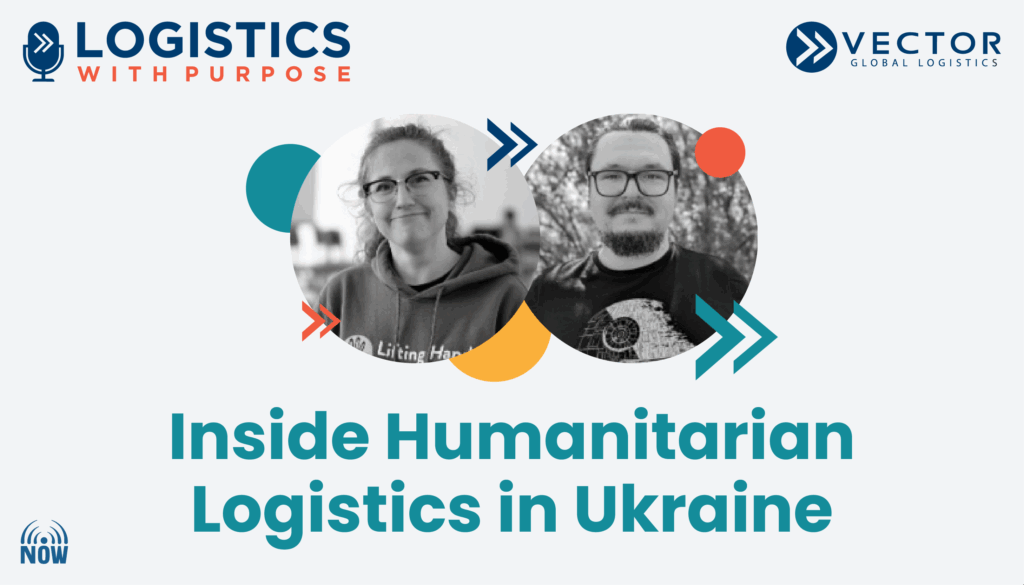
Yes, I would love to introduce Haley Smith, who is the founder and director of Lifting Hands International, as well as ior Tara Sheko, who is the Ukraine director. So we had the privilege of hearing from IOR a couple of months ago in our leveraging logistics for Ukraine call. We’ve known of Haley for a long time. We’ve spoken with Tracy and Jessica and many people on their team. But so this is our first chance to really hear everything from Haley as the founder. And then IOR will of course tell us what’s happening in Ukraine. And Haley will be able to shed light on what’s going on around the world because we love talking about Ukraine anytime we can. But also want to note that Lifting Hands International does incredible work around the globe for displaced people. So I am delighted to have this conversation with them and hear probably even more than I even knew about them. So before we get into it, I’m going to ask you both a couple of just quick questions to set the stage and get the ball rolling. So Haley, first up, what is one of your favorite hobbies?
Hayley Smith (02:41):
Well, one of my favorite hobbies is I love history and I go down these massive rabbit holes. Right now. I’m going down a very big rabbit hole of the Chernobyl nuclear disaster, and I think it’s because I’ve been close to the exclusion zone before. I visited Belarus about five years ago before COVID, and I had a chance to go and do my own tour on my, I decided against it. I probably would’ve gotten in big trouble and maybe some. But yeah, I just love history. So that’s my latest one. World War. I was a big rabbit hole for a long time, and I would go and go to all the battlefields and museums, and so I’m a huge nerd.
Kristi Porter (03:18):
I love it. I love it. I
Hayley Smith (03:19):
Try to mask as this cool person, but in the end, I’m a huge nerd.
Kristi Porter (03:23):
So have you seen the Chernobyl miniseries on HBO?
Hayley Smith (03:27):
Oh, I sure have.
Kristi Porter (03:28):
It’s amazing. I mean, you know what’s going to happen, but you’re on the edge of your seat the entire time. It was fantastic. I love that series.
Hayley Smith (03:36):
Yeah, Yor has been there. He’s been to Twitch insanely jealous of Oh, fascinating. Okay. That’s one thing I hold against him, but everything else I love about him, but I’m very jealous of that.
Kristi Porter (03:47):
That’s awesome. And you have been all over the world, both for travel, for work, for everything. So where is one or two favorite places for you to be,
Hayley Smith (03:56):
Jordan? Hands down. Jordan’s one of my favorite countries. I speak Arabic. I’ve been to many Arab countries, and I would say Jordan is, I vibe with Jordan. It’s a wonderful place. There’s a lot of hospitality. There’s a little bit of chaos that I love. I love just tiny bit of the traffic and the noise. Very different from Norway, which is very orderly and very quiet. I love just making friends immediately, and there’s just enough respect of private space that I have that other countries in the world that maybe there’s a lack of. So Jordan, it’s a perfect combination for me and the history, the culture, the food, the hospitality, the Insta Friends. I love it. And also Norway’s great. I live in Norway, so it’s beautiful nature. The summers are gorgeous, and so yeah.
Kristi Porter (04:39):
Oh, fantastic. Yeah, I’m sold on both places now there. Ior, what is, I know, of course you’re living in a war zone, so you may not get to this much, but a recent book TV show, something that you’ve watched that has made an impact on you or read Well,
Ihor Tereshchenko (04:56):
Okay. Maybe it wouldn’t be the best book to recommend to other people, but I read Vladi Meridian by Carac McCarthy, and it actually really impressed me, but it’s a really hard book to read and a really tragic story, so had a really huge to me, but I am a big fan of his, so I try to read one of his books from time to time. Oh,
Kristi Porter (05:17):
I love that. Thank you. We’re always taking recommendations here. And then what is a quote that inspires you or helps get you through the day?
Ihor Tereshchenko (05:25):
Oh, this kind of tough question. Somebody keep on keeping on, I guess.
Kristi Porter (05:30):
Yes.
Ihor Tereshchenko (05:30):
Just our philosophy. Keep on keeping on. Yeah,
Kristi Porter (05:32):
Absolutely. Well, of course, Haley, before we move on, we also saw that you’re a huge Seinfeld fan, so we couldn’t get off the interview without talking to you about that. So which character do you relate to most and why? Oh my gosh, we’re all about the hard questions here.
Enrique Alvarez (05:49):
Yeah, for sure. It’s a great series, by the way.
Hayley Smith (05:51):
Oh, man. They’re all kind of despicable people, I think. I love George. I love George Costanza. I love just his voice, his acting. He’s just a fantastic character.
Kristi Porter (06:02):
He is. I know this year, I keep saying it’s the summer of Christie, I keep using his, it’s the summer of George. I love that one. You’re killing independent
Enrique Alvarez (06:11):
George. That’s the he’s,
Hayley Smith (06:13):
He’s just such a despicable looter, but his lines are so good, so good.
Enrique Alvarez (06:18):
I love it. Ior, have you ever watched Seinfeld? No,
Ihor Tereshchenko (06:21):
Unfortunately, no. No.
Enrique Alvarez (06:23):
Okay. Put that on your list. We’ll have to introduce you to Seinfeld.
Ihor Tereshchenko (06:26):
If you’re talking about miserable people. I’m a big fan of it’s always Sign in Philadelphia, so I can mail show. That
Enrique Alvarez (06:33):
Is a good show too.
Ihor Tereshchenko (06:34):
That’s the Danny DeVito, right?
Intro/Outro (06:36):
Yeah,
Enrique Alvarez (06:36):
Yeah,
Ihor Tereshchenko (06:37):
Yeah. Well,
Enrique Alvarez (06:38):
Good show. Well, thank you again for your answers. Thanks for sharing a little bit of yourselves with us and our audience. Now let’s look a little more into your childhood. We would like to know a little bit more about who you were and if you can tell us a little bit more of your childhood. Where did you grow up? Anything that you can remember? And I’ll start with you, Haley, if you don’t mind.
Hayley Smith (06:58):
Yeah. I grew up in El Paso, Texas. My parents met at the University of Utah. They’re both from Salt Lake City. My dad was a JAG officer in the Army, ended up at Fort Bliss where he retired from the Army and started his own law practice there. I’m the youngest of five siblings, and so they traveled the world. And then I was born in El Paso, raised there. I would say that El Paso absolutely formed who I am. I absolutely adored the diversity of culture. I think that Fort Bliss brought a lot of culture. And then I love the Hispanic culture. I love how everyone’s very friendly. You hug people when you say hi. There’s no awkward handshakes. It’s just straight for the hug. I also grew up constantly, if you go on I 10 around kind of the mountain to the other side of El Paso, you have to kind of go around the mountain.
(07:44):
You’re right on the border of Mexico, the Fiad Juarez. And I have a kid I was just constantly exposed to. If you are driving on one side, you see relative wealth. You see the University of Texas at El Paso. You see the huge football stadium. You see really lovely historical homes in these preserved neighborhoods. And then you look to the other side and you see abject poverty. You see a different kind of infrastructure at night. If you go up to the mountain, you can definitely see a division. And so as a child, I think I was exposed very young to inequity and also just why is this side of the border doing more okay economically than this side? We went all the time. We had friends at the Mecado. We would always go to the same shops. And my dad, I don’t speak very good Spanish, but my dad’s very fluent.
(08:31):
And so we had these wonderful friends we would go visit. And so it was this, everyone’s the same, but for some reason, this country just has a little bit less economically or the socioeconomic situation there is different. And it just didn’t make sense to me, and it’s never made sense to me. And so I think I’m able to see that people are people, and a lot of the powers that be, and a lot of just the decisions that are made global leadership really hurts the day-to-day person, if that makes sense. It really did steer into my mind that we’re just kind of lucky. And also that there are politicians who make terrible decisions. And some of the reason that America has so much wealth is because we exploit places like Mexico and NAFTA really hurt Mexico. And so it’s always going through my mind is why do people have more and less, and what can we do to help alleviate that?
(09:18):
Is it up to me? Is it up to us? Is it up to the politicians? And so it’s always just brain’s always trying to filter this information, especially as I’ve been exposed to more and more of the world and seeing some more of the disparity, I have to just really sit back and instead of always concentrating on it and trying to figure out what’s happening is just how can I help alleviate some of the problems? How can I connect with the people so it’s not us coming in and playing Savior and that there’s just a lot of collaboration and seeing people face-to-face, hearing their stories and treating those stories with dignity and just trying to do our best to help others in a way that’s sustainable, in a way that doesn’t make people feel like objects, so that they’re just these sad people. Yeah, humanizing people is a huge part of LHI.
Enrique Alvarez (09:59):
Wow.
Hayley Smith (09:59):
Because we’re human.
Enrique Alvarez (10:01):
No, I bet It was very interesting for you growing up in El Paso, right? Because you see this imaginary line, it’s just very random. Why is it there? Why isn’t it like a couple feet this way or that way? And then of course, you see the differences. And of course, that makes you think how arbitrary some of these decisions are and maybe how silly some of the policies are as well, because you pointed it out, will equal hort. Tell us a little bit more about you. Where did you grow up? Where were you born, and what can you share with us in those early ages of your childhood?
Ihor Tereshchenko (10:32):
Sure. I was born in Kiev, but my mom is actually from Louisville. Where is part of your team working now? So I spend all my holidays, like summer, winter holidays in Western Ukraine. So I’ve been traveling all the time here and there. And when I was growing up, I see these really different cultures here in ku. Well, to be honest, it was more Russian speaking surroundings, and I’ve been growing up in Russian, speaking surrounding, but when I went to view each year, I felt like maybe I was born and was growing up in Kyu, but my heart and my soul always were in Western Ukraine because for me it was a place where they were really fighting and trying to preserve Ukrainian traditions, Ukrainian culture, Ukrainian heritage. Although I’m from Ki and I’m considering myself a ki of learning how you call it. But yeah, but I also always felt a bit closer to Western Ukraine.
(11:22):
But what actually I’m now reconsidering from my childhood years and what I’m thinking a lot quite often is that, well, basically when I was growing up, I saw a lot of people live in Ukraine. We had a huge wave of economic immigration beginning from early nineteens when the Soviet Union collapsed and there was a huge poverty here in Ukraine. So people were living and living and living with all, almost every family in Ukraine have now have someone living abroad even before the full scale invasion. And to be totally honest with you, before the full scale invasion, I also wanted to leave Ukraine and looking for a better life, looking for better job opportunities, better future for my children. I have one son, but I’m hoping to have more. The war actually changed everyth, so now I don’t want to leave Ukraine. A lot of people still do, and they’re trying to flee Ukraine, but I don’t want to because I reconsidered what it means to stay in, fight for your family, for your traditions, for your heritage. So it really changed my mind into trying to stay here and do my best just to help our country to survive and to be a prosperous country for Ukrainians. Thank you. Thank you so much. Yeah,
Kristi Porter (12:26):
Thank you both. It’s easy to see, just hearing these little snippets of your lives, what led you to these next steps and how we ended up here today, and your passion for your country, your global communities, helping others and making sure that there is more equity, there is more help, there are plenty of resources and helping find ways to redistribute those. So before we get back into Ukraine, Haley, founder of Lifting Hands International, you could have done a lot of things. What led you to this point and then tell us about the mission.
Hayley Smith (12:59):
Yeah, I’ll do this. The long story short, the beginning is actually when I was at BYUA long time ago, I was really struggling. BYU is a pressure cooker, especially if you’re not a cookie cutter type of LDS person, and I definitely was not and definitely am not anymore, but I really needed to latch onto something to get me through some dark times. I went to the public library, I picked out a book because I was like, I got to concentrate on something. I got to do something to get myself in a better place. So I went to the language section and I pulled out a book and I said, I’m going to sit down and I’m going to learn a foreign alphabet. And I just picked out a book and it was the Arabic alphabet. I sat down and I started learning it, and I absolutely fell in love.
(13:41):
This was my last year at college and I already had plenty of credits. I really probably should have graduated, but I extended the year so that I could take Arabic and I fell in love and it put me on this trajectory that pulled me out of this stark place and propelled me towards seeing the world in a very different way. Seeing the post nine 11 world in a different way, seeing a lot of the reasons behind conflict, seeing that it goes, a lot of it is traced back to war I. Everyone says, oh, they’ve been fighting for millennia. It’s like, actually, no. A lot of it is just recent history. I loved living in different countries, being instantly accepted into someone’s family and welcomed into through their home and fed and given all kinds of wonderful experiences. I’ve lived in Egypt and Morocco. I’ve lived in Jordan.
(14:26):
I visited Lebanon, Qatar, Israel, even though whatever, I have mixed feelings about that, I was able to go to some Arab conclaves of Jerusalem and everything like that. So it was really beautiful. I became an Arabic teacher at Boston Public Schools, cuts our foundation international, had a grant at my school. I taught beautiful, wonderful students for a couple of years. I created my own curriculum. I spent a summer in Jordan making videos because teenagers need to seek teenagers. And so it really opened their minds to, oh, they’re teenagers just like us. And these stereotypes were just, I destroyed these stereotypes in this classroom and even had an opportunity to take five of our brightest students to cut off for a cultural exchange. Anyway, long story short, I was getting homesick. I ended up quitting that job and moving to Arizona to be closer to family.
(15:12):
And within six months I was sitting desk job and feeling like I’d made the hugest mistake of my life. But this desk job, let me have more time to learn more Arabic, study Arabic to watch the news. And at this time, this is 2015, and I was watching closely at a Syrian refugee crisis and the exodus of people from Syria to Turkey to Greece and just the logistical disaster that that was. And so I felt really compelled to go to one particular camp that’s a registration camp that became the refugee camp. And I had these ideas of what humanitarian work is. I thought I knew what refugee work is. I grew up in the nineties and watched the Yugo, SLB wars just happening in front of my eyes. I saw the UN logo and blaze and all the cars and the tents. And so I thought when I went to Greece, I would see kind of the same thing when I got there.
(16:00):
It was just pure chaos. No one knew anything. And the only phrase I could say to people in Arabic was mfa, which is like, I don’t know. Where do I sleep tonight? Mfa? Where do I get food mfa? How do I register? Where do I sleep for two days? Because the line is so long, mfa. And it really did kind of kill a part of my soul because it’s people that I love and it’s a language that I understand, and people were telling me their stories from person to person. And I just was in a little bit of shock the one day that really, speaking of logistics and distributing aid around the world, the one day that really made the impact and made me want to start LHI is we got news on the walkie-talkie. Like, Hey, we’re bringing in some people that had just capsized.
(16:42):
This is December in the age agency, it’s freezing. We’re going to bring them. They’re going to line up outside of this tent. We’re going to stick you in this tent and there’s boxes of aid and we need you to go through it and clothe people. And so the first image, and I still remember this so well, is this old older man, he’s the first in line in his chin was quivering violently. It was so cold. And he was saying, please help me, please help me. There are children, women, older women in this long line. Eventually it was just so cold that they put them in a women’s tent, in a man’s tent and told them to strip down because they were just going to freeze. And one volunteer and I went into this tent and were desperately trying to find winter clothing, underwear, even thermal socks, anything to clove people.
(17:24):
And it was just junk. It was like, well-meaning people that were going through their closets and just getting rid of whatever they were, high heels. I mean, there was lingerie where I picked up like, okay, no. So I ended up giving away my jacket. I left the camp that day into my t-shirt and leggings because what am I supposed to do? And there was this one moment that I was in the women’s tent and people were crying. I was crying because I just felt so helpless. And I was announcing, I’m so sorry, we have to wait for people to deliver more aid. And one lady lit up a cigarette and she’s like, oh, it’s okay. I’ve seen death. This is nothing habi. It’s okay. Just relax. And so yeah, people started being like, it’s okay. We’ll figure it out. You did your best. And so I left that day feeling quite shocked, feeling like either I can go back home and be at this desk job and I can keep reading the news and watching the news and I can keep working this little job or I can do something with what I saw. And so I started LH, I filled out the paperwork, afraid lifting hands. International popped in my head. I have no idea where it came from, but I was like, well, the org needs a name. So filled it out, filed the paperwork, got 5 0 1 C3. My goal was to fill a shipment of labeled boxes of things that are actually needed. And I know that sounds like the most simple business plan for a nonprofit, but you would be so surprised at the lack of organizational and organized response, especially when it comes to material aid.
(18:50):
And to this day, our shipments are the most requested in several countries because the partner orgs that are the receiving orgs will open the truck and everything’s just labeled and they know what their is, and they don’t have to dig through these boxes looking for stuff, and half of the shipment they have to throw away. It’s not like that. So that’s where the LHI came from. I guess that was the long story long, but it was a big, yeah,
Enrique Alvarez (19:12):
It was a good story. Thanks for sharing that with us. We’ll definitely pull deeper into lifting hands and how it has evolved from the very, very early beginnings. So of you filing that paperwork, I thought you were going to have a slightly more interesting throw about the name, by the way, which is an amazing name. He just popped to your, it
Hayley Smith (19:32):
Was right.
Enrique Alvarez (19:33):
It’s a good name, yes.
Hayley Smith (19:35):
And LHI. It just rolls off the tongue. Yes,
Enrique Alvarez (19:37):
It’s a good name. Well, ior, shifting to you briefly tell us a little bit more about your education and things that actually you did early on. What did you study and how do you get actually into this organization? And how do you met Haley and how did all that happen?
Ihor Tereshchenko (19:55):
So my first degree was in economics and I ended it I believe in 2013 or something like that. And I joined Federation of Trade Unions of Ukraine. I was advocating for labor rights, I was taking part in collective bargaining between employees, representatives, employers, representatives, and Ukrainian government. But then I decided to switch and to try something bigger, something more complex, because I dunno, I just was always attracted to challenges, I guess always trying to challenge myself a little bit more to motivate me. So anyway, I switched to public service, joined Minister of Social Policy, then Minister of Economy. I’ve been working in a directorate for employment in Ukraine, although it was a structure inside Ukrainian government. It was actually built and sponsored by European Commission because it was a separate division that was responsible for harmonization of Ukrainian legislation, visa, European legislation within agreement of association between EU and Ukraine.
(20:59):
So it was a big part of Ukrainian process of joining European Union. And I’ve been working there until the war started. And actually, what was funny, and I believe I can tell about it now, I don’t have anyone around here. So in the first day, two days of war, our HR service in ministry just tried to find people because people were all away Ukraine, some people were trying to gather relatives to the border. As I did in the first day. Some people just left KI and was hiding in their summer houses in the villages where they had relative, et cetera, without no connection. So it was a pure chaos. So they brought everyone they could find. I got back to KI and my family left to Ukraine. I got them to border and they left. So I got back to KI and I was assigned to lead a relocation program for Ukrainian businesses for the next half of year.
(21:48):
Although my profile and my main responsibilities were labor market and employment service, employment programs, et cetera. But again, we had to deal with what we got. So I was leading this relocation program and we were trying to help small and medium businesses to relocate from eastern thousand Ukraine where they were just losing their means of production under bombing and to get them somewhere safer to western Ukraine, to Northern Ukraine, et cetera. So I’ve been doing this for around half a year. But then when the war was wagon and we had more and more, well, I was witnessing more and more atrocities here in Ukraine, I decided that I want to be just closer to people and doing some good to them that I can actually be sure that I’m doing something good for them. Because when you are working with ministry, you are way too far from people.
(22:36):
However you try your way too far from your neighbors, your family, and your just people around. So I joined a Society of Red Cross of Ukraine, and I worked there for around half a year. But I dunno, I decided to look for something else where again, because it’s a big organization, a huge organization, and it involves a lot of bureaucracy. And I was looking for something more, I dunno, something more flexible, something more applicable, something more practical I guess. So yeah, I just saw a announcement that some organization with kind of a bit strange name looking for a partnership manager. Yeah. Here I am two years later with Lyft Health International.
Enrique Alvarez (23:16):
And you skipped very quickly through one of the things that might be interesting for the interview and to me in particular. So you both come from a very similar background. You both want to help people. You both went and saw something that you didn’t like. And instead of just going back to your desk jobs, you said, no, I’m going to do something about this. And you did, which is inspiring and now you’re both working together. Why lifting hands? What was the one thing that you thought, this is it. This is going to be my home for now?
Ihor Tereshchenko (23:44):
I don’t know. I think it was an interview when I met our COO, Jeff of operations, Gerald, and he, who was a country director at the time, I really liked them. They looked like really cool dudes. And when I watched our LHI Instagram and when colleagues described me what they were doing at the moment, I saw that they’re doing really cool programs. They’re helping people all over Ukraine. And what’s actually was defining moment for me, to be honest, was that I saw on Instagram that the child leadership come here to Ukraine. They’re afraid they’re not sitting somewhere engineer or whatever. And they actually come here, they try to talk to people, they care about people. And this approach, this really caring approach is something that I can definitely say that what really motivates me to work with LHI. So yeah,
Enrique Alvarez (24:33):
It was very, very authentic and of course very brave to do what they do. And Hailey Bow and back to you. What was the story behind Ukraine? At what point did you think that it was going to be a good thing to expand? Because you’ve been helping a lot of different countries around the world before Ukraine. So what was your story behind? Well, this is not something I’m going to be waiting of and you did something again.
Hayley Smith (24:56):
Yeah, we’ve really been able to hone and polish what we do, and that is responding quickly to emergency situations where there will be refugees and displaced people. And the couple of weeks leading up to the invasion, everyone was holding their breath because of all the Russian forces that are building up in Belarus and Russia. And we have a couple of team members. One two speaks great Russian and he’s now learned Ukrainian. He lived in Moldova for a while and worked with an NGO there. So we knew that a lot of people would flee to Moldova. So initially we were like, I was on a plane to Yosh Romania and then crossed into Moldova right after the full scale invasion where there were thousands of people fleeing. And we were going around Moldova trying to figure out how we can help. And so what we ended up doing is supporting dozens of small NGOs who overnight had to become humanitarian NGOs.
(25:47):
I mean, we had people that were little NGOs that were helping elderly people grow food, and all of a sudden they had to become these humanitarian refugee organizations. And so we provided a grant to each one. It can go a long way in Moldova. Within a couple of weeks though, just the scale of the invasion, we knew that there was going to be a lot of need in Ukraine. Ukraine’s a really massive country with a large population. So while we really loved working in Moldova, we knew we could do a lot more within Ukraine as well, using our connections. We found a number of existing organizations and or community groups within Ukraine, and we went in and we talked to them. We identified which GU stats had really good solid operations. Obviously know the way of the land, they know the language, they know the locals, they know how to get in and help.
(26:34):
And in order for them to keep going and not have to quit after a couple of months, which is usually the case for the small organizations, that they get overwhelmed with large growing budgets. So we started this beautiful team, this network of teams where all over Ukraine, where we’ve established this is what we do best is going in and we figure out what people need in their context, which is why we have animals in some places. And then we have community centers in some places. So within Ukraine, we establish community centers in towns that have been destroyed, where the schools are gone demolished, where a lot of people still live because it’s not easy to just leave if you don’t have a salary. If you’re an older person, you live on a stipend and you live off the land. You can’t just go to Poland and come up with $2,000 a month for rent though.
(27:19):
That’s what we did. And we established community centers in northeast Ukraine, one in southeast Ukraine, we did some aid distributions in Odessa, we established a women’s shelter. So people who are displaced from the east, who can’t make it to Poland, who don’t have $2,000 a month for rent, they can live free of charge or they can stay for a day. We have people that have been there for years. We have three generations right now. There’s a 89 or a 90-year-old woman who remembers World War ii, and she and her daughter and granddaughter live at the shelter. The granddaughter goes to school is this beautiful artist. And so it’s just this beautiful community. And we also send aid to Ukraine. I think initially there was a large organizations go in and say, okay, we’ve done our job, we’ve distributed aid. A lot of times it’s just they take it over the border and then lead it.
(28:04):
They don’t establish distribution routes, especially large orgs who don’t have teams within the country. They don’t have teams to get it to where it’s actually needed. And they kind of just hope that locals will take care of it. And so we wanted to make sure our aid was getting to places. And so that’s one reason we have IOR and some other employees in Ukraine is to make sure that stuff gets from the border to where it’s needed. And that includes, I mean, EOR goes to donates, which is extremely risky and dangerous. He and our colleague Anastasia also go quite regularly to do some distribution to frontline communities. Looks like we lost ior, but
Enrique Alvarez (28:37):
He did say at the beginning of the conference that they were expecting some blackouts. Good. He’s back. Yeah. Sorry guys.
Ihor Tereshchenko (28:44):
Just get a blow out.
Hayley Smith (28:45):
I would say personally, I think like IOR said, my team members and I insist on going. I think yes, it’s risky. And my hair started falling out after this latest trip. Literally I went in June and it was, I mean, there’s always risk. Every trip I’ve gone, there’s been something, but this last time was a lot of somethings and that was very eyeopening. I think for me, it’s just getting a tiny, tiny taste of what IOR and our other team members have to live through literally every night. It’s just so stressful. But you know what? And people are like, why do you put yourself through that? I’m like, well, I’ll open your eyes. I have the opportunity to do this. I have a CEO of an org. I have to go and see our progress programs. How am I supposed to come back to places like Brooklyn and go to fundraisers and say, our org does this?
(29:25):
I mean, I’ve never seen it. And also just talking to people, showing up for people. I know that if I were in their shoes, okay, some random American woman comes every six months. But I think it does make a huge difference because especially at our women’s shelter where I see the same people over and over or our community centers where I’m seeing youth grow up over the last three years, it’s so beautiful to have these relationships where you hug people and they’re crying and I’m crying. Just you love them so much. That is a fantastic part of my job. And it’s definitely that way in Ukraine. It’s a beautiful country with beautiful people. And I feel like the news doesn’t cover really what’s happening right now. A lot of people are like, oh, I thought the war was over. Where are you getting that information? It’s escalated. Aviv got hit. I think even historically, it’s one of the worst attacks on Aviv ever, right? IV was somewhat spare in World War ii, and then now it’s just getting pummeled. It just doesn’t make any sense. And you have hundreds and hundreds of drones every night. It’s a war of attrition. They’re trying to just bleed Ukraine, dry of anti-missile artillery, and every shahi drone that flies over, it requires thousands of dollars worth of air defense. And so it’s just disgusting. And just having been there and just being like, when you hear an explosion, it’s just this weird realization of that is someone trying to kill
(30:41):
That? Is this clear? I want to kill you? And when you hear it and when you see it, it’s like the most palpable, horrible ceiling. I try to turn it into motivation to get people to give money because that’s how we keep going and just build this community in the US of supporters who wants to help in a palpable way.
Kristi Porter (31:00):
Yeah. Thank you. Yeah, I think we obviously had a very real life example just now. We lost IOR for a minute because he went into a blackout and is now joining us and trying to reset back up. So I think one of the things I am constantly asking our team in Ukraine, I’d love for you to share with the audience too, is not only are you trying to keep yourself and your family safe, but you’re trying to get work done. You’re trying to provide aid to others. As Haley mentioned, you’re going to other regions, some of which you’re incredibly dangerous right now. So I guess paint a better picture for those of us who are sitting in very safe places right now. What does it look like to try and get work done on a daily basis when you’ve got so much to care and worry about?
Ihor Tereshchenko (31:45):
Okay, so let me paint you a usual day in Ukraine. So I work from my home, so I got a small office here and science occasion blackout. So sorry for lighting. Yeah, it’s a backup one. It looks like this. When I wake up, I usually, me or my wife, we get in our son to kindergarten. So I try to plan my meetings for early morning mostly so I can get up, get him to kindergarten and start working immediately. But lately it wasn’t happening unfortunately because when there’s air alarm, when there’s rockets flying, all the school and kindergarten facilities are closing. So you have to stay home, you stay to hide. Actually, a lot of people are still going to underground cars, mattress, et cetera. But we do that occasionally, but not really often because most of shelling happens at night. And if you can imagine getting your child from bed at two 3:00 AM and getting them to some shelters that’s 10 minutes from your place, especially in winter when it’s cold, just huge emotional stress for children.
(32:48):
So we mostly now have a hallway life and a sleeping place in a hallway. So we’ve got a special mattress that can be rolled. So you just roll it over in your hallway, you put some pillows there, and we are sleeping like that for most of nights in our hallways. But for a workday, it’s actually even a bit more stressful sometimes because when you’re trying to work, you’re focused on some task on your hands. It can be a big strategic task, it can be some small technical issue, but you’re focused on that, you’re working, and then just immediately air alarms goes on. And when there’s drones coming, it’s a bit easier because they take time to, for example, it takes around 40 minutes I guess, from a Russia border for a drone to reach crane. But when you have a ballistic missile or supersonic missile, it’s totally different that you have 40 seconds, one minute to do anything to say to yourself, and you can’t do actually anything at that time.
(33:42):
So one minute is not enough to get from I leave on the seventh floor to get downstairs and get outside. So you just focus, you hope for the best. You try to not think about that because when I live in a war for more than three years now, almost four years, actually, if you keep thinking about this constantly, you’ll just go mad. I was considering myself a very mentally stable person, very mentally stable. I never been too stressed about anything. But even now I feel that I’m reaching really severe state of anxiety, especially during shellings because it’s not just me, it’s my family, it’s my child. And not being able to protect your family, it just pushes the ground from your feet and that’s what you’re going through almost every day for three years now. It’s stressful. Yes, it’s hard, but as I said previously, just keep on keeping on because we know have actually a lot of possibilities to stop this, and the whole world is trying to stop this and unfortunately and successful yet you just need to adopt. So adaptability, I believe is one of the strongest features of Ukrainians now because we adapt to blackouts, we adapt to constant sharings, we adapt to sleepless nights. And actually that’s a very severe form of torture, I must assure you, because when you’re not sleeping for weeks straight, it’s really messing with your head. So yeah, we just adapt. We’re trying to do our best. I believe most of Ukrainians are trying to do our best and just keeping positive, I guess, at whatever meeting we have.
Enrique Alvarez (35:12):
Wow. Well, that’s very, very powerful and a very big picture. You’re basically painted for everyone here and the audience, and we appreciate for you being so open and candid about this and sharing it with us. You did mention NI horse, something that’s very interesting, and I shift this to Haley because when most people think about humanitarian aid, they always think about, well, we’ll send food and water and shelter and hygiene products. But then you mentioned something that’s just probably as important, which is the mental health aspect of it, and you’re leaving it. You have a young son as well, and of course that’s very important that he grows up considering his mental health. And so how do you guys tackle this? I know you guys have done really good job also on this psychological support side of things, especially in areas like Ukraine as he who was mentioning, and maybe GAA as well. Could you tell us a bit more about what your team faces and how do you support them psychologically?
Hayley Smith (36:06):
Absolutely. That’s a really good question. And first I just want to say that I’ve met i’s wife and son, and I feel like they’re doing an incredible job of helping him adapt. And he’s an adorable child, and it’s an honor to work with Vijo and see him and his wife. Yeah, okay. So obviously, yes, people think once food, clothing, also in refugee camps, if people are out of danger, they’re living away from the shellings and the bombs, then they’re okay. I think we all know, especially after COVID, I think the research and our own experiences empirically prove that we need people, we need care. We need mental health support. We absolutely have to have community. And even from our own little tiny experiences, even my own little tiny experiences, hearing shelling and drones in Ukraine, the hypervigilance, the irritability from losing sleep, the hopelessness, the anxiety, that’s also the case in Gaza with the continuous shelling and even post ceasefire, there’s just so much unrest and so much fear that people are going to these dark places where they need psychological first aid.
(37:17):
So our model is to work with local organizations, local psychologists who are trained in helping people get through traumatic experiences to cope with trauma. In Gaza, we work with this fantastic organization, it’s called Mind Body Medicine, where they have these trained professionals who go and hold sessions to help people cope. We teach them breathing exercises, meditation that you can do in five seconds breathing, where you can get through traumatic experiences. Initially, we were training first responders in this self psychological first aid because they aren’t getting relieved. There aren’t any other teams coming in and relieving them. And so they’re day after day after day after day, being exposed to horrific situations, including the safety of their own family or losing their own family members, losing their homes, losing extended family and friends left. So just the amount of grief and facing this incredible violence. So that was really successful and we were able to find more people and train them in the trainings.
(38:21):
And so people became trainers, and we were able to extend and expand that program to children, to people who also take care of displaced people and people who run the camps, people who run the UN schools that are our shelters. So we would love to be there as long as possible. We’d love to even just expand our program for the rebuilding. That’s also going to be very difficult. Again, once the bombs stop, it doesn’t mean that the trauma stops in Ukraine. We have psychologists that go and have sessions. I’ve attended a couple of the sessions where the children are making little clay models about how they feel, and it’s just really incredible to see that. In Greece. We have a community center next to refugee camps where we do the same thing. It’s trauma-informed care. We have a women’s space and a children’s space. We have every activity is designed to help people cope with traumatic experiences.
(39:10):
And refugee camps are not nice places to be. I’m sure they’re not nice places to live. There’s a lot of violence, there’s a lot of tension, there’s a lot of desperation. And so to be able to leave that situation in that context and go to somewhere that’s so bright and joyful is absolutely needed. And that’s one funny thing. When people go to our grace program, they’re like, everyone’s just so happy. You kind of expect it to be this heavy experience, but it’s not. We want people to be happy there. So our team is really, we really want them to be okay. We make sure that they have activities. Our team itself have activities to stay healthy and happy so that they can really be there for people. And so that’s definitely something we’ll always be committed to is the psychological benefits of our work.
Kristi Porter (39:50):
Yeah, very
Hayley Smith (39:50):
Important. Can really heal.
Kristi Porter (39:52):
Yeah.
(39:53):
I wanted to ask you something you’ve touched on a couple of times, but this is something we continue to hear in our leveraging logistics for Ukraine conversations. It’s something you live all the time. So with Ukraine and specifically the original was like, it’s going to be a long couple of weeks or a month or something, and then the world will be over. Clearly that’s not the case. Ukraine is still standing strong, but there also is a time with, you work in a lot of really difficult areas and on a really in difficult populations, also some war zones or refugee camps, things like that. People only have so much to give. As you said, some people are like, oh, is the war still going on? So there’s an awareness issue. You’re trying to fundraise for different causes, different programs, different people. What does that look like from your standpoint? How do you keep people focused on where the funding needs to go? How are you fundraising? How are you trying to juggle all of these different areas that you need support for?
Hayley Smith (40:54):
Good questions. Yes. I would say my biggest goal as the CEO of a humanitarian organization is to remain present in places where there will be need for years, ongoing need. I think a good example was when last year I went to Uganda and we visited four refugee camps. And the refugee camps are quite isolated. Uganda’s great Uganda, mixed up a lot of refugees and does a pretty good job considering their circumstances, but they’re quite isolated. You enter the camp and then you have to drive and these terrible roads that just get washed out all the time. But each entrance of a camp had these signs of all these organizations and projects, this project sponsored by this org, and there’s dozens of them, and they’re all faded. They’re all old, some of them are 20 years old. And you go into the camp and you talk to people and they’re like, it’s just people come and go.
(41:44):
The services come and go. And so you get used to having a certain service and then it’s taken away and it can feel so horrible for people who are absolutely desperate. They know they’re dependent on aid and hate that. And then you’ll have these organizations come and do this incredible work and help them become self-sufficient and then they’re gone because it’s lack of funding. I really don’t want to be that kind of org that comes in, establishes these amazing programs. We’re helping people become, helping them to get healthy mentally and physically, and then we’re just gone. I think that does a lot of harm. And so my goal is whenever we have an influx of funding, and that happened with Ukraine, for example, people were just throwing money at organizations. We got quite a big chunk of change from a couple of donors, and we were able to establish these programs in Ukraine, and they have done so much good.
(42:37):
They have really brought these villages together where you have these community centers, you youth councils, women sewing circles, and to establish something like that I think is just a huge responsibility. So I’m always trying to remind donors that if you donate to a program, then it really should be something that’s consistent and that if you get really excited about one program and then you switch to another program or another org the next year, that you could be putting an organization at risk of having to cut programs. So that’s something that we’re always trying to find donors that are really committed to one cause for several years, I would say it’s been a huge challenge. I think the political environment right now is not conducive to people focusing on one problem. There’s just all these global emergencies popping up everywhere. And I think the human impulse to try to put out these fires is very strong and admirable and beautiful.
(43:30):
And I just think the general public needs to know that there’s a lot of people that still need help and that the latest emergency is very important too. But to remember those that are still in need. And so when you have refugee camps that have been around for decades, they’re still need just as much need as an emerging crisis. So we are always searching for people who would like to be committed to one thing and stick to it, and that is a huge challenge. But yeah, I’m being quite frank here, and I do not want anyone to think that we’re not grateful for the donations. We are so grateful for every single donation. We depend greatly on independent donors. We have a lot of small donors. We have a couple of big donors. We have a grant writer. A small percentage of our money comes from private foundations and grants, no federal funds.
(44:15):
We’re really glad that we didn’t because then talk about harm being done by suddenly cutting programs. So I’m in New York right now. Today’s fundraiser is for Ukraine. Our board chair has been to Aviv a couple of times with us and seeing it on the ground, it’s amazing when you actually get to go and see the need. We just want to keep doing things like that. Just getting your eye. I love to travel around and talk to people and tell people about the organization. I’m always up for going out for a coffee or a meal and just blotting like I’m doing right now because it’s really important. And I think people just, and you have to connect and people don’t know. So it’s really helpful to have someone across the table that can just tell you what’s going on and what I’ve seen and what I’ve heard, the stories that I’ve collected while I’ve been gone. And yeah, I think that’s really important to be a witness. And
Enrique Alvarez (45:00):
We’ll definitely put some links when we post this interview so that a lot of people in our audience can contribute to all the efforts that you’re leading because they’re all incredibly important. They’re very impactful, they’re helping a lot of people. And as you said, the media cycles are too quick these days. We forget that maybe the Ukraine war is still going. We forget that there’s tons of other refugee camps that you pointed out that are still operating and they need help, and they need our help and they need our listeners help. So we’ll at least try to help you with the awareness side of things. I think. Thank
Hayley Smith (45:34):
You for saying that, and thank you for doing that. I think it’s all a community effort, right? Yes. We’re an organization, yes, we have to run a business. Yes, we have a hierarchy and a team and everything, but it really is a community effort. There’s no way we could do any of this without our individual donors. Five bucks a month even. People make a huge difference. Everything makes a difference. Anything
Enrique Alvarez (45:51):
Helps a lot. And you add to the bigger pot. And so Haley, thank you so much. I was going to try to move on to something that’s very characteristic of your organization, lifting Hands International as your shipper tracker, right? Because we’re talking now a little bit more about logistics. How do you get the product onto the right people, onto the right regions? And sometimes it’s very, very hard to go into these countries, into these different regions of the world. And I think something that you do is this shipment tracker. Could you tell us a little bit more about what it is and what impact has it on maybe the donors, your organization, the people that you’re helping?
Hayley Smith (46:29):
Sure. Yeah. Our shipment track is on our website. It just kind of shows what shipments we’re collecting for and what’s in them and how it’s going to benefit people. I think LHI was initially our first mission was to send aid. And so that’s something we do really well. We have learned that you have to have partner organizations on the receiving end who distribute the aid. We don’t just send it and then just fly over and are the ones that distribute. That’s impossible. So we spend a lot of time vetting organizations that can be the distributors on the ground, people who have experience taking aid to refugee camps, and they know what people need. And so that you don’t have random donations going to people when they don’t actually need it. And so if there are a lot of school supplies on the shipment, then it means that we’ve had conversations with the distribution teams and their schools, and there’s children who need these school packs and these school kits, survival kits are going to Burundi because right now the camps are just so full of Congolese that there’s no room in the tents.
(47:29):
And so they have to sleep outside and they’re getting bitten. Malaria is spreading, right? You just have to make sure that we are in regular conversation with people on the other side. So we have identified over the years, many partner orgs who specialize in shipping. One of our biggest partners is HHRD, helping Hands for Relief and Developments. They did our first shipment ever. And so we talk to them, they identify what’s needed, we collect aid, we pack it, and then we get it onto shipping containers. And they love our shipments because they’re organized and they’re sorted and it’s stuff that’s actually needed. And then we also work with other shipping companies that will help us get our aid to where it’s needed, help it process customs, and then our distribution teams are waiting on the other side with open arms and are immediately distributing the aid.
(48:13):
And while I said that, we’re not flying over to all these destinations, I have been at distributions though. I have been in Jordan, for example, when they do get a shipment and I just happen to be there doing our livestock program, and then I’m able to go with the team and distribute the aid myself and just see it with my own eyes, the huge impact it has. And when the children just press the school kits to their chest, and each kit has a little card in English that says you are loved. And so I think it has that extra connection of we have not forgotten. New that we see is our brothers and sisters in this world. We’re all brothers and sisters in the end. So I’m really grateful for the shipping organizations and our partner organizations that help us get dozens and dozens and dozens of shipping containers to refugee camps in far flung places that maybe some of our volunteers haven’t even heard of.
(49:03):
We just sent one to Mauritania, for example. There’s some conflict in unrest there, and half our volunteers were like, where? So it’s a really wonderful opportunity to educate people when they’re coming in and they’re doing kits and they’re putting stuff together. Maybe they’re a corporate group just required to go for the day, and then they actually get immersed in this beautiful environment that our warehouse is, and they’re able to learn a little bit about where their aid is going. And they know that by the end of this hour that they’re there, they have learned enough to know that this stuff is going to get to where it’s needed.
Kristi Porter (49:31):
Thank you for your perspective and your candor today. Again, there’s learned so much being in the logistics space around humanitarian aid, particularly what amazing, huge things very small teams do, and then also a little bit more what it looks like behind the scenes. But the vast majority of people are just sending in their donations and don’t really have a good understanding of peeking behind the curtain to see what goes on. You obviously started out of a need because there were certainly humanitarian aid being sent, but it wasn’t being done well. We have heard horror stories of aid being sent across the border and then just left by the wayside. So what would you like to see? You’ve been around a lot of countries, a lot of situations, a lot people. How would you like to see the humanitarian aid industry in general? What would you like to see done differently? Either practice wise or working together wise, or what would you like to see?
Hayley Smith (50:27):
Yeah, you definitely hit the nail on the head when you talked about working together wise. The only way you can get effective work done is to work locally, work with local teams, and depending on where you go, sometimes the local teams are just little groups of people who want to help, and our responsibility is to make sure that the organizations we work with are solid and are getting the information and the monitoring and the valuation, the metrics. We spend a lot of time training our partner orgs too. We will have incredible teams. There’s one team in Uganda, they live in the camp. They actually live there. The camp has been around for so long. Some of them were able to go get scholarships and go get trained. Our veterinarian got trained and then came back to the camp, and so the people in the camp have access to the veterinarian.
(51:11):
He just lives a couple of huts down, but a couple of those team members that are really in charge of going around, we had to say, we need this information. We need it once a month. We need you to actually talk to people and you need to figure this out and this out. How many of your kids are able to go back to school or the people that are selling the baby goats, how much money are they’re making? We need to know this stuff. And they don’t always know which questions to ask. Some of them need to be trained in spreadsheets. Some of our organizations don’t have access to internet, and so we’ve been able to train them in how to get them a little internet module and they’re able to connect in Ukraine. We have had a couple of, I say that a couple of our teams have flown the coop and that they were able to establish their own organizations and apply for grants and that they’re financially independent now and can do, and so they’re our partner work now, not just our team.
(51:56):
I think that the vast majority of work is done by small organizations, and so I really encourage people to support more grassroots organizations. They’re able to get in there and be a little more nimble and meet needs immediately, and they’re able to have these conversations with people, and we want to make sure that when we’re talking to people on the ground that we make sure that they know that we’re listening to them and that yes, there’s always a power imbalance, but we don’t want them to feel like they have to tell us what we want to hear, so we make it clear like, Hey, what do you guys need? We know that yes, you might need some clean water or whatever, but there might be other things we don’t know about, and so that really is the future of humanitarian work. It should be based in research, and it also should just be very much collaborative effort.
Enrique Alvarez (52:37):
Well said, and thank you once again, ior. As we wrap this up, I wanted to ask you, what does the phrase logistics with purpose mean to you?
Ihor Tereshchenko (52:44):
Oh, I wasn’t prepared for that question.
Enrique Alvarez (52:48):
Oh, well, that’s what makes this question better. It would be your first reaction.
Ihor Tereshchenko (52:52):
Yeah, sure. So for me, it would be the same as, I guess humanitarian work with purpose, so not just doing it for numbers, for statistics, for results, we’re doing it for people, so doing logistics for people. It’s I guess the best purpose that you can have in any field of business. So yeah, let’s keep doing it for these people in mind, and I believe we will be more than success.
Kristi Porter (53:12):
Fantastic. What are a couple of statistics or stories that really help empower you to keep going another day?
Ihor Tereshchenko (53:20):
I’m always remember pretty often remembering how when you’re going to really remote frontline settlements out in Western Eastern Ukraine, and we’re talking really frontline settlements, three kilometers, five kilometers from metro battle zone. Whenever you come there with some goods like food products or hydrogen products or whatever, that was a part of logistics with purpose all the way from say, us to Ukraine, people really glad not just that you brought them these items, they are glad just to see other people. Even people whenever we come there, they say we are so glad that we are not forgotten. So for them, sometimes it even might be more important that the most essential things like food, keeping yourself clean and in at least somewhat decent conditions, because I guess when you’re living in basement for a year or year and a half, two years now, with some people without electricity, without water, without connection with outside walls, you don’t know if there’s a wall outside and all those remnants from World War II where some people were living for dozens of years on island isolated. It actually happens right now in Ukraine. What keeps me motivated is just semantics, basically, it’s just about semantics. Whenever we’re talking about humanitarian, sexual, sometimes we forget that there’s a human in humanitarian, and I would just want people to remember how it did a bit more of.
Kristi Porter (54:42):
I love that collaboration and connection.
Enrique Alvarez (54:43):
Thank you so much. Yeah. You both have been in currently open and just authentic and inspiring, so we really appreciate you taking the time to have this conversation with us. Haley, as we finish this interview, I mean, are there any kind of call of faction for people that are listening to you right now? Anything that you would like to tell them?
Hayley Smith (55:03):
Yeah, I think I would reiterate that a little bit of money, if you can spare a few bucks a month can go a really long way. If a lot of people were to do that, then we would be able to keep our programs running for as long as it’s needed. I think people feel a little bit powerless. I absolutely would. If I were still a teacher and reading the news and I wouldn’t know what to do, I would feel so useless. I think a lot of people feel like they have to go and help and like, oh, I can’t, if they have kids or jobs like, oh, I can’t do anything. But I think if people realize the power of just a few bucks, they would feel really empowered. It really makes a difference. It’s not just throwing some money into the ether and just hoping it gets to where it’s needed.
(55:41):
Yes, there are some organizations that have a lot of load and maybe aren’t doing the right kind of work, but you have to just put a little bit of time in, find the right organizations and keep supporting them. I would say that any organization really appreciates a general donation because then we have the flexibility. If there’s something that happens, huge emergency in another part of the world, we’ll have some extra funding, or we have some funding that’s not tied up. So at the end of the day, I would say after 10 years of doing this, that’s definitely the way that normal day-to-day people can make a difference. In addition to helping in their own communities too, because
Enrique Alvarez (56:10):
Absolutely. No, thank you. Well said. And yes, main message. People need to make sure that they’re not forgotten. I think that’s very important, as Hor was saying, and maybe us need to make sure that we don’t forget either, and maybe just foregoing that one latte a week or whatever, and donating it to organizations like yours might be a much, much better idea. So thank you. Once again. How can our listeners connect with you, Igor, and how can our listeners connect with you, Haley, and of course, with Lifting Hands International, how can people go and donate directly to you?
Hayley Smith (56:41):
Yeah. lhi.org is our website. We have a lot of information about our programs. We’re launching a new website in a couple of months, but the one we have right now is still just fantastic. It’s an amazing tool. You go, and it’s very clear. We’ve made it very clear where you can go and donate and you can find our email address and contact us through there. I love hearing from people. I love hearing people’s stories. I read every single email that comes through. I may not respond in a very timely manner, but I do definitely read every single thing that comes through.
Kristi Porter (57:10):
Perfect. And ior.
Ihor Tereshchenko (57:12):
Yeah. Yeah. I try to talk. I’m there on our team page and my email’s there, so please, if someone needs me, I am always open.
Kristi Porter (57:21):
Well, wonderful. Thank you both so much. Again, appreciate your honesty, your candor. Ior, thank you for joining us during a blackout. We just have no idea of what’s going on, and so glad Haley is doing the great work she’s doing, her team that you guys have connected, and that clearly great things are being done. So we love working with you. As I mentioned at the beginning, I’ve been to your warehouse in the Salt Lake City area. It is very well organized. It is very well done, and our team just adores you and we can’t wait to work together more and do some more good. But for all the amazing projects that you’re doing, we definitely encourage everyone to go on your website and look a little deeper and see if it’s a cause that you’re really willing to get involved in, and we certainly love it. And of course, for our audience, thank you for tuning in once again, despite tariffs, despite current government shutdown, despite all the things that there are still great things happening behind the scenes and even in front of the scenes in the logistics world, and we’re happy to bring you these stories. So we will see you again in another two weeks. So thanks so much everyone.