[00:00:00] Mike Jones: embrace your uniqueness and creativity. I’m not trying to say that AI tools and things like this don’t have value. They have a lot of value. But if your default move anytime someone asks you a question or you’re confronted by a problem is to ask ChatGPT or Claude what’s to differentiate you from the other people because it’s just going to give you the same answer. So I would always encourage people to sit down and think, “What is it I want to say?” Or, “How might I go about solving this problem?” Before using those tools.
[00:00:29] Scott W. Luton:
[00:00:41] Mike Jones: Thanks, Scott
[00:00:45] Scott W. Luton: you might be.
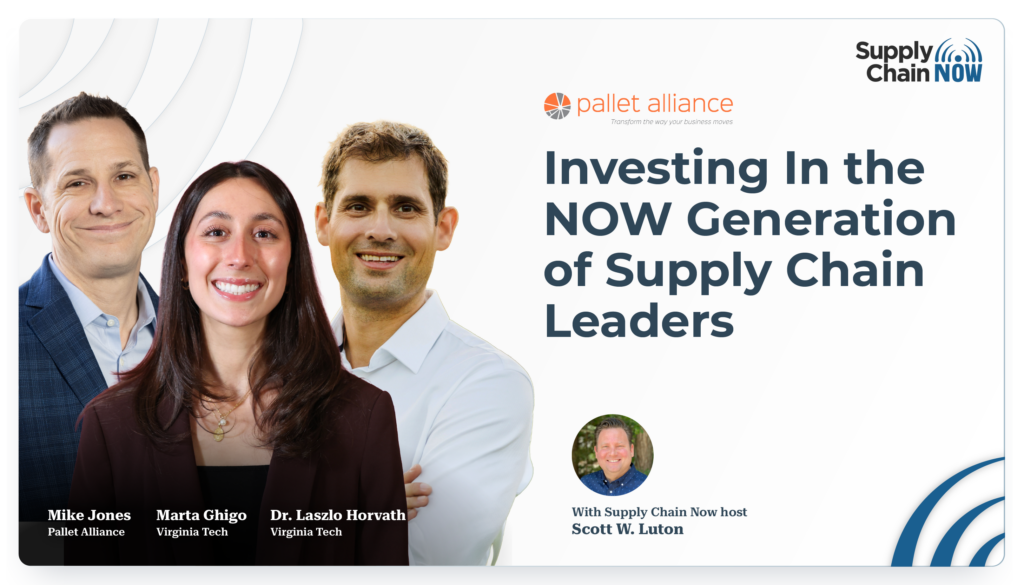
[00:00:46] Scott W. Luton: Scott Luton with you here on Supply Chain Now. Welcome to today’s show. Folks, today we’re continuing one of my favorite series. It’s the Now Generation, where we sit down with students and professional educators from some of the leading colleges and universities around the world. On the Now Generation series here at Supply Chain Now, we’re delighted to partner this year with Dr. Stephanie Thomas and the WISE organization at the University of Arkansas to power the series forward. WISE exists to show students that supply chain is exciting, impactful, and full of opportunity. This initiative creates community, connects students with industry leaders, and helps them build the skills and confidence to launch meaningful careers.
[00:01:25] Scott W. Luton: Stephanie and the WISE team are doing great work, including offering some terrific programming and annual events. You can learn more at the link that we’ve got down in the program notes.
[00:01:35] Scott W. Luton: Okay, so folks, today is a very special episode. We’re doing a variety of things here. One, we’re profiling an incredible school, Virginia Polytechnic Institute and State University, perhaps better known as Virginia Tech, right?
[00:01:49] Scott W. Luton: And we’re gonna be speaking with an excellent student and professor from Hokie Nation. We’re also gonna be featuring a passionate business leader and organization that supports programs and students at the school. That is Mike Jones and The Pallet Alliance organization. And we’re gonna be remembering and honoring one of our friends of the show that’s no longer with us, but whose legacy continues to impact and shape industry everywhere.
[00:02:12] Scott W. Luton: That’s the late Tyson Steffens. So get ready, folks, as we have a very special show teed up here on Supply Chain Now. All right, so we got our work cut out for us.
[00:02:21] Scott W. Luton: Uh, first, I want to introduce a great panel that we’re featuring here today, starting with Marta Ghigo, a senior at Virginia Tech that’s deeply involved in the packaging program.
[00:02:32] Scott W. Luton: She’s majoring in packaging systems and design, about to graduate, in fact. Uh, she’s very well known for her passion for packaging innovation, sustainability, and creative problem-solving. And through her involvement in the packaging program at Virginia Tech and hands-on engineering and design projects, Marta has developed experience in packaging systems, sustainability analysis, and consumer-focused design.
[00:02:56] Scott W. Luton: Also joining us, Dr. Laszlo Horvath, professor and department head in the Department of Sustainable Bio- uh, Biomaterials at Virginia Tech. Now, originally, Dr. Horváth is from Hungary, but he’s been a faculty member there at Virginia Tech since 2010. He also serves as director of the Center for Packaging and Unit Load Design.
[00:03:17] Scott W. Luton: And when he finds the time, because I, I’m convinced he’s got several clones, plus he’s got three small kids at home, but he’s also published 36 peer-reviewed journal articles and has generated over $7.5 million in research funding, amongst many, many other things. And then rounding out our panel here today, Mike Jones serves as CEO of Pallet Alliance.
[00:03:38] Scott W. Luton: But beyond the business management aspect of his role, Mike has a track record for delivering real innovation to industry, especially when it comes to next-generation pallet-based solutions. Now, if you talk to Mike for a few minutes, you’re gonna quickly learn that he attributes Pallet Alliance’s 30-plus years of consequential success to many things, but most of all to its people.
[00:04:01] Scott W. Luton: So I wanna bring in our panel, Marta, Dr. Horváth, and Mike. All right, Marta, how you doing today?
[00:04:07] Marta Ghigo: Good. How are you?
[00:04:08] Scott W. Luton: Wonderful. Wonderful. Congratulations on your pending, graduation. We look forward to learning more about that.
[00:04:15] Marta Ghigo: Thank you. It’s exciting. It’s tomorrow, so I’m a little nervous for it, but
[00:04:19] Scott W. Luton: It’s gonna go great. It’s gonna go great. And, and we’re, we’re gonna ask you a f- a fun, warm-up question in just a minute. but welcome in. Dr. Horváth, great to have you here today. How you doing?
[00:04:28] Laszlo Horvath: Very good. Thank you for having me.
[00:04:30] Scott W. Luton: You bet. Appreciate what you’re doing, uh, helping to, uh, fill the talent pipeline of bright, incredibly bright people coming in, in the industry, so great to have you.
[00:04:38] Scott W. Luton: And Mike Jones with The Pallet Alliance. Mike, great to see you. I think we’ve rubbed elbows earlier, uh, in our journeys, but great to have you here on Supply Chain Now, my friend.
[00:04:48] Mike Jones: Great to be here. Thank you. It’s nice to take a little bit of break from racing from trash fire to trash fire.
[00:04:55] Scott W. Luton: It is. And there’s lots of fires out there. Lots of fires. Gosh, it’s been an interesting year to start, but welcome in. Um, all right, so let’s do this.
[00:05:03] Scott W. Luton: 99.9% of the shows we have here at Supply Chain Now, I like starting with a fun warm-up question to kinda humanize our guests a little bit. And in this case, we’re gonna be celebrating some of the things you are doing outside of supply chain.
[00:05:14] Scott W. Luton: Marta, for example, you have got a big milestone, as you mentioned, coming up tomorrow where you graduate from Virginia Tech. So I gotta ask you, what is one thing you’re looking forward to doing to celebrate this big feat?
[00:05:27] Marta Ghigo: Well, it’s actually very exciting since my major is like in a smaller college here at Tech. It’s not under the College of Engineering. All my friends that I live with and I’ve gotten close to are graduating Saturday, so they’re all coming to my graduation, like most of them. And then here in Blacksburg, since it’s quite a small town with just a bunch of college students, there’s a bunch of bars that do like happy hours and such.
[00:05:51] Marta Ghigo: So I’m gonna go with all my family and all my friends, and we’ll have a nice happy hour celebration. I’m glad that they all get to join in on mine and I can like watch them cross the stage as well. It’s gonna be a big day to celebrate and everyone’s free, so it’s like very celebration for me. But…
[00:06:06] Scott W. Luton: That’s terrific. Well, I hope you have, uh, uh, seriously congrats. That is a special time, and I can’t wait, uh, we all can’t wait, I’m sure, to see what you do in industry as you, um, move on to what’s next. So congratulations, Marta. now, Dr. Horvat, we were talking earlier in the pre-show, when you’re not doing all these big things in the industry there, uh, and helping, uh, you know, students on their, their journeys, you’re very busy at home too ’cause you’ve got three kids.
[00:06:32] Scott W. Luton: I think their ages are two, five, and seven, so you have your hands full during the week and on weekends. Is that right?
[00:06:40] Laszlo Horvath: Yeah, exactly.
[00:06:42] Scott W. Luton: And what’s, uh, so what is one activity, uh, if you have a, the Saturday to yourself and you have all three kids and you wanna get them out of the house, what’s your go-to, Dr. Horvat?
[00:06:52] Laszlo Horvath: Oh, they like to stay outside, so we go out to the backyard, fire up the fire pit, do some marshmallows, have some movies on the backyard and just play.
[00:07:00] Scott W. Luton: I love it. Can I get an invite this weekend? So you had me at s’mores and movies, uh, and of course, the good old fire pit. That’s terrific. all right. So Mike, on a similar note, got two, two children as well. I think six and nine are their ages. Uh, and they’ve, they’ve got you roped up, into a new challenge.
[00:07:20] Scott W. Luton: Is that right?
[00:07:21] Mike Jones: No, that’s correct. Yeah. Six and nine-year-old girls and, um, about a year and a half ago, they both started doing taekwondo and, uh, you know, as the, the family taxi to child activities, I was driving over there anyway and waiting through their classes. And after about a year of prodding me, you know, “Why don’t you get up and, and do it with us?”
[00:07:43] Mike Jones: They, they finally got me to do it, so I’m, uh, a few months into my taekwondo journey, slightly more fit and a lot more achy.
[00:07:52] Scott W. Luton: I bet. I, I took karate way back in the day, way back. Uh, Zen Sho-Do Kai was our, our type of karate back in the day, and, uh, I was not good at it. And, but, but my body was a lot younger, so I had less aches and pains. But, uh, I admire what you’re doing. I look forward. You’re a yellow belt. You’ve ear- already earned your yellow belt, right?
[00:08:12] Mike Jones: Right. That’s right.
[00:08:13] Scott W. Luton: Hey, hey, achieving. I love it. Uh, we look forward to seeing what’s next. But Mike, great to have you here. And, and also big thanks to you and the Palette Alliance for bringing us this story, bringing us this, um, this, uh, the whole panel, and really appreciate what y’all do to support industry.
[00:08:29] Scott W. Luton: so let’s do this.
[00:08:30] Scott W. Luton: Let’s level set from a professional standpoint about, our panelists’ journeys here. And Dr. Horvat, I want to start with you. if you would share a little bit about your background, tell us a little bit more about what you do at Virginia Tech and your whole, your area of focus there.
[00:08:44] Laszlo Horvath: so my whole professional background was revolved around wood engineering. so that’s what my master’s was, my PhD, and when I came into Virginia Tech, I was hired to start a packaging program. So I’m one of the co-founder of this program, uh, which is right now a really successful, comprehensive packaging program, within the university.
[00:09:04] Laszlo Horvath: And I also… Other than when I teach, I teach industrial and protective packaging. and this is how we met with, uh, Pallet Alliance. Industrial packaging is revolves around pallets that are ubiquitous around the supply chain. We always say that pallets move the world because pretty much every item that you buy eventually was traveling bulk loaded on a, on a pallet.
[00:09:26] Laszlo Horvath: So a lot of my research focuses on that, optimizing their design, creating new knowledge that goes into different, uh, STEM software packages that, companies use around the world.
[00:09:38] Scott W. Luton: palettes do move the world. think we’ve said that a time or maybe a million times, and, and Mike included with some, with, uh, Tyson back when he joined us for those episodes back in the day. But I wanna, uh, Dr. Horvat, that’s remarkable. I love that, um, entrepreneurship, that you’re exhibiting at Virginia Tech to really focus, some resources and some innovation and, uh, some supply chain thinking into such a critical component of global supply chain.
[00:10:04] Scott W. Luton: when did you found that program, Dr. Horvat?
[00:10:08] Laszlo Horvath: so the wood engineering, uh, my family had a custom furniture manufacturing plant, so I spent my whole life from childhood to be in the facility where my, my dad’s company was basically building different chairs and tables and kitchens for, uh, for people. So that really made me more interested in the wood engineering side, and that’s why I went to the university to study this.
[00:10:32] Laszlo Horvath: Then when I came to Virginia Tech, I learned about the amazing world of pallets.
[00:10:36] Scott W. Luton: Gotcha. Okay. Okay. You spent a, you spent your lifetime in this area. That’s amazing.
[00:10:41] Scott W. Luton: all right, so that brings me to Marta, ’cause Marta, you, you and your journey have benefited from some of, uh, what Dr. Horvat has started at, um, Virginia Tech. Let’s get to know you a little bit better. I, I got to start though, before we talk about your major and what drew you into the program, you grew up in Rome, Italy, is that right?
[00:10:59] Marta Ghigo: Yeah, that’s correct. Moved to the US when I was nine.
[00:11:03] Scott W. Luton: And do you ever, do you have– I’m assuming you got a bunch of family back in Rome. Do you go back and visit from time to time?
[00:11:08] Marta Ghigo: Yeah, we are lucky enough to go back twice a year. Um, my immediate, like immediate parents and siblings are here, but no one else in America like at all. It’s all just Italy and nowhere else in Europe either, so.
[00:11:21] Scott W. Luton: but you get to go twice a year. Mike and Dr. Horvat, I’m not sure, that, that sounds like a pretty good deal. Uh, and you’re gonna have to give us some tips ’cause we- our family’s headed there soon. Uh, but I digress. Tell us again, I mentioned your major on the front end. Tell us what your major again and what drew you into the program.
[00:11:39] Marta Ghigo: Yeah, so the major’s name is Packaging Systems and Design. And I also was drawn into it a little bit on like the family wave. My dad actually studied mechanical engineering in college. And in Italy he was working for this company that got like bought out for another company. And the reason we came here is ’cause, they were starting to like build plants to manufacture these lids, which could be considered like an aspect of packaging.
[00:12:04] Marta Ghigo: And choosing like colleges or like majors at the time in high school was like a little overwhelming. So obviously went to my parents, asked them like, “What do you guys think I should do or could be good at? I’m considering engineering.” Just ’cause math, especially like being someone who had to learn English as a language, numbers kind of stayed consistent my whole life.
[00:12:24] Marta Ghigo: So I always reverted to numbers as something easier to like look at and understand and like comprehend and everything just, uh, since I was a kid. And, talking with my dad, he was like, “You should go into something engineering.” And then my mom was like, “You are too creative for mechanical engineering.
[00:12:40] Marta Ghigo: Like you are gonna be with a bunch of men all the time in classrooms and working on…” She doesn’t really know as much in the engineering world, but she just thought it was gonna be cars and that’s it. And then I spoke with a packaging designer and she told me about the work she was doing at her company.
[00:12:57] Marta Ghigo: And when I looked up the field, I found Virginia Tech as one of the colleges for it. So I came here, toured. I spoke with a couple of our professors and like the college sets up, you know, those tours for students in high school, and I loved it. I looked at the curriculum and like the classes seemed super interesting.
[00:13:16] Marta Ghigo: I like the sustainability angle of it. And yeah, I really have had the best time here these four years. I started as a freshman, which is kind of rare,
[00:13:23] Scott W. Luton: Wow, okay. So you’re really doing what you were meant to do, following your passions. And I tell you, Mike, quick, I got one more question from Marta, but really quick, Mike. I don’t know about you, but between, it sounds like Dr. Horvat and Marta have been doing this, like, from birth. I feel like I’m a late bloomer.
[00:13:37] Scott W. Luton: How about you?
[00:13:39] Mike Jones: yeah, same here. I’m– I guess I’m a little envious of the family connections to packaging and, and this kind of thing because my family never had anything to do with pallets except as, uh, Laszlo pointed out, we got stuff that was shipped on a pallet at some point. So yeah,
[00:13:56] Mike Jones: in a former life, I was a weatherman and, you know, anyway, I can talk more about that later, but…
[00:14:02] Scott W. Luton: and hold that thought for one second, ’cause I, I do want to, uh, your back– you got a fascinating background. Of course, you’ve been doing some big things at Pallet Alliance. give me one second.
[00:14:13] Scott W. Luton: But Marta, really quick, before I go to Mike, your internship, I was reading about the intern-internship at Unilever Dove.
[00:14:18] Scott W. Luton: tell us what you did there.
[00:14:20] Marta Ghigo: Yeah. Uh, I actually received that internship really early on. It was the spring semester of my s- freshman year, so I had really just begun in the program. And when I went to the career fair and everything, I was talking to the Unilever team and representatives there, and they had a couple packs of like body washes and all of those shampoo bottles and such of the brands that they own.
[00:14:42] Marta Ghigo: And I really was drawn into the packaging field because of those consumer brands at first. I loved the idea of like working on something that you would see on the shelf and you could buy and have in your shower or give to your friends and like you made it. So when they like offered me a co-op internship for it, I like jumped on it right away.
[00:15:00] Marta Ghigo: I was so excited to do it and I learned so much. I really focused on like plastics and kind of the design work for bottles. I was on the skin cleansing team, so any product you wash off your body, so scrubs, body washes, soaps. Now I have like a warehouse in my bathroom for all of those products. So it really paid off in a lot of ways.
[00:15:20] Marta Ghigo: And I learned so much about like the packaging side on the transportation end as well and all of like the supply chain logistics. But I definitely was working more on the immediate packaging there, whereas I’ve had some other experiences too where I got a little bit more of that supply chain and like transportation experience
[00:15:41] Scott W. Luton: Very, very cool. That is terrific. thanks for sharing. And Mike, I tell you, when I was thinking about when I mentally inventory what I was doing as a freshman in college, it wasn’t nearly as cool as what Marta just shared. W- what about for yourself?
[00:15:54] Mike Jones: well, I had an interesting journey to and through college. Uh, I had a break while I did four years in the, in the Air Force. Um, you know, as I mentioned, in a, in a former life I was a weatherman. So, um, I was not involved in any internships or anything like that. So
[00:16:09] Mike Jones: makes me
[00:16:10] Scott W. Luton: very
[00:16:10] Mike Jones: a little bit like a slacker in retrospect.
[00:16:13] Scott W. Luton: Mike, same, same. Uh, but you know what? You, you, you just mentioned, and we were talking a little about this pre-show, I think our time in Air Force overlapped a little bit, but your role was a lot cooler than mine.
[00:16:24] Scott W. Luton: so tell us a little more about your, your background, including in weather and, of course, in industry.
[00:16:29] Scott W. Luton: And, and of course, you’ve been at, Pallet Alliance now for over 20 years. Tell us what you did there too.
[00:16:34] Mike Jones: I’ll say about, about my time in weather is it, it is definitely the most thankless job out there because nobody ever notices when you’re right, and you’re right most of the time because weather’s boring most of the time. But the 5% of the time there’s anything interesting going on, it’s really difficult to forecast with any precision.
[00:16:52] Mike Jones: So, it’s difficult to do it well and, you know, people only really notice when you’re wrong.
[00:16:57] Scott W. Luton: Right. It’s like Rodney Dangerfield of roles out there. No respect, no respect. But the good thing is, is you’ve been in industry doing big things, uh, moving mountains for quite some time. Tell us about, uh, your role at Pallet Alliance.
[00:17:12] Mike Jones: I actually started at Pallet Alliance on a part-time basis. I was on my way to law school and was doing website review for an eHealth company, and they shut the part of the company that I was working for down, so I needed something else to do for a little while. So yeah, I took a part-time job doing administrative work for The Pallet Alliance.
[00:17:29] Mike Jones: And while I was there, I noticed that, uh, they were having all kinds of problems with their computer systems and, um, they were using some overpriced consultants who weren’t doing the job very well. And I said, “I think I can probably do just as good a job, so keep paying me 10 bucks an hour and let me work on that instead of moving files around.”
[00:17:47] Mike Jones: And they did. so I went to a library, people still went to libraries at the time, and I read a bunch of books and, uh, learned how to do IT. So they offered me a salaried position, and that’s where I started with the company. And over the next, I don’t know, 15 years, I, I guess I worked my way up through the company.
[00:18:04] Mike Jones: I did lots of different things. Um, became a customs broker. We imported some steel nails for a while, um, managed operations, uh, information systems. And sometime around 2015, we started looking into IoT technology with pallets, uh, specifically wooden pallets, to get supply chain visibility and provide shipment monitoring and, um, yeah.
[00:18:27] Mike Jones: So, uh, we, we’ve done some work in, in that side of the industry. But, you know, during that time, obviously I, I fell in love with pallets somewhere along the line and, you know, logistics. and it’s just, endless really complicated problems to solve and opportunities to make, really big changes in the aggregate by making incremental improvements.
[00:18:48] Mike Jones: So, you know, it’s never the same day-to-day.
[00:18:51] Scott W. Luton: never, never. Well, very well said. And we’re gonna touch on, uh, all the cool things that Palant Alliance, uh, does a little later in our conversation.
[00:19:01] Scott W. Luton: But I, I wanna bring up a really important, major theme in this conversation that we were talking pre-show and we were celebrating pre-show, and that is, all of our connections, but certainly your connection to the late Tyson Stephens, right?
[00:19:11] Scott W. Luton: Where– Did y’all– I’m assuming y’all worked together for a, a big chunk of years
[00:19:15] Mike Jones: so he was the original external employee. A, a, a couple founded the company in 1995, and, um, they ran it together, just basically by themselves for a while. And, and he was actually the first employee from the outside. So he’d been there a few years when I started. And, um, you know, he was kind of on the, on the opposite end of the spectrum.
[00:19:38] Mike Jones: Whereas I had no education in supply chain or packaging, he had an abundant amount of experience. And, um, yeah, I mean, he was always friendly to me. He was patient with me. He took the time to, you know, repeatedly explain to me what we did and, you know, what a pallet was and, and how it worked and, and this kind of thing.
[00:20:01] Mike Jones: And over the years we, we became friends.
[00:20:03] Scott W. Luton: I appreciate that, Mike. And, uh, y- as you were describing Tison, that it syncs with my, uh, memory too. We, we met Tison in our earliest chapters here at Supply Chain Now, way back in, um, 2018, 2019, and he was a terrific supporter, wonderful guest, and kind of what you were saying, very passionate, very intelligent, and he had…
[00:20:25] Scott W. Luton: He, he was one of my favorite senses of humor that, you know, we ever interacted with, right? He was someone that you always wanted to have extra time with. And beyond all of that, uh, Marta, Dr. Horvat, and Mike, you know, he was tireless in his efforts to help companies innovate and push the industry forward.
[00:20:42] Scott W. Luton: And, our team is honored to lift up Tison Steffen’s legacy and impact here today as part of our conversation, and I really admire, Mike, you and the team at the Palette Alliance honoring that same legacy with this great scholarship program, which we’re gonna touch on here in a minute.
[00:20:59] Scott W. Luton: Um, all right. So, let’s keep driving a little bit.
[00:21:02] Scott W. Luton: So Dr. Horvat, I really want to learn more about, um, the College of Natural Resources and Environment and, and especially some of the programs connected to packaging and wood science. Tell us more.
[00:21:15] Laszlo Horvath: Yeah. So the College of Natural Resources is, is one of the smaller colleges at Virginia Tech, and then it houses different programs like forestry or geography, fisheries, and sustainable biomaterials. We, we actually have a meteorology program, so we train also weathermen. and then the department that I’m in is sustainable biomaterials, and that’s what has the packaging program.
[00:21:37] Laszlo Horvath: we have a really interesting program because packaging is… As you can think about it, is everywhere in the world. Every product that you ever buy is, is in a package, um, except extremely few items. We also have a sustainability program that focuses on environmental impacts, impact calculations.
[00:21:56] Laszlo Horvath: And if you think about it, packaging causes some of those sustainability challenges because you buy the product, you use the product, and you throw away the package We recycle some of it and some of it biodegrades, but that is one area that we are all-encompassedly focusing on, how to help companies ship their products to the destination without any damages, and then how can they do it in a way that the end result, that package, is, uh, not degrading the environment and it’s not gonna cause environmental programs.
[00:22:29] Laszlo Horvath: And, and that is the program that Marta is in.
[00:22:31] Scott W. Luton: That is outstanding. we need that program. Dr. Horvat, I really, really admire what you’re doing. Our industry needs, uh, so many more programs like that. We’ve got some big challenges to solve, especially when it comes to sustainability and shipping better. While protecting the product and delighting the customer, how can we do that without saving materials and, and, uh, doing it in a smarter, more responsible way?
[00:22:54] Scott W. Luton: Let me ask you this, Dr. Horvat, and we’re gonna get to Marta and Mike’s take on this program in just a second. But, uh, what makes, when it comes to how you and your fellow professors, uh, prepare students for success, prepare them for industry, you know, what makes Virginia Tech’s approach there unique but also really successful?
[00:23:12] Laszlo Horvath: Yeah, t-two elements that make the program really successful. One is hands-on, um, industry-sponsored projects. So we want every single student that finish from the program have as much, as many hands-on experience as they can. So they get it with co-ops and internships, like Marta did. They do undergrad research with our faculty.
[00:23:32] Laszlo Horvath: We have a distribution packaging lab where we actually test a lot of the products for companies. We offer this service to them so they can… They have a problem, they come in, they bring that problem, and our students actually work on that, those, those challenges and help them solve that. So they are gaining hands-on experience even while they are in the semester and studying their classes.
[00:23:56] Laszlo Horvath: And the other is really sustainability. The fact that we sprinkle in sustainability throughout the whole curriculum, um, focusing on bioplastics, biodegradable products like paper products. Our students learn how to assess, environmental implications and select the right packaging, ’cause there’s always a key question, uh, should we use multiple use plastics because we can use them for a longer time, but when we don’t use them anymore, we have to figure out how to either recycle or, remove them, sustainably?
[00:24:24] Laszlo Horvath: Or do we use single-use paper products that, uh, we’re only gonna use once, but they can biodegrade at the end? And that’s what they are learning about how to make those decisions and help companies make those decisions.
[00:24:35] Scott W. Luton: Very big questions. Very big questions, and it, and, and it seems like we’re getting better options and solutions to those questions and many others. Uh, but good stuff there, Dr. Horvat. Um, all right.
[00:24:46] Scott W. Luton: So Marta, just hearing what Dr. Horvat as he described the approach, what’s been your experience thus far in this program?
[00:24:52] Marta Ghigo: I think just backing off of what he said too, the hands-on experience has been the biggest impactful thing on my learning and everything. obviously I’m a senior, so we have a senior design project which all seniors get to participate in. But those internship experiences too that I was able to get through our program and the opportunities of like our career fairs and everything, I think have taught me so much about what the real industry is like.
[00:25:16] Marta Ghigo: And getting those experiences while being in college has set me up at least really successfully for graduating, and I’m very grateful to say like I have a job lined up that like aligns with what I’ve learned and what I’ve studied. I think it would be really disappointing to study something for four years that you’re passionate about and want to work in and end up not working in that field when you graduate.
[00:25:37] Marta Ghigo: So I think this program really sets you up to go towards those interests, and it’s very catered to what you want to make of packaging ’cause there is so much of packaging that you can do. Like packaging touches every single side of the supply chain of… It’s so hard to describe into words. Like I know I’m kind of word vomiting right now, but a package can be like the very material side of it to the end of life, to the transportation.
[00:26:05] Marta Ghigo: There are so many steps in it and people have to work along all of those steps. So having our program really touch on each one and having opportunities to work in whichever side of packaging you’re, like, interested and very passionate about, I think has been, like, the biggest experience, like, learning here at Virginia Tech.
[00:26:25] Marta Ghigo: I think it’s just a great program overall, and looking back on, like, the four years, the hands-on learning has definitely made the biggest impact.
[00:26:31] Scott W. Luton: Love it.
[00:26:32] Scott W. Luton: So that begs a question, ’cause you’re about to, um, you graduate and move out into, um, doing a whole bunch more hands-on work, right? Uh, changing how industry’s done. I got a two-part question for you. Number one, what are you most excited about, uh, as you, you know, start your, your full-time career, I’ll call it?
[00:26:51] Scott W. Luton: and what’s one area in industry that you personally want to drive big change or, or innovate big things in?
[00:26:58] Marta Ghigo: I’m definitely excited about how the industry’s evolving. I think especially around sustainability and technology. My generation lives in such an interesting time with AI and everything trying to be so automated and, always faster, better. But I think that really is starting to put more of an emphasis on connection and people, especially now that we kind of have these computer systems to figure out all the nitty-gritty work.
[00:27:23] Marta Ghigo: I think the connection in our field has grown more, and that’s something I’m very passionate about, especially being in the smaller college at Tech.
[00:27:43] Marta Ghigo: I’ve met some great people in packaging. I think it’s made the culture of this career really exciting for me to be stepping into knowing, you know, I’m gonna be able to look forward to going to work every day.
[00:27:44] Marta Ghigo: I’m not sure if everybody can always say that. And, uh, for
[00:27:48] Marta Ghigo: the
[00:27:48] Marta Ghigo: future of the…
[00:27:49] Scott W. Luton: they can’t. Marta. They– There’s a lot of
[00:27:51] Scott W. Luton: folks… I’ve had roles, right? I think, I bet Mike and Dr. Horvat may have had some roles too, where, man, you just did it ’cause you needed a paycheck, and then, and then the passion comes later. At least I know I can, I can say that. But, uh, Marta, this is exciting for you to be, to love what you do so much and to be able to now go in the industry and do and act on your passion every day.
[00:28:13] Scott W. Luton: That is outstanding, Marta.
[00:28:16] Marta Ghigo: it’s definitely niche. I don’t think everyone gets excited about plastic bottles. But I think there’s a lot of innovation for it, and I think where I’m gonna specifically cater to work into, I’ll be able to make hopefully a positive impact without it being so obvious. I think sustainability’s a big topic of that.
[00:28:34] Marta Ghigo: Like, I would love to make a positive impact in sustainability without, you know, sacrificing those, like, aesthetics of products and why people wanna buy them, you know?
[00:28:43] Scott W. Luton: Outstanding. we’re confident you will. Look forward to, to having you back on in a couple years, and we’ll, we’ll do a check-in. Um, all
[00:28:49] Scott W. Luton: right.
[00:28:51] Scott W. Luton: So Mike, gotta be smiling ear to ear because of y’all’s contributions towards, uh, you know, helping to build this pipeline and engage these students so they can find their passions, much like Marta was describing, and also to help Dr.
[00:29:03] Scott W. Luton: Horvat, um, uh, continue the critical research. Uh, and there’s so much, there’s so many, uh, innovations coming down the pipe, uh, thanks to, um, you know, what we’re finding out, uh, through research and whatnot. So let’s connect the dots here a bit, Mike. Let’s, uh, make sure folks understand what the Palette Alliance does, number one, and then I’d love for you to make the connection back to where, you know, what you’re doing to help support, uh, the students’ learning journeys as well.
[00:29:32] Scott W. Luton: So, so tell us more, Mike
[00:29:34] Mike Jones: well, essentially we work as outsized procurement for multi-site manufacturing companies. so we’re sort of an extension of the company, and what we do is we give them expertise that it just doesn’t make sense for them to pay for themselves and acquire themselves. Um, so we do everything from designing their packaging, uh, pallets specifically, but also crates, to sourcing it for them.
[00:30:05] Mike Jones: And so essentially you can have a company that’s got five manufacturing facilities, and when we engage with them, they have a few different products, but they’re getting different pallets for the same products at, at different locations. And, um, you know, a lot of cases they’re using the, the nearest pallet supplier who may not be the best one, so they don’t have a lot of standardization.
[00:30:27] Mike Jones: their designs aren’t optimized. And so we’ll go to all of their manufacturing facilities. We’ll look at the product, we’ll look at their processes, we’ll look at their shipment characteristics, and we’ll design the right pallets for them, and then we source those pallets for them. So we do everything from vendor, uh, managed inventory to, uh, design changes as the cost picture, changes from, you know, different materials because they, you know, all kinds of woods don’t always get more expensive at the same time and things like this.
[00:30:59] Mike Jones: Um, products change, processes change, and that kind of thing. And, um, we consolidate all that spend data for them at the corporate level. So, essentially they have one contact that manages all things pallets for them, and we get it right for them, and then we keep it right for them over time.
[00:31:15] Scott W. Luton: So really quick, before we talk about your connection to, um, uh, the education landscape. Do you find– And what you just shared there reminded me some of the conversations we’d had years ago. there’s so much opportunity. A lot of f- a lot of– The industry can sleep, meaning, um, can kind of mail it in when it comes to palettes.
[00:31:34] Scott W. Luton: But from a single site manufacturer to certainly a multi-site manufacturer and other, and other facilities, there’s tons of opportunities, and you’re helping organizations find them and then, uh, capture them. Is that right?
[00:31:47] Mike Jones: yeah, that’s right. And, um, you know, I mean, companies spend a lot of resources managing pallets at the end of the day, and a lot of it they don’t see. So, you know, they just know that they get– they can look at their PNLs and, you know, they can say, “Okay, pallets cost me X.” But that’s just what they paid for the pallet.
[00:32:05] Mike Jones: But they consume an awful lot of resources throughout their supply chain, managing them, dealing with pallet quality problems, and all those kinds of things. And so we really, we take all that off that plate, and we make the cost smaller.
[00:32:16] Scott W. Luton: Love that, Mike. Uh, very unique. There’s so much opportunity, I think, in what y’all do, and I know that y’all have grown left and right, uh, because you’re really good at what you do.
[00:32:25] Scott W. Luton: So now let’s, let’s talk about how you’re, you’re giving forward. Uh, and w-what do you feel is most important about The Pallet Alliance’s connection to the students’ learning journeys?
[00:32:36] Scott W. Luton: Tell us more about that.
[00:32:37] Mike Jones: Well, from a selfish perspective, you know, educated packaging professionals are our core differentiator. So, we have four graduates of Virginia Tech’s packaging program, um, on staff, uh, you know, all of whom had some experience with pallet design and processes. And when they show up, uh, at least a couple of them we hired straight out of school.
[00:32:57] Mike Jones: Um, to Dr. Horvath’s point earlier, they already had hands-on experience, so we didn’t have to teach them how to solve a problem. We didn’t have to teach them how to think creatively about what they were seeing. And so, if you hire people straight out of college, you can’t always take for granted that they’re gonna show up ready to help you right away.
[00:33:15] Mike Jones: I mean, a, a lot of times you, you spend a lot of their early period with the, you know, the company training them. And there’s some of that with, with everyone, but, but I’d say, you know, we have felt consistently like the graduates we get from Virginia Tech are, um, you know, they’re, they’re ready to contribute right away.
[00:33:34] Mike Jones: So that, that adds a lot of value to us, I would say, for sure.
[00:33:37] Scott W. Luton: Dr. Horvat, it’s gotta make you, uh, uh, grin from ear to ear, uh, when he, when he talks about, you know, graduates from your programs at Virginia Tech. Maybe he didn’t say instant contributors, but maybe they are instant contributors ready to go. Uh, Dr. Horvat, you wanna respond really quick to that?
[00:33:54] Laszlo Horvath: absolutely. And then one thing that is interesting that we see from the student standpoint that go into Pelt Alliance, they always tell students that Pelt Alliance seems to be a one-way street for them. They go in, but they never leave the company afterwards ’cause everybody who went in up to this point still works for a company.
[00:34:09] Laszlo Horvath: And, and that’s important for at, at this day and age that students go to companies and they stay for the culture afterwards. The challenge is, like, you have to keep them excited and interested throughout the time. And if you can, you have long-term employees.
[00:34:24] Scott W. Luton: Excellent point.
[00:34:28] Scott W. Luton: And before I continue on or talk about the, the scholarship program, Mike, I want to check in. Marna, uh, you know, dating from your, internship as a freshman and the culture that was there to, you know, other interactions you’ve had with companies, and even, you know, there’s, there’s a culture at every university and every program and, and, and things like that.
[00:34:46] Scott W. Luton: Is culture up high on your list when it comes to companies you’re considering working for after you graduate?
[00:34:53] Marta Ghigo: Yeah, I actually think that was one of my top factors when deciding. I’ll actually be going back to my summer internship this past summer for post-grad. I’m going to Newell Brands. Haven’t made a LinkedIn post about it yet, but I can talk about it. And, um, I think the biggest thing after obviously, like, enjoying the work that I’m working on and it being what I wanted to do, it was the culture.
[00:35:15] Marta Ghigo: Everyone there was so willing to help and teach you, especially as an intern. Like you said, you’re almost like a fresh grad. Obviously, I could give as much of my knowledge as possible, but I was really there to really take it all in. And I think the culture that packaging as, like, in general has, you can’t really go wrong with most of the companies.
[00:35:35] Marta Ghigo: And that’s just really drove me all throughout these four years too. The students, I see it in our classrooms with the professors even. I never got the privilege to have Dr. Horvath as a professor, but I got to take some of his classes taught by other professors too. And even having a professor teaching someone else’s class and still being so passionate and open to teaching you about it, I think has been really great.
[00:35:56] Marta Ghigo: It kind of sets you up to be that worker that keeps the culture good in this major.
[00:36:02] Scott W. Luton: Outstanding. And Mike, before we talk about the, the special program, you know, as CEO, I know, uh, my hu-hunch is that culture is near and dear to your heart. And when I think of, uh, the Tison-Steffens out in industry and, how they can, protect the culture and make, make it for a great environment for folks to be in.
[00:36:22] Scott W. Luton: Going back to Dr. Horvat’s point about, you know, folks coming into an organization and not leaving for a variety of reasons, but culture being probably up at the top. your thoughts on culture, your thoughts on, uh, what Tison-Steffen’s added to the culture at the PAL Alliance, and then we’re gonna tou-touch on the, uh, the scholarship program
[00:36:39] Mike Jones: it’s, it’s hugely important. I, I think that’s, um, you know, there’s a lot of competitive pressure from the marketplace, you know, to get more efficient and to, you know, drive better outcomes. And, and ultimately companies aren’t gonna work with you if, if you don’t get results. But, um, I think, I think character is, is every bit as important.
[00:37:02] Mike Jones: The, the way that you do things and, um, you know, the leaving every relationship that, that you enter into better, treating everybody with respect. insisting on, integrity, I think. it’s really important. And, and I would say that Tyson personified to some extent, you know, that, uh, integrity.
[00:37:23] Mike Jones: I think the other thing too that, that is really important that, that he imbued the culture here with is, you know, if you’re not making mistakes, you’re not challenging yourself. you’re just basically hitting the button over and over again. And, um, you know, we have a culture here where people are– they’re, they’re free to make mistakes.
[00:37:40] Mike Jones: won’t go quite so far as to say they’re encouraged to make mistakes, especially when it comes to customer-facing projects. But by all means, you know, we don’t, we don’t have a culture of blaming. You know, we don’t have a culture of fault-finding. We don’t say, you know, “Never try that sort of thing again.”
[00:37:55] Mike Jones: It really is about, you know, we innovate by being creative and by giving each other space to make mistakes.
[00:38:00] Scott W. Luton: Well said, Mike. Well said.
[00:38:02] Scott W. Luton: And I got to add one more little, little, uh, anecdote, uh, about, uh, Tysen Steffens, who we lost way too early. I think he was 48 years old, uh, which is, is, is just heartbreaking. But, um, but clearly the uplifting thing here is his legacy continues to do big things, and that’s why, that’s why really all four of us are here.
[00:38:21] Scott W. Luton: but picture this. I think it was MODEX 2020, uh, so that was about six years ago. Uh, maybe 2019. I may get my years confused. Anyway, we had 3,000 interviews over the course of four days. And, uh, and, and we, we were joking with, uh, Tysen, uh, on the, on the heel of a 20-interview day, about getting him in And after we left there, uh, and left, uh, left our l- mobile studio there on the exhibit floor, Tyson laid down in one of our chairs, and he found like a semi blanket, and he took a picture of him kinda sleeping to be the first person in the interview chair.
[00:38:57] Scott W. Luton: And he sent us that picture, and I looked high and low for it ’cause we all, our whole team got a good kick out of that. And it really illustrated his wonderful sense of humor, uh, which was only part of the, uh, part of the, uh, what made him special.
[00:39:11] Scott W. Luton: So let’s talk about, what you and your organization did, the Tyson Steffens Memorial Scholarship that benefits what Dr.
[00:39:16] Scott W. Luton: Horvat’s doing, benefits incredible students like Marta that’s gonna go on to, to, to, to change, uh, change the world in some way, shape, or form. Tell us about the scholarship program, Mike.
[00:39:27] Mike Jones: No. Yeah. Yeah, just, just sort of briefly, um, he was a big proponent of giving back and being of service and this kind of thing. And, after he passed away, we were thinking, what’s some way we can, memorialize his, um, you know, his passion for education and his passion for service.
[00:39:45] Mike Jones: I think his belief that innovation and creativity in palettes and packaging was really important. And, I don’t know who originally had the idea, but, think it struck us all as, uh, a really good way of, memorializing him to open the door to support students going through Virginia Tech’s packaging program, which is, you know, the lifeblood of our expertise.
[00:40:10] Mike Jones: So, um, we talked with the, the college at some length about the best way of doing that, and we settled on endowing a scholarship. So that’s what we did. And, um, uh, it’s set up as a perpetuity, so after you endow it, they’re just gonna continue to make that award, indefinitely.
[00:40:28] Scott W. Luton: That is outstanding. Um, it, it really is. Appreciate what you and the team have done. And Dr. Horvat, I, I know that, um, schools welcome these sorts of special initiatives. Uh, so many, so many folks and programs benefit from, from initiatives like this. What does this support mean, uh, that Mike was describing from a university perspective?
[00:40:48] Laszlo Horvath: Yeah, company partnerships and, and supports like this are really important for us, and it’s really important for the students too. So on one hand, packaging is not something that people or even pallets people really know about or students really learn about. So these scholarships help us promote this area to more and more students so they come into the field.
[00:41:08] Laszlo Horvath: And it’s also hugely important for students. I mean, cost of education is high. Although they get a really high-paying career afterwards, going through school costs a lot of money, and these scholarships really help students mitigate a lot of those costs throughout their education.
[00:41:22] Scott W. Luton: And that, uh, Marta, that tees us up because I want to ask you about it. As one of the recipients, and as someone that is, about to graduate, uh, what does this kind of support mean for you and, and your peers?
[00:41:33] Marta Ghigo: Yeah, the support is truly means so much to me specifically, but even all students. Like Dr. Horvath said, packaging is so small that I personally had to go out of state to do my major. It wasn’t even offered in state. And I think now it’s growing and bigger and that’s so great for so many students. But I do think it’s still small enough that If you find this niche field and you wanna really be successful in it, you do still have to go to a great school.
[00:41:57] Marta Ghigo: If you have to come all the way to Virginia Tech, at least you know that there’s support behind it. And I think it’s also super beneficial just to see that industries are wanting to invest in the next generation of students. I think that gave me a lot of not only financial support, but like the connectional and like just mental support throughout going through the field.
[00:42:17] Marta Ghigo: I felt a lot of like encouragement. I got to even meet Mike and Erin and a couple of the Palette Alliance people when I went to Pack Expo, which is an event that our program organizes. But yeah, it’s really meaningful to see someone’s legacy just continue through supporting our students and helping grow the future of the industry, and kind of makes you also want to eventually be able to do the same, give back.
[00:42:40] Marta Ghigo: Hopefully, maybe not anytime soon, but I’ll be setting up my own hopefully someday.
[00:42:45] Scott W. Luton: and I bet it’ll be sooner than you think. Mike, y’all must have a, a pretty tenured team at the organization, huh?
[00:42:51] Mike Jones: Yeah. Yeah. Uh, once people get here, they tend to stick around. So, um, you know, it’s, it’s good.
[00:42:59] Scott W. Luton: That is, that is terrific. That’s a blessing for sure. Uh, superpower. Um, okay.
[00:43:05] Scott W. Luton: So, Marta and Dr. Horvat and Mike, I got a question for you. And, and if you’re like me, my crystal ball has not worked since 2016. It’s been broken. It’s been in the shop. it’s not doing too good. So when it comes to, when I ask y’all though, uh, when it comes to the future of global supply chain, especially from a packaging standpoint, what do you see?
[00:43:26] Scott W. Luton: And Marta, I’m gonna start with you.
[00:43:28] Marta Ghigo: I think AI’s super interesting, very buzzword topic for the industry. I think if we can find a way to balance sustainability with the performance and efficiency of AI, that will be the huge next step for packaging.
[00:43:43] Marta Ghigo: But, you know, that’s kind of generic maybe, but…
[00:43:46] Scott W. Luton: wait, uh, but you know what? Um, it is really difficult, uh, as someone that covers the industry all day, that’s my job, right? It is so difficult to keep up with, with the latest application that AI, uh, in any sector, in any industry, certainly an industry as, as, as far and wide as global supply chain.
[00:44:05] Scott W. Luton: So Marta, I bet you’ll be able to come, come back and join us in, in six months or so and tell us some of the cool things you’re doing to apply AI in your, uh, in your new role. We’ll see. Dr. Horvat, same question. When you think about the future global supply chain, especially from that packaging standpoint, what’s an observation or even a prediction?
[00:44:24] Laszlo Horvath: So it’s becoming much more complicated and much more exciting. So if I’m looking at it from a packaging standpoint, we have omni-channel distribution instead of Producing something, send it to a warehouse, give it to a store, customer walks in, take it, take it home. Now we can send it anywhere, anytime with any mode of transportation.
[00:44:42] Laszlo Horvath: You can get it with a drone, you can get it shipped to your house from the warehouse, from the store. So we are designing instead of just for rails, airplanes, ships, and trucks, now we are designing for personal cars, rickshaws, bikes, drones, which keeps us busy, and I think it makes this industry much more exciting for, for our students to deal with all of those, all of the, all of those great technologies.
[00:45:08] Laszlo Horvath: Like, how can you design, for example, a product for the store in one of the big box stores versus also de-designing a way that you get it through e-commerce where you don’t really need the graphics anymore, but you wanna make sure that it survives all at the same time.
[00:45:23] Scott W. Luton: Yes, Dr. Horvat, of your response makes me think of how can we bake more and more circularity thinking into product design, which really can deliver on so many different levels. Uh, and we’ve got to do more of that, I think, as an industry. good stuff there, Dr. Horvat, and a lot of your work is helping, organizations and the talent therein think differently to do things like that.
[00:45:44] Scott W. Luton: Um, now, Mike, tell you what, I’m not sure what’s tougher, predicting the weather or predicting global supply chain. Depends on the day maybe. But when you think, when you think about the future global supply chain, what do you see?
[00:45:57] Mike Jones: I mean, I’d be lying if I said this isn’t a conversation that I’m having, you know, several times a day at this point. I think the real answer to that, nobody quite knows. ’cause I, I’m not in academia, look at it from the practical management of complex sourcing operations perspective.
[00:46:17] Mike Jones: you’re seeing a lot of expectations for greater efficiency and cost reduction, people trying to make the, the marketplace more efficient and things like this. I will say is all of these AI initiatives in supply chain, explicitly depend on the quality of the data, and, data from wooden pallets, which is primarily where we operate on, is, is often muddy and unclear and, you know, difficult to gain.
[00:46:46] Mike Jones: I’d say something that manufacturing companies are not especially good at is,data gathering and management, from those materials. So I think the importance of helping with those initiatives, you know, helping them make more sense of, of what’s actually going on, um, is gonna become more important.
[00:47:05] Scott W. Luton: Hmm. Well said, Mike. Well said. Uh, what, and Dr. Horvat and Marta, I, I appreciate all three of your perspectives. And I’m gonna make a, a bold prediction too. I tell you, whenever you drive through Metro Atlanta, almost no, no, no matter what time of day, especially up near Spaghetti Junction, you’re gonna find a little tiny pickup truck with about two miles of pallets sticked up, going, going to one facility to the next.
[00:47:29] Scott W. Luton: I predict that pallets will drive themselves, uh, to facilities at some point soon. We’ll see.
[00:47:34] Mike Jones: Yeah.
[00:47:35] Scott W. Luton: Um, all right.
[00:47:36] Scott W. Luton: So, uh, let’s do this. Let’s do one piece of actionable advice. All three of y’all are in a, in a unique position, I think, to, uh, give folks, uh, that are either, uh, considering this field maybe, like before they even get into college, before maybe they’re high schoolers right now, right?
[00:47:50] Scott W. Luton: Or, about to enter global supply chain as a career, and they wanna get a tip for how can they do what y’all have done, especially, uh, Mike, you and Dr. Horvat having been in industry for quite some time. We know what Marta’s gonna go do, right? We know she’s gonna go out there and move mountains, but, you know, y’all have been doing it for a little while.
[00:48:09] Scott W. Luton: Um, so one piece of actionable advice. And Marta, we’re gonna lead with you. If you, if, if there’s a high school senior considering, following you, you and your footsteps, uh, and being a, uh, packaging design and, and systems major, uh, what would be your one piece of advice to them?
[00:48:25] Marta Ghigo: I would say, like, to really just stay curious and take advantage of, like, every single opportunity you get in college. I think that’s made the biggest impact on me. I took advantage of, like, every experience I could. The field’s so broad, so many careers that you can go into afterwards. But if you really, like, build those communication skills and teamwork and problem-solving abilities in your major, I think you can really get the most out of it.
[00:48:50] Marta Ghigo: And there’s so much to get out of it that just staying curious is, like, my biggest advice. Like, never lose that curiosity ’cause I think it can be discouraging sometimes when maybe you apply to something and you don’t get it, especially nowadays. Or I know there’s a lot in the world, even with the environmental aspects, sometimes you can feel like it’s doomsday all the time.
[00:49:09] Marta Ghigo: But if you keep up with the curiosity, you’ll find the little, you know, positive things and motivations that keep you going.
[00:49:15] Scott W. Luton: Marta, that was, that was said with, uh, a level of maturity far beyond your years. I think that that was very, very well said. And would you
[00:49:23] Scott W. Luton: also encourage global
[00:49:25] Scott W. Luton: travel? Global travel, going to Italy twice a year,
[00:49:29] Marta Ghigo: for sure. I do have my trip booked, so I think maybe that helps with the stay and curious part, but…
[00:49:36] Scott W. Luton: Well, as w-w-what a past guest once told us, and I, and I’ve been stealing it ever since, you know, global supply chain is certainly the world’s best, team sport, right? And it’s one of the most beautiful components, I think, of this industry. all right, so Dr. Horvat, same question. One piece of advice, whether folks coming into, uh, the university, world or folks about to enter global supply chain as a profession.
[00:50:02] Laszlo Horvath: It’s hard to follow Marta after this. But the main thing that I would point out is get involved early, ’cause that’s something that is interesting is students come as a freshman, they get into the program, they just try to figure out how the university works, and then they think that it’s not the time yet to be more involved in experiential learning and, you know, looking for an internship.
[00:50:21] Laszlo Horvath: And we have so many examples. We have one student who just joined the program last year, coming in in the fall, freshman, know nothing about the industry, but came to the job fair that we had in October, and then started to talk to some of the packaging engineers. And every packaging engineer in the field are extremely excited and passionate about this.
[00:50:40] Laszlo Horvath: Obviously, they spent like an hour talking to her about all the exciting opportunities. She got an internship right there on the spot two months into the program for the next summer. And then she started to network throughout the fall, and then now she has the next internship for the next summer. So now we have a student who’s basically just finishing, at that time, finishing the first semester and already have two summer internships locked down without knowing a single thing about packaging just by not being afraid talking to people.
[00:51:08] Scott W. Luton: we could all learn from that example, I think, Dr. Horvat. I really appreciate that. Um, it’s amazing what you can do even when you aren’t sure you can do it or don’t know if you could do it or, or can’t even envision it. and Mike, that leads us to you. appreciate what you’ve been doing for over 21 years now at The Pallet Alliance, uh, seeing the organization through all sorts of growth and, and, um, new team members and tenured team members, and of course, driving innovation across industry.
[00:51:33] Scott W. Luton: What’s one piece of advice you’d offer folks out there?
[00:51:36] Mike Jones: I would say, and this is more like a global suggestion than one specific to, uh, going into supply chain, and that’s kind of identify and embrace your uniqueness and creativity. I’m not trying to say that AI tools and things like this don’t have value. They have a lot of value.
[00:51:54] Mike Jones: But if your default move anytime someone asks you a question or you’re confronted by a problem is to ask ChatGPT or Claude what it thinks, what’s to differentiate you from the other people because it’s just going to give you the same answer. Um, and you know, if your go-to move when you need to make an email is say, “Hey, draft this email for me,” it’s gonna look the same as, as everyone else’s email.
[00:52:16] Mike Jones: So I would always encourage people to sit down and think, “What is it I want to say?” Or, “How might I go about solving this problem?” Or, “How does this make me feel?” Before, um, you know, using those tools.
[00:52:27] Scott W. Luton: Mike, excellent. You know, if we are to protect our human superpowers, we need to use and develop our human superpowers. It’s kind of a version of what I heard you say there. That’s great advice. all right.
[00:52:40] Scott W. Luton: What a great wi-wide-ranging conversation. I appreciate what all three of y’all are doing. I wanna make sure that our, uh, SC&Global fam can connect with all three of y’all, whether they wanna, um, uh, bring y- I know you’ve already got your career lined up, Marta, but they wanna reach out and, and connect with you on LinkedIn or something.
[00:52:56] Scott W. Luton: Or maybe Dr. Horvat, they wanna be a supporter of your program. Or Mike, maybe they wanna learn more about what The Pallet Alliance does and, and how maybe they can benefit from what y’all do, uh, y’all do out in the industry. So Marta, Marta, uh, Ghigo, a senior, a graduating senior, a really soon to be graduating senior at Virginia Tech, how can folks connect with you?
[00:53:16] Marta Ghigo: Uh, I have a LinkedIn. I have an Instagram too, but maybe… LinkedIn, it’s just my name, Marta Ghigo. So I’ll definitely connect with anybody on there. And my Virginia Tech email won’t work anymore.
[00:53:27] Scott W. Luton: right. Gotta go to LinkedIn,
[00:53:30] Marta Ghigo: find me. I think my name’s not the most basic here in the program of packaging, so hopefully they’ll be able to differentiate it.
[00:53:38] Scott W. Luton: Outstanding, Marta Ghigo. Really appreciate that. Congratulations again. Um, Dr. Laszlo Horvath, professor and now department head, uh, in the Department of Sustainable Biomaterials at Virginia Tech. Congratulations again, Dr. Horvath. How can folks track you down?
[00:53:55] Laszlo Horvath: So I’m also on LinkedIn. Um, anybody searching for Laszlo Horvath and Pelt, there’s not a whole lot of people who-who’s called Laszlo Horvath and actually works with Pelt. Uh, and then we have the departmental, um, site for sustainable biomaterials where, um, anybody can reach me, and we have a lot of good resources that companies or interested people could use.
[00:54:17] Scott W. Luton: Yes, you do. those that you’re nurturing, those that you’ve founded and started, and of course, uh, you’re not sitting on your laurels as you continue to fuel, uh, research innovation in this space. so I really appreciate what you do, Dr. Horvath. and Mike Jones, uh, I tell you what, I know we just scraped the tip of the iceberg in terms of all, really all three of y’all’s journeys and, but certainly what y’all are doing at The Pallet Alliance.
[00:54:40] Scott W. Luton: I know folks can learn more at your URL, which I believe is tpai.com, right? Which is shorthand for The Pallet Alliance, so tpai.com. How can they connect with you, Mike Jones?
[00:54:54] Mike Jones: Uh, yeah, I can be reached through the website or, um, yeah, like the other two, you can find me on LinkedIn, just Mike Jones and Pallet Alliance. There aren’t many of us, so…
[00:55:05] Scott W. Luton: Very unique. There’s something to be said, uh, for that. Uh, Mike, really appreciate you being here, appreciate what y’all do in the industry, and really appreciate the support you’re giving great programs like Virginia Tech and their, uh, A-plus students like Marta. So thanks for being here, Mike.
[00:55:20] Mike Jones: Thank you.
[00:55:22] Scott W. Luton: folks, uh, I hope you’ve enjoyed this conversation as much as I have.
[00:55:25] Scott W. Luton: Uh, I think it, there’s lots of good news on a variety of levels, and I wanna thank again our panel for joining us. Folks, connect with them, see if you can support their journey, see if you can, help other students on their path to finding where they belong in this world. it’s such an advantage to do that, like Marta said, uh, early on as a freshman in, in college.
[00:55:46] Scott W. Luton: Uh, but regardless, thanks for being here. Big thanks to Dr. Stephanie Thomas and WISE. Folks, go check out and get involved with their incredible work supporting supply chain students everywhere. And perhaps most importantly, we wanna thank our, our friend, Tyson Stephens Uh, who gone way too soon, but his legacy, uh, which is built on all the mountains he moved while he was here with us.
[00:56:07] Scott W. Luton: Uh, may his family well know the extraordinary difference that he made and that his legacy here continues to make. And with that said, folks, you know the homework you have. Take one thing from Mike, from Dr. Horvat, or from Marna, and there’s lots of actionable perspective they gave. Take one thing, put it in action, do something with it.
[00:56:25] Scott W. Luton: Deeds, not words. That’s how we’ll continue to transform global supply chain. And with that said, on behalf of the entire Supply Chain Now team, Scott Luton challenge you to do good, give forward, be the change that’s needed. Be like Tyson Steffens, and this world will be a whole bunch, whole lot better place.
[00:56:39] Scott W. Luton: And, uh, we’ll see you next time right back here on Supply Chain Now. Thanks, everybody.