

Kase Helps Brands Save With Amazon Shipping Through EasyPost
More
warehouse automation
November 21, 2024
The Future Is Now: Four Businesses Transforming Modern Warehousing
Warehousing historically hasn’t been a particularly exciting topic. But times have changed. Thanks to technological innovations, warehouse automation has made the receiving, housing, and distributing of goods truly fascinating stuff. At Supply Chain Now, we spotlight companies doing exciting things throughout the industry. In modern warehousing, the innovations garnering attention include systems integrations involving robotics, automation, and artificial intelligence (AI); the use of optical character recognition (OCR) technology in yard management; an “elegant” automated storage and retrieval system (AS/RS); and a solution called Chuck. Warehousing at a Crossroads: Innovation for Efficiency “The warehousing industry is experiencing a technological revolution, with advancements in automation, robotics, IoT, AI, and data analytics transforming operations and driving efficiency. These innovations are not just enhancing operational capabilities but are also paving the way for smarter, more connected, and efficient warehouse environments,” an October report by Taiwan-based logistics property developer ALP said. ALP said AS/RSs, automated guided vehicles (AGVs), and robotics “are at the forefront of the smart warehousing revolution. These systems enhance efficiency, reduce labor costs, and improve accuracy.” AI and Robotics: A New Frontier for Modern Warehousing A Forbes Council post in November said that “one of the most visible impacts of AI and…
algorithmic decision making supply chain
February 19, 2026
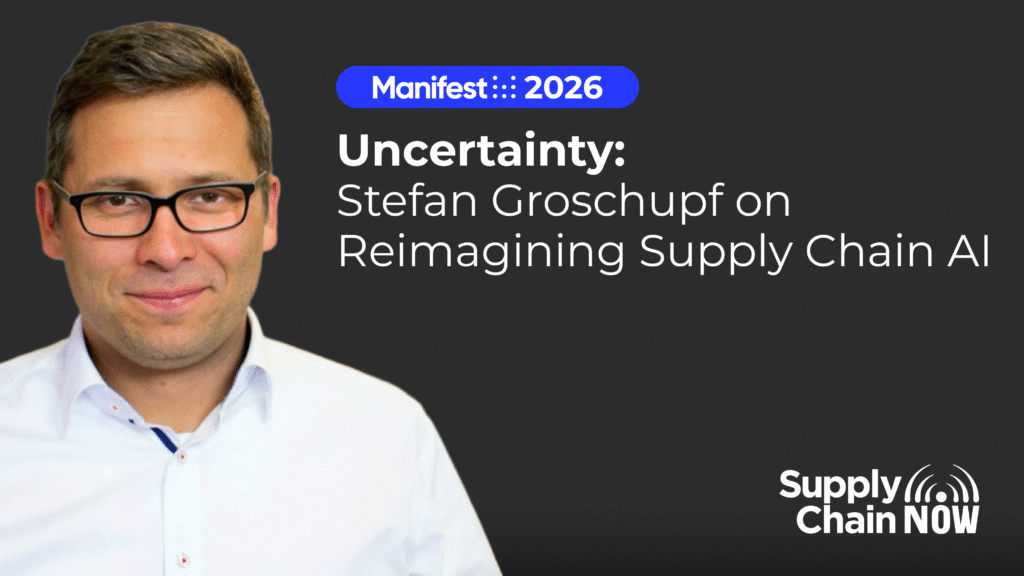
Building for Uncertainty: Stefan Groschupf on Reimagining Supply Chain AI at Manifest 2026
A Legacy Behind the Mission At Manifest 2026 in Las Vegas, Scott Luton sat down with Stefan Groschupf, CEO & Founder of Centrum AI, to discuss how a new generation of technology is being purpose-built for today’s supply chain realities, rather than yesterday’s assumptions. What began with a lighthearted joke about multivitamins quickly turned personal. When Scott quipped that “Centrum” reminded him of a vitamin from the eighties and nineties, Stefan shared the real inspiration behind the name. “My dad… the biggest building he constructed was called Centrum,” he explained. “That was the inspiration. His legacy, a head nod to him.” For Stefan, the company name represents more than branding; it reflects a mission rooted in impact and responsibility. Designing for Today’s Reality “We’re building a new tech platform for the supply chain industry that is really built on the foundation of the reality today,” Stefan said. That reality includes uncertainty, dirty data, data silos, and geopolitical shifts that are reshaping global trade. He offered a simple example: in many ERP systems, a lead time is entered as a fixed number — say 15 days. “That’s of course nonsense,” Stefan noted. “It’s anywhere between nine days and 18 days……