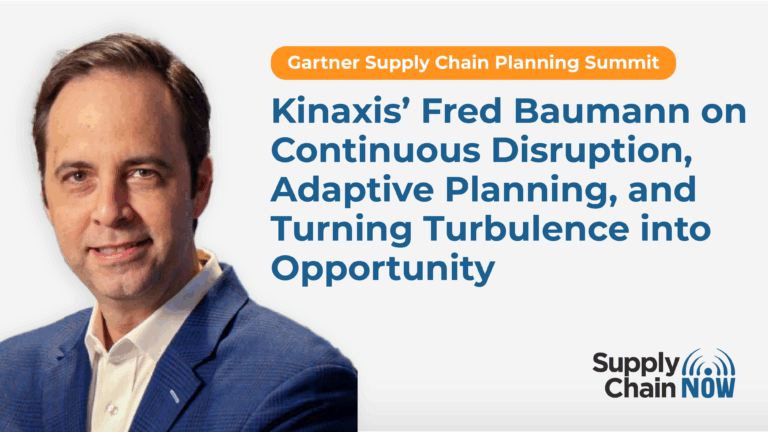

Kinaxis’ Fred Baumann on Continuous Disruption, Adaptive Planning, and Turning Turbulence into Opportunity
At the 2025 Gartner Supply Chain Planning Summit in Denver, Scott Luton sat down with Fred Baumann, Senior Industry Principal at Kinaxis, one of the world’s most recognized leaders in supply chain planning and orchestration. Kinaxis has spent over four decades shaping the planning landscape and has been named to the Gartner Leaders Quadrant an extraordinary 11 consecutive times—a testament to its execution strength and long-term vision.
Baumann’s role at Kinaxis centers on helping chief supply chain officers and senior leaders shape their strategic transformation roadmaps, quantify value, and build the business cases necessary to achieve breakthrough outcomes.
From Episodic Disruptions to Continuous Turbulence
When asked about old and new challenges facing supply chain planning teams, Baumann observed a major shift: disruption is no longer episodic—it’s continuous. Historically, companies faced major disruptions every few years. Today, volatility and constraint-related challenges—whether driven by tariffs, sourcing changes, geopolitical shifts, or supply shortages—are unfolding weekly or even daily.
This environment demands a new way of working. The speed of global business is accelerating, and uncertainty is at historic highs. As Baumann noted, organizations must now adjust their supply chains “much faster than they had to even last year.”
The shift isn’t only about resilience. It’s also about opportunity.
Most companies view turbulence as something to recover from. Baumann argues that leaders should instead ask: How can we convert this disruption into competitive advantage? Those who capitalize on volatility faster than their peers—whether by securing constrained commodities, shifting production, or adjusting supply strategies—stand to gain market share.
In other words, supply chains must now be designed not just to withstand shocks, but to adapt and win.
Agentic AI: The Most Exciting Breakthrough
When Luton asked what excites him most about Kinaxis’ current innovations, Baumann didn’t hesitate: agentic AI.
While AI is the industry’s most popular buzzword, Baumann sees genuine, transformative value in agent-based intelligence embedded within planning systems. He explained that agentic AI can:
- Automate menial and repetitive planning tasks
- Evaluate risks and mitigation options autonomously
- Generate multiple scenarios and recommendations in real time
- Enable planners to shift from manual firefighting to strategic decision-making
Most importantly, Baumann emphasized that autonomous supply chain capabilities are not about replacing humans—they are about removing latency. Faster insights lead to faster actions, which lead to faster competitive advantage.
This is the foundation of what Kinaxis calls Adaptive Planning—an always-on, always-adjusting approach to matching continuous disruption with continuous alignment.
“Adaptability is the new resilience,” Baumann said. “It’s not just responding—it’s responding and capturing opportunity at the same time.”
Where to Learn More
Baumann invites leaders to connect with him on LinkedIn and explore the thought leadership, white papers, and innovations shared by the Kinaxis team via the company website. Check out a 2025 webinar on Supply Chain Now featuring Fred Baumann & a panel of industry leaders, focused on the topic of “Breaking Through the Chaos: Supply Chain Maturity in an Age of Economic Volatility”: click here.
We also invite you to listen to the full audio version of this interview with Scott W. Luton and Fred Baumann: click here.
More Blogs

Collaboration That Actually Pays Off