Intro/Outro (00:02):
Welcome to Logistics With Purpose, presented by Vector Global Logistics in partnership with Supply Chain Now. We spotlight and celebrate organizations who are dedicated to creating a positive impact. Join us for this behind the scenes glimpse of the origin stories, change making progress and future plans of organizations who are actively making a difference. Our goal isn’t just to entertain you, but to inspire you to go out and change the world. And now here’s today’s episode of Logistics with Purpose.
Enrique Alvarez (00:35):
Good day and welcome to another exciting episode of Logistics with Purpose. My name is Enrique Alvarez, co-founder and managing director of Vector Global Logistics. And as always, I have my fearless co-host here with me, Kristi. Kristi, how are you doing today?
Kristi Porter (00:48):
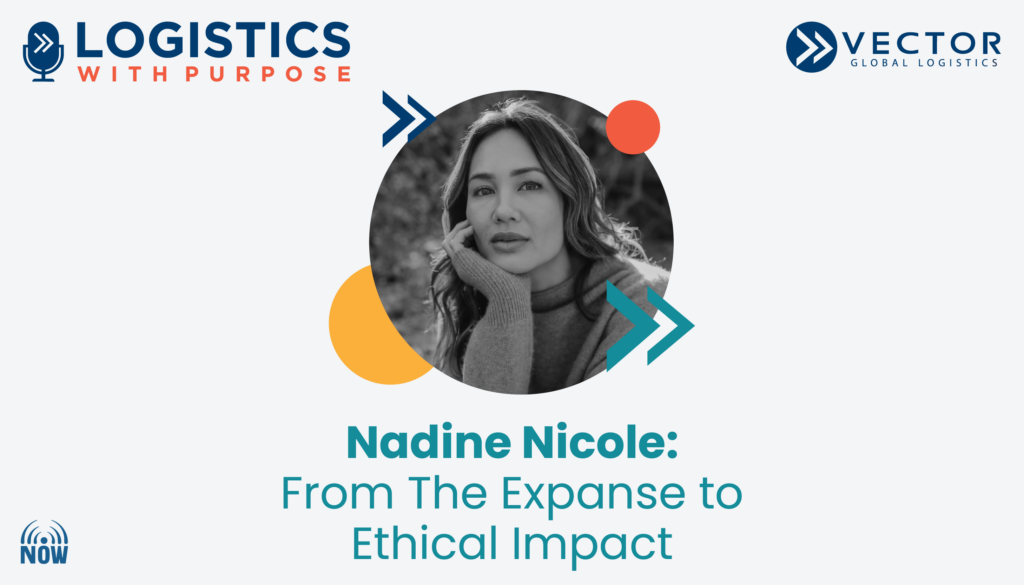
I am good. We’ve been anticipating this conversation for a while now, so I’m delighted it’s coming to fruition. It’s going to be an exciting conversation, a wide ranging conversation. As with all of our guests, we think they do one thing and then we learn so much about them in the process. And so we have another one for everyone today. And I’m excited to introduce everybody to my friend, Nadine, who has become a friend over the past year. So Nadine Nicole Hyman, she is an actress, entrepreneur, and impact-driven leader. If you know her from the Expanse playing Clarissa Mao, which is how I was first exposed to her, she was an actress on The Young and the Restless, other major television productions. But beyond all that, she’s the founder of True Connection, a nonprofit that uses healing arts to support young people. We will learn so much more about that.
(01:36):
An advisor for Space for Humanity, which is an amazing organization. Go back and listen to that episode. And then most importantly and most recently, the founder of Yari Designs, an ethical jewelry brand celebrating diversity and empowerment, which is a really cool mission. There’s a lot to learn about starting your own jewelry line, which she will definitely let us know more about. But Nadine, thanks so much for your time. Thanks for being here. I’m so glad to see you.
Nadine Nicole Heimann (02:01):
Thanks for having me, you guys. I’m really excited to have this conversation and see where it takes us. There’s a lot to cover. So yeah, I’m excited for our guests to tag along.
Kristi Porter (02:11):
Yes. Thank you so much for rolling the punches with us. And so first of all, before we jump into your amazing career and your incredible projects, I’m going to ask you some quick questions, just respond with the first thing that comes to mind, all right? All right. So what is one thing you can’t live without? One thing I can all
Nadine Nicole Heimann (02:28):
Live without is my yoga mat. First thing in the morning with it, I have had a lot of injuries and my nickname when I was growing up used to be extreme Nadine. I would just lime up anything and jump off whatever. And when we were growing up, we had a boat and we would go skiing and tubing. And so we made up Mortal Kombat tubing where I kind of made up mortal combat tubing where you would try and knock the other person off the other tube and just life. I’ve had a lot of injuries and played hard and done a lot of sports. I’m still very athletic and like to be in my body a lot. But I kind of wish someone would’ve told me when I was younger, “Be very gentle to your body. It’s going to start giving out on you. ” So I need my yoga mat with my roller every morning to stretch for, got a good half hour to keep my body functioning.
(03:23):
That’s
Kristi Porter (03:23):
Awesome. So you were doing your stunts, your own stunts long before you became an actress. What is your favorite hobby? I know you have a lot of things going on, but what is your favorite?
Nadine Nicole Heimann (03:32):
My favorite hobby, I mean, I love hiking. I go hiking with my dog all the time, pretty much being in nature and being in my body and then being kind of in a meditation place in the present moment with my significant other. Yeah. And what is one thing you do to stay productive? I start really early in the morning. I like to get my kind of big tasks or the tasks that I’m anticipating that are going to be kind of heavy lifters. I like to take care of those at 50 AM. Or 6:00 AM or 7:00 AM. So by the time 9:00 or 10:00 AM rolls around, I’m like, I’ve had a fairly productive day. I can get onto smaller stuff or go for a hike and then have another afternoon session. But I like to get up early, have my morning stretch, get a couple big tasks done really early, and then I feel good throughout the day.
(04:26):
And then I can take breaks, I can work out, I can meditate and walk. Another thing is I use a standing desk when my body is starting to feel like I’ve been sitting too much at the desk or computer and I walk around my apartment while I come back to my standing desks just thinking, walking and breaks. That is an excellent habit.
Kristi Porter (04:46):
Yeah. What a great habit. You’re even more my hero now as I struggle to pull myself out of bed by eight or nine. What is
Nadine Nicole Heimann (04:54):
Your favorite bet? When I was little, it was the BFG forever. I absolutely loved The Big Friendly Giant. I thought it was so mystical. And I just imagined being, was her names like Sophia, Sophia. Little pocket while he’s striding over islands and going across continents. I was like, “That would be so much fun just for with a big giant that can go really fast, really far.” But as an adult, I think my favorite book is West With the Knight by Beryl Markham. She is an incredible author. Her prose will make you cry. She’s such a good writer. And this book is about her growing up in South Africa and her father basically telling the land there and her having to deal with animals, lions, herds as a young girl just running around in the desert and then her being one of the first aviators to be able to track migrations when they started testing that.
(05:50):
It’s just a really incredible book. Well, thank you for
Kristi Porter (05:53):
The recommendation.
Enrique Alvarez (05:54):
Yeah, that sounds very exciting. Very much in line with the action in you. And it sounds like a really good book that will definitely put the link to in the podcast. As an actress, of course, you’ve always asked to be someone else. You’re always portraying someone else. But as we will discuss in more detail later on, your nonprofit and of course your new company are probably all about you being authentic to yourself. So whether you’re applying a hero or a villain, what aspects of yourself always seem to show up or you’re done sometimes because you’re that good?
Nadine Nicole Heimann (06:26):
I think the parts of me that are always showing up in my work in acting specifically are very common to all humans. And that’s why we can take on these other roles and try and sit with them and live in them is because we all have certain needs and desires. It’s very basic when you start really going for what does this character need and what is it bringing out of me? And it usually comes down to whether you’re a villain or a hero, you’re needing love or support or to belong or to be seen and heard. And I think that’s one of my, personally, my biggest needs is to feel seen and heard just from the trajectory of my life and circumstances and how I’ve grown to become. That’s one of my biggest needs is to be seen and heard. And I think it’s so human.
(07:17):
A lot of people can empathize with that. And that’s pretty much in every character you’re going to find is that they have a sense of belonging or a need to be loved or supported.
Enrique Alvarez (07:26):
It feels sometimes, especially these days that we tend to forget, but that is the truth. If we were to just really just understand or remember, because we all know this as you pointed out, but I think there will be a lot easier and better to get along and communicate and there wouldn’t be so much division between people. Good. Yeah, thanks for sharing that.
Kristi Porter (07:46):
Yeah, thank you. Yeah. So before we jump into the projects that you’re working on right now, tell us a little bit more about your background, where you grew up, what life was like, besides all the jumping and mortal combat and just like Brad, yes.
Nadine Nicole Heimann (08:00):
So that’s part of it. So I grew up in a little town called Rochester Hills, Michigan. I was actually voted the ninth best little town to small town to grow up in the United States twice recently in 2025 and then another time, I think in the ’90s or something like that. So it’s a small town, but it’s suburbia and I would always call it kind of like white suburbia. I kind of grew up at Twinkie. I don’t know if a lot of people know what that means, but it has a lot of community. Everyone kind of knows each other, says hi in the streets. It was just really kind of an ideal way to grow up, I think. We were a very active family. My dad is third generation here from Germany, and my mom is first generation here from the Philippines. And they met in California and moved back here to Michigan where my father grew up.
(08:56):
And we grew up a very active family. My parents were jewelers. They started with the bead store and turned it into a fine jewelry store that they co-owned for over 44 years. We grew up with lake life, like I said, tubing and skiing and had a little cabin up north where Michigan doesn’t have big mountains, but little hills, so we would go snowboarding a lot. I was always in a sport, basketball, volleyball, softball, track. I grew up doing martial arts TaeKwonDo and kickboxing. So we were always kind of having fun, exploring together, doing a lot of road trips. My dad loved to adventure, go to amusement parks, things like that. So we had a pretty active upbringing.
Enrique Alvarez (09:42):
Well, looking back to that early part of your life and your parents and family, and is there any kind of particular story that you remember that kind of shaped who you are now and what you do?
Nadine Nicole Heimann (09:53):
Well, going back to those sports that I played a lot of when I was younger, one of them was actually wrestling. And it’s because I didn’t make the volleyball team in sixth grade in middle school. And I was like, “Oh my God, I didn’t make the team. This is crazy to me. And what am I going to do with my time now after school?” And so I was like, “I guess I’ll go try out on the wrestling team.” And there was no girls on the wrestling team. It was all boys, but my boyfriend in sixth grade at the time was on it. He’s like, “Why don’t you just come practice wrestling?” Why not? I ended up being the only girl on the wrestling team in sixth grade. And it was really interesting to see the reactions from the challengers that we would take on. People, especially the parents, would be very upset that their boy had to wrestle a girl.
(10:44):
And I totally empathize that losing to a girl at that age was hard. It was emotional for a lot of guys. And then for them, it was kind of a lose situation because they were taught not to beat up on girls, but then they didn’t want to lose to a girl either. It was interesting just to see that go down. But what I really appreciated from just learning about these challenging situations was that my father would show up at every match and get down by the court with my coach and coach with him and cheer me on. Even with other parents being like, “That’s not right,” or, “That’s not okay,” or people being mad at me for being the only girl on the team. My dad was so supportive and I went on to get second in the city. I was really good. I could throw my weight around and I just felt really supported.
(11:38):
I felt like I could do anything I wanted to. And that’s kind of how my parents raised me. I was like, “You will be able to do anything you want to do. As long as you put your mind to it and you work hard, you can do whatever you want. ” And I’ve always kind of had that mindset. That’s kind of what created me is that, “Oh, well, I can carve any path. I don’t have to take someone else’s path that they’ve chosen for me. I can always create my own and I’ll feel supported.” And I think that’s a really special thing that they have. It’s not like they were typical … They have high expectations. My mother is typical Asian immigrants, but it wasn’t like, “You must become a nurse or a doctor or a lawyer.” It was like, “We believe in you for whatever you want to begin.”
Enrique Alvarez (12:19):
That’s amazing. Yeah. Very supportive, right? Yeah, especially for your dad.
Kristi Porter (12:24):
I feel like your next fun fact for Two Truths and Alive will be the fact that you were on a wrestling team and played and matches in one trophies. Yeah, that’s incredible. I love that. Well, let’s talk a little bit about your career. It’s been fantastic. As I said in the intro, I first saw your name and knew your face from watching the expanse on, well, first sci-fi network, then Prime. If you love space, then check that out. It’s fantastic. You played Clarissa Mao who probably had the biggest change of heart and personal arc in that show. So you did an amazing job on that. But we talked a little bit about human emotion and understanding a minute ago, but just being in the industry, how has acting shaped the way you understand people and emotion and just what it means to be human?
Nadine Nicole Heimann (13:14):
I think going back to what we were touching on a little bit ago about everyone having their own needs of whatever that is, basic human needs, understanding that it makes it a lot easier to forgive people who not even really care to fully have to understand everybody and their choices, whether it’s not aligning with you or me, or I’m not understanding someone’s choices or I don’t agree, or maybe it’s triggering to me, or maybe I feel like it’s wrong, that there’s always a history there of their own needs and wants of certain kinds of belonging and being seen. And that we’ll never fully understand that, but we each have our own to a very deep level. And so I think that that’s kind of helped me empathize with other humans and just trying to create … For acting, you need a lot of self-awareness to be able to have mastery over your body, over your voice, over your physicality, over your choices.
(14:21):
And if you don’t have a lot of self-awareness, it’s hard to be able to do a lot of different things or have a lot of range or create different kinds of characters or go different places. And so I think some of us have really worked on being aware of our own patterns and our own needs, and some of us haven’t really reflected on it as much as we could. Or maybe that’s one of the things is we don’t go there for certain reasons, self-preservation or protection, but growth comes in so many different forms and it happens on a different timeline for everybody. And so I think that’s what it’s taught me is try and to lessen my expectations of others and to allow them be on their own journey.
Kristi Porter (15:05):
I love that. We need more of that. It sounds like a lot of emotional learning and emotional intelligence as well. Very cool. Well, you’ve also been led through your career to Space for Humanity, which is where we met. You were already advising and part of their circle before I was incredible group who is trying to democratize space travel, which is just the coolest mission in the world. So how did you become involved in their mission and what have they taught you in the process of just being around that circle of incredible people?
Nadine Nicole Heimann (15:37):
Such a special community, and I’m so grateful to have met you on there. They are so special to my heart. And I found them because someone asked me to speak at Yuri’s night during COVID, because Yuri’s night’s a really special event for space community, and they would gather at the Southern California’s Space Center and different cities all over the world. They’ll have these Yuri’s night events. But during COVID, it had to be online. So as a guest, they’re like, “Will you come on Zoom and talk with us as a guest with Chatham who played Amos in the Expanse?” And we had a great dialogue with George and Loretta Whitesides, George is the ex- CEO of Virgin Galactic and Loretta, his wife, does SpaceKind and throws Yuri’s night. So dialoguing with them, I spoke a little bit about my nonprofit, True Connection, and we connected on that.
(16:32):
And so Rachel, who was CEO of Space for Humanity at the time, was watching the Yuri’s night and was like, “Oh, okay, that might be a good fit to come on to advise for Space for Humanity.” And I was just so grateful and honored and surprised. I was invited to be part of this community, but I really appreciate their inspiration and their inclusivity to see them bring in women of all backgrounds from all over the world and help their dreams just manifest in ways that are beyond my comprehension to create vast ripples of transformation and change for STEM and for women in general across the planet has been ineffable to
Kristi Porter (17:19):
Witness. Fantastic. Yeah. Incredible organization, incredible people behind it. And I know you love space just as a person and outside of the roles you’ve played and it’s just a personal and fun interest. And Enrique and I love talking about space and yeah, it just feels like there’s no limitation and they are certainly a group that epitomizes that.
Enrique Alvarez (17:37):
Absolutely. And I think it’s exciting and intriguing and inspiring at the same time. So that sounds like a really, really good organization. And of course, we’ll put the link so that everyone else that’s listening to the podcast can learn a little bit more about what the organization’s about. And as we mentioned, and this is very evident to me, even after a few minutes talking to you, Nadine, that connection for you is very important, right? You are someone that really comes across as a very connected individual and you feel like empathy is important and making sure that you’re respectful to everyone. And so you found it in 2012, the non-for-profit called True Connection. The organization, of course, fosters deeper sense of interconnectedness with ourselves, one another, the planet. But tell us first and foremost, what is True Connection to you? What is its core and what inspire you to build this organization?
Nadine Nicole Heimann (18:29):
True Connection isn’t so much just an organization, actually, your typical C3 organization. It’s more of an expression of my healing journey than anything. I started it in 2012 because a few years before that, I’d had an epiphany about my needs and my own healing journey, the climax of it or the beginning of it. And I realized that I needed help. And after going through a trajectory of self-awareness and healing, I wanted to be able to share that with other kids. And so I basically emailed a lot of different orphanages around Africa, seeing if I could bring art and volunteers for lessons and healing and trauma. And I met this really incredible woman who had an orphanage in Sierra Leone, and she took me under her wing and was like, “Come out here. You can take over the school. We have … ” I don’t even know, it was an entire orphanage and it was enclosed with tall, thick cement walls and barbed wire at the top, almost looking kind of like a prison just because Sierra Leone has had a lot of turmoil and they wanted to make sure that the kids were safe and they lived there until they were 18 and could leave.
(19:43):
So me and a girlfriend wrote a curriculum on trauma and healing, expressing it all through creative arts and journaling and meditation. And we took it to these kids out there and we had the most profound experience. There was just so much love and appreciation and educational knowledge and healing. These kids just soaked it right up. They were just so eager to learn and they were so grateful for this kind of education, which I think is a little bit different than here. They really soaked it in. And when we left everyone, everyone at the orphanage was at the gates just bawling, just crying like. It was just a really beautiful experience. We bonded so deeply and it took me two years to raise a little bit more money to go back and see them again and do it again. And at this point, some of the older kids were winning art competitions or submitted a book about their lives.
(20:40):
We had instilled in them a sense of self-expression that built confidence. And we were doing photography with them. We got them a bunch of little cameras so they could learn perspective. It was just a beautiful experience. And I was like, “This is a lot of time, money, and management to go to Africa for a few weeks and once a year.That’s not sustainable.” I was like, “If I want to continue this work, I need to do it locally.” And so that’s when I decided to do this in LA and just refine the curriculums. I moved into the social emotional learning world with some educators and we got into a bunch of different schools and after school programs, we started working with the Los Angeles Police Department and then COVID hit. So we’ve been on pause since then. First of all, it was a really intensive love for me.
(21:33):
I put all of my money into it, all of my time, all of my energy, which I absolutely loved. And it was a deep part of my healing journey, so I needed it. But I was also on the verge of burnout all the time and I wasn’t giving myself to the other places in my life that I needed to grow more. And so I’m pulling that back up, but it’s in a different way now. We’re doing education online. We’re going to do a journal that is about rewriting your narratives and you’re limiting self-beliefs for adults in general with guided meditation. So we’re going to build out more of a digital online platform is the goal now. That’s amazing.
Kristi Porter (22:12):
Incredible job. Congratulations.
Enrique Alvarez (22:14):
Well, not only that, but I think it’s also very brave of you, right? Because one, you’re sharing this and those were, I’m sure, very challenging times for you. And as you were healing, you not only tried to heal yourself, but then you saw that there was a need for other people that were probably dealing with the same thing. And by the way, you were struggling and dealing with PTSD, correct?
Nadine Nicole Heimann (22:35):
Yes.
Enrique Alvarez (22:35):
And panic disorder. So my question would be, well, first, once again, very brave and it’s great that you’re so vulnerable, so we appreciate you sharing this with us. For people that are listening that might be facing similar situations or think that they might, what was one or two pieces of advice that you would give them now so that they can manage and heal the way you did?
Nadine Nicole Heimann (22:56):
I would say my adverse childhood experience that kind of affected me in this way, I was about six years old and I didn’t see the complex developmental trauma symptoms until they weren’t kind of full-fledged happening till I was 13, but at this time I still had no clue of what it was. I was just existing with it. I didn’t have the light bulb until I was about 26 years old, and that’s when I started the organization. It was like when I had this awareness that I needed help. So my biggest piece of advice to anyone struggling with post-traumatic stress disorder or regulation, emotional regulation issues that are very challenging, safety issues that are very challenging, feeling safe in your own body, is that rewiring is possible and to take it very seriously and commit your life to it and it can happen a lot faster.
(23:54):
I think I had different forms of escapism mixed in with my healing journey, which a lot of us do. But I think that if I would’ve committed to it, it wouldn’t have taken as long as it did, which took over 10 years. I would say about seven to eight years in of intensive healing, of being very self-aware about it and taking a lot of different healing modalities. About six to seven years in it, I was still having the same exact symptoms and I was scared. I was like, “Oh, maybe this is just the way I’m wired for life. Maybe this is never going to change.” It wasn’t until about eight or nine years that it really started changing. And then now, God, I don’t know, it’s been like 15 years. I feel like you’re average stressed out human that emotional regulation daily and seriously and take self-care and to high consideration.
(24:49):
But I did rewire my brain and I did come full circle coming out of a place where I was very segmented. I was very dissociated a lot of the times, especially in triggered situations, and I’ve come into a place of wholeness. That doesn’t mean that I never dissociate or I never get triggered. It just means that I am very highly aware of when that happens and I know how to deal with it now and take care of it. And it happens a lot less often, and I can operate and function in a much more healthy, joyful, stable, balanced life. And that was a really big ask before. It was a really tall ask that I didn’t know if it was possible. And it is, it’s possible. And rewiring can take 10 years or shorter if you’re really committed and know how to meditate and regulate and find those healing modalities that work for you, but it’s possible and that you deserve it.
(25:49):
And there’s a lot of different modalities out there, including psilocybin and meditation or breathwork, or there’s lots of different things at homework and it enhanced that process now. So that would be my biggest takeaway for-
Enrique Alvarez (26:02):
Thank you. No, thank you so much. And for all the listeners that are going through this, know that you guys are not alone. You’re not the only ones that are going through this. There’s a lot of things you can do. And self-awareness, as Nadine said, connectivity is important and rewiring as possible. So no, thank you. Thank you so much. That’s very important. Thanks.
Kristi Porter (26:22):
Yeah. And just pointing out that everyone is worthy of it as well. Thank you for that as well. And thanks for your vulnerability and authenticity. And you put a lot of care and heart and creativity in everything you do, and that’s certainly evident, including with your new project, which I just love so much. And I’m excited to talk more about it. And it’s a completely different direction. It carries a lot of these same themes, but in new packaging. And so I think it’s really cool the way you’ve kind of evolved all your loves and are now working on Yari Designs, which is jewelry. So we’ve heard a little bit about your parents’ background, but why did you decide to pursue a jewelry line and what is the story behind it?
Nadine Nicole Heimann (27:04):
Well, it’s been a dream for a long time. Ever since I was little, since I grew up, my parents had a jewelry store and I would work there during the Christmas season being their rapper. I would rap kids and then just run around the store and try in all the wedding rings and be like, “I think I want this one.” Still not married, but just picking up money- But you knew what you want. No, I just always remember feeling so proud of my parents from them being entrepreneurs and building their own small business. And I wanted to take that and kind of run with it at some point. I knew I wanted to do a jewelry line at some point. My mom was a designer and she’s really good at drawing. She’s very talented at it. And my dad also was a drawing engineer in the Navy so he could draw as well.
(27:51):
So I get my artistic capabilities from them. And also, yeah, I’ve just learned so much from them and they’re my partners in it. And so it keeps us closer and working together and I just can keep learning from them, which has been really fun. And we can do something creative together and business oriented together. And I wanted also to do something that was about women and empowering women. So I want to be able to highlight influential women. So I’m starting to get those stories together now, but I would love to tell diverse women’s stories that are creating ripples and making impact in this world in all of their own different creative ways. I think it’s such an interesting time about how we see influencers and how social media is taking over. So just to have a place where girls, women, or people in general can go and read about women that are really trailblazing, really creating transformative impact that are transformative leaders and seeing that as power and beauty.
Kristi Porter (28:58):
And tell us just about the jewelry. You also have, I mean, people can go there and read inspirational story while buying gorgeous jewelry. So you have also been very meticulous about your standards, what you want it to be, the design of it, how it’s all put together. So let’s dive a little bit into that and people can go to … It’s Y-A-R-I, Yari Designs. So I encourage you to do that. It’s beautiful. But yeah, I know you have very high standards for it and it shows. So
Nadine Nicole Heimann (29:24):
Tell us about that. Perfectionist. So it’s elevated every day wear that we just slaved over the proportions and the measurements to make sure everything’s durable. We have our own custom clutches. The backings to the ears are thick and durable and handmade. So every little thing kind of feels high quality and it’s recycled gold, which is really important to us because we don’t want to be part of the mining problem. We want it to use only things that are recycled. And gold is just appreciating like crazy. It It’s going off on its own thing. And I think that they’re going to start creating new metals would be my guess eventually. And then we use sustainably created diamonds as well, the highest tier of that. So they’re luxury items, but I have a lot of thought behind them in their design and where they come from. And they’re classy and edgy, but also refined and minimalist.
(30:24):
I love minimalism. So all of these aspects of me are in the designs and I’ve been getting great feedback from them. I absolutely love them. They’re fun, but I do want to create a sustainable luxury brand. And so these are the intro collections for Elevated Everyday Wear.
Enrique Alvarez (30:41):
Well, congratulations. It’s kind of almost full circle to your parents and I’m sure they’re very proud of you for being an entrepreneur as well and actually accomplishing what you have accomplished. And I’m sure Yadi is going to be incredibly successful. You briefly mentioned how important it is to you, the ethical sourcing. You mentioned recycled gold and sustainably sourced diamonds. And so you must have learned a lot of things that you didn’t know before, like supply chain and logistics. Has any of that surprised you? I mean, what was your initial reaction to being exposed to the worldwide supply chains?
Nadine Nicole Heimann (31:16):
Every step has surprised me. I think it’s more of a general knowledge and knowing that building your own business is extremely challenging and no one would, especially product development and no one would ever know until you start doing it and you’re like, oh, well, there’s an obstacle and there’s an obstacle and there’s an obstacle and another obstacle. And you don’t know that these obstacles are going to come until you’re in it. Yeah. Sourcing with prices, having anything sustainable has a price tag to it. So trying to be competitive and ethical at the same time is extremely challenging. And then also just being able to communicate with different people over the world because jewelry, gold, gems, vendors, everything is sourced from everywhere. They might source it in Tanzanian, then it goes to London and then it gets manufactured in New York. And there’s all of these different bottlenecks and it’s just very global.
(32:11):
So when the tariff started happening, that adds another level of challenges, tons of different bottlenecks. But I think sticking to what you initially set out to when you learn all of this is one of the hardest things. And it’s why it’s also just taken so long to be able to find someone that can create the CAD designs the way that I want them and will work with me on this fine tuning and then actually want this two millimeters changed and actually want this changed. So most manufacturers are like, “You’re done.” I’m dropping you after like, “I just want to make this little tweak.” And they’re like- It sounds
Enrique Alvarez (32:47):
You’re hands-on, right? Very hands-on in the product.
Nadine Nicole Heimann (32:49):
Very
Enrique Alvarez (32:50):
Special for you.
Nadine Nicole Heimann (32:51):
The designs are unique as hope to. The earring jacket collections are something that’s totally unique and new, and no one knew how to make them. Most manufacturers were like, “No,” without even trying, they were like, “That’s a lot of labor. It’s a lot of just unique have to … We don’t know how to do that.
Enrique Alvarez (33:08):
” Well, and if you extrapolate this a couple years into the future, what is your ultimate goal for Yari and what impact do you want it to have in the long-
Nadine Nicole Heimann (33:17):
I would say it’s probably going to take a couple years to build the business and get the awareness out there and get some influencers on that are aligned with our values and just our brand. And I would love to be a sustainable luxury brand that is role modeling influential women, a diverse women, women of color, women having their own businesses, highlighting influential women and just a place where girls can see elegance and power and juicy expressiveness in a place that is rooted in its values and its ethics and its morals and really sticks to them and highlights really beautiful, influential women. And just to see that as something worth aspiring to is something that should be our future, that we should be mindful about what we’re buying, how we’re making it, slow design process, low manufacturing numbers so that we’re not just throwing tons of scraps and waste away in fast fashion.
(34:26):
And then just seeing what- Congratulations. … beautiful women that support each other kind of feels like. Yeah.
Enrique Alvarez (34:32):
Congratulations. I’m sure a lot of business owners out there are going to learn a lot from what you just said and definitely inspired hopefully not only people in the supply chain, but around the world and definitely potential customers down the road too. So congratulations again.
Kristi Porter (34:49):
Thank you. Thank you. Yeah, it’s a beautiful mission. And as we have heard, you have a can- do, determined spirit that has been long instilled in you. So I know it will be a huge success. So as we kind of look into wrapping up here, I guess I’ll ask you again for another bit of a reflection. I love hearing you speak in this way. And I know that it’s very central to who you are as well. So I guess when you think about your acting career and space for humanity and True Connection and Yari, how do all these connect for you? Do you have a sense of the purpose that you bring to these projects into your life? What kind of shows up for you? What themes?
Nadine Nicole Heimann (35:29):
I think going back full circle to how I was supported by my parents at the beginning of carving your own path. I try and find purpose and intention in all that I do even when I’m washing the dishes or vacuuming or working out, how do I want to feel while doing that and how much presence can I bring to that moment? But with all of these projects, I think that that’s just an extension of that is living in my ever-changing purpose and trying to learn, explore, express, connect, and to keep carving out my own path. And hopefully while doing that, having fun, bringing more joy and health and balance into my and others’ lives. And then hopefully lifting people up, giving them opportunities to learn more about social emotional learning or women’s issues or women empowerment or our stories. And then just bringing people together and having a little bit more sense of compassion and kindness within our communities.
Kristi Porter (36:36):
I love it. It’s a beautiful expression. Perfectly sums up who you are and who I’ve gotten to know over the past year. And I look forward to seeing what’s next, which speaking of, if you could tell our audience a little bit more about what’s coming up for you personally, professionally, what are some of your plans and what can we expect?
Nadine Nicole Heimann (36:55):
Well, I’m just recording the last guided meditations for the True Connection Journal that myself and a colleague wrote. It’s called The Centered Self: A Journal and Guide to Rewriting Your Life’s Narrative. So that will be coming out as a physical journal and an audiobook. And you can actually use them together and it’ll come with guided meditations and journaling work and self-discovery exercises to use during the week. So that’s coming up soon. I’m trying to self-publish that. We’re trying to self-publish that within the next couple months. So I’m gunning for that. And I have, I don’t know, about 30 more pieces designs that I’m photographing to put up on the jewelry line. So still building that out. We’re still in build mode very much for Yari design. So support on all of these endeavors and creative projects is always appreciated. And then just trying to support all the projects around me with Space for Humanity and any other projects and advocating for sustainability and all of these passions.
(37:59):
Nothing else is coming out right this minute.
Enrique Alvarez (38:02):
It sounds like that’s a lot. That sounds like a lot. That sounds like a lot. But no, Nadine, thank you so much as we’re wrapping up this interview with you. I just want to say it’s been a pleasure interviewing you. We wish you the very best. It sounds like you are force of nature and nothing’s really going to stop you from the goals that you have set for yourselves. So congratulations. We need definitely a lot more people like you that think connection is important in this world. And just tell us, where could our listeners connect with you and learn more about your work from the True Connection to Yard Designs and all the other initiatives that you’re currently leading?
Nadine Nicole Heimann (38:37):
Well, True Connection is true-connection.org. So T-R-U-E-connection.org and yaridesigns.com, Y-A-R-I-D-E-S-I-G-N-S.com. And then I’m on Instagram as Nadine Nicole.
Enrique Alvarez (38:56):
Thank you so much. Count with our full support, and of course we’re big fans of yours. Thank you.
Kristi Porter (39:01):
Yes. Thanks so much for your time. Yeah, it’s been great. I’m so glad to chat with you. I’m so glad we were able to make this happen. I know our listeners enjoyed it. I loved getting to know you in a new way. And I just keep thinking of little Nadine on the wrestling team. That has just totally stuck with me. I love it so much. Thank you so much for your time and you would just show up yours yourself and I love that about you and thank you for that. And we, of course, thank our listeners. Thanks for tuning in. If you enjoyed this episode, then guess what? We’ll have another amazing episode in two weeks. So we hope you’ll join us then on Logistics With Purpose, the only podcast focused on supply chain’s positive impact. So we’ll see you soon. Thanks and bye.