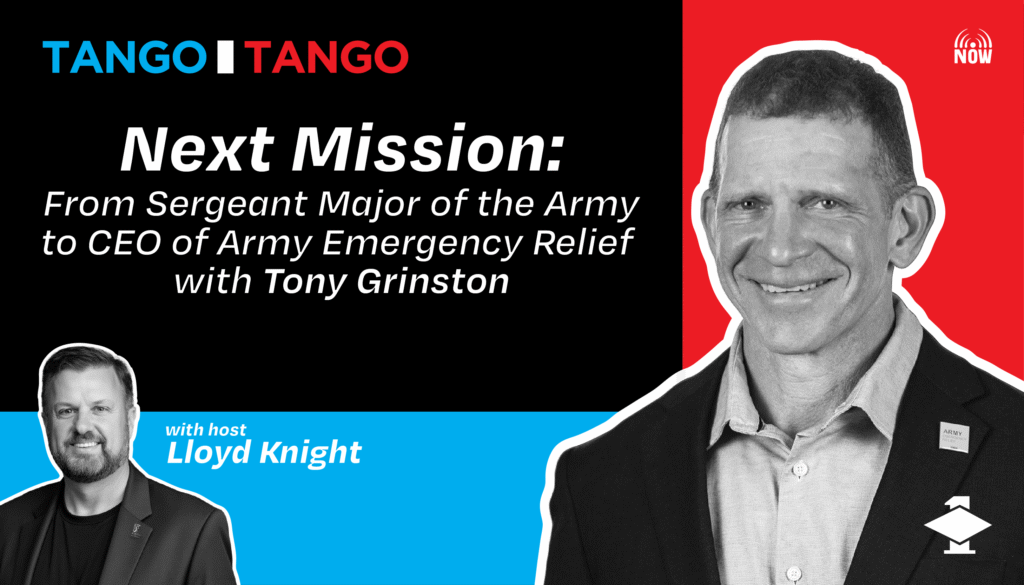
[00:00:00] Tony Grinston: The world’s gonna be a place if you just don’t care who gets the credit. You know, do what you think is right to make people’s lives better. I can’t ever prove that’s, you know, I did that.
[00:00:10] Tony Grinston: I can tell you what I did to. To get the suicide rate lower. everybody takes credit. Nobody knows who really did it. but I still think I was on the right path.
[00:00:33] Lloyd Knight: Welcome to the Tango Tango Podcast. As the recording said, I’m your host Lloyd Knight. And Tango Tango is all about real conversations, uh, directly from a retired first sergeant. And I am always, I’m always super pumped to do this. I love this love Tango Tango. But today we have, and I say this all the time, but we have an amazing, guest.
[00:00:56] Lloyd Knight: We have retired Sergeant Major of the Army, and CEO of Army Emergency Relief. Tony Grinston on Tango Tango. Welcome to the, uh, podcast, Tony.
[00:01:07] Tony Grinston: Yeah, Lloyd, thanks for having me. I’m really excited about the conversation.
[00:01:11] Lloyd Knight: So we’re excited about this conversation. We’re excited that you’re coming down. To Atlanta a couple times, uh, this month after our conversation. But you’re coming down for the next Vetlanta Summit on February 24th at Delta Airlines, and we’re really looking forward to the panel discussion we’re gonna have with you.
[00:01:31] Lloyd Knight: you’ve already had me once for a, uh. An interviewer. So I’m hooking you up with Zach Knight, a uh, army veteran and a board member of, of Vetlanta to talk with you. So that’s gonna be a great conversation. If you’re in Atlanta area, come see us. You can register vetlanta.org. So Tony live up in DC but where are you originally from?
[00:01:53] Tony Grinston: Yeah, I grew up in, uh, a small town called Jasper, Alabama. And the funny part was somebody one time said, when I got announced to be the star major of the army, it’s like, oh, we got somebody famous from Jasper, Alabama. So it’s a really small town. and then somebody goes, oh wait, there was this guy, I think it was Gober from like the Andy Griffith show.
[00:02:15] Tony Grinston: It’s actually from Jasper, Alabama. So, Andy Griffith, so, or the Sarm major army we’re world famous, man.
[00:02:22] Lloyd Knight: You probably have a great barbecue joint, um, in Jasper, I would imagine. So
[00:02:27] Tony Grinston: there might be one or two there. Yeah.
[00:02:29] Lloyd Knight: you’re, you’re not one of those world tide guys, are you?
[00:02:32] Tony Grinston: Roll tide. Yes, I am one of those. I I, I’m surprised they let me in Georgia every once in a while, but, uh,no, I’m a diehard Alabama fan. so we got a little work to do. So the beat down that we got from Indiana was. all true Alabama fans were like, I don’t know. I don’t know. This coach is gonna make it.
[00:02:49] Tony Grinston: It’s like, Hey, hey man, you gotta, you gotta win. We gotta win championship. but we had a good run at it. And Alabama has been, uh, a great team and I’m still extremely loyal. so yes. Roll
[00:03:00] Tony Grinston: Tide.
[00:03:01] Lloyd Knight: You do go dogs and you mostly have the dog’s number, but we get you every now and then. So the, uh, I think we get you sometimes when it matters, but, what were your interests when you were growing up in Jasper, Alabama?
[00:03:12] Tony Grinston: I don’t know if there was interest or work or what it was. , I grew up with, you know, brother, a sister, but it was a single mom. Household. we worked a lot, you know, we were kids, you know, you help mom and when, when you got older, you worked for your uncle.
[00:03:29] Tony Grinston: It’s like, I don’t remember a time where I didn’t work. but, you know, in the fun or interest outside of that, you know, clearly football, I love football, I love sports, I love being outside. If it’s football, basketball, anything competitive, I was like, and outside I was all in. you know, I think if I’d been a little tired, I, I kept playing football, but, uh, you know, five nine, I started off at left tackle, which is, you know, five nine is never gonna be a left tackle.
[00:03:54] Tony Grinston: what the problem was when I was a kid, I was super tall. you know, when you look at my elementary school pictures, like, here’s everybody and there’s me. The problem is I stayed here and they, they all went here. Uh, so,I love sports. I love being outside, enjoying, um, being.
[00:04:09] Tony Grinston: out in the nature I didn’t do a lot of hunting and fishing. Maybe that’s because, you know, my mom didn’t hunt or fish. I didn’t have any, you know, male role models or it doesn’t mean that women don’t hunt or fish. But, my mom was too busy just working. and there was nobody really to go, Hey, let’s go out and do this.
[00:04:24] Tony Grinston: But I was always outdoors doing something, exciting and fun and active and I still like to do that to this day. but growing up in Alabama though, it was kind of funny. There’s that. And I tell people this like, oh, is this really true? It’s actually really true. once we hit summer, we take our shirts off our shoes and we didn’t put ’em back on until we went back to school.
[00:04:44] Tony Grinston: So we’re very country is what we would say.
[00:04:49] Lloyd Knight: So no shirt, no shoes, no service is a real thing. So.
[00:04:54] Tony Grinston: Well, you know, I don’t, I don’t know if we had like a, a store like that in my, in my little area. We have woods. Uh, so, it would’ve took us a little while to get there. But yeah, it’s still a real thing, probably. I don’t know. I haven’t lived there in a long time. I’m sure my family walked around with shirts and shoes in the summer Now.
[00:05:11] Lloyd Knight: So, let me see. You have a strong work ethic. You love the outdoors, you like sports. So the, the army just seems like a, it was a natural fit for you. did you go right into the army after high school or did you, uh, pursue something else?
[00:05:26] Tony Grinston: Well, believe it or not, after you hear all that you think, you know, I did. but I didn’t. And I had a real passion to go to school. I guess because. Maybe I saw my mom’s struggle with what she’d done and she didn’t graduate high school. I’m pretty sure my grandmother didn’t graduate high school.
[00:05:43] Tony Grinston: So I said, first of all, I’m gonna graduate high school. But not only that, I wanna go to college and, from somebody that just said those would be outdoors and, and be out and very active. I was very adamant that I get my education says the guy who dropped out and, and joined the army. but That’s what happened. And I didn’t really drop out. I didn’t fail out. I just cashed out. So, I’d gotten, uh, scholarships to go, two years at a local college and two years at the University of Alabama. And when we say like, two truths and a lie, people would say, was that for running or sports?
[00:06:17] Tony Grinston: Actually it was for academics. and I went to Mississippi State where I didn’t have any scholarships and I was like, well, that was probably. When you look back it goes, that was pretty stupid. Uh, but uh, I’d taken physics in the summer and I’d finished it and then I got this huge bill, for the architectural program.
[00:06:33] Tony Grinston: I was already enrolled and I was like, man, I don’t know how I’m gonna pay for that. And the recruiter called and it sounded like a good deal. Co just do two years and get your college and go back to school. And, uh, 36 years later.
[00:06:45] Lloyd Knight: So did, did you ever, ever, in your wildest imagination when like you were signing your, your name at the recruiter’s office that you would stay for 36 years and you would advance the highest enlisted position? I mean, Uh, I bet you your thought process was nowhere in that galaxy.
[00:07:05] Tony Grinston: Absolutely not. I just told you I wanted get my education. Lemme tell you, my mom, I had such a bad temper. My mom was like, you won’t make it a day in the Army. Like, somebody’s gonna make you mad, you’re gonna lose it and uh, you know, you’re not gonna last. So my mom didn’t think I’d make it five minutes ’cause I had a huge bad temper.
[00:07:23] Tony Grinston: And I guess where I got that from, it was her. Um, I was like, that’s a pot calling in the kettle black, isn’t it? So, um, so I’m be honest. When you really look at it, I can give you, it’s like this serendipitous little things that happen my entire career that kept me staying in. And it was never, at no point in that first probably 25 years did I think, oh, I’m gonna be this army, amazing army.
[00:07:54] Tony Grinston: Now people say that, and you know for the 1% they actually get it right, or the one. Probably one 10th of the, 1% of the people actually say that, you know, you pick the person, you know, along the way people say, oh, this guy’s, you know, one day he is gonna be the sma. I’m like, okay, I’m getting out tomorrow. So just telling them I was like, yeah, yeah, you don’t know me. so yeah, I had no intentions. I mean, there’s so many things I could tell you about my life that I just like. still look at it and go, man,I did that. Or you know, I’ll give you an example. at some point I was gonna go have breakfast.
[00:08:29] Tony Grinston: I was in Iraq and they said, you gotta have a meeting with the Secretary of Defense. At the time, it was Honorable Gates and I was in Iraq and I kept a, a written journal. I still have them. And I wrote in that journal. I was just like, oh my God. You know, I can’t believe, a kid from small town, Jasper, Alabama is gonna have breakfast in a meeting with the Secretary of Defense.
[00:08:49] Tony Grinston: I couldn’t like believe that. so even at that point when I was a battalion sergeant major, did you think at no point would I be the sergeant major of the Army? I’m gonna be honest, I’d probably, if you’d asked me at that point, if I was like, yeah, I’ll probably die. You know, I was in my second tour in Iraq, I got 15 months.
[00:09:05] Tony Grinston: I’m in Mama de. It’s a terrible place, People get blown up. I’ve seen just crazy things for the whole time I’m there and I’m like, I’m not gonna live past, you know, this day. I hope I get to see the Secretary of Defense tomorrow. You know, it’s got a moment. But at no point did I ever think, you know, I’m gonna get that point.
[00:09:21] Tony Grinston: I think the first time I really thought this is gonna be possible. I think I was at JBLM and I was the course art major, so. Somebody said, well, what do you think you wanna do? I said, well, I think it would be great to be, force com, you know, trade off or the SMA. so that would be around 2015,
[00:09:41] Lloyd Knight: All right.
[00:09:41] Tony Grinston: 20 16, 20 17, maybe 2017 when I actually thought this might be a possibility.
[00:09:50] Lloyd Knight: So let’s back it up. when you joined the army, what MOS and for none of veteran listeners and viewers, m os is your army career field, your occupation, specialty. What MOS did you, uh, sign up?
[00:10:04] Tony Grinston: Yeah, there’s a, there’s a really funny story about that, uh, too. So, I went to the recruiter, said he happened to call me. I’m home from Mississippi State. I’m, taking my physics class. I finished it and he goes, come on in. You get two years, so they don’t even do this anymore. You had two years from the day you came in to the day you got out and then later we, we had a new program that says after a IT, maybe you get two years, or you gotta do three years after a IT.
[00:10:30] Tony Grinston: But the time you would join, go to your training. That’s advanced individual training. You go to your training. Then, you know, that counted as your time and then, 18 months you’d be back home. And if you did that program, you had two choices. You go, so I come in, he goes, yep, you only do two years.
[00:10:51] Tony Grinston: It’d be quick and in and out, but you only get two choices when you make that and it, what are, and I go, what are they? Okay, you got, artillery or infantry? shoot these big bullets or you know, I, so I literally go, what’s the difference? And the guy goes, take one walks, one rides. I just thought it would be smarter to ride.
[00:11:15] Lloyd Knight: Uh, absolutely, uh, good choice. I’m an Air Force guy. We like riding. So the, uh, you find yourself, Fort Sill, Oklahoma for your training.
[00:11:26] Tony Grinston: Yep. Fort Sill.
[00:11:27] Lloyd Knight: Okay. And a, uh, and was that what you kind of imagined it was gonna be or was it much different?
[00:11:35] Tony Grinston: I don’t think I’d imagine too much. You know, watch all the movies, of course at the, you know, we all watch full metal jacket or something, you know, where, you know you got the crazy drill sergeants yell and choke yourself. Not with your hands. With my hand. You know, it’s like, oh, does that really happen?
[00:11:52] Tony Grinston: And you had stories and I had, I think my uncle was in the Air Force. so a little bit. I I don’t really think it surprised me too much. It was, you know, I tell my stories and now people go, was it really like that? Like yeah, it was, it was pretty tough, man. These guys were not playing around. Uh, so, I think everybody expects it to be hard.
[00:12:11] Tony Grinston: And it was, and they yelled. I did a lot of pushups. It’s, I still remember my first day at my, basic training, not the reception. ’cause they fool you. They bring you in. They’re really nice to you. And then, They put you in this little thing called a cattle car. It’s like, it’s literally a cattle car.
[00:12:28] Tony Grinston: It’s like, it’s an open thing with a bunch of people and you know, like the first couple days they’re bring you in, get your shots. Like these people aren’t so bad. This was not like what I expected. And then, you know, and, and then that bus stops, that cattle car stops and this dude goes crazy. And I’m like, what just happened?
[00:12:44] Tony Grinston: That guy just became the devil and we were throwing our bags out. And people get outta the cattle car. I mean, the stuff flying everywhere. We’re jumping out of this thing, this guy’s yelling at us and I get to the formation, this is the former, fut s the Army. And I get there and they’re just yelling.
[00:13:02] Tony Grinston: I’m like, there’s nobody yelling at me. That’s so good. Just, don’t look at anybody. And I lock my.
[00:13:08] Lloyd Knight: Oh
[00:13:09] Tony Grinston: I remember this, this is like 40 years later and I fall down, you know? ’cause you know, you lock your knees. You’re like, these people are, and I, and know, bam, you know, I fall down and all of a sudden, you know, I, you know, I look up this drill, sergeant gelled at me and he’s like, frog kick.
[00:13:24] Tony Grinston: I look at him like, you’re insane. Like, I don’t, what does that mean? I don’t know. If, what is that frog kick? And he’s just screaming at me at the top, A frog kick. I’m like, what is that? Are you, have you all PI have all you lost your mind. And he shows me what it is and he makes me do it. But um, you know, there it is.
[00:13:47] Tony Grinston: There’s my first day that.
[00:13:49] Lloyd Knight: So the, uh, well, yeah, much different. You probably did more pushups in that first day than I did in my entire, I wasn’t gonna say basic training, but it honestly might be my entire Air Force 20 year career. So the, uh, and if you’re wondering what he is doing, he is not dancing. He is got
[00:14:06] Tony Grinston: Yeah. Yeah.
[00:14:08] Lloyd Knight: So yeah, we, we figured that was gonna happen, but it That’s okay. So the, uh, so yeah. Wow. I, and then, and then the, so you get through basic training and the, then you go through the actual training and a, um, how difficult was that, that training? I know there’s some math involved,
[00:14:24] Tony Grinston: Yeah, I, I didn’t,I mean there I’ve had some really challenging, uh, training in the army. basic training in a IT where the advanced individual training was not one of them. I’d been to college and what I didn’t tell you, I told you I was taking physics. the scholarships actually for academics, were in math, so any math for me it was like, this is kind of goal, I guess.
[00:14:45] Tony Grinston: But, I mean, I took calculus, I think in the 10th grade or something like that. It was crazy. But, um, it was, uh, physically challenging and, uh. But, you know, for mentally, I didn’t think it was overly hard. So, by the way, any artillery people don’t come after me. I don’t wanna hear it later.
[00:15:03] Tony Grinston: Uh, so, but, I didn’t find it overly taxing. I thought it was a great job. I loved it. I did it my whole career. I never changed my MOS, um,
[00:15:12] Tony Grinston: I never found it to be extremely hard. I, I enjoyed it. I loved it.
[00:15:17] Lloyd Knight: So the, uh, when I went through load master training, and this is even predates you back in 87, math was big in the load master course. What you do in geometry and algebra and basic math and, and you’re not using a calculator and about 50% of. The class is washing out around you, and it gets really stressful when like, you’re at a table of eight and the next thing you know, you’re, you’re the only one at that table.
[00:15:42] Lloyd Knight: but it was math and. I had to learn, study, discipline. ’cause honestly, I was not like you, so I was not a good high school student. And I, uh, I had to figure out and get study discipline and then it worked, which ended up, you know, serving me very well with all the degrees I I had earned. let’s talk about degrees.
[00:16:02] Lloyd Knight: So you, um, I would, I’m assuming that you end up going back to college and, and getting a, uh, at least one degree and probably more than one.
[00:16:12] Tony Grinston: well, we’ll talk about that, but yeah, I got one. I have a bachelor’s degree in business administration. And you know, I started off as an architect. Well guess what? Going to night school to be an architect is not gonna happen in the Army. So it’s like, yeah, right. Okay. So I take it, I took a lot of classes in the, in the beginning, and this is all pretty, you know, internet, uh, online classes.
[00:16:34] Tony Grinston: So I still remember while everybody else was going out to clubs and doing these other things, I was going to night school. any chance I got where I wasn’t in combat or the field, I was going to school at night, and I did that for years. Everybody’s like, well, you’re a slow le learner ’cause it took you 16 years.
[00:16:53] Tony Grinston: It, it did take an extremely long time for me to get my bachelor’s degree. I would like to say it wasn’t a solo learn. It might be because, I’m pretty sure I didn’t miss any deployments either, even before. nine 11 happened. I’m a Desert Shield Desert Storm combat veteran. I’ve got a tour to Cosovo.
[00:17:11] Tony Grinston: I’ve got all these tours all over the place. So I was very, uh, I don’t know, I never like said, Hey, I’d love to volunteer for this. It is just, uh, the units I was in, really kept us, out and away and, uh, but I was very adamant that I was gonna get my. A bachelor’s degree and the story is, you know, why didn’t I go ahead and get my master’s?
[00:17:33] Tony Grinston: I was like, go get your Master’s. I was like, well, well, nine 11 happened and I actually applied to get my master’s while I was at the SAR Majors Academy and finally finished my degree. I was like, oh, let me go ahead and start my master’s, and like, well, you need like six more months. And to get it started, I said, well, six more months, I’m gonna be back in combat.
[00:17:51] Tony Grinston: I said, I need, I need to get it going now. And uh, and. There was like a, you know, you gotta wait. ’cause like as soon as I finished my class, I had to wait, get a, my certificate. I think I may have taken a, an introductory class, but, they said, no, it is gonna take you a little bit longer. And, um, you know, I got a PhD in go into combat after that.
[00:18:14] Tony Grinston: and then I opened my big mouth, they’re like, if you can’t go there, just send me back to combat. So. Uh, well, I finished my bachelor’s degree and then I was an early grad from the Sergeant Majors Academy, so I could redeploy back to combat. And then that started a, that was my 15 month tour, followed by a, a 13 month tour followed by another, nine month tour followed by PCS, then another nine month tour.
[00:18:39] Lloyd Knight: Yeah. So I apologize. No master’s degree. You don’t have to apologize.
[00:18:45] Tony Grinston: I’ve got a master’s in, uh, in combat or something. I dunno.
[00:18:49] Lloyd Knight: Yeah. Like you said, you have a doctorate in combat. Holy cow. So the, yeah, it’s, it’s persistence. I like the persistence story and Sergeant Major Academy alone, if I, if I remember it right, is that eight months, nine months, something like
[00:19:03] Tony Grinston: Yeah. It was supposed to be nine months. I got the six month version.
[00:19:10] Tony Grinston: You’ll graduate early and, uh, redeploy to combat. It’s great.
[00:19:14] Lloyd Knight: So the, so the, uh, air Force, we, we have a senior NCO Academy and our, our senior NCO Academy is eight weeks. And the Army sergeant, some army sergeant majors can come to that. So it’s a, uh, yeah, I had a great one in my class. He. He thought they were a, uh, sending him to the, uh, senior NCO Academy to learn how to be a gentleman.
[00:19:35] Lloyd Knight: So, so, so he can eat with a knife and a fork. It was, it was really funny. But he, he really, appreciated the, uh, the learning that went on there. And it’s a, uh, yeah, it’s, it’s a incredible academy. It was outside of the first Sergeants Academy. I think it was probably the best school I went to in the, uh.
[00:19:53] Lloyd Knight: In the Air Force. so let’s talk a little bit about combat. what units did you, uh, were you a sergeant Major in combat with,
[00:20:02] Tony Grinston: Okay, so you said SAR major and combat. Okay. Well, I moved around a lot, so yeah, let me think. Uh, so we did, Ford Drum up in New York. So 10th Mountain Division was the first SAR major, uh, combat tour that was 15 months. the second tour as a sergeant Major was in a infantry brigade out of bomb holder.
[00:20:26] Tony Grinston: One 70th out of Germany, bomb holder. And then that’s my second and my, my second, well actually at that time on my third combat tour, maybe my fourth, but that was my second time as a sergeant Major in an empty brigade in Afghanistan. And then I went from that tour in Afghanistan to Fort Campbell, Kentucky out of the hundred first and deployed again, with the hundred first back to Afghanistan.
[00:20:52] Tony Grinston: And then as a division star major, I deployed to Iraq with the first infantry division out of Fort Riley. And 2014 15, and that was my last tour as a SAR major. And I’ve got two or three before I was, uh, E nine. Yeah.
[00:21:10] Lloyd Knight: Okay. Wow. so now let’s talk a little bit about your, your ascension to become sergeant major of the Army. Can you talk a little bit about what that process happened? I, I imagine it was not a short process that when your name, came up on the hill, there was probably a, a bunch of other candidates, that had to do with interviews and background checks.
[00:21:31] Lloyd Knight: And so how long was that process and what did it look like?
[00:21:36] Tony Grinston: Uh, yeah, I used to joke and say, yeah, you voted for me. And people are like, I, I must have missed that vote. There’s no vote. So, that’s what I tell the soldiers, like, you voted for me if you don’t like it. Uh, they’re like, I’m gonna revote so there’s no election. so you gotta be at a certain level.
[00:21:54] Tony Grinston: at the time you had to be a three star working at a three star level before you could submit your packet. So you submitted a packet. they went through a screening process, and then I think there was the in person beginning of that was, I think nine people. I can’t remember the exact number.
[00:22:12] Tony Grinston: And, they review your packet. You come in and of course, just like any good thing, you start out with a PT test.
[00:22:19] Lloyd Knight: Wow. Really?
[00:22:20] Tony Grinston: you had to be the SAR major army, and you’re graded and it was a scored event against everybody else. so you came in, matter of fact, we were driving in the, the riding over there and we’re kind of joking.
[00:22:32] Tony Grinston: It was cold, it was like 31 degrees. And it’s like, you know, we’re riding over to Fort McNair, we’re gonna do it over Fort McNair. And it’s, 31 degrees. And we all go, do we have anything else today? They’re like, no. I was like, well, why are we doing it at 30 degrees? We had just gotten used to, you know, I was like, that’s brilliant.
[00:22:55] Tony Grinston: So good. So, you know, so starts off with a, a package. You gotta smit you gotta be the right level. then there is a, a physical fitness test. then that’s a graded, uh, event. And then your packet goes through, uh, a panel. And then you get a time slot. Um, the questions are no topics. Army, that’s, you know, that’s what you get.
[00:23:19] Tony Grinston: you didn’t know who was in the room and you don’t know the topics, so you literally breached the door and like, I don’t even know who’s gonna be in here. so, and then what, what are they gonna talk about? Anything in the army. that goes on. And then once you do that, if you get past that, they narrowed it down to five.
[00:23:36] Tony Grinston: once they narrowed down that five, you had those, the top five had to do an interview, a personal interview with the chief of staff, which was General Mille. Then once that’s finished, they announced who would be the next sergeant major of the Army. Now I thought that was a little easy, so I actually made it harder.
[00:23:56] Tony Grinston: So, um, actually it wasn’t easy. It was very, it was very tough. everybody in that room was either a three or four star or the SAR major army in that panel. When I walked in the room, there were no, the only enlisted was the SAR major, the army. And the majority of people asking me questions were four stars Generals.
[00:24:17] Tony Grinston: Yeah. So, yeah. Good luck. Uh, that’s an easy one.
[00:24:21] Lloyd Knight: were the questions on. Scenario based, were they history based? Were they, army regulation based?
[00:24:30] Tony Grinston: Now they didn’t ask RV regulations space. It’s like, yeah, I wish. Well, that’s uh, AR 6 71. No, those are the questions they were asking. So, um, it was more scenario and, and I’ll give you like what would you change about the Army or, what’s wrong with the army? pick a topic. Sexual assault, suicide didn’t matter.
[00:24:52] Tony Grinston: Okay. Tell me what’s wrong with, how come we can’t fix suicides in the Army? Like, okay. and it actually, I remember my answer. I think that there was some kind of question like that. I said, our problem is we look at it holistically. We play whack-a-mole. This isn’t about, solving one problem. It’s about solving all of.
[00:25:10] Tony Grinston: The better we do with how we treat people and how we do things that fixes all the problems, sexual assault, suicides, domestic violence and all these things. But we always like to fix it. Oh, today it’s sexual assault. Tomorrow it’s suicides. Next time it’s gonna be domestic violence, then it’s something else.
[00:25:28] Tony Grinston: And I said, it’s all linked. And that was one of my answers.
[00:25:32] Lloyd Knight: was a great answer.
[00:25:33] Tony Grinston: but I promise, you get a panel of four star generals. I don’t care who you are. Um, that’s mildly intimidating.
[00:25:42] Lloyd Knight: Yeah. Yeah.
[00:25:43] Tony Grinston: I think they tried to intimidate me too. They’re like, they got all stern looking at me and um, I’m like, I, you were my division commander, man.
[00:25:51] Tony Grinston: It’s like, don’t even try it.
[00:25:54] Lloyd Knight: So, so you mentioned you made it harder on yourself. How’d you make it harder on yourself?
[00:25:58] Tony Grinston: I made it harder on the neck guy, not me. But, um, . What I did and I said, what do I really do as the SARS army? What’s those things? I felt like I would’ve no done better if I had prepared more and had a baseline. So you’re not gonna know how to be the SARS army until you’re the SARS army.
[00:26:16] Tony Grinston: I wanna be clear on that. but the things I do that, you know, are really hard is testifying in front of Congress ’cause no other enlisted routinely does that. But as a so army every year, maybe more than once, if you make ’em mad, uh, you’ll go over there and you literally sit in front of a camera and you testify in front of Congress.
[00:26:35] Tony Grinston: If you haven’t done that, which is the majority of people in America have it, it is not nice and it is not friendly, and it’s not something I look forward to at all. So we did a mock, testimony with the. Who would be the future SMA. And then we had behavioral, um, occupational therapists and behavioral health, uh, folks in the back to see like who could really go through that pressure.
[00:27:00] Tony Grinston: And then right after there, they had to go through a media interview. ’cause as the sergeant major army, you do a lot of media. and they had to do a written assessment and then they had to do a cognitive and non-cognitive assessment at West Point.
[00:27:13] Lloyd Knight: Wow. So the, uh, intense, so.
[00:27:17] Tony Grinston: So the current, the 17th SMA was like, really? Tony? Like, really
[00:27:23] Lloyd Knight: What’d you do?
[00:27:25] Lloyd Knight: when you got the call, I, I guess it was General Mill that called you and, and said, Hey, uh, you have that well Walker, uh, listeners and viewers do that.
[00:27:34] Tony Grinston: one of the things I don’t normally talk about too much is everybody was like, you know, everybody’s like, oh, that must have been a great time. it was actually a little tedious for our family. I’m not, you know, I’m not gonna lie. And, you know, my daughter was a senior next year. She was gonna be a senior in high school.
[00:27:51] Tony Grinston: That process started, I’m gonna say like October of, 18 or something like that. And then in 19. they’re like, uh, we hadn’t made an announcement yet. I’m like, well, I gotta figure out where my daughter is going to her senior year in high school.
[00:28:09] Lloyd Knight: Yeah.
[00:28:10] Tony Grinston: And I mean, that’s not a fun feeling. And it was like, dad, where am I gonna go to school?
[00:28:16] Tony Grinston: And then eventually she’s like, I’m staying here. I was like, she goes, you might go do this job, but I’m not leaving.
[00:28:21] Tony Grinston: This is before they made the announcement. And I’m like. Yeah, I was not very happy. And eventually she did move with me and I asked her later, you know, are you happy you moved? She said, absolutely.
[00:28:31] Tony Grinston: I think people don’t realize that, oh, and everybody kept saying, oh, congratulations, congratulations. But deep inside I’m like, there was turmoil when our, with our family. So part of it was, you know, extreme joy and, and appreciation. but the backside of that was my daughter moved to our third high school in three years.
[00:28:52] Tony Grinston: And, uh, so there was a little bit of, there wasn’t a little, it was a lot of tension in the family, on that. So I was extremely appreciative. I’m so glad I got a chance to do that. It was an incredible job. but for the one person that gets selected, there’s only been 17 in the history of the army.
[00:29:10] Tony Grinston: There’s a lot more to it. Than that you all, everybody’s like, all you wanna be was SMS. I said, well, careful what you wish for. You might be the dog that with the car. So said like, Hey, what do I do with that now? but it, it was, it was, um, extremely exciting and I, I did promise though, I said the next time, when we decide, please, let’s not wait till the last second to do that.
[00:29:35] Tony Grinston: Um.
[00:29:35] Lloyd Knight: Yeah.
[00:29:36] Tony Grinston: and of course, you know, you gotta get a teams call while you’re doing this, by the way. so, but anyway, it was a joyous time. It’s still another PCs move and I had kids, so I still had to figure out where they’re gonna go to high school. And both my kids, um, were, um, still a little younger, so they were both in, uh, high school or going to high school at that point.
[00:29:56] Tony Grinston: so it was joyous in one moment and equally as, uh, frustrating at the same time. What I didn’t realize though, is you instantly get like Army famous and I’ll give you the example is I would go on when I’m the force combat star major now. The only person higher enlisted than the force sergeant Major is the Sergeant major of the Army.
[00:30:18] Tony Grinston: So that’s it. So I go, I’m on Fort Bragg. I go to lunch Before I’m the sergeant, major Army. I go to lunch. I sit down and I have lunch with soldiers. Now. I’d look and see how much food they have on their plate. I sit down and they would know that a Sergeant Major just sat with them. They had no clue on who.
[00:30:36] Tony Grinston: I was like, none at all. They’re like one, one group, like. Well, you’re not my battalion sergeant major. You’re not my grade. I’m like, yeah, not, you’re right. It is like, well, you’re not the division sergeant Major are you? I’m like, no, I’m not the 82nd everyone, division sergeant major. I said, I might be a couple levels above that.
[00:30:54] Tony Grinston: And they were like, what? that exists. It’s like, so it’s like, but now the day I got announced, there’s a good new and a bad news story. This, so not the day I got announced, but after I got announced. So it’s in the paper, you know Michael, a Gron is gonna be the sergeant major of the army.
[00:31:14] Tony Grinston: And I estimate, daily said, Hey, go get some uniforms with your new rank zone on so that you’re ready. And I turned them in and I was going to pick them up. It’s Saturday, I’m wearing, you know, a t-shirt, some cargo shorts, some flip flops, and uh, I go to get my uniforms. And somebody in the, in, it’s in the Fort Brag food court.
[00:31:38] Tony Grinston: Somebody outside takes a photo. I mean, I had thousands of comments about cargo shorts. the only thing that really, really, really made me mad, there was a whole bunch of comments about the woman standing next to me that was my daughter.
[00:31:53] Lloyd Knight: Oh, oh yeah.
[00:31:55] Tony Grinston: so I would. when you’re first time you’re a course art major, you, you don’t think anything about grabbing your kid and going to the shop at, you know, at all.
[00:32:06] Tony Grinston: but I, I’m gonna be honest, it was pretty rare, you would see me with my daughters, after that.
[00:32:12] Lloyd Knight: Yeah,
[00:32:13] Tony Grinston: Out in public. I went to the mall one time when I was SMA here in DC and some dude’s like so major and starts running over and my daughter’s like, really? Dad? Like I, yeah. I was like, okay, we’re going home.
[00:32:24] Tony Grinston: Uh, you know, so it’s like I’m shopping for a birthday gift for or something. yeah, I think, yeah, there’s a lot of that that goes with it. it’s pretty cool, but it does come with some extra bonus things.
[00:32:38] Lloyd Knight: Yeah, it’s interesting the, the, so we, we were talking about, uh,chief master sergeant of the Air Force Bash now retired and she came and spoke at the Bush Institute and she talked about those extra just non gnarly things and, and she had a little bit more from the media side of the house because, you know, first female and then first Asian.
[00:32:58] Lloyd Knight: And she talks about she got a call, like they, the media wants to know what type of Asian you are. Right. And a, uh, and just, just this, just really dumb stuff. So, wow. That, that is like some craziness
[00:33:12] Tony Grinston: I’m gonna ask Joe. my next text to Joe Bass is coming. What kind? Asian? She’s like, she’s like, she’s gonna be like Tony. Really? It’s like.
[00:33:22] Lloyd Knight: Yeah. Well, don’t tell her where that came from. So the, uh, so yeah, so, I imagine there’s, uh, all kinds of gnarly stuff to the job that, that you hated. You know, being a First Sergeant, I hated reviewing all the suicides each quarter, the Air Force, I didn’t have to testify in Congress. we’ve talked several times how, how much he just despised that and, and, What are the things you absolutely loved about being the SA?
[00:33:48] Tony Grinston: Oh, it is the ability to help soldiers like no other job in the army. I loved it. I would routinely say things first. Uh, you know, if you brought something up to my level, we are gonna do hard. Like, let’s do hard. ’cause anybody can do easy, right? Anybody can go down and, I don’t know, cut the grass in the motor board or something.
[00:34:07] Tony Grinston: I don’t know. That seems relatively easy. but when you, you got to do things as a certain major of the army, you could make a huge impact in a manner of seconds. And it was like. I like, wow, I couldn’t do that as a force comm major. I got so many stories about like, you know, what you could do and what you couldn’t.
[00:34:26] Tony Grinston: but I’ll just give you one example. we were somewhere, I, and I got probably two or three examples of this, so I’ll use, we were in Alaska and this kid goes. And he, he, you know, it is funny, we’re giving a coins, it’s like the chief and the chief. I was with the chief this time, so he got the chief of staff of the army, then me, and then, um, I think that was it.
[00:34:46] Tony Grinston: And we’re giving out coins and we’re going down this row and this kid goes, I’d like to stay in Alaska. And you know, the chief goes, he turns to me, he’s like, Sergeant Major, can you do that? I’m like, yes sir, you need my help. I’m like, no, I don’t need your help with that. Like. We’re good. And, uh, he goes, okay, s somebody’s got it and he leaves on, which is number one a great story in itself, right?
[00:35:08] Tony Grinston: The trust that, you know, of course I’ll take care of that. And it, what’s even better was like, I go, okay, you’ll stay in Alaska. And then he was like, what? That’s it. I was like, yeah, sorry. Major army. That’s how this works. I said, uh, so hold on, let’s get the lights going.
[00:35:23] Lloyd Knight: good. What, what you said
[00:35:26] Lloyd Knight: is, is he still there? Uh,
[00:35:33] Tony Grinston: yeah, you just, I, you know, when the, when the HRC SART major gets a call from the S Army and says, Hey, uh, you’re gonna take this, you know, kid off assignment and he’s gonna stay in Alaska, you know what the answer is, right?
[00:35:47] Lloyd Knight: yeah.
[00:35:47] Tony Grinston: Yes. SART major. Then he’s, you know, I remember the first time I called him, he is like, well, you know, Sergeant Major, you know.
[00:35:56] Tony Grinston: I was like, I think I phrased it like, can we, you know, leave this kid in Alaska or some assignment? And the first time I called him, he goes, yeah, Sergeant Major, he was on assignment. You know, that’ll be kind of hard. Now we’re gonna do that for everybody. And I listened. I was intently listening.
[00:36:11] Tony Grinston: I, and then I know I’ve raised it as a question. I mean, you know, do I need to restate it? I’m not, I’m actually not asking you.
[00:36:20] Lloyd Knight: How’s that?
[00:36:22] Tony Grinston: he was like, okay, I get it now. Yeah. okay. That’s, that sounds so simple. Um, but I mean, there’s a ton of other stories, a lot harder than that one, but the Force Sergeant Major, probably, I couldn’t make that call.
[00:36:36] Tony Grinston: the chief was, we were out somewhere and like we give a kid a coins like, why don’t you just promote him? He is like, I could do this. Like, you’re cheapest half of the army. Let’s promote him. And he’s like, yeah, let’s promote. , so those are the e really easy, simple, great things I loved about it.
[00:36:48] Tony Grinston: The really hard things where. getting a billion dollars a year in the budget to fix the barracks. That’s the hard part. So that was the, you know, the easy was get taking a, a kid off assignment. but we got that when I left and I testified to it, I said, the plan right now is to spend a billion dollars a year to renovate the barracks for the next 10 years.
[00:37:10] Tony Grinston: It’s in the budget, it’s in our plan. and that sounds like, oh, of course you did. Um, man, that is not easy and I challenge anybody to do it. So, there was a lot of meetings and programmatics and things with the Secretary of the Army, the chief, the budget folks, everybody. Um, no, we can’t afford that. We can’t do this.
[00:37:33] Tony Grinston: And I’m like, I wasn’t backing down. but that’s what I loved about being the SAR bases army, is you could make a lasting difference. it’ll be 10 years from now, somebody’s gonna say, I really enjoy this. And I’ll probably just smile like, yeah, I, because it takes so long to get things going and, and done that.
[00:37:53] Tony Grinston: if you do it the right way, it’s an incredible impact for years on the Army. if you really push for the right programs.
[00:38:00] Lloyd Knight: H huge. and, and I, I take it back to what she said about suicides and assaults and, and, and, and crime in the military. You know, the, uh, it’s about improving things as a whole, like right. And, living conditions, like, holy cow, like, I wanna live someplace that’s see safe a uh, Clean and comfortable, and that I’m not gonna have to worry about mold, like Right.
[00:38:24] Lloyd Knight: And that a, uh, or, or the building falling down around me. So I’ve seen the impact you’ve had with, with the barracks renovations, and we see what’s going on with Bay Housing. So it’s, I mean, what that’s, we owe that to our Sailor Airman, Marines, guardians, and, uh.
[00:38:42] Tony Grinston: my, one of my most famous stories was. somebody went out, no, somebody, secretary of the Army. secretary Warman went out, she went to Fort Bragg and, and somebody said, Hey, the barracks are really bad. And she goes, we need to look into this. And I said, well, I’m going next week. I’ll, I’ll go check it out.
[00:39:00] Tony Grinston: And then somebody goes, no, we went and they’re not that bad. I was like, okay, well I’m still gonna go ’cause you know, I am who I am now. Remember. Somebody said they’re bad. Tells the Secretary of the Army, I’m gonna go. But then in there somebody says, they’re not that bad. just remember that. So I’m going for a different reason and I take a reporter with me.
[00:39:21] Tony Grinston: So remember they’re not that bad. So, we’re gonna do some other pieces, but the reporter’s still with me. He wasn’t there for the barracks. It was for something completely different because it’s not that bad. And. I got to one or two rooms and I just stopped and said, I threw the reporter out. I threw everybody below, like senior sergeant majors out and said, I want everybody moved.
[00:39:47] Tony Grinston: Like right now. Like, like right, right now? Right now. Like, right now, right now. Like, and it, it’s a, it’s a well-known article by the way. Uh, but ’cause he wrote it. He’s back there like. You know, he was not in the room. I threw him out too though. But you know, he’s like, yeah, he looks pissed. And he just threw everybody out.
[00:40:05] Tony Grinston: And I said, you’ll move everybody outta this building. again, it was not that time. I didn’t even phrase it as a question and, I made a lot of phone calls and said, Hey, I’m gonna need some money to move people out. We’re gonna need a place from the stay. And I made a bunch of phone calls on that and, we moved everybody out.
[00:40:23] Tony Grinston: So, and then we renovated the building and we got the money to renovate it. But, but it goes back to what you said. Why was I so passionate about that? I mean, imagine, you know, you don’t have, you got a crappy place to stay. and I was still working on food service. I had a meeting every quarter with, everybody worldwide on
[00:40:39] Tony Grinston: food, so I can tell you Anyway, so, and then there’s all these things I was trying to work on and I said, man, you got a bad place to stay.
[00:40:47] Tony Grinston: You gotta grab your food. And you got, you know, throw in my wife with me or throw in, I wrecked my car. And then, and then we go, and then you got a suicide. And I said, what I thought about prevention is that when you prevent something by barracks, a food or something, you, everybody will take credit.
[00:41:08] Tony Grinston: Nobody will actually know what fixed
[00:41:10] Tony Grinston: it, but you’ll just know that it didn’t happen, right? So in 2022, we had the lowest suicide rate we’d had in 10 years. and of course everybody’s, oh, that was us. It was the chaplains, it was the resiliency folks. It’s like, it’s like everybody takes
[00:41:25] Tony Grinston: credit.
[00:41:25] Lloyd Knight: Yeah.
[00:41:26] Tony Grinston: what we did. Um, and I, what I tell, I coach a lot of people too, I said, Hey, you know what? The world’s gonna be a place if you just don’t care who gets the credit. You know, do what you think is right to make people’s lives better. when you do that, like, I don’t, I can’t ever prove that’s, you know, I did that.
[00:41:45] Tony Grinston: I can tell you what I did to. To get the suicide rate lower. but there’s no, because it didn’t happen. everybody takes credit. Nobody knows who really did it. but I still think I was on the right path.
[00:41:56] Lloyd Knight: You are absolutely on the right path, and you’re, and I’m gonna use, uh, an Air Force core value. So, excuse me,you’re service before self. I think you’re, you’re passionate to support the soldiers out there. your determination, your dedication led your next role. So you decide to, retire from the Army after 137 years in the army. And
[00:42:18] Tony Grinston: Yeah. Somebody already joked that I was born in like seventeen seventy six one time, so. Look good for 250
[00:42:24] Lloyd Knight: Yeah, absolutely. So the, um, so you become,and correct me if I’m wrong, you become the first NUN General ever to lead Army Emergency Relief.
[00:42:38] Tony Grinston: Yeah. Yeah. Uh, not just, not in general, but first enlisted two, so yes. The, to be the CEO director of ar That’s correct.
[00:42:46] Lloyd Knight: That is absolutely a testament, of your role, not only the time you were SMA, but your entire career. I think it’s a, uh, cumulative, the, the landing, this position, and I know what great things you’re doing there. we had two government shutdowns, and, and the, the, uh, in the last, the, uh, six months and, and I’ve, what I’ve, I’ve seen Army emergency relief.
[00:43:09] Lloyd Knight: Firsthand, they, uh, come to the aid. And,it’s just such an impressive organization along with the sister services, the Air Force Aid. Uh, you know, I’ve got a lot of history with them being a First Sergeant. And how did that happen, uh, that you got tasked with this role? I, I know you were absolutely qualified for it, but how did they land on the first enlisted, uh, person coming into the lead?
[00:43:36] Tony Grinston: I think I won the lottery. I’m be honest with you. I love what I do. I just, uh, it really fit with my whole, you know, I always wanted, you know, help soldiers and their families and I was always passionate about it. sometimes I wasn’t always nice about it. I already told you, but,I love, uh, this position now.
[00:43:53] Tony Grinston: How did it, how did it happen? So it’s a story of failure. so I will tell you And for some reason, everybody likes what I told that story. So I just retired in August of 23 and I, I’m very active and my wife’s like, you need to get a job. You’re destroying our house. You’re remodeled and everything.
[00:44:10] Tony Grinston: It’s like, get out. You know,she didn’t really say that, but I did destroy the house. So, uh, but they, here’s the thing. I said, I want to do something. Extraordinary and I wanna do something maybe somebody else hadn’t done. And I applied to be a CEO of a different job and I didn’t get it. And I posted that I didn’t get it and everyone was like, oh, that’s so cool that you failed.
[00:44:34] Tony Grinston: I was like, well, thanks. I appreciate it. I was like, yeah, great. I was like, um, then I got called like, are you okay? I’m like, man. I was starting my hr, I was like, you don’t me, sorry for me, because I wanted to challenge myself. I wanted to do something. Now, there’s probably people I was, you know, I ran a business, like I didn’t start my own business and run it.
[00:44:55] Tony Grinston: it’s going in, doing interviews to say that I’m qualified to lead an organization where in the past you look at their resumes and you’d say they weren’t. And I didn’t get that first job. And. And I said, well, what about a ER? And somebody said, wow, you’d want to do that? I’m like, yeah, I think that’d be kind of cool.
[00:45:17] Tony Grinston: And I think I said, go work for a R and then like, oh, you’ll just be the CEO. So my first lesson to myself and anybody leaving out is, tell people what you really wanna do and then maybe there’ll be somebody along the way to help you. you know, you have to tell people. So that’s kinda how it started, is that I would go.
[00:45:36] Tony Grinston: Yeah, I think I would, you know, love to work for a ER and if I don’t tell people that, then they never believe that’s a, a reality. And then, few months later I got here. so I think part of it is don’t sell yourself short. be realistic. ’cause there are gonna be some failures. It doesn’t mean you are a failure, it just means you didn’t get that job.
[00:45:59] Tony Grinston: You just keep going. but you have to try. And you have to tell people that you’re trying, where a lot of times, you know, you’re talking to your wife and that’s not gonna help you. You have to tell people that, Hey, what would you know when people asked you? What would you like to do? I thought about this.
[00:46:16] Tony Grinston: so I, I was lucky enough to get in this position and since November 23, I’ve been here. I took over as a CEO in January 24, and I was telling somebody today, I don’t. I believe there’s one day that I’ve had where I didn’t enjoy coming to the office.
[00:46:38] Tony Grinston: it’s tough. The government shut down. I mean, there’s a lot of frustration things, you know, it’s a business.
[00:46:43] Tony Grinston: There’s all these things. the worst thing you know is, firing somebody. You know, there’s all these things that come along with this, but there’s not one day, I think, yep. You know, why am I doing this? Not one.
[00:46:56] Lloyd Knight: we
[00:46:56] Tony Grinston: it was probably, it might’ve been every other minute when I was, had a couple with the jobs, like, why did I do this?
[00:47:02] Tony Grinston: we get to help soldiers. They, uh, so I, I love my job too. I get to help veterans and service members and just to drive this
[00:47:09] Tony Grinston: of fact, you know, it’s so great and somebody’s like, why is it so much better, than the, you know, I did incredible things as the Star Beijing army and I told you about, you know, assignments and things, but. At a ERI mean, you know, I got a board, but when people say I need help, I can go.
[00:47:27] Tony Grinston: Yep. And the latest story is somebody called and said, Hey, this family’s really struggling. child’s got like cancer. They need this oxygen bottle to move around. And it’s kind of a bad story where the Army said, and Tricare said, we’ll pay for it, but they couldn’t find a vendor that would take Tricare.
[00:47:45] Tony Grinston: And they, so they called me and our policy says, oh, you know, if Tricare’s paid for it, why would we? And they called me and said, Hey Tommy, this person needs help. I go, okay, we’ll help ’em. I’m like, that’s it. I like, yeah, that’s what it means to be the CEO. So it’s like that’s, so, uh, that’s great. So, and then about five days we gave ’em a grant.
[00:48:07] Tony Grinston: They got that thing and I got this beautiful no back, from this woman and she said, I have been struggling to do this. We’ve rented this machine. It’s cost us thousands of dollars over the years. And a ER helped us in five days and we’ve been struggling with Tricare for two years. that’s it.
[00:48:27] Tony Grinston: You gotta love that. You have to love that job.
[00:48:31] Lloyd Knight: Love. Absolutely. Love that. Hey, for our listeners and viewers who aren’t overly familiar with Army Emergency Relief, can you give us a really a 40,000 foot overview? I know we see the banner in the back that has some of that listed, but, but yeah. Can you break it down a little bit more?
[00:48:46] Tony Grinston: Yeah, we number one where the Army’s nonprofit and people go, are you really? I was like, yeah, really? So, uh, so we have active duty board members on our board,We, uh, go to the Secretary of the Army, and they sign a memo allowing active duty board members to sit on our board, and we only help active duty soldiers, guard and reserve.
[00:49:06] Tony Grinston: So if you served only one term. and then you get out and you’re a veteran. You call me, I’ll try to find another organization. I actually called Lloyd. We’ll find somebody to help you. But, we won’t, we don’t provide assistance to veterans unless you’re a surviving spouse or a retiree. You retire. So active duty garden reserve under certain conditions, and surviving spouses and soldiers get financial assistance.
[00:49:32] Tony Grinston: You need to help pay for your house, your car repairs,basic needs, health and welfare like the wellness. TRICARE didn’t pay for something. Workforce development, career skills. we do scholarships, but it’s all financial assistance, to serving soldiers and their families.
[00:49:51] Lloyd Knight: it’s amazing,the, these service organizations, the goodness that’s out there and helping out at the tactical level. you guys are making a huge difference. So any of our listeners and viewers that want to get involved want to donate. How, how can they find.
[00:50:09] Tony Grinston: Yeah, it’s armyemergencyrelief.org. One big word no spaces, just armyemergencyrelief.org. You go in the middle of there and I’ll, I’ll put a plug in really for if people need help, you go to that same site, armyemergencyrelief.org, and you apply for assistance. Click that button. And then you can, uh, start the online application.
[00:50:31] Tony Grinston: right next to that is a donation button too. You just click on that and you can donate. but more importantly if there’s anybody listening and they’re a retiree out there, or a surviving spouse or an active duty soldier and they need financial assistance, please go to a. and then click on that assistance button.
[00:50:49] Tony Grinston: And then for those that really want to help, soldiers, active duty, those soldiers that are serving over in Poland or wherever at in Syria, you name it, anywhere in the world to get assistance, you can click on that donate button if you.
[00:51:04] Lloyd Knight: thank you Tony. Absolutely amazing. Thanks again for coming on the, uh, podcast. Thank you for coming out Vetlanta. I’m looking forward to that conversation. Looking forward to breaking bread with you again in the near future and, and wow. Thank you for your service. Not only in uniform, but thank you for your service outta uniform.
[00:51:23] Lloyd Knight: you’re making a huge difference. It, it goes noticed even, even by your Air Force Brethren, we’re, we’re noticing what a amazing work you’re doing. We, we appreciate it. And to my listeners and viewers out there, as always, be like, Tony, be safe. Be kind and be remarkable.