[00:00:00] Makayla Amatuegwu: When I did my first supply chain class at Whitman, it really just opened my eyes and it was kind of a battle with my family as I do come from a Nigerian family. So you can really only be a doctor, an engineer, or a lawyer, and that’s it. But I fought my way through and Syracuse really helped them like my family.
[00:00:18] Makayla Amatuegwu: See that supply chain is a really amazing career to go into where you could really just. Show how invaluable, invaluable you are to your team.
[00:00:30] Voiceover: Welcome to Supply Chain Now, the number one voice of supply chain. Join us as we share critical news, key insights, and real supply chain leadership from across the globe.
[00:00:40] Voiceover: One conversation at a time.
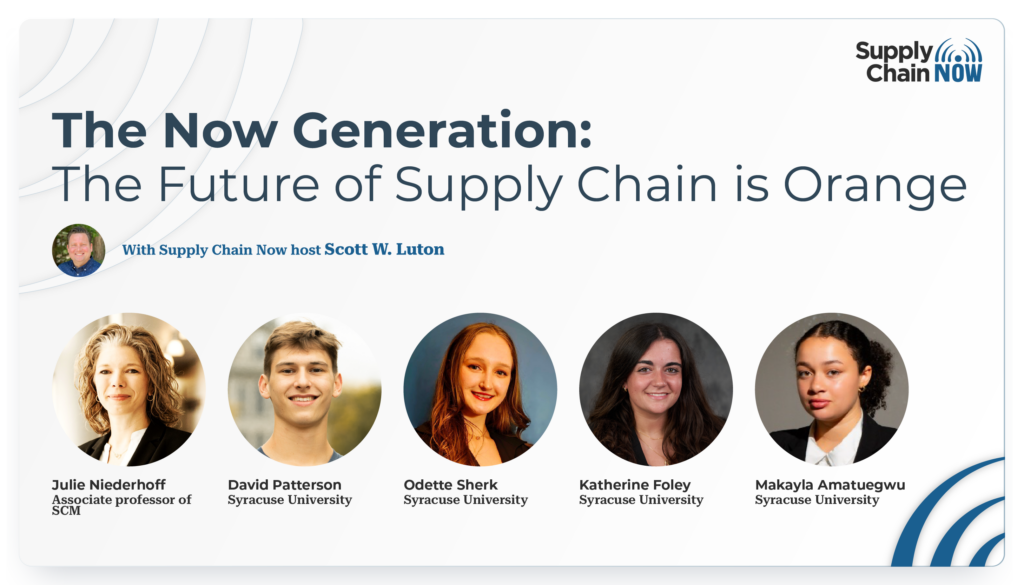
[00:00:42] Scott W. Luton: Hey, good morning, good afternoon, good evening, wherever you may be. Scott Luton here with you on Supply Chain Now welcome to today’s show, folks. Today we’re continuing one of my favorite series, absolute favorite series, one that we like to call the Now Generation, where we sit down with students and professional educators from some of the leading colleges and universities around the world.
[00:01:03] Scott W. Luton: And check this out here in 2026. We’re delighted to partner. With the one and only Dr. Stephanie Thomas and the WISE organization at the University of Arkansas to power the Now Generation series forward. If you don’t know Wise exists to show students that supply chain is exciting, impactful, and full of opportunity.
[00:01:22] Scott W. Luton: The initial creates community, uh, connect students with industry leaders and helps ’em build the skills and confidence to launch meaningful careers. Stephanie and the Wise team are doing incredible work, including offering some terrific programming and annual events. You can learn more via the link we’re dropping in the program notes below about folks.
[00:01:42] Scott W. Luton: Today we’re gonna be featuring an outstanding school for the first time here on Supply Chain Now, Syracuse University, where they tend to say that the future of supply chain is orange. I kinda like that as a Clemson fan, but it’s a different shade of orange. But kidding aside, Syracuse’s home to a very well regarded supply chain management program.
[00:02:02] Scott W. Luton: Garner and others rank it in their top 25. And here’s a fun fact. I just learned it earlier today. Syracuse is home to the oldest supply chain management program in the country. They were teaching supply chain long before school. How cool is that? So get ready folks, as we continue one of our favorite series here at Supply Chain Now.
[00:02:21] Scott W. Luton: Now, with that said, I wanna introduce our esteem panel here today we got a super packed, superpowered panel. I’m starting with Dr. Julie Niederhoff, Associate Professor of Supply chain Management and Department Chair of Marketing, Retail, and Supply Chain Management, all at Syracuse University. Now, Professor Niederhoff teaches both undergraduate and graduate classes and has been nominated twice for the Meredith Teaching Award.
[00:02:47] Scott W. Luton: Beyond her teaching duties, Professor Niederhoff has developed quite the track record for her research, which has been published in some of the top research journals in the world. Julie, how you doing, my friend?
[00:02:58] Julie Niederhoff: I am really excited to be here. I’m doing well. Thank you, Scott.
[00:03:02] Scott W. Luton: Hey, I admire what you do. It’s great to see you for a minute at, uh, the Wise event.
[00:03:05] Scott W. Luton: And you have brought, as I’ve already seen, I’ve done my homework. You’ve brought a power panel of students that are certainly making their impact right now already in industry. And I’m starting with, uh, Odette Sherk, a graduating senior at Syracuse University’s Whitman School of Management, pursuing a Bachelor of Science and supply chain management, marketing and environmental or environment sustainability and policy, a triple major.
[00:03:32] Scott W. Luton: Now, Odette has been recognized as a Whitman scholar due to her top performance in the class of 2026, along with several other awards, and she serves as president of the Franklin Supply Chain Club. Odette, how you doing?
[00:03:44] Odette Sherk: I’m doing great. Looking forward to today.
[00:03:46] Scott W. Luton: Great to meet you here today, and you’re joined by, by three fellow students, starting with Katherine Foley, a junior studying supply chain and retail management at Syracuse University.
[00:03:57] Scott W. Luton: She’s, she is president of the Syracuse Retail Club. And amongst many other things. I’m intrigued by this. She’s part of the bass fishing team. Katherine, how you doing?
[00:04:08] Katherine Foley: I’m doing great.
[00:04:10] Scott W. Luton: Wonderful. Wonderful. We’ll get to get you to share your favorite lure. May be with us later in the show. Oh yeah. We’ll see.
[00:04:15] Scott W. Luton: Uh, also joining Odette and Katherine and, and Professor Niederhoff is Makayla Amatuegwu, uh, who’s also a junior majoring in supply chain management and finance. She’s also president of the Women’s Network chapter at Syracuse. Uh, and while she’s abroad, right now, she’s originally from Long Island, New York, and she’s gonna be serving as an intern for Micron Technology in the months to come.
[00:04:40] Scott W. Luton: Makayla, how you doing?
[00:04:41] Makayla Amatuegwu: I’m great.
[00:04:43] Scott W. Luton: Wonderful to see you here today. And then finally, David Patterson. Uh, also a junior majoring in supply chain management. He’s active in a variety of clubs. Like, like that’s the common theme here today. When they’re not doing big things in supply chain, they’re active in, in clubs and leaderships, uh, positions, you name it.
[00:05:01] Scott W. Luton: Uh, David is involved in entrepreneurship club and when he, uh, while he loves a, a great case competition, you can also find David playing sports and musical instruments in his free time. David, how you doing?
[00:05:16] David Patterson: Well, I didn’t expect to put on snow boots today, but other that I’m doing pretty good,
[00:05:21] Scott W. Luton: I hear 10 inches of snow is what’s to be expected up in y’all’s neck of the woods.
[00:05:26] Scott W. Luton: Uh, but stay, Hey, uh, stay warm, stay off the roads. Down here in Georgia, a little bit of rain throws us for a loop, so I could only imagine, uh, 10 inches of snow. But anyway, great to have you, David, and, and, and really the whole team. And Julie, I wanna start with you really quick before we, uh, get, get another students a little better.
[00:05:45] Scott W. Luton: Again, I’ll, I’ll share with you pre-show I admire what you do, um, what I’ll call it. What’s the opposite of extracurricular? Is it intra curricular? What? Whatever. In the classroom, outside the classroom, evening, weekends, you know, clearly you’re really engaged in supporting your students’ journeys and I really admire that.
[00:06:05] Julie Niederhoff: Well, thank you. Yeah. I think it’s such an honor to be able to plug into their academic, uh, time here at Syracuse and be part of their academic journey. And I can’t think of a better job in the world than getting to watch 18, 19, 20 year olds figure out what they wanna do in their life and then jump like two feet right into it.
[00:06:22] Julie Niederhoff: It’s just so exciting.
[00:06:24] Scott W. Luton: Well, I’ll tell you, uh, it really, you’ve got one of the best seats in the world, and we’ll touch on that later in today’s conversation. Um, okay. So, uh, we’ll go round the horn and get, get to know y’all a little bit better. We’re gonna find out, uh, kind of where you’re from, as well as some extracurricular passions or hobbies that you may have when you’re not doing big things in supply chain and getting ready for massive careers.
[00:06:47] Scott W. Luton: And, and Odette, I wanna start with you. Tell us a little bit about your, uh, your hometown and one of your hobbies.
[00:06:53] Odette Sherk: Absolutely. So my hometown is Pittsburgh, Pennsylvania. Okay. So not too far from Syracuse, but a little bit more re removed from our lake effect snow phenomenon. So it was fun getting to know that effect when I got up to school here.
[00:07:07] Odette Sherk: And I actually have a lot of interests outside of supply chain because I didn’t really know what supply chain was until I took Julie’s class my sophomore year. But for a very long time I have been interested in sewing and fashion design. So I have been doing that for about 14 years now, which sounds like a long time when you’re on a college podcast.
[00:07:29] Odette Sherk: And I’m very interested in kind of creating. Tailoring and making new suits and dresses and that aspect. And I also, I know you mentioned this for David, also involved with musical instruments. So I’ve been playing the viola since I was around nine years old. And I do play in the Syracuse University Symphony Orchestra.
[00:07:51] Odette Sherk: So if you’re not finding me around the business school, you can go up to the Big Red Castle that is the face of Syracuse University, and I might be stuck in a practice room up there.
[00:08:01] Scott W. Luton: Oh, Odette. Love it. Alright, so, uh, Odette, uh, the viola. Um, alright, so I’m, I’m showing my lack of musical prowess here that’s related to the violin.
[00:08:12] Scott W. Luton: I gotta, is my hunch. Is that right?
[00:08:14] Odette Sherk: Yeah, it’s like the violin that’s just a little bit bigger and we never play the melody, but we’re always supporting behind the scenes.
[00:08:21] Scott W. Luton: Okay. There’s a supply chain orchestration, uh, pun or analogy there. We’ll circle back to it. But Odette great to have you here today.
[00:08:28] Scott W. Luton: Alright, so, c. If you would tell us where your ho, you know, your hometown and some of your hobbies that you’re involved with outside of supply chain too.
[00:08:39] Katherine Foley: So I am from Fairfield, Connecticut, so not too far from New York City. Uh, grew up going into the city a lot. Both my parents worked there, so kind of second home for me.
[00:08:48] Katherine Foley: Um, outside of the classroom, I am also pretty involved on campus. Um, I’m president of our retail club, which has been an absolute joy to be a part of here. I’m also a part of the bass fishing team here, which again has just been a great outlet for me to kind of delve into some of my more of my interests.
[00:09:08] Katherine Foley: Um, I also really love rock music, which I don’t think a lot of people would assume by looking at me, but I am huge into rock music. Saw Pantera by myself over the summer. Um, so much fun. Um, and I’m also very, very much so into fashion. So all sorts of fashion, fashion, tech, high-end, luxury, um, cultural fashion, all different scopes and realms of it.
[00:09:32] Katherine Foley: I love it. So yeah.
[00:09:34] Scott W. Luton: So Katherine, um, I think that you were involved with New York Fashion Week, uh, juggling amongst many things you do. Is that right?
[00:09:42] Katherine Foley: Yes, that’s correct.
[00:09:43] Scott W. Luton: Okay. And was it more on the logistics and operations side of, of Fashion Week?
[00:09:48] Katherine Foley: Yeah, so I worked fashion week this past February and then also last year I worked that February as well.
[00:09:56] Katherine Foley: Uh, this year I was on a runway as like a production assistant, versus last year I was in a B2B showroom. So it was a little bit of a different kind of vibe there. But, um, it definitely was a lot of logistics, a lot of operations, organizational skills, um, trying to get everyone organized from point A to point B in a timely manner.
[00:10:16] Katherine Foley: Obviously there’s a million different moving parts in those kinds of settings, so having to be on my toes at all times was really important. But yeah, it was a lot, a lot of fun. So.
[00:10:26] Scott W. Luton: Love it. And of course, uh, the fashion and, and, uh, apparel world, uh, lean heavily on fast moving, uh, supply chains. Mm-hmm.
[00:10:35] Scott W. Luton: Highly proactive supply chains to stay on top of trends, have a very challenging industry. Hey, really quick, Julie, I’m, we’re about to get to know Makayla and David in just a second, but I’m gonna pause for a minute. We heard from Odette and Katherine some comments on both of these, these first two individuals.
[00:10:51] Julie Niederhoff: I’m telling you, we have amazing students and you know, these are just two of, of those as a sample. Um, they’re pretty fantastic young people and they’re gonna make a big splash. Um, but what you’re hearing already, Odette, triple majoring Katherine having a solid footing in both retail and supply chain.
[00:11:07] Julie Niederhoff: That’s one of the things that I think we do super well here at Whitman in the Syracuse University. Um. Is to allow our students to double or triple or for the rare super, super dedicated student, quadruple major. And so, uh, we often will talk about supply chain and um, and you know, Ette mentioned coming into her sophomore intro to supply chain class, not quite knowing what it even was.
[00:11:29] Julie Niederhoff: And then sort of, we call it the gateway drug here, getting, getting pulled into the major. And a lot of students keep that other foot that they thought they were, you know, they came in thinking I was gonna be retail, I was gonna be marketing, or I was going to be finance. And then they just kind of fall in love with supply chain and so they end up partnering them.
[00:11:44] Julie Niederhoff: And I think we just create these incredibly well-rounded, interesting students who, when you start coupling all these combinations are so uniquely positioned into what they love.
[00:11:56] Scott W. Luton: Yeah, I, I agree. And, and just for, uh, big Brother, the f FDA a or some of the other agencies, we mean the gateway drug in a very positive
[00:12:05] Julie Niederhoff: and the nicest possible way.
[00:12:06] Scott W. Luton: That’s right. I’ll be, my, our phones are getting bugged. Who knows? Uh, anyway, uh, no, all kidding aside, it’s so important. And, you know, it’s a big common themes with these is how do we attract the best and brightest, like these four into supply chain programs. So clearly you are doing great work there. Um, Makayla, now Makayla, I’m not gonna reveal where you are in the world.
[00:12:28] Scott W. Luton: You can if you would like, but, um, ’cause you’re abroad right now, I’m very jealous. Uh, if you would tell us about your hometown, where you grew up, about yourself, and of course one of your hobbies.
[00:12:38] Makayla Amatuegwu: So, I am currently in London. I actually just got back from. What most people do in when you’re abroad. I was just traveling.
[00:12:47] Makayla Amatuegwu: I just came back from Portugal and Brussels, so that was fun. So my hometown is Long Island, um, Suffolk County, New York, if anyone knows. And I moved to the suburbs of Philadelphia when I was in high school. So I do also consider that a hometown of some sorts. But I do heavily resonate with Long Island and Suffolk County.
[00:13:08] Makayla Amatuegwu: I am a beach girl, so, and then some of my hobbies do include traveling at, if you can’t tell. And then I also am very musically inclined as my other two counterparts. Um, I do play four instruments and I also did dabble in songwriting in high school, but I never got through leasing an album even though I wanted to.
[00:13:31] Makayla Amatuegwu: But yeah.
[00:13:31] Scott W. Luton: Wow.
[00:13:32] Makayla Amatuegwu: Those are just some things that I wanted to do.
[00:13:34] Scott W. Luton: All right. We got a supply chain band. We’ll, we’ll be forming, uh, in the months ahead, y’all, y’all will be the first calls that we make. Um, and gosh, to hear about, um, uh, all the, the locales you’re visiting, different countries, the perspective that must give you, especially being a supply chain, uh, nerd like I am.
[00:13:55] Scott W. Luton: And I use that, that very lovingly. Uh, it’s gotta be really, really, uh, enriching and, and fulfilling, huh?
[00:14:01] Makayla Amatuegwu: It really is.
[00:14:02] Scott W. Luton: Yeah. It’s
[00:14:02] Makayla Amatuegwu: a great perspective to get. So if anyone’s listening that’s thinking they wanna travel, but they might not get around to it, you should definitely travel.
[00:14:10] Scott W. Luton: Do it now. Do it now. Okay.
[00:14:13] Scott W. Luton: Alright. So, David Patterson, you’re our fourth and final panelist here. Uh, again, big thanks to Julie for bringing some of syracuse’s. Uh, best and brightest, tell us about your, uh, hometown, uh, a little about yourself, and what’s the big hobby of yours?
[00:14:28] David Patterson: Absolutely. Well, I’m from Watkins Glen, New York, so it’s a small little village of about 16 to 1800 people, a very big tourist town during the summertime.
[00:14:38] David Patterson: It’s right on the south end of Seneca Lake, so it’s nestled in the, in the heart of the Figure Lakes region of upstate New York. Uh, there’s a international racetrack there, so that tends to draw a crowd for NASCAR during the August months, and I think it’s actually in May this year. So quite early in the summer, there’s a famous state park that has like a gorge trail that runs up through the hills, the wineries.
[00:15:00] David Patterson: So
[00:15:01] Scott W. Luton: yeah,
[00:15:01] David Patterson: always grew up with, you know, a ton of people during. One season and then it being very quiet during the winter months. And I, I just love it out there. It’s so great to just go back home and see family and just relax and kind of break away from the world. It’s nice and isolating and coming to Syracuse, I tell my friends, which is funny enough, it always felt like the big city for me, even though Syracuse to them is like their little town in their little village.
[00:15:27] David Patterson: So people always love hearing that. And I always think that like, uh, like earned a great perspective for me to kind of meet people from all over the world here. And I absolutely love it here. And part of the things I do up here at Syracuse besides, uh, playing trombone and piano usually in my room, is in the, the Goodman Leadership Academy here at Whitman, which is kind of like an accepted group of students that we work on, like collaboration.
[00:15:53] David Patterson: And we have guest speakers over learning about, uh, personality development, how we can be more efficient, team leaders and you know, kind of navigating throughout the world and using our majors to kind of apply to that. So it’s really interesting and I just recently through Whitman, went to California.
[00:16:11] Scott W. Luton: Okay.
[00:16:11] David Patterson: On the Los Angeles to the San Francisco trip. It was kind of like a tech industry, tech heavy, uh, trip out there. And it was my first time out to the west coast and we met like a bunch of alumni out there. It was just absolutely fascinating and it certainly gave me a little bit of a high end perspective on supply chain, some of the industries out there.
[00:16:31] David Patterson: It was really fascinating.
[00:16:33] Scott W. Luton: Outstanding. And I only, um, going back to halfway through your response there, uh, you’re talking about your musical instruments. I’m assuming you have some very strong diplomatic relations with your neighbors ’cause you play trombone and piano in your room. You’re managing those relationships well, right?
[00:16:52] David Patterson: Yes. Okay. I am known as like the trombone guys sometimes, and I have like a certain schedule where I have to play it, so I’m not like disrupting
[00:16:59] Scott W. Luton: anyone sleep
[00:17:00] David Patterson: schedule. Okay.
[00:17:00] Scott W. Luton: Fair enough. I, I figured. I figured. But, uh, regardless, uh, well, good stuff. David and Julie, before we talk about the role as you play and your highly regarded research comment on what we heard there from Makayla and David.
[00:17:13] Julie Niederhoff: Yeah. And I think it’s just kind of fun how that’s set up perfectly, which is Makayla talking about being abroad in London and, and David just got back what yesterday, the day before, um, from this multi-day trip to the West coast. And I think again, that’s one of the things that we really encourage for our students, and it’s so great to hear two of them talking about these opportunities to, um, to travel.
[00:17:32] Julie Niederhoff: We take students, uh, as much as we can to case competitions, these immersion trips, um, you know, wherever we can. We try to give them that experiential learning, um, throughout their four years while they’re here. Um, David, you’re a sophomore, right? Junior, so I You’re like that weird credit gap? Yeah.
[00:17:49] David Patterson: Yep.
[00:17:49] Julie Niederhoff: Okay.
[00:17:50] Julie Niederhoff: Sophomore by year, junior by credit. Um, oh, okay. And so, um. So we have, you know, we have, we have people early in their process. We have people, you know, kind of wrapping up like Odette. Um, and I think everyone here has done some amount of traveling and, and experiencing the world and getting hands on experience.
[00:18:05] Julie Niederhoff: And I, I just love the perspective that brings into the classroom and that they can bring into their internships and their jobs.
[00:18:12] Scott W. Luton: It’s invaluable. And on a lighter note, see you come on Supply Chain Now and you get bumped up a whole class. See how that can, that can happen. Uh, we’ll see. We’ll get it, we’ll get it.
[00:18:22] Scott W. Luton: All right. But, uh, uh, Julie, I can’t, kidding us out. I can’t agree with you more. And, uh, gosh, talk about well-rounded holistic experiences, that experiential learning, it’s so important. We heard that all in little, little, uh, just short responses from all four. Um, alright, so really quick, uh, Professor Erh, if you would, tell us about the roles you play, uh, formal roles you play, and of course, um.
[00:18:47] Scott W. Luton: The research, tell us where you focus a lot of your, uh, well regarded research. Sure,
[00:18:52] Julie Niederhoff: yeah. So, um, I wear a bunch of hats here you’ve already mentioned. I’m the, I’m an associate Professor of supply chain management and I’m currently serving as the department chair for our department, which is the marketing major, the retail major, and the supply chain major.
[00:19:04] Julie Niederhoff: So, um, really thinking about products and services, conception to delivery. Um. And I am the co-director of the Franklin Center for Supply Chain Management, which is, um, a center that was founded back in 1919 when this major was founded. Um, founded by the Franklin Automotive Manufacturing Group, which was based here in Syracuse at the time and was really excited to support a transportation and traffic major.
[00:19:27] Julie Niederhoff: Um, and the Franklin Center supports the Franklin Student Club and helps pay for and manage a lot of these activities that we are able to support our students in. Um, I also co co-organized the annual Salzburg Meor Salzburg. Me, I’m sorry, lemme start over. I also co co-organized the annual Salzburg Memorial Lecture series, which awards the Salzburg Medallion.
[00:19:50] Julie Niederhoff: Um, which goes to a supply chain management industry leader, either an individual or a company who’s really leading the way in supply chain. And so, um, through that, every fall we get to put together a two day series of speakers and guests. And we honor, we have been like the, you know, chief operations officer of companies like Patagonia, Toyota, Coca-Cola, Schneider Electric.
[00:20:09] Julie Niederhoff: Those are just a few of the companies we’ve been able to honor in the last few years. Bring them onto campus along with a bunch of other speakers and connect our students with these incredible, uh. C-suite executives, um, that they get to talk to. So that is, um, just some of the, some of the roles I’m juggling.
[00:20:26] Julie Niederhoff: That’s a lot. At any given time. It’s, it’s a lot.
[00:20:29] Scott W. Luton: So, but hey, uh, supply chain’s not for the faint of heart. It’s not. And clearly all of those hats you wear are providing opportunities for, you know, the Katherine Ettes, Makaylas and Davids of the world. Yes. Um, and that, that’s, that’s invaluable too. Um, now the research you do on top of all that, tell us about the research
[00:20:48] Julie Niederhoff: on top of all of that.
[00:20:49] Julie Niederhoff: Yeah. On top of all of that, I am research active. And so, um, I tend to focus my research on, um, the behavioral side of supply chain. So how real human decision makers, uh, manage decision making in supply chain context. So that might be a pricing question, an inventory management question. Um, you know, how does that person behave when they’re in a high risk situation or in a fairness oriented dynamic, you know, does that change what happens?
[00:21:13] Julie Niederhoff: Um. We’ve looked at how workers behave in a queuing system. If you have, um, high visibility of the number of customers in your line versus low, does that affect the way the worker performs? Um, but currently I’ve been focusing a lot on that type of question, but in humanitarian aid logistics. So I’ve been really fascinated with how the prolonged exposure to traumatic events affects the way that humanitarian aid, logisticians approach, these very high risk, high stress, um, allocation decisions, management decisions.
[00:21:43] Julie Niederhoff: You know, do we wait for more information or do we act today? Hmm. Um, how does that prolonged exposure to stress influence the way that they manage those decisions? And so that is where I’ve been spending a lot of my time for the last few years.
[00:21:57] Scott W. Luton: Outstanding. Uh, that’s, I got so many universal applications.
[00:22:01] Scott W. Luton: Those, those kinds of the, some of the main themes of your research you shared. Um, and gosh. Decision making in general, uh, is probably all y’all can attest to. Uh, it’s, it’s a, been a timeless challenge and, and here in the golden age of supply chain tech, it’s been really interesting to see how, um, AI and many other, uh, innovative technologies are being used to, um, either replace some of the decision making so we don’t have to make ’em, which I find fascinating or some of the tougher decisions, how they’re we’re able to make those faster, easier, better, more confident.
[00:22:32] Scott W. Luton: Um, what’s old is new again. Good stuff there, Julie and, uh, between what you do and your research. Um, alright, so circling back to the students here, uh, Katherine, I’m gonna lead with you in this next question because I know that I can. Um. Uh, perceive your passion, all four of y’all’s passions. Just in a little bit of time we’ve spent here today, but let’s dial it in on one topic or trend or issue across global supply chain that really interests you right here today, in March, 2026, Katherine, what comes to mind?
[00:23:04] Katherine Foley: Yeah, I mean, for me personally, coming from things, from kind of a more of a retail perspective, uh, when I first got to Syracuse, I like Professor der h mentioned, I came in as just retail management and then later on, after taking an interest supply chain course, realized how valuable those skills could be to me.
[00:23:22] Katherine Foley: Um, and then tacked that on as well and have fallen absolutely in love with it. So it’s been great. But I think that being said, coming at it from a little bit of a different perspective, um, I think sustainability is always the first thing that’s gonna come to mind. Um, it’s something that I’ve taken a lot of time to do research on in my spare time.
[00:23:41] Katherine Foley: Um, and I specifically, I did a project for a course a few weeks ago about the new introduction of the EU digital passport that they’re attempting to launch, um, which would provide a QR code on clothing tags that consumers could then scan with their phone while they’re in store, and it would give them a complete from, from the mill all the way to the warehouse, start to finish transparent.
[00:24:03] Katherine Foley: Um, recollection of the supply chain for that product. So I think that’s definitely an issue. Um, that’s always been a longstanding issue and I think it’s very refreshing to see it kind of being paid a little bit more attention to. Um, and I think it definitely could be something interesting to follow and hopefully potentially brought into the US as well, um, sooner rather than later.
[00:24:26] Katherine Foley: So
[00:24:26] Scott W. Luton: yeah, inform consumers. Um, yeah, powerful thing. This stuff there. Katherine, uh, Makayla, how about you?
[00:24:33] Makayla Amatuegwu: Yeah, so one topic that has interested me across global supply chain currently is more so on the rail or transportation sector. Um, during our Salzburg Memorial Day last semester, um, Odette actually did a, um, fun little, um, presentation with a couple other members from the Franklin Supply Chain Club about um, how rail can be improved in the Americas.
[00:24:57] Makayla Amatuegwu: And I thought that was well North America specifically, but I thought that was really interesting as I also. Did attend a Northeast ASSO rail, associ Northeast Association of Rail Shippers Conference also last, um, last year with Syracuse, which was really informative and I wound up getting an internship through that also.
[00:25:19] Makayla Amatuegwu: So I feel like rail is something that is sort of looked over, um, when, as a student when coming into supply chain because people more focus on like, um, procurement or sustainability. But I do think that rail is a big sector that should be expanded more upon, especially in the Americas.
[00:25:42] Scott W. Luton: Big opportunities, Mikayla, and you’re right, air cargo and ocean freight probably.
[00:25:46] Scott W. Luton: And certainly, you know, uh, good old ground freight probably gets a lot more attention. But really quick before I move on to Odette and David, um, Julie, I wanna check in with you on that. Uh, we heard about Katherine’s. Passion for sustainability and empowering customers with information where they can make better selection about products and probably, uh, vote with their wallet more, which, which a lot, a lot of times leads to some advancements for industry.
[00:26:09] Scott W. Luton: And then with Makayla, you know, the, the rail industry is probably one of the most, uh, uh, misunderstood or, or just not understood industries. And of course from a, um, a travel perspective, you look at the rail system in North America and the rail system in Europe, two totally different universes. But, uh, Julie, what do we hear there?
[00:26:31] Julie Niederhoff: Um, yeah, I think both of these people, uh, being able to explore these passions and what they find most interesting and, you know, I think in both cases they’re kind of moving in that same future, future forward direction. Right. So you’re hearing Katherine talk about the role of transparency, and once retailers have that transparency, they’re going to, as you said, vote with their wallet, which companies are then gonna follow.
[00:26:54] Julie Niederhoff: The voters follow those, re those customers, um, sort of preferences, right? So that’s gonna cause supply chains to shift. And so, uh, understanding kind of the long-term impact of that kind of visibility. Um, Makayla brought up the rail industry, which as you said is highly slept on from, from the understanding of the rail industry, which is, um, highly underrated by the majority of Americans.
[00:27:17] Julie Niederhoff: They really don’t understand the vast amount of shipping that’s happening on our rail systems. Um, and the opportunities that we maybe are not taking advantage of as fully as we should in developing new rail technologies. And again, the implications, um, yeah, for future supply chains, both for transporting goods and transporting people, reducing emissions, reducing costs, I see both of these students touching on current topics that have so much profound possibility on impacting future supply chains.
[00:27:45] Scott W. Luton: Yes, of course you got the historic potential merger mm-hmm. In the rail industry here in the us. We’ll see if that gets approval and moves forward. Uh, good stuff. Katherine and Makayla. Uh, David, let’s go to you next. Odette, you’re gonna be a cleanup hit on this first question, David, your thoughts around, uh, a passion, uh, a trend or topic or issue that you’re passionate about across global supply chain.
[00:28:08] David Patterson: Right? Yes. I’ve been thinking about this for a while and recently I just did a essay about globalization for my Maxwell class, and it’s really kind of honing in on coming up with like what your thoughts are about the current state of globalization. And so what I think is happening right now and what I think is very objective and true in the landscape right now and what it has to do with supply chain networks is that especially the United States and the global North countries tend to be kind of pulling back away from this hyper efficient supply chain network in the global landscape.
[00:28:40] David Patterson: You see this with like the tariffs and the chips act, the inflation reduction act from previous administrations and current administrations. And that just really fascinates me on how like other countries react to that, the relations that go on and it makes me kind of wish I majored in international relations as well at Mass at Maxwell as well.
[00:29:00] David Patterson: So I kind of wish I did that, but it was really cool to kind of relate that to supply chain as well. And I think, uh, that relating to Micron coming to Syracuse too has a lot to do with that and seeing how that we’re trying to become more reliant on, you know, domestic industries with these really important industries such as pharmaceuticals, semiconductors, uh, defense systems and like agriculture and stuff like that.
[00:29:31] David Patterson: Hmm. So that kind of stuff really is very, very broad and very hard to tackle at times. And, you know, there’s trade offs and there’s some consequences that come with that. And the whole theory of economics with that. But I think it’s fascinating. I really like following the current state of what’s going on with that and how it’s impacting, you know, communities like Syracuse,
[00:29:50] Scott W. Luton: David, that’s a, uh, you’re speaking about a, a really long equation with tons of variables, right?
[00:29:55] Scott W. Luton: Uh, exactly. Globalization alone. Uh, it’s interesting to see the, the old trends and new trends and, and oftentimes things come back kind of cyclical. But Julie, I propose to you. I’m waiting for either the Tylenols or the Aleves or whatever, pain reliever like aspirin. If they embrace a tariff promotional campaign, they will dominate the market in supply chain practitioners landscape.
[00:30:19] Scott W. Luton: They really will. I’ll tell you, we got halfway through the conversation and then the T word came out. It’s been a challenging situation, but David, good stuff. Uh, Odette, uh, same question. What’s one thing you’re really passionate about and you’re tracking across global supply chain?
[00:30:34] Odette Sherk: Yeah, well, like David mentioned, he’s also a student at the Maxwell School of Citizenship.
[00:30:40] Odette Sherk: So my third major is environment and sustainability policy. And that is a very unique major here at SU because it actually doesn’t exist as a standalone major. You can only declare, declare it when you have a base major, and one of those acceptable ones is supply chain. And so it has a very kind of customizable path that you can proceed through.
[00:31:04] Odette Sherk: And so I’ve been able to take a variety of classes in Maxwell focused on environment and sustainability with a very heavy business focus.
[00:31:13] Katherine Foley: Mm.
[00:31:14] Odette Sherk: And so through the past few years, I’ve spent some time learning the actual. Science pertaining to climate change and the impacts that the supply chain field is having on that change.
[00:31:26] Odette Sherk: And also some of the business implications for this and how we can react and respond to it. So recently, I’ve been particularly interested in how we’re monitoring all of the kind of passage through the supply chain with Scope three emissions particularly. And so the Scope three emissions is basically tracking how much is your supplier emitting and your supplier’s supplier.
[00:31:53] Odette Sherk: And your supplier’s supplier. Supplier all the way down until you get to the raw materials. And so that’s really been kind of a topic more up on the news. It’s becoming. More necessary in the EU already to keep track of your scope one, scope two, and eventually scope three, supply chain emissions. But I believe California has also announced that as of 2027, that will be impacting a lot of public and private businesses operating there as well.
[00:32:21] Odette Sherk: So really finding ways to balance the complexity of a global supply chain with some of these reporting standards that we need to uphold in order to be able to achieve a green economy.
[00:32:33] Scott W. Luton: Julie, I’ll tell you, between, um, economic forces that David mentioned and then o debt, of course, when you think of scope three, you think of a whole new complexity when it comes to seeking end-to-end visibility, a whole new twist on visibility across ecosystems.
[00:32:50] Scott W. Luton: Your thoughts, Julie, what we hear there from David Ette.
[00:32:52] Julie Niederhoff: You know, if you were to ask me what, what my favorite topic is, um, it kind of goes into this area as well, which is this, you know, this sort of resiliency and flexibility of supply chains. And so, um, all of them have kind of talked about this, like, how is this new change?
[00:33:04] Julie Niederhoff: How is this new opportunity, um, going to affect what makes the most sense for a company to do in their supply chains? And, um, that forward thinking, that forward looking perspective in whichever set of lenses they’re bringing to that question is so fascinating and so interesting for them to bring. And, um, you know, I think, uh, kind of off of David and Odette’s, um, comments here, we do know that when you incentivize just one player in the supply chain to do something like reduce emissions, uh, they can game that system by making their supplier’s supplier take a credit for those emissions, right?
[00:33:38] Julie Niederhoff: Right. And so, um, understanding that like it. If you have bad emissions and then you just change whose name goes to those emissions, that doesn’t actually improve the world. And so, um, understanding, you know, kinda that, that big behavioral factor of, you know, where those incentives are being placed, where those expectations are being placed, how that transparency is made available to customers and then customers can respond to it.
[00:34:01] Julie Niederhoff: Super important. And to David’s point, um, you know, the only thing for certain in this life is change, right? Everything is always changing. Um, and everybody likes to point to COVID or point to these new tariffs, um, or point to, you know, uh, some new current crisis. But the reality is everything’s always changing.
[00:34:19] Julie Niederhoff: And so companies are constantly having to think about where is that sweet spot between being super flexible and being able to adapt quickly. And not wasting all their money on tons of redundancy and tons of unnecessary, um, flexibility. And so I think, you know, they’re, they’re really hitting on some of these really key issues about how do you structure that supply chain to accomplish what you need to accomplish, not just now, but into the future.
[00:34:44] Julie Niederhoff: Um, being ready to take advantage of new opportunities, being ready to shift when the time is right, um, but doing so in a way that is respectful to your shareholders and respectful to your values. So really, really interesting stuff to hear them talk about.
[00:34:59] Scott W. Luton: Outstanding. And Julie, it’s one more certainty in life though, uh, and related to, uh, emissions, I think the dominant emit.
[00:35:06] Scott W. Luton: All the hot air and, and, um, wasteful emissions in the world is Washington DC I saw a research piece the other day. I did. I did. I did. I promise. Uh, Makayla, I’ll circle back. Uh, a lot of good stuff there. I really appreciate all y’all sharing and some of the things you’re most passionate about. This follow up question is gonna be related to that, right?
[00:35:26] Scott W. Luton: So, Makayla, when you think about what you want to do in industry and why, including some of the change you’d like to be a part of, um, of, of driving and impacting what comes to mind? Makayla?
[00:35:39] Makayla Amatuegwu: So I know I did mention rail, but something that I am currently getting into is also has, is related to sustainability.
[00:35:46] Makayla Amatuegwu: But one sector that I’d like to go into is the mining and minerals aspect of supply chain. And I know that those are two contradictory like terms ’cause you don’t really think of mining as a sustainable, um, sector, however. That’s why it really interests me to go into su sustainability for minerals and mining because I wanna be able to make a change different than everyone else basically.
[00:36:14] Makayla Amatuegwu: So I kind of wanna leave my, my mark on the field, but, um, minerals and mining is needed in general for renewable energy because we do use the minerals and what we mine to create new technologies. But the main issue is more so just the ethicalness and just the ability to improve the traceability and to reduce the environ environmental impact, offset mining.
[00:36:40] Makayla Amatuegwu: So I feel that that’s one thing that I would like to do and why, and I feel like that would be a major improvement in the, in the industry.
[00:36:49] Scott W. Luton: Makayla, good stuff there. And, and you’re right on a lot of accounts and, and on top of all those, those, uh, balances that, that the global industry and, uh, supply chains will have to, uh, find a path is you’ve got, uh, you know, um, mining is spread out and, uh, we all like our smartphones, however, we don’t have as many active minds here in the states to get some of the critical components that go into things like the iPhones, other things we enjoy electronics and, and much many other things.
[00:37:22] Scott W. Luton: We’ve got our work cut out for us to protect and grow access to make consumers happy. So it’s mining and minerals. That whole space is going, going to be a fascinating, uh, aspect of global supply chain in the months to come. So good to hear that, that Makayla, uh, David, same thing. What do you wanna do in the industry?
[00:37:42] Scott W. Luton: Why, and, and some of the change you’re looking to drive.
[00:37:45] David Patterson: Yeah, so to relate it to kind of what I was touching on globalization, how like industries are really trying to find their most cost effective and efficient supply chain networks while also trying to deal with kind of these economic factors. What really initially opened me up to that was working with my dad in a hospital.
[00:38:01] David Patterson: He works in a facilities department, is the director of it, and he’s constantly ordering stuff for his facilities team to make repairs in the hospital. And the big mother company that he goes through is Granger. And I was just so impressed with Granger and how quickly that they would get their stuff to the hospital, like instantaneously from these massive warehouses.
[00:38:24] Katherine Foley: Hmm.
[00:38:24] David Patterson: And I’m just thinking to myself like, how do you even like begin to think about that and how do you even get these shipments there? You know, they’re still producing all the way over overseas in China and then getting all their stuff shipped over and there’s already stuff sitting in, like on the, in these warehouses they have their, um, their inventory.
[00:38:44] David Patterson: Watching and all these logistics and forecasting and just thinking about that and being exposed to it before even coming to school. I think I already had my, my supply chain mindset set when I was doing, uh, my first introduction class with Professor Niederhoff in 2 56. And so, yeah, it was, uh, that was definitely eye-opening and I think that’s an industry that I really want to get at is kind of like the, the distribution and kind of the global landscape manufacturing from like overseas and how we get our products across the country.
[00:39:16] Scott W. Luton: And you mentioned the healthcare supply chain. You know, it’s a matter of life and death talk, the, the utmost stakes. Uh, Julie, I wanna check in really quick with you. Uh, Makayla. I was trying to think of my, um, I was trying to make Ms. Beckham my 10th grade chemistry teacher, happy and mention some of the periodic elements, uh, that are involved in, in, uh, some of the, um, minerals in the mining space.
[00:39:41] Scott W. Luton: Uh, but of course, uh, kidding aside, mining minerals, healthcare supply chain. David mentioned some of the global, uh, aspects of that. This is some heavy stuff. Julie, your thoughts?
[00:39:52] Julie Niederhoff: Fascinating topics from both of them. I’m always so impressed with what our students are doing outside of the conversations that I’m having with them and finding out, you know, what’s driving their interests.
[00:40:00] Julie Niederhoff: Um, you know, you mentioned earlier like AI coming in and making new decisions and making decisions easier, but at the end of the day, you know, I, I AI’s not gonna go out and mine things. There might be ways to apply it that will allow us to do things more efficiently and more, um, environmentally friendly and, and all of these things.
[00:40:19] Julie Niederhoff: Um, you know, David’s talking about getting hospital supplies in. Um, we’re not gonna stop having people who need hospital help. Um, and so these, these fundamental needs within the world of, you know, being able to get these rare earth metals and these, these minerals, um, so that we can build the technology.
[00:40:36] Julie Niederhoff: Being able to make sure that we’re providing top healthcare and, and access to. Real, actual like non-negotiable needs. Yeah. Um, is so important. And I love that they are thinking about, you know, ways that they can contribute to these incredibly important sides of, uh, the supply chain.
[00:40:55] Scott W. Luton: I’m with you Julian.
[00:40:56] Scott W. Luton: It’s so interconnected, like so much of global supply chain is, it’s really amazing. Um, alright, so Aade, same question. What do you wanna do in the industry and why?
[00:41:04] Odette Sherk: Absolutely. I think a lot of my discovery of what I wanna go and do after graduation is tied back to my sophomore year here at Syracuse, which is when I started getting involved a little bit more in the sustainability space at Maxwell, but also.
[00:41:20] Odette Sherk: Um, I took Julie’s class and had my first supply chain class, and I distinctly remember, she pulled me aside at the end of one class and said, I think you should consider majoring in supply chain. I was like, well, that’s not the plan, so thank you. But the plan has been made. And it was a little bit after that that I just kept thinking about it and I realized, I wanna study everything.
[00:41:44] Odette Sherk: How can we make it happen? And so since that kind of point for the last two years I’ve been able to spend here at Whitman, I’ve really been motivated by how I can continue finding new problems, learning about the problems, and coming up with solutions. So my plans for next year are already relatively set.
[00:42:03] Odette Sherk: I’m going to be joining Deloitte Consulting as a technology enablement analyst. And so really joining that kind of continuous problem solving. Aspect of consulting, which was what drew me to the field. And I’m really excited to be kind of in the technology space, especially as we’re in some of this AI transformation period, to be on the front end of learning about that.
[00:42:29] Odette Sherk: And I’m very interested in really getting my hand into green consulting and working with that, combining sustainability technology and the supply chain to create a greener future.
[00:42:41] Scott W. Luton: Oh, a debt. I love it. Love it. And congratulations. Uh,
[00:42:44] Odette Sherk: thank you.
[00:42:45] Scott W. Luton: And uh, Julie, I’m impressed. I’m a planner. I think all of us may be planners.
[00:42:50] Scott W. Luton: It sounds like a debt is a very serious planner, which I love. Uh, so Katherine, uh, you’re the cleanup editor in this question. What do you wanna do in industry and why?
[00:43:00] Katherine Foley: Yeah, so I think it probably makes the most sense to kind of rewind it a little bit for me. Um, during COVID, my mom also works in facilities and she works in operations within, um, high luxury fashion.
[00:43:13] Katherine Foley: So a little bit different of a. Perspective again, but um, I vividly remember being home from school and sitting on a couch right outside of where her office is in our house and Eve’s dropping on every single one of her conference calls, um, as much as I could before she noticed I was there and then would give me the boot.
[00:43:33] Katherine Foley: But, um. Kind of like learning that language and learning that industry and hearing kind of what her role was. Um, always before when I was in like elementary and middle school people were like, what does your mom do for work? I’d be like, oh, she’s a business lady. Like, whatever. Um, but I think gaining a better understanding of what it is that she actually does and finding that same passion and love for that, um, and the way that she had before has really been super pivotal to, um, my experience thus far professionally.
[00:44:01] Katherine Foley: So, um, as of right now, I did, I held, held an internship last summer in buying, which I loved. I I had a great time. Um, but I think walking away from that buying internship, I’ve really pinpointed that I love the vendor negotiations, I love the relationship building strategies and kind of wanted more of a way to implement my supply chain knowledge as well.
[00:44:24] Katherine Foley: So, um, I’m hoping on moving into more of a procurement type. Role, um, in my future. And I think, again, that being said, um, connecting back to our previous points on sustainability, being able to really foster that sustainability within procurement and especially within, um, those higher luxury markets where sustainability is not the first thing that they’re thinking about all the time.
[00:44:47] Katherine Foley: Um, I think it’s definitely, there’s so many points to be made about it. Um, and there’s so much room for change, specifically within high luxury. Um, and specifically like again with mining, um, looking at jewelry companies as well. I think it’s, it’s fascinating to me and it’s somewhere I’d love to put myself one day.
[00:45:06] Katherine Foley: So yeah.
[00:45:07] Scott W. Luton: I like it. And you know, you, there’s plenty of room for change. That’s a great comment you just made there in so many aspects of, of global business and global supply chain. And, and you also called out the, um, something Makayla touched on the ethics of it all. Right. And, and that will continue hopefully, because it’s, it’s growing in importance to consumers.
[00:45:28] Scott W. Luton: Uh, we’re, we’re supply chains are gonna have to address that more and more, thankfully right. In, in, in so many different ways. Um, and that’s a great thing. Even it, it will create more work, but also more opportunity and the right thing can happen more often. Um, let’s see here. Julie. Yeah. Any comments before we we’re gonna talk about, um, well actually let’s pause here for a minute.
[00:45:49] Scott W. Luton: I’m gonna ask the panel here about how cool it is and how, uh, beneficial to their careers that, that, um, being a part, being a student at Syracuse University and being in the program there has helped. But Julie, your comments won’t heard there from Katherine and her debt.
[00:46:05] Julie Niederhoff: Yeah. So Katherine, I loved hearing about your prolonged take your kid to workday.
[00:46:10] Julie Niederhoff: Um, essentially, essentially COVID for a lot of kids was a take your kid to work. Experience. Right, right. A lot of, I think a lot of this generation got to see a little bit more behind the scenes than prior generations have ever seen of their parents working. And maybe that’ll, uh, shift the way they approach their career decisions.
[00:46:26] Julie Niederhoff: Um, but one of the things I, I often will ask students if they’re debating their major or they’re debating, you know, what kind of internship to see. ’cause I’ll say, you know, what kind of problems do you enjoy solving when you get a list of problems in a supply chain class? Which are the ones that like really capture your interest or you feel like excited about solving.
[00:46:43] Julie Niederhoff: And so, um, I just love hearing, you know, from Makayla and David and Katherine that they have these sort of spaces that they really like, but also Odette’s answer that she just loves solving problems, period. Right. She just, right. She likes to formulate the problem. She likes to, to attack a new problem and, and take it apart and, and make sense of it.
[00:47:00] Julie Niederhoff: Um, and you know, there’s a space for that too. A really important space of that consulting space or that research space of, um, you know, being sort of. Flexible about what kinds of problems you’re solving. So, um, really fun to hear from all four of these students about what’s driving their interests.
[00:47:17] Scott W. Luton: It is that, that, that’s one of my fast, my most favorite aspects of these conversations.
[00:47:23] Scott W. Luton: And the, and the answers we get are just fascinating. So thank you all. Uh, alright, so let’s go around and, and, uh, David, I’m gonna start with you in this question here. When you think about Syracuse University’s supply chain management program, what makes it successful? What makes it, uh, so sustainable in the sense of long, um, enduring right.
[00:47:44] Scott W. Luton: Uh, since 1919. I got that right, Julie?
[00:47:47] Julie Niederhoff: Yeah.
[00:47:47] Scott W. Luton: Oh my gosh. 19. 19 long before Old’s Cool as it is today. Um, and how has it prepared you for a very successful career to come?
[00:47:58] David Patterson: Absolutely. Well, yes, my time here at Whitman is, has only been two years, so I’m still like exploring and definitely set on supply chain.
[00:48:06] David Patterson: It’s definitely one of my passions. I love the, the faculty and the staff here and just the overall adaptability for Whitman I think is incredibly important and immense. Currently, we’re going through the transformation 2030, uh, project through Whitman is to aim to be a overall top 25 undergraduate business school in the country by the year 2030.
[00:48:28] David Patterson: And I think a lot of what the supply chain program is doing here at Whitman is really gonna drive that forward. The Salzberg Memorial Award ceremony and that kind of two day speaker event. Blew me away last semester. I mean, it was so cool seeing these people come in from MIT and they were just so absolutely knowledgeable about their topics with their research and seeing the awards presented.
[00:48:51] David Patterson: It was just like very cool to be a part of. And I felt like very almost patriotic for Syracuse. I’m like, wow, this is like so cool that we’re doing stuff like this. And it’s really kind of that initiative that we’re really taking forward and that leap that we’re trying to differentiate and really trying to stand out as a top business school in the country.
[00:49:09] David Patterson: And I also really like how the supply chain program is kind of small in niche in the overall population of Whitman. It’s not like your typical finance person, you know, which is a very popular major and obviously they’re gonna go on and do very successful things, but the supply chain is just very niche.
[00:49:27] David Patterson: You don’t really hear about it a lot. I have like a lot of friends, we just kind of stick together and we really have that drive to they can impact in the industry and. You know, hearing what everyone likes about here in supply chains, that it is very uniquely different and it can really apply to a lot of your passions and what you wanna do in the world.
[00:49:45] David Patterson: So that’s what I really love about women in the supply chain program especially. And I do think it’s really gonna help me in the next couple years find one of the passionate jobs and industries that I wanna be a part of. Possibly, you know, a manufacturing, a global supply chain, uh, position throughout that represents, you know, Syracuse or, um, a higher up in a company.
[00:50:07] David Patterson: But yes, I think, I think I can get there through Syracuse. It’s been a, an amazing experience.
[00:50:11] Scott W. Luton: I know you can, I know you can. And you’ve mentioned the Whitman School of Management a couple of times. And folks, I’m gonna leave here with a hankering for chocolate or poetry ’cause that’s what I think of what I think of Whitman.
[00:50:24] Scott W. Luton: But now I’m adding a third management and one of the leading oldest and, uh, uh, most successful supply chain programs, business programs. Uh, good stuff there, David. Now we’re gonna move from. A, a newer individual to supply chain management. Syracuse to Odette, who is a, essentially a graduating senior. Um, may be having the most experience in the program here amongst our panel Odette.
[00:50:48] Scott W. Luton: Talk. Talk to us about the value that this program offers you.
[00:50:53] Odette Sherk: Absolutely. I think really being able to speak to this, having been in the program for three years now, I hear a lot when people first come to Whitman, we have a really big painted orange wall and it’s kind of abrupt when you see it. And so, yeah, I’ve heard a lot of people come in and some of the parents, oh my gosh, it’s so orange.
[00:51:14] Odette Sherk: Say the orange grows on you, but I think really the orange grows with you. And so I’ve had that kind of opportunity entering the supply chain space and really coming to that realization of I wanna study everything. And I told this to my advisors and I told it to Julie, and really everyone that I approached and said, Hey, I don’t know what to do.
[00:51:35] Odette Sherk: I’m interested in everything. I wanna learn it all. They didn’t say, we’ll go figure it out. They just said, then you will study everything and we’ll make it work. And so Whitman really has a very unique way of supporting these multiple interests with double majors. And through this experience, I’ve gotten to be involved as the president of the Franklin Supply Chain Club here, which has also really exposed me to all of the hard work that Julie and the other staff is putting in to coming up with these incredible opportunities for us to learn outside of the classroom with some like case competitions and the guest speakers and kind of all of the interactive ways.
[00:52:17] Odette Sherk: I know Makayla mentioned she went to the nearest conference as well. There’s just kind of so many out of classroom experiences that take that textbook learning that we have in some of our classes and bring them into practical application that just takes it to a whole new level.
[00:52:34] Scott W. Luton: Uh, I can hear it. And, and clearly it’s evident in all those conversations.
[00:52:38] Scott W. Luton: And, um, uh, Odette, uh, I wish, I can’t wait to, I can’t wait. Once you’re in, in all, all of you are in industry for a few years, we’ll have another one of these interviews so you can reflect back, uh, on just how right Professor Ne Hoff was about everything, right? That, that, that realization’s coming. And also you reminded me your perspective there at one point.
[00:52:58] Scott W. Luton: I know the Oscars were just, um, uh, a day or two ago, I think there was a movie that captured one of the themes that you were talking about. Was it, um, everything Everywhere, all At Once? Wasn’t that an Oscar winner a year or two ago? Who, who would’ve, that was a supply chain management movie. Uh, but it was, um, alright, so let’s see here.
[00:53:18] Scott W. Luton: We did David and Odette. Uh, let’s go Katherine, and then Makayla and Julie, we’ll get you a comment and then we’re gonna talk about one of your favorite aspects for engaging. I can only imagine. How much you gotta prepare to engage bright folks like this. Katherine, your favorite part or your observations around the value Syracuse University poses from a supply chain management program standpoint?
[00:53:37] Katherine Foley: Yeah, so I actually was a transfer student into su so my freshman year I played NCAA division three field hockey and I was a goalkeeper. So very, very different lifestyle. Um, but kind of being able to quote unquote redo my entire college admissions process, um, I had a lot more criteria and a lot more in on my checklist of things that I wanted in a school.
[00:54:03] Katherine Foley: Um, and I think coming to Syracuse has only exceeded all of those prior things that I had thought of. Um, they’ve really, like my other peers, have mentioned, our faculty really wants you to succeed and they want to see you thrive at all times. I think that was like my number one thing, getting me through my first few weeks here because.
[00:54:22] Katherine Foley: Obviously transferring in as a sophomore, don’t know many people. Um, so when I was still learning how to make friends in the classes, I then had my Professors and other faculty to fall back on, um, to give me the support to make it feel like home there as well. Um, but I think overall, that being said too, I think a lot of the skills that they teach us are very, very transferable.
[00:54:45] Katherine Foley: Um, and I think there’s definitely a lot of opportunity for real world application. Um, we also do a lot of different, um, group work and collaborative kind of work within our classes, which I think is really important. Um, and I think. Touching on that point again of, um, like the real world application of what we’re learning, um, as we talk about AI and how much of a pressing topic it’s been within our world today, I think the focus on soft skills has been more than ever because obviously AI models are being pumped out, left and right every single week that are able to replicate these hard skills.
[00:55:20] Katherine Foley: So I think, um, Whitman and our supply chain program does a really, really fantastic job at fostering those soft skills and those team environments and things like that, that are really gonna be the thing that’s gonna propel, uh, difference moving forward in our professional careers.
[00:55:34] Scott W. Luton: And soft skills are so critical, so critical.
[00:55:37] Scott W. Luton: Um, that’s a, that’s such a great call out and, and earlier in your response, this support as, as folks or students coming in with all different varying levels of, um, um, uh, friends or, or a support network. And that’s a great call out on the front end of your response. Um, alright, so Michael. Uh, you were to clean up here on this question.
[00:56:00] Scott W. Luton: When you think of your experience at Syracuse University, uh, and especially as a supply chain major, uh, the impact, what makes it so successful?
[00:56:10] Makayla Amatuegwu: Well, when I was doing my college admissions process, um, I also had a bit of a tough time trying to figure out what exactly I wanted to do. ’cause I wanted to either go into cardiology, geology, um, finance.
[00:56:22] Makayla Amatuegwu: Okay. And supply chain wasn’t really on my mind. I didn’t really have a, an inkling about even what it was. Um, and then like Odette, when I did my first supply chain class of Whitman, it really just opened my eyes and it was kind of a battle with my family as I do come from a Nigerian family. So you can really only be a doctor, an engineer, or a lawyer, and that’s it.
[00:56:41] Makayla Amatuegwu: But I fought my way through and Syracuse really helped them, like my family see that supply chain is a really amazing career to go into where you could really just. Show how invaluable, invaluable you are to your team. So, um, Syracuse as a whole, I do also think that the faculty and the Professors and the advisors are genuinely the most amazing team you could possibly have.
[00:57:08] Makayla Amatuegwu: Um, Julia included, um, she did take us to the wise convention, as you mentioned earlier, um, in Arkansas this past fall. And it was honestly a really amazing experience where we were able to meet multiple different professionals in various different fields and also you, and it was really an amazing time.
[00:57:27] Makayla Amatuegwu: And we also get, um, again, a multitude of, um, opportunities to just go and explore and meet a bunch of different alumni in a multitude of different fields. So I feel as if Syracuse, if I didn’t come here, I wouldn’t be on the track I am today. And all I can say is I’m really grateful that Syracuse has given me the opportunities that it has, because I don’t think I would’ve reached this level of success without this school.
[00:57:52] Scott W. Luton: Wow. Okay, Makayla, thank you so much. Now, Julie, before I ask you about, um, and actually that it might fit in well, I’ll just ask you your favorite aspects, but he, but first hearing those four, Katherine and Odette and David and Makayla talk about what you and your faculty, um, uh, team of colleagues are doing and doing on behalf of industry.
[00:58:16] Scott W. Luton: That has gotta be like music to your ears, Julie.
[00:58:20] Julie Niederhoff: It really is, it’s so gratifying to hear, you know, we all take our jobs really, really passionately and seriously, you know, we are all very dedicated, um, to the art of teaching, engaging with students, connecting them with our amazing alumni network and our, uh, industry partners.
[00:58:35] Julie Niederhoff: And so it’s really nice to hear that it’s, it’s landing, um, the students are, are seeing it and recognizing it and, um, taking advantage of it honestly. ’cause that’s, you know, the biggest thing is you can put, set up all the success in the world and then the students have to engage with it. So, um, I would say what I heard from all of them is the amount of support that they feel, uh, from the faculty, from the career center, from the experiential learning office, from the study abroad program, um.
[00:59:01] Julie Niederhoff: And I would, I would just echo that one of the best things we have here at Syracuse is deep support. We have support across our departments. We have a dean who, uh, interim associate dean, the interim dean of the Whitman School of Management. Um, Alex McKelvy. He really supports the supply chain department.
[00:59:18] Julie Niederhoff: Our new chancellor, uh, who was just announced last week, um, uh, I know he’s interested and supportive of the supply chain department as well. Um, you know, I think it’s widely recognized that this is an important part of the future of industry and of business and of sustainability, um, and raising. That profile for our students and raising the caliber of our students is something that we’re just always trying to achieve.
[00:59:44] Julie Niederhoff: And so, um, I think we already have some pretty high caliber of students. Uh, they’re pretty impressive, uh, but we’re always looking for ways to make them better. So we got connected into WISE this year and we took a team of students to the WISE Conference in the fall. As Mikayla mentioned, she was one of our attendees.
[00:59:58] Julie Niederhoff: We had, um, two students just get back this weekend from the Wise Ulta collaboration. Uh, they were in Chicago touring, uh, the Ulta, Ulta Beauty, um, facilities.
[01:00:09] Scott W. Luton: I’m jealous.
[01:00:10] Julie Niederhoff: Yeah, it looked amazing. I didn’t get to go. Um, but I heard from our career center person who went with them and she was glowing about what a wonderful event it was.
[01:00:18] Julie Niederhoff: Um, Odette has done. Case competitions. Katherine and David have done a case competition recently as well. And, and Mikayla I know will know the answer to this, which is every time we do anything, we all say thank you Franklin. Right. Um, because the Franklin Supply Chain Center, the Franklin Center for Supply Chain Management, uh, we’re very, very blessed to have it, is supported by our alumni network and it provides us with, um, really important financial resources that allow us to send students to the nearest conference that Makayla went to and that we’re sending six students to next week, or sorry, next month.
[01:00:51] Julie Niederhoff: Um, we send, Odette went to Denver and Minnesota for case competitions. We sent, you know, students all over the world. Um, and we help support that expense so that every student has that opportunity regardless of what their financial, uh, profile might look like at home. And I’m just super grateful for that support that we have from our alumni, from our dean, from our chancellor, and here within the faculty.
[01:01:15] Scott W. Luton: I tell you what, uh, can I still, is it too late for me to register into the supply chain management program at Syracuse? That is, uh, I love it. And it does take, it does take a village. It takes resources, uh, especially to, to provide just one element of your answer true experiences that can’t be almost, uh, impossibly replicated via textbook or, or a lecture or whatever else.
[01:01:39] Scott W. Luton: Um, this is terrific. Uh, terrific. Uh, Makayla and Odette and Katherine and David, and of course Julie, it’s been a pleasure to, to just spend a little part and better understand a little part of your overall journey. Uh, I wanna go around the entire panel and make sure folks know how to connect with y’all.
[01:01:58] Scott W. Luton: Maybe they want to, uh, compare and contrast your program and others, or maybe have you come in and keynote a, uh, um, an event or something, or who knows, maybe even hire you. Uh, I bet y’all have a lot of folks competing for you. Uh, all four of y’all being on their team, that’s a great thing, a great place to be.
[01:02:17] Scott W. Luton: So, Odette, let’s start with you, Odette Sherk. Uh, how can folks connect with you? Ette?
[01:02:21] Odette Sherk: The best way to reach me is through LinkedIn, so it’ll come up under Odette Sherk when you search the name. Fortunately, not many people are named Odette, so I’m pretty easy to find on LinkedIn.
[01:02:31] Scott W. Luton: Well, I love that, uh, and congrats again.
[01:02:34] Scott W. Luton: Uh, Deloitte is getting, uh, a wonderful addition to the team, so congrats. We’ll have to reconnect soon. Uh, Katherine Foley, how can folks connect with you?
[01:02:44] Katherine Foley: Also, best form would probably be my LinkedIn. Unfortunately not like Odette. There are quite a few Katherine Foleys in this world, but I should come up close to the top.
[01:02:55] Katherine Foley: It has like a gray background, and then my banner is, uh, Whitman. So,
[01:03:00] Scott W. Luton: okay, so Katherine Foley. We’ll, we’re gonna take that advice to heart and, uh, let’s see. You did Pantera last. What’s your next concert?
[01:03:08] Katherine Foley: I, I don’t know. I’ve been dragged into the house music, electronic music scene as well. Um, so I, I’m going to a festival in Brooklyn in May with a few of my friends.
[01:03:19] Katherine Foley: Okay. Um, I’ve had bad luck though. I tried to see Alice In Chains last year and they canceled 20 minutes before, so
[01:03:25] Scott W. Luton: Oh.
[01:03:26] Katherine Foley: It was a bummer. But yeah, I know. I’m gonna like, hoping to get some more on my radar once, once school ends and I have some more free time. Hopefully. So.
[01:03:34] Scott W. Luton: Outstanding. Well, good luck. We’ll, we’ll, thank you.
[01:03:36] Scott W. Luton: We’ll have to check back in with you, uh, Makayla. Makayla, uh, uh, um, I’m a two-way goul. Mm-hmm. Uh, my apologies. Um, I need one more cup of coffee this afternoon. I tell you what. Hey, but Makayla, uh, your, your world travels that you’re on, I want to ask you, do you get back and you reflect back on your journeys?
[01:03:59] Scott W. Luton: Where are you going next?
[01:04:01] Makayla Amatuegwu: To Idaho for my internship.
[01:04:03] Scott W. Luton: Okay. All right. A little closer to home. Uh, so we’ll, we’ll see. We’ll, you’ll compare and contrast Idaho and, and Europe. We’ll see how that goes. But Makayla, how can folks track you down?
[01:04:14] Makayla Amatuegwu: They can find me through my LinkedIn, like Odette. I’m pretty easy to find.
[01:04:17] Makayla Amatuegwu: If you can spell my last name correctly. We’re the only family in the world that has my last name. So,
[01:04:23] Scott W. Luton: man, that is such a unique, really cool thing, Makayla, uh, and it’s been terrific learning from you as well. Here today, safe travels as you head from Europe to New York and then to Idaho. Uh, David Patterson.
[01:04:39] Scott W. Luton: Uh, first off, how can folks connect with you?
[01:04:42] David Patterson: Absolutely. Well, I am pretty disconnected from like social media, so I don’t like have Instagram or anything like that. But I do have LinkedIn, which is always important. And my name is incredibly, uh, reoccurrence. So my, I have like a specific, uh, hyperlink, which is pretty easy to go by.
[01:04:59] David Patterson: So it’s just linkedin.com/in/DavidPatterson13. And then one more slash
[01:05:07] Scott W. Luton: Okay,
[01:05:07] David Patterson: so
[01:05:08] Scott W. Luton: always get the extra slash in David, is that right?
[01:05:11] David Patterson: Exactly.
[01:05:12] Scott W. Luton: More the
[01:05:12] David Patterson: merrier.
[01:05:13] Scott W. Luton: And any trombone playing in, in any trombone concerts tonight in, uh, dormitory.
[01:05:21] David Patterson: Yes. Orange Hall will have, uh, a concert in my dorm room and I’m sure half of the hole will hear it and probably be banging on my door.
[01:05:29] Scott W. Luton: David. Hey, call Kidding aside. I’m so jealous. All y’all that can play, uh, musical instruments, I’m very jealous. So keep keep doing it while you can. For sure. Appreciate it and great to have you here. On the Now Generation, uh, here on Supply Chain Now. And then finally, Dr. Julie Niederhoff. I really, again, admire what you’re doing to hear Odette and Katherine and David Makayla talk about, uh, uh, and, and represent not just Syracuse, but represent, you know, global supply chain, really.
[01:05:56] Scott W. Luton: ’cause they’re already ambassadors. Uh, that has just got to be, and there’s a reason why you’re smiling. I mean, I’d be extremely proud too, huh?
[01:06:04] Julie Niederhoff: Yeah. Yeah. It’s just such a joy to be around them. And, you know, this is why I love my job, because I get to walk into classrooms with, uh, 40 students. And if you’re lucky, you’ve got these four, you know, you’ve got, you’ve got students like this, and you know, it’s just magical.
[01:06:19] Scott W. Luton: It is. And how can folks track you down? Maybe they’re gonna try to, um, uh, better understand how they can replicate or maybe they won’t track you down for research speaking, you name it. How can they do that?
[01:06:30] Julie Niederhoff: So I’m also on LinkedIn and uh, like Mikayla have a pretty unusual last name. So if you can, uh, spell it, it’s J-U-L-I-E and then N-I-E, just like Julie, which everyone can spell Julie, um, Niederhoff, and I should be like the only one who pops up.
[01:06:45] Julie Niederhoff: Obviously. Uh, gonna have Syracuse and Whitman all over it. Um, you can also always go to the whitman.syracuse.edu website and dig around on the faculty directory. And that has my email and other contact information for my professional, uh, office contacts.
[01:06:57] Scott W. Luton: Outstanding. Well, Julie, again, really appreciate you, Odette, Katherine, Makayla, and David all being here today.
[01:07:05] Scott W. Luton: Really enjoyed your story. Wish we had a couple more hours for sure, but uh, uh, we’ll have to have you come back and give us updates, but save travels to each of y’all and to our audience out there, either listening or viewing. First off, thanks for being here. You’re why we do it all. Uh, we appreciate all, uh, your feedback.
[01:07:23] Scott W. Luton: The feedback is a blessing. Keep it coming. Uh, great input and support. Uh, and also big thanks to Dr. Stephanie Thomas and Wise, uh, as Julie and Makayla and others mentioned here today, appreciate the great connecting organiza organization, empowering organization. They are. Uh, you can folks learn more at the link in the show notes, but folks, you got homework man.
[01:07:43] Scott W. Luton: This, this Power Pack panel brought it here today between Michaela, David, Katherine, Odette, and Julie. You gotta take one thing they shared here today and do something with it, right? Deeds, not words. And with all that said. On behalf of the whole team here at Supply Chain Now, Scott Luden wishing you all the best.
[01:08:01] Scott W. Luton: Do good, give forward, be the change that’s needed. We’ll see you next time, right back here on Supply Chain Now. Thanks everybody.
[01:08:09] Voiceover: Join the Supply Chain Now community. For more supply chain perspectives, news and innovation, check out supplychainnow.com. Subscribe to Supply Chain Now on YouTube and follow and listen to Supply Chain Now wherever you get your podcasts.