Share:

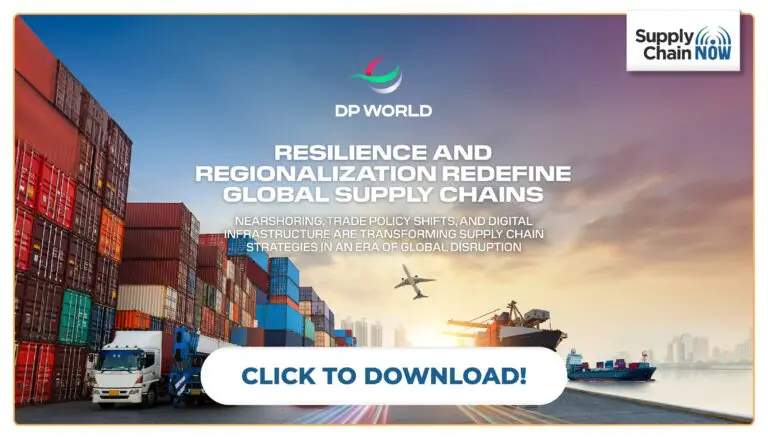
Resilience and Regionalization Redefine Global Supply Chains

Global supply chains are being tested like never before. Rising tariffs, shifting trade policies, and the push for sustainability have accelerated a new era of resilience. Businesses are no longer simply reacting to disruptions—they’re proactively reconfiguring their networks with nearshoring, diversification, and advanced technology.

The latest white paper from DP World explores how companies across the Americas are turning volatility into opportunity by investing in regional supply chains, leveraging economic zones, and adopting digital innovation to stay competitive in a fragmented global market. Download your copy today to see how you can position your business for strength and agility.


What You’ll Learn:

This white paper provides actionable insights for supply chain leaders navigating geopolitical, economic, and technological change. Inside, you’ll discover:

✔ Why resilience now outweighs efficiency: 88% of businesses plan to reconfigure supply chains in 2025.
✔ How trade policies are driving regionalization: New U.S. tariffs are reshaping sourcing strategies and opening opportunities in Latin America.
✔ Where investment is accelerating growth: Nearshoring fueled $36B in foreign investment in Mexico in 2024, with DP World investing $2.5B in logistics infrastructure across Latin America.
✔ How technology is enabling agility: From AI-powered predictive analytics to digital twins, innovation is cutting costs, reducing delays, and future-proofing operations.


Who Should Read This Report
✔ Supply chain and logistics leaders
✔ Retail, manufacturing, and consumer goods leaders
✔ Trade policy and risk management professionals
✔ Investors focused on resilience, nearshoring, and growth opportunities


Why DP World:

As a global leader in logistics, DP World is helping companies across the Americas build supply chains that are sustainable, agile, and future-ready. From freight forwarding and warehousing to advanced digital solutions, we deliver end-to-end resilience in a volatile world.


Don’t let uncertainty derail your supply chain. Download the report and start building resilience today.


Download the white paper here to learn more

More White Papers
White Papers
August 29, 2025

Modified Agile for Electronics Development: A Smarter Path to High-Value Solutions

Modified Agile for Electronics Development Electronics development has never been more complex—or more critical. Traditional waterfall methods often slow teams down with long cycles, costly redesigns, and missed deadlines. While software teams have thrived with agile, hardware development requires a different approach. This white paper introduces the Modified Agile for Hardware Development (MAHD) Framework™, designed specifically for electronics teams. By adapting agile principles to hardware’s unique challenges, MAHD enables faster timelines, reduced risk, and higher-value solutions. If your organization struggles with shifting requirements, late-stage changes, or cross-disciplinary silos, this guide provides a smarter way forward.   Why Download This White Paper?   Understand why traditional methods fall short and how hardware-specific agile solves the challenges waterfall and “faux agile” can’t. Get a clear introduction to the MAHD Framework™, a proven model that accelerates development by 25–50% while reducing costly risk. Learn practical strategies and tools—from system-level user stories and tailored prototyping to Altium’s solutions for agile electronics success.   What You’ll Take Away:   A framework purpose-built for hardware and electronics – not a software agile retrofit Practical methods to reduce wated effort, improve predictability, and accelerate time-to-market Real-world examples of how electronics teams can align strategy, execution, and customer…
forced labor
White Papers
November 5, 2025

Ensuring Forced Labor Compliance in Automotive Supply Chains

Turn data into insight – map, monitor, and mitigate fortced labor risks across your value chain. Since the Uyghur Forced Labor Prevention Act (UFLPA) went into effect in 2022, sub-tier supply chain visibility has become an increasingly critical and ubiquitous prerequisite for import compliance. Automotive companies, due in no small part to their highly complex supply chains, are among the hardest hit by this requirement of anti-forced labor and ESG regulations. A recent study by Sayari analysts found that 95% of leading OEMs’ exposure to forced labor risk comes from sub-tier suppliers. The ability to identify and mitigate risks throughout their value chains is critical for OEMs aiming to minimize operational disruptions, avoid detentions, and maintain competitive advantage. Download the report to learn how Sayari is overcoming barriers to supply chain visibility, enabling OEMs to map their sub-tier supply chains, identify indirect exposure to forced labor risk, and foster greater supply chain resilience in an increasingly dynamic trade landscape. DOWNLOAD NOW