[00:00:00] Jake Barr: The purpose of the data is to give you, to equip you to actually turn it into action. Mm-hmm. Not something you stick in a file cabinet it. The objective is to actually make you step back and think. So if there’s one thing that you can do with the information, it’s actually, as Chris said, over and over look, it’s about using it to better prepare yourself for what you believe the actions might need to be to allow you to keep your supply chains agile and relevant.
[00:00:34] Jake Barr: Quite frankly,
[00:00:36] Voiceover: Welcome to Supply Chain Now the number one voice of supply chain. Join us as we share critical news, key insights, and real supply chain leadership from across the globe, one conversation at a time.
[00:00:49] Scott W. Luton: Hey, good morning, good afternoon, good evening, wherever you may be. A Scott Luton and Supply chain Hall of Famer, Jake Barr with you here on Supply Chain Now.
[00:00:58] Scott W. Luton: Hey Jake, how you doing today?
[00:01:00] Jake Barr: We are ready for another edition of what do the numbers tell us?
[00:01:05] Scott W. Luton: Because the data doesn’t lie. Is that right?
[00:01:07] Jake Barr: It does not lie.
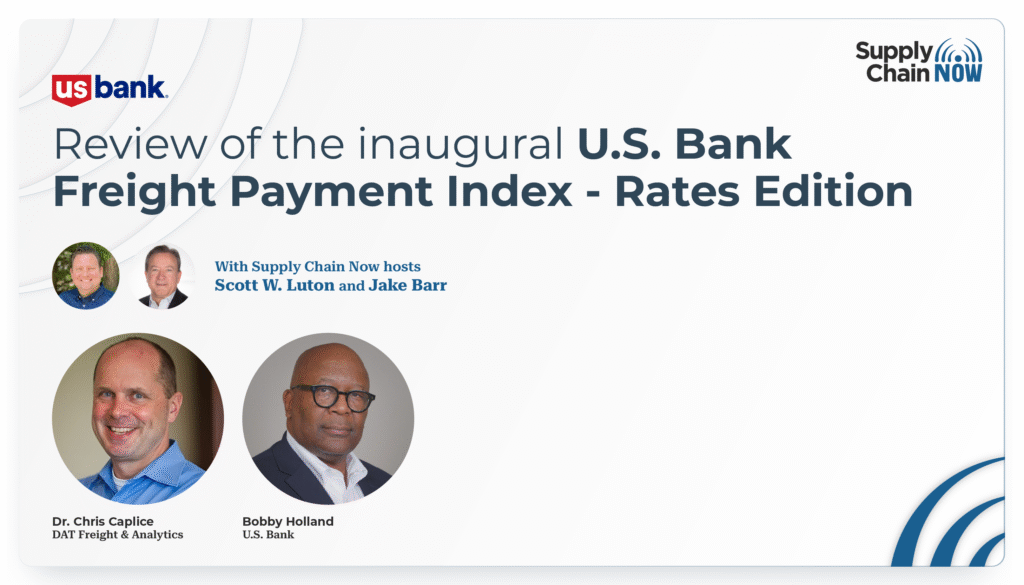
[00:01:09] Scott W. Luton: Folks, stick around. We’ve got a terrific, terrific show here today as we conduct a special edition, and that’s A-D-D-I-T-I-O-N by South Carolina spelling as we continue a long running quarterly series, uh, a really a popular, informative series that we get a lot of feedback around, but we’re diving into the inaugural US Bank Freight Payment Index,
[00:01:32] Scott W. Luton: Rates Edition. So it’s a new quarterly publication that provides valuable freight market information on broadband spot rates, contract rates, fuel, average cost per mile rates whole bunch more, including important economic context and perspective, which is one of my favorite parts. And we invite you, just like you see there on the screen, download a copy.
[00:01:53] Scott W. Luton: Follow right along and wanna get your feedback on, on the data. ’cause it doesn’t lie as Jake has spiked the football on. I wanna let to hear your take now. It’s really important to note Jake, the Rates edition along with today’s conversation is gonna help supply chain professionals better understand what’s going on in the freight market so they can make better informed decisions in the weeks and months ahead.
[00:02:14] Scott W. Luton: And this terrific resource is a joint project delivered to the market. By two data powerhouses. It’s like Hulk Hogan and Andre The Giant US Bank who processes more than $43 billion in freight payments annually. And DAT Freight Analytics, who has an incredible database of more than $1 trillion in freight market transactions is free to access.
[00:02:38] Scott W. Luton: Y’all. Check it out. Download it. Jake, we’ve got a big show here today. Huh?
[00:02:43] Jake Barr: Absolutely, and you’re correct. You got the two powerhouses
[00:02:48] Scott W. Luton: world champions, as the folks used to say back in the day from three syllables to two. So let’s bring in our one-two puncher today, Jake, in addition to your perspective, which is extremely valuable.
[00:02:59] Scott W. Luton: Bobby Holland, director Freight Business Analytics at US Bank and another Hall of Famer, Dr. Chris Caplice, chief Scientist with DAT Freight and Analytics. Hey. Hey Bobby. Welcome back. How you doing?
[00:03:14] Bobby Holland: Doing well. How are you?
[00:03:15] Scott W. Luton: Wonderful. Great to see you and Chris, great to see you here today. Welcome to Supply Chain now.
[00:03:21] Chris Caplice: Thanks. Great to be here, Scott. Good to see you again. Jake.
[00:03:24] Scott W. Luton: We have been ready to go on this one. Jake, are you ready to dive in first with a fun warmup question because it’s football playoff time. Are you ready, Jake? Oh,
[00:03:33] Jake Barr: no. Oh, I’m ready to be punished because these guys have teams still in the playoffs, and I don’t.
[00:03:38] Scott W. Luton: They do. So Chris, I wanna start with you a little fun, warm up question. As I’ve learned in the pre-show programming, you spend a lot of time in Boston slash Cambridge and New Hampshire. You’re a long time passionate New England Patriots fan. So I gotta ask you two part question. Your favorite Pat’s memory in recent years and is New England gonna win it all this year?
[00:03:59] Chris Caplice: Yeah, you know, I don’t have one favorite Pat’s memory. All the duck parades that we’ve had up here in Boston has been an embarrassment of riches over the last 20 years, to be honest. Like they all blur, you know, so many championships, so many rings. But this year, gosh, I hope so. Drake May is just doing a great job.
[00:04:16] Chris Caplice: Drake. Drake, may, may. He’s fun to watch. So it’s nice to see football being exciting back up in New England again.
[00:04:22] Jake Barr: I just, I just heard, I just heard blah, blah, blah. Okay. I’m just saying, you know, you gotta
[00:04:27] Chris Caplice: fix your speakers there.
[00:04:28] Jake Barr: You need to fix Chris. Chris, just thank the Titans for giving you a coach again.
[00:04:33] Jake Barr: There we go.
[00:04:34] Scott W. Luton: If y’all can’t tell everybody, Chris and Jake may go back a decade or three. We’ll see a lot, a lot of, uh, great exchanges coming up and Bobby switching gears. And by the way, Chris, I’m, I’m very jealous of your trophy. Case there with the Patriots. We’re trying to get our first here in Atlanta.
[00:04:49] Scott W. Luton: We’ll see, but you’ll forget
[00:04:51] Chris Caplice: the Red Sox, the Brews, and the Seltz. So
[00:04:53] Scott W. Luton: I, this
[00:04:53] Chris Caplice: includes the whole package, the
[00:04:54] Scott W. Luton: whole package. I’m very familiar. There he
[00:04:56] Chris Caplice: goes.
[00:04:57] Scott W. Luton: So Bobby, now Bobby, your Denver Broncos are two wins away. Big games, but still two wins away from reaching their first Super Bowl since 2016. So as this can be year, they play for it all.
[00:05:08] Scott W. Luton: Bobby.
[00:05:10] Bobby Holland: Oh, I’m just an honorary member of the Denver Broncos fan club. I used to live there, so I kind of haven’t relinquished my full membership yet.
[00:05:18] Scott W. Luton: Yeah.
[00:05:18] Bobby Holland: Um, I don’t think they’re gonna make it all the way.
[00:05:20] Scott W. Luton: No.
[00:05:21] Bobby Holland: Okay. But I’m halfway across the country from everybody that heard me, just heard me say that. So just be safe.
[00:05:28] Scott W. Luton: You’re out of arms reach, uh, Bobby. Uh, I like so we’ll see. I’ll tell ya. I miss the John John away’s got a great new documentary on Netflix, folks, go check it out. Alright, so Jake Pats fan, Broncos fan, lots of playoff football. What’s your take, Jake?
[00:05:45] Jake Barr: I have a feeling that the Pats are gonna be in the Super Bowl.
[00:05:50] Scott W. Luton: Hmm.
[00:05:51] Jake Barr: And I have a feeling it won’t be against the Bears. How’s that? Okay.
[00:05:56] Scott W. Luton: Alright. That’s, that’s a, a fair and safe bet. We’ll see how it plays out and uh, we’ll dive into on, on a lot more future supply chain now shows for sure. Alright, so we got a lot to get into here today and I wanna start with some, a little bit of level setting.
[00:06:10] Scott W. Luton: Chris, it’s great to have, uh, uh, appreciate all your work at industry. Great to have you here today on supply chain now. So if you would tell us a little more about DAT Freight and Analytics. Sure. Then of course everybody, maybe three people out there know And your role there, Chris?
[00:06:24] Chris Caplice: Yeah, sure. I think everyone on this call knows DAT.
[00:06:27] Chris Caplice: It’s the powerhouse. It’s the largest data and analysis firm in the truckload market space that what people might not know is that we don’t just do have products for shipper, for carriers and brokers. We also have a huge portfolio of products for shippers. That’s where I really came in from the Chainalytics acquisition in 2020.
[00:06:45] Chris Caplice: But the, the hallmark of DAT is the massive amount of data that we have and the benchmarking forecasting. And other marketplace services that we provide to really make the entire market more efficient.
[00:06:58] Scott W. Luton: Outstanding. Chris, uh, the best. Get better. That’s kinda what I heard is a theme in your description there.
[00:07:03] Scott W. Luton: Um, one more thing really wanna encourage folks, uh, amongst all the great work Chris, is do in industry. I love the Freight Vine podcast. I think you’re soon to be publishing episode 1 65. So you’ve been at it for a little ways. Love of the great work. The most recent episode was with Kevin Zweier. I got that right.
[00:07:20] Scott W. Luton: That’s correct. Yeah. So folks, check out Freight Vine, wherever you get your podcasts, uh, including Apple Podcasts. Of course. Okay, Bobby. Today we’ve now our sixth year of collaborating, help informing supply chain leaders of what’s going on in the domestic freight markets and helping them border. Make better, faster, more confident decisions.
[00:07:41] Scott W. Luton: So two questions for you. We’ll start with the first one.
[00:07:44] Bobby Holland: Mm-hmm.
[00:07:44] Scott W. Luton: Tell us if you would, about the US Freight Payment Index for folks out there that may, may still be behind things. Okay.
[00:07:53] Bobby Holland: Well, the US Bank Freight Payment Index is our primary viewpoint, our representation of the market, the truck freight marketplace that’s informed by more than $43 billion worth of payments last year.
[00:08:06] Bobby Holland: Numbers for 20. Anyway, it’s in that, it’s in that ballpark.
[00:08:11] Scott W. Luton: Right, right, right.
[00:08:12] Bobby Holland: Plus minus. But the point is we have a huge amount of data and we want to, like you said, enable our subscriber base to at least have some more data points as they look to make the right business decisions, um, in this marketplace.
[00:08:27] Bobby Holland: And this is how we present it.
[00:08:29] Scott W. Luton: Love it. And as y’all saw there, if you’re tuned in and watching us, I love the overarching, but also the region by region views. And Jake, really quick before I continue on, as we get Chris and Bobby to weigh in on, uh, this new addition, the rates edition, the value, Jake, speak to the value of the Freight Payment Index.
[00:08:48] Jake Barr: Look, the site, as we all know, the supply chain is in a new world of never normal. And as a supply chain leader, you’ve got to be able to take advantage of ingesting as much information you can around not only what the marketplace is doing in total, but then layers of that because your business has many layers to it.
[00:09:09] Jake Barr: So fundamentally, having both of these. Operations provide perspective is really crucial because you’ve got to be able to, to make progression, projections about the day-to-day operations, where the shortages, the, the impacts they’re gonna have, and especially from a cost perspective.
[00:09:27] Scott W. Luton: That’s right. Well said, Jake.
[00:09:28] Scott W. Luton: Someone been there and done it for sure. All right, so Bobby, today of course, we’re diving deep into the brand new rates edition of the index. It’s gonna bring a lot more value to these quarterly releases that have really. Uh, y’all have gotten a lot of feedback from the market around. Tell us how this came about and what’s unique about this supplementary edition.
[00:09:49] Bobby Holland: Well, we have a partnership with, with da, uh, that’s growing and as part of that partnership, we thought that, okay. In the Freight Payment Index, our main publication, we often talk about spot and contract rates and how they’re either affected by, or how they affect the truck market space. And so we thought that it would be, you know, again, in the interest of providing more data points for our, our consumers, that if we met with the, we’re arguably the number one freight payment, freight out and payment provider partnering with debt that we could shed some more light on, again, the effects or the effects or impacts of rates in the marketplace.
[00:10:33] Bobby Holland: Again, we mentioned it in the Freight Payment Index, and this is more of a. I’m more focused on the rates only and not the general broad or regional market space. We try to be informative.
[00:10:42] Scott W. Luton: Yes, and y’all do a good job there. Chris, what would you add to the rates edition here?
[00:10:48] Chris Caplice: Yeah, mainly just echo what Jake and Bobby said.
[00:10:50] Chris Caplice: What we’re doing is combining the expertise and reach of two powerhouses and experts in there in their areas and bringing those together, and it’s really nice to see the combined effort of that really give a holistic picture of the market.
[00:11:02] Scott W. Luton: Well, well said Chris. We’re gonna dive into all of that. Bobby, Chris and Jake, and again, folks, you’re gonna find a link to download your own copy, spill coffee on it.
[00:11:11] Scott W. Luton: If you like to print it out. If you’re a hard copy guy like I am, sometimes mark it up, dog gear, you name it. But we’d love to get your take on it all. Jake, before I move on and we get into the national picture and what the story is and some data points, anything you’d like to add about the value you see as someone that’s been in industry?
[00:11:28] Scott W. Luton: Leadership circles for quite some time about what this rates edition will bring to the table.
[00:11:33] Jake Barr: I want to underscore what they’ve already offered up, but more importantly, if you even just looked at your baseline graphic or what you put onto the screen, even an average supply chain leader, I hate to say it this way, but Chris and the rest of ’em, they’ve got the understanding of this.
[00:11:47] Jake Barr: If you go vertical by vertical or a subset of what categories and what companies you’re dealing with, whether it’s a Fortune 50 or. Fortune 200 or a Fortune 500 company. There’s a large disparity between how well prepared folks are and what I call delivering standard operating practice of how much is really a contracted base carriage, and how much is spot market to, to blend and bridge.
[00:12:15] Jake Barr: To what you’ve got contract and, and that could be by region, it could by, could be by type of transportation, et cetera. So you get yourself exposed a lot to being potentially hit by, you know, needing to rate buffer as I call it, to close those gaps because you don’t have a robust enough overall transportation strategy or you haven’t done enough scenario analysis to understand hey.
[00:12:42] Jake Barr: We’re really exposed in this segment, so this is great to help quantify and provide a light to folks who haven’t done that work yet.
[00:12:52] Scott W. Luton: Bill flashlight mag light. Uh, I love that, Jake. Well said. Okay, so let’s do this. I wanna get Bobby and Chris to weigh in. I’ve got the lead graphic. Bobby, first at a high level, just the data points themselves.
[00:13:05] Scott W. Luton: This is gonna look a little different than the regular quarterly Freight Payment Index. Just kind of unpack what we’re looking at here first. Bobby.
[00:13:12] Bobby Holland: Yeah, what we’ve got here, uh, we’re showing again the the spot contract spot and contract rates for, and the fuel rates per mile for dry van. And the reason we chose to focus on dry van is because that’s the bulk of the data that we receive from DAT.
[00:13:30] Bobby Holland: And so it has the clearest signal as far as, you know, gauging, uh, the impacts and like I said, how they’re impacted by the marketplace. So what we see here is. It’s interesting to see that contract rates were pretty level, which is what you would kind of expect. There’s been minor variations. There’s been more variation in the spot rates, but from a low in October, pretty good rise in November and then dipping again, uh, into December.
[00:13:59] Bobby Holland: But the interesting thing to note is if you look at the volumes that supplier that provision these numbers, we can see that. The both rates remain pretty, pretty up there for what they are on a lot less volume and part of that seasonality. But part of that is, is continuing to paint a picture. Perhaps that capacity is still tight and costs are high, uh, being passed on to the shippers.
[00:14:27] Scott W. Luton: Yep. All right. So Chris, we’re gonna get into what the data’s telling us at a national level in a minute. But before we get there, ’cause I wanna do some, some, um, some foreshadowing there, Chris, just react to what we’re measuring, what we’re capturing here. Your take on, on, on its value. What would else would you add to what Bobby shared?
[00:14:46] Chris Caplice: Yeah, I think what the data that you have here really reflects the breach that DAT has. The contract rates are coming from shippers and what they pay for the contract rates. These spot rates are actually what the broker pays for that. And this is really important to see how the broker buys versus how the shipper buys.
[00:15:03] Chris Caplice: Because as, as Bobby was saying, spot rates are much more volatile. Mm-hmm. They’re the canary in the coal mine. Seeing how they’re being procured in the market is very helpful. ’cause that gives you a leg up on what happens. It’s usually about a three to four month lag. But what we’re able to show here is not just contract rates in this, but show the the leading indicator, which is really spot rates.
[00:15:23] Chris Caplice: And below that we have the numbers. Numbers don’t lie. We’re telling you exactly the numbers that we have in terms of. Of contract and spot. We have a ton of contract rates, but we’re the only real provider of all of those spot rates. Like I said, that’s the leading indicator in this market.
[00:15:39] Scott W. Luton: Chris, uh, really appreciate you putting a, a fine, uh, point on the pencil there.
[00:15:44] Scott W. Luton: Probably messed up that analogy, but y’all know what I mean. Jake, what would you add, especially on the value of any canary in the coal mine and being able to kind of get a sense of, of where we’re going in the future? Uh, what’s around the corner? Your thoughts? Jake?
[00:15:56] Jake Barr: I’m already choking on the data. That.
[00:15:58] Jake Barr: That’s the canary in the coal mine. I’m already looking ahead and as a supply chain leader, I’m going, I don’t like that picture.
[00:16:05] Scott W. Luton: Mm mm And the data doesn’t lie, folks, we’re gonna keep hammering that home throughout today’s session. So let’s do this. We’re about to get a better sense of what. This first snapshot, all the data and economic industry insights are telling us.
[00:16:20] Scott W. Luton: But before we do, I wanna share just a couple of data points from across industry. Nothing’s gonna surprise this panel and nothing’s gonna surprise our bet. The smartest audience, all of global supply chain that’s, uh, our supply chain now, global fam. So let’s do this first, as reported by manufacturing dive, the ISM manufacturing, PMI shows.
[00:16:40] Scott W. Luton: That the manufacturing industry in the US contracted, at least according their data for the 10th straight month and finished with its lowest reading of 2025 in December. Now, there’s a little bit of good news. Perhaps there were signs of life with positive movements and new orders, backlog of orders, and new export orders.
[00:16:57] Scott W. Luton: But the flip side, the jury’s out. That’s just like a little blip. We’re the start of a little bit of, little bit. Give me a little bit of momentum. We’ll see. Secondly, on the consumer spending front, the National Retail Federation data shows that total. Retail sales in November and December, 2025. Grew month over month as well as year over year.
[00:17:16] Scott W. Luton: I’ll take it. Inflation may be had a little roll there. And finally, as the rates addition mentions according to transportation insight and the FMCSA more freight carriers are exiting the market. Then entering, you can sh, you can see it right here by comparing the net carrier revocations and the new carrier authorities from the FMCSA.
[00:17:37] Scott W. Luton: So, Chris, I wanna come to you now that we’ve got an understanding of what the rates edition shows, and now we’ve got some of the things we’re looking at nationally and regionally, nationally. What’s all this telling us? What’s the story here, Chris?
[00:17:51] Chris Caplice: Yeah, so we all lived through the pandemic, but it’s hard to believe that the pandemic has been over for four years.
[00:17:57] Chris Caplice: So it, it’s crazy. We still have that in our memory. Uh, we saw the rates go up. We saw the rates crash. We’ve been in a trough for the last two and a half years.
[00:18:03] Scott W. Luton: Hmm.
[00:18:04] Chris Caplice: And what we’re seeing in the data in this report, as well as what we’ve seen over the last six to 12 months. Is it a slowly we’re slouching towards recovery?
[00:18:12] Chris Caplice: And to Jake’s point, how you feel about this market depends on where you sit.
[00:18:16] Scott W. Luton: Mm.
[00:18:16] Chris Caplice: If you’re a carrier or a broker, you’re saying happy days are finally coming. The market’s tightening up a little bit. If you’re a shipper, you know you had your day, it’s gonna be tightening up, but it’s not gonna be a sudden peak.
[00:18:27] Chris Caplice: It’s gonna be a slow. Grind above equilibrium. We’re seeing the market tighten but not dramatically.
[00:18:33] Jake Barr: Hmm. I’m looking for the defibrillator already.
[00:18:36] Chris Caplice: Oh, come on. Come on. This is nothing compared to 2020 to 2022.
[00:18:41] Jake Barr: Oh, oh. Yeah, but see, I, I was already in, I was dead, declared dead three times during that. Just bringing it back.
[00:18:49] Jake Barr: You know, every time you, you were
[00:18:49] Chris Caplice: golfing, you were golfing then
[00:18:51] Jake Barr: Jake, far every time, every time you came back, the rates shocked you back into it.
[00:18:55] Scott W. Luton: Mm-hmm. Yeah. We know, I love that phrase, slouching towards recovery. Right. And I also, Chris mentioned that, hey, the shippers, Hey, had your had your days. We’ll see where we go from here.
[00:19:06] Scott W. Luton: Uh, Bobby, I wanna get you to also tell your story of what you see here across, uh, this, the rates and the data and, and things going on in the marketplace. What are your thoughts there, Bobby?
[00:19:17] Bobby Holland: Well, like I said, um, the contract rates have been steady. As we quoted in our document, it says that it, perhaps it gave carriers and shippers, you know, some time to, to figure out their next moves.
[00:19:29] Bobby Holland: But again, the biggest thing to note is just how markedly the volumes dropped, but the, the prices did not. So that’s, and for all the reasons that, you know, we, our, our data sees the same thing that Chris and Jake brought out about carrier capacity. It is tight. It used to be driver shortages. Now it’s expensive drivers.
[00:19:51] Bobby Holland: Again, the, the, the stuff that’s happening with, uh, the driver’s li the licensing, lot of stuff. And then of course tariffs are always still working in the background. They’ve kinda leveled out as far as their volatility, but they’re still there and they’re still impacting. So there’s a lot of variables in the marketplace that are impacting, which is why it’s kind of good to see this view of rates.
[00:20:12] Scott W. Luton: Yes. Good stuff, Bobby and Chris. All right, so Jake, I want, I wanna get you to comment as well on the story, but first I gotta give you a little credit. Jake, Bobby mentioned tariffs. Some folks were looking at yesterday of what the Supreme Court would do, and you were right on Monday. Jake, you said the Supreme Court’s not weighing in on, on Wednesday, so I gotta give you a, a victory lap first, Jake, and then tell us your take on the story here that folks should pay attention to.
[00:20:37] Jake Barr: Well, I mean, Bobby and Chris just unpacked a bunch of stuff there. But you know, the Also, let’s not forget, the data doesn’t lie as we said, but you dropped some trinkets and some nuggets on some. Corresponding information around the manufacturing index. Uh, a few other things. So realistically, in one way, this is a kind of a corollary to what Chris was talking about.
[00:21:01] Jake Barr: Hey, you had your day as a shipper. Well, guess what? I had my day as a shipper, but. If manufacturing in the US continues to contract at its current pace, that’s gonna put even more stress on fewer shipments to pick up. But actually to the contrary with the what’s happening from a consumer spending standpoint and at least the number of categories, you’re getting an increase in actual freight movements, right?
[00:21:28] Jake Barr: Mm-hmm. It’s a ju act. Right. That’s why we depend upon these guys to be able to do it, because I don’t want to use my old magic eight ball to make the choice.
[00:21:37] Scott W. Luton: And Chris alleged, you spent all your time in supply chain on the golf course. That, that, that can’t be the case. Right. And
[00:21:44] Jake Barr: that’s just not true. But that’s okay.
[00:21:46] Jake Barr: I’ll get him back.
[00:21:48] Scott W. Luton: All right. During the
[00:21:49] Jake Barr: pandemic? During the pandemic.
[00:21:50] Scott W. Luton: Oh, gotcha. A little, little clarification. Okay. All in good fun. Um, okay. So let’s get into, there’s so much that we could be here for hours, uh, and we got the right panel to do that for sure. But what are some of the most important and regional observations, Chris, or just other callouts that folks gotta be and shippers in particular gotta be aware of?
[00:22:10] Chris Caplice: Yeah, the report itself calls out a couple things about increasing the Northeast and, and the effects of the Southeast, but I think what’s really happening over the last month, we’re seeing. A, a really more rapid rise in spot rates, especially for temperature control coming out of Southern California or out of the Northwest.
[00:22:28] Chris Caplice: And a lot of this is due to agriculture. The spot rates are definitely increasing up. Contract rates are staying steady when they’re being adhered to. But spot rates, you’re gonna see 30, 40% increases for many different reasons, holiday weather, but also some other situations with English language proficiency.
[00:22:44] Chris Caplice: And non domicile regulations being more enforced, those areas are much heavily populated with drivers that are at risk for that. Nationally, we won’t see as much of a, of an impact, but regionally we could see large localized impacts.
[00:22:59] Scott W. Luton: Hmm. And Jake, this is something we were talking pre-show for us. Uh, prompt Bobby, your thoughts Jake, on the impact to drivers in certain regions of the, uh, the country.
[00:23:10] Jake Barr: I, it’s, as Chris said, it’s extremely volatile at the moment. I mean, now there I, it’s almost, we’re playing whack-a-mole, right? If we end up having an impact of, well wait, we’re deploying ice to certain parts of the country, there’s a little bit of a delay. But as Chris outlay, we, we’ve got drivers that don’t want to go to certain places, right?
[00:23:35] Scott W. Luton: All right, so, and Chris, uh, I’ll circle back in case there’s anything else you wanna share. We’re gonna get some fearless predictions. We’re gonna get some predictive advice for actions that supply chain leaders should take as well. So folks, stick around. Alright. So, Bobby, regional observations or any other call outs that, specific call outs that are viewers and listeners should really be taking note of?
[00:23:56] Bobby Holland: Sure. Uh, when we looked at the treasury data. In conjunction with what we’re seeing in the DAT rates, it’s kind of been alluded to, but in the Northeast has slightly stronger outbound volumes due to manufacturing and uptick in retail activity. I think that was also shown in, in the slides that you put up the southeast as a weaker job market and softer consumer spending.
[00:24:21] Bobby Holland: So that kind of balances it out. And then we also have issues in the Midwest with cross border traffic. Uh, as well as, uh, refinery issues, which kind of helps to explain some of the fluctuations in fuel rates and fuel prices.
[00:24:35] Scott W. Luton: Yeah. Alright, so, uh, good stuff there Bobby. I, I think Jake, Jake, you’re pretty accurate with that whack-a-mole analogy as, as a kid that went to showbiz pizza all the time and lost at that game all the time.
[00:24:48] Scott W. Luton: That there’s some supply chain relevance there for sure. Chris, before we get into talking about some actions that supply chain leaders should take, given everything we’re talking about here today, is there anything else, I know you’ve got, you’ve got your finger on the pulse like few do in this industry.
[00:25:03] Scott W. Luton: Is there anything else you’d like to call out? Chris.
[00:25:06] Chris Caplice: No, I think, um, some of the charts that you showed, the, the, uh, carrier authorizations, how those are declining, everything that masks some things. What we’re really seeing is that a lot of the larger fleets have been shedding their over the road random freight.
[00:25:19] Chris Caplice: They’ve been shifting to dedicated ’cause. Dedicated is more profitable. You see it, it’s, it exceeds the amount of contract one way over the road, val volume that’s out there. So we’re seeing a shift also from what’s being considered for contracting going over there. And so are there fewer drivers? Sure.
[00:25:35] Chris Caplice: We’re seeing capacity decrease a little bit for some of the reasons that Jake was saying as well, but not to the level that I see a sudden. Really contraction that’s gonna drive rates up. I see. Again, a slow, steady equilibrium. ’cause we’ve been below market for a long time now. Yep. And, uh, the, the spot carriers can’t go any lower in tho in those regions.
[00:25:57] Scott W. Luton: Jake? Uh, I think what, whatever, uh, Dr. Chris Caplice says, I think you, that’s pretty good to take to the bank. He’s been doing this for a little while. Huh? Jake?
[00:26:05] Jake Barr: No, he’s completely spot on on that. I
[00:26:08] Chris Caplice: couldn’t agree. I think Bobby’s the bank. I’m, I’m not, I’m, you know, I’m just saying.
[00:26:12] Scott W. Luton: So Chris and Jake specifically for y’all in these next two questions, when you think Chris, of actions that supply chain leaders should be taking, given all the things we’ve talked about, the data-driven insights, it’s not lying to us.
[00:26:26] Scott W. Luton: Sure. What comes to your mind that you’d like to share? Not just from a shipping perspective, but also you know, a general. Business planning perspective.
[00:26:35] Chris Caplice: You gotta understand for shippers there, people who have been buying transportation, they’ve been accused of crying wolf for two years now. This is the third cycle.
[00:26:43] Chris Caplice: ’cause we all thought the market would turn a little earlier and it didn’t. We thought this time last year was definitely gonna turn, and then the tariff, uh, carousel came out and every seven days a new tariff changed. We’ve gotten better at that. We’re absorbing that and we’re understanding that tariffs really aren’t affecting the volume as much, mainly changing the ports of origin.
[00:27:01] Chris Caplice: So what I would say what shippers need to do is build their base, make sure their house is ready, and just get those sustainable relationships for when the market does turn. ’cause it will turn. It’s not like, you know, we have memory here. We’ve seen how these, uh, it’s a very cyclical market. Get ready for it.
[00:27:18] Chris Caplice: Build in your base. Get your asset base carriers in your collection of non-asset based, and be ready for when the market does turn. Repair your wool roof now before it starts raining.
[00:27:27] Scott W. Luton: I like it, Chris. And don’t, and, and build outta bricks. No straw.
[00:27:31] Chris Caplice: Yeah. Don’t
[00:27:32] Scott W. Luton: use sticks. Straw. Build that basis, said. Now, Jake, I don’t wanna, uh, put words in your mouth, but we were talking pre-show, we were talking about, you know, level loading and, and leaning less on spreadsheets, moral, modern, innovative technology scenario, modeling, touch on some of those things.
[00:27:46] Scott W. Luton: And what other actions you think supply chain leader shippers and general business leaders should take.
[00:27:51] Jake Barr: Yeah, I mean, to Chris’s point that those are just incredibly accurate statements of what you should be doing and, and unfortunately it’s shame on you if you didn’t learn from pre pandemic and pandemic situations to where you actually needed to be doing some of that get ready work of saying, Hey, I’m gonna analyze.
[00:28:13] Jake Barr: All my freight moves, I’m gonna set up more dedicated loops. I’m gonna be a little more selective in how I build out the network to involve some partners so that I can add more contracted loops. And I’m going to add the scenario analysis that allows me to think about if I’ve done my prep work of building a bit more agility of how I’m able to flex my manufacturing processes.
[00:28:38] Jake Barr: Because if I can stabilize. I don’t need to have a huge peak next Wednesday or the following Tuesday after that, I can literally level my, set my way out and work it, even with my contract relationships with a lot of my call distributor retail partners.
[00:28:56] Scott W. Luton: Hmm. Uh, good stuff there, Jake. Lots of practical perspectives.
[00:29:01] Scott W. Luton: One of my favorite parts about these conversations. And now Chris, I’m gonna start with you here. What are a couple of developments that supply chain leaders should keep their eye on? In the months to come, weeks to come, months to come. Your favorite cadence there, or do you have any bold prognostications other than the Patriots winning it all again this year?
[00:29:18] Chris Caplice: Yeah, sure. I mean, so I think just keep on on track of how things are moving. Keep your eye on the spot markets. Not just the vera all in drive and still look at the, the spot mark for temp control. ’cause they all influence each other. And so the big thing that I would tell this for shippers is that un, you know, we see this uncertainty in the market, but a lot of the uncertainty is self-inflicted.
[00:29:40] Chris Caplice: The planning department doesn’t always talk to marketing. Uh, it doesn’t talk to transportation. A lot of times transportation, especially the procurement and execution are the flea on the tail of the dog. And so a lot of this uncertainty that the. That shippers face when they’re procuring transportation and having all this, this really volatility is self-inflicted.
[00:29:59] Chris Caplice: And so I would highly recommend you talking to your marketing teams. You know, we get hit in the face with promotions we didn’t know about, and suddenly, yeah, you need 12 trucks today out of Albuquerque. And so the whole idea is work internally, and that’ll help reduce some of the uncertainty and volatility you see in the market.
[00:30:16] Chris Caplice: Okay,
[00:30:17] Scott W. Luton: Chris. I think that is a very sound prediction of what’s to come because it’s timeless. Jake, as old as the notion of communication is, we still stink at it. So oftentimes, uh, Jake, absolutely, but,
[00:30:32] Jake Barr: well, I’d use a different word for it, but yes, you are correct. You’re
[00:30:36] Scott W. Luton: correct, the Jake. So Chris gave us a little bit of predictions and what you can do about it.
[00:30:41] Scott W. Luton: Uh, in the months ahead, Jake, what are some of your prognostications of what we might see?
[00:30:46] Jake Barr: Well, I’m going to prognosticate for you that a number of the largest tariffs are gonna be ruled illegal, and then you’re going to have to balance, and you’re, by the way, that doesn’t mean they’re going away. They’re.
[00:31:01] Jake Barr: Portions of those are gonna come back in different forms because the administration has already signaled that it is going to take different actions. Right Now, what does that mean? If you’re a shipper and you’re in a transport side? I’m sorry guys, but we don’t pick up a plant and move. On 24 hours notice.
[00:31:23] Jake Barr: So even if tariff has changed, right? We’re still gonna have a flow of goods. Now what we may do is we dramatically change the pricing of those goods, right? Mm-hmm. But we also have goods that are in in flight, in movement, right? In trucks. ’cause transportation’s all about moving, right? So fundamentally, this is one of those shame on you if you haven’t already started.
[00:31:48] Jake Barr: Playing the what if games and the scenario modeling of how you’re gonna pivot and shift. I may pivot and move stuff to, again, another state, another country, et cetera, et cetera, right? I’m gonna change suppliers, right? I had two principle suppliers for packaging materials or a key ingredient, and they were from different regions of the world.
[00:32:10] Jake Barr: I may pivot. Guess what? We don’t have the teleporter from Star Trek yet, so you’ve got lead time. You’re gonna have to, so it’s otherwise called, Hey, the emperor’s gonna be naked if you haven’t gone in and already done your pre-work. So if you, if you’re waiting for that magic eight ball to give you the answer, you’re too late.
[00:32:30] Chris Caplice: Yeah. That’s a Jake Deford. A hundred percent. And in fact, shippers need to, and they, most of ’em have the four corner strategy for imports. So I have stuff in the northwest, the northeast south, and the gulf was the fifth, fifth corner. So if you don’t have your sandbox built, you don’t have flexibility in real time.
[00:32:46] Chris Caplice: So you gotta build that ahead of time to have real time flexibility.
[00:32:50] Scott W. Luton: Billion dollar advice here from the panel and folks, Bobby can perfectly predict the future, but fiduciary regulations prevent us from getting his own thoughts with those questions. If y’all have been watching this show for six years, you know that already, and Bobby, you, but you were gonna comment on something.
[00:33:06] Scott W. Luton: I think Jake or Chris said just a second ago, did I miss something Bobby?
[00:33:09] Bobby Holland: I just said, these guys are killing it with these metaphors.
[00:33:11] Scott W. Luton: Oh, they are. You can tell they’ve been around. They have done some things together in their time and industry. I’m gonna have a little bonus question here, Jake and Chris, and if you don’t wanna weigh in on it, it’s related to the man, any potential manufacturing pulse that a lot of folks have had.
[00:33:30] Scott W. Luton: A lot of different predictions from the reshoring impact to tariffs, to whatever. Lots of different takes out there. And of course, we shared a minute ago. We’re one set of data shows that the manufac, the US manufacturing industry has been. Any comments, Chris? Any predictions, just any observations on what 2026 may mean from a US manufacturing activity perspective?
[00:33:55] Chris Caplice: Yeah, sure. I, this is a little bit outta my area of expertise, but you know, I have a PhD so I can have an opinion on everything. Um, so I agree with, with Jake, if you suddenly have a tariff that says, you know, it doesn’t make sense for me to produce something in this certain place that could go away. What we saw was that these tariffs, they’re negotiating standards.
[00:34:14] Chris Caplice: They’re not tariffs, they’re negotiating employees. So no one’s gonna make a billion dollar, a hundred million dollar investment. On something that could go away in in three weeks.
[00:34:23] Scott W. Luton: Yeah.
[00:34:23] Chris Caplice: And what we’ve found is we’ve done a study up here at MIT, we’re looking at the tariff elasticity. If I raise the tariff on a certain.
[00:34:30] Chris Caplice: Goods in a certain country, we can measure what the decline’s gonna be, but it’s gonna go somewhere else. It’s not like we’re gonna suddenly not be demanding these things as a consumer in the us. It’s just gonna come from somewhere else. And if it stays in Southeast Asia, it’s probably still gonna come through the West Coast port.
[00:34:46] Chris Caplice: Right. Some might come to East Coast, so it’s really not gonna, in my opinion, change the amount of flow coming in. Maybe points of origin coming into the country, right? But I don’t see massive investment changes being made on a tariff that could change it that. Drop of a hat,
[00:35:02] Scott W. Luton: Chris, I love it and I wish we could, uh, I wish we had him a couple more hours with you ’cause you should have a opinion.
[00:35:07] Scott W. Luton: And I love your comment about a PhD. I can have a opinion on anything, anytime you wanna talk manufacturer or supply chain. Chris, you come on back. Jake, I wanna pull one thing out that Chris mentioned because I just saw a headline, I think it was yesterday. Talk about lip service, about what tariffs would do versus reality.
[00:35:23] Scott W. Luton: I think China has had a banner year in exports as they strengthened relationships around the globe. So we’ll see. Yeah, we’ll, we’ll, we’ll see where, where that leads. But Jake, your thoughts on manufacturing activity, what we might expect rest of the year.
[00:35:36] Jake Barr: Yeah, I’ll, uh, I’m gonna back up the truck on a couple of the comments Chris made because, uh, while he, he says he is, uh, he’s really the master transportation, which he is by the way.
[00:35:46] Jake Barr: Chris has deep. Broad supply chain knowledge. So fundamentally, here’s one thing that I think we’re also cemented on. You don’t make a knee jerk reaction on a hundred million dollar to a billion dollar investment around a physical plant structure and infrastructure just because somebody says, well, guess what?
[00:36:08] Jake Barr: We pulled it, we changed our mind. We’re not gonna have the tariff today. Well wait a minute. A few weeks ago and a few months ago, that’s what we said, right? So. Here’s what I know to be true and what I see happening across all the US manufacturing base companies that were reticent to actually invest more in further process automation have now leaned into it.
[00:36:34] Jake Barr: So what are they doing? They are pro trying to provide a. An ability to up their agility gain by further automating some sub-processes. Now that’s not just robotics. Mm-hmm. Okay. That’s material handling investments and a number of other things, and that is happening across the board. So it’s gonna be a great year for the investments in further process automation and decision automation fronts.
[00:37:07] Jake Barr: As it pertains to what you were saying though, Scott, around physical footprints, that’s just simply, I’m sorry, you’re smoking dope. If you think there’s gonna be major, major weight, we just pulled the tariff and now we’re gonna build a a billion dollar factor. No, we’re gonna, it’s gonna require a period of stability.
[00:37:28] Chris Caplice: Yeah. And to add to that, Jake, suddenly, if manufacturing jobs came, talk to anyone in manufacturing and there’s a labor shortage.
[00:37:35] Jake Barr: Oh, there
[00:37:36] Chris Caplice: is. Yeah, you, I mean, it’s across the board. You can’t find it. And our immigration policy is not making that easier, to be honest. So I agree with Jake a hundred percent that all the investment is going into process improvement, whether it’s gen AI for.
[00:37:49] Chris Caplice: For service process or actually automation. It’s, it’s changing the game. Mm-hmm. And making people be more flexible in real time. And
[00:37:56] Jake Barr: Scott, it’s putting a premium back on, as you and I have talked on other episodes around upskilling of the workforce because
[00:38:04] Bobby Holland: Yes.
[00:38:05] Jake Barr: Wait a minute. The workers I had when we’re talking, when Chris and I are talking about labor short, da da da, what?
[00:38:12] Jake Barr: Wait, I, I, I actually, I could use the people I have, but I actually ha need to have ’em have. If I’m gonna do this automation work, they need more skills than they had before.
[00:38:22] Scott W. Luton: Right. Uh, I wish we keep this conversation going. I’ve got a quick, quick follow up question. What signals are you following that indicates the tariffs could be deemed illegal?
[00:38:33] Scott W. Luton: Jake, and by the way, Chris mentioned how they’re more negotiating ploys perhaps than anything else. I think there’s a lot of truth to that. Jake, what else would you add? What leads you to believe that they’re gonna be, uh, deemed illegal?
[00:38:45] Jake Barr: Well, this is where as a supply chain professional, you’ve gotta have members of your team that are.
[00:38:50] Jake Barr: I’ll call it duty rates and tariff specialists as well.
[00:38:53] Scott W. Luton: Right.
[00:38:53] Jake Barr: So I, I had a number of ’em on my team and so I stay in constant contact with them. And there’s a broader, I’ll call it fraternity of folks that do that work, but they know every tariff at the every government reg. And they can point to, hey, they’re gonna pull this off, but they’re gonna try and reinsert either this act or this act, which would allow this sub components and these set of ingredients and materials to still semi be tariffed.
[00:39:23] Scott W. Luton: Mm.
[00:39:23] Jake Barr: Instead, but it’s gonna be called a fee structure instead of a, it will be called the same. Now there’s still legalities around whether those will stick,
[00:39:32] Scott W. Luton: right? Yeah.
[00:39:33] Jake Barr: But the point is, and what Chris and I were getting at a few minutes ago is. Wait a minute, I’m not gonna make a billion dollar investment just because we’re playing whack-a-mole.
[00:39:45] Jake Barr: Right?
[00:39:46] Scott W. Luton: So true. And, and, and to your point, both your points and some of the things Bobby touched on, there’s been various mega projects, uh, uh, uh, come to a crawling stop, including a couple here in our home state of Georgia. Uh, we’re tracking. Okay, Chris, I think you were gonna add one more thing and then we’re gonna, we’re gonna circle back to Bob and make sure, but know, has that, knows how to connect what you’re saying, Chris?
[00:40:08] Chris Caplice: Yeah, so this is a really good example of when you can use the difference between effects and events. Um, there’s a lot of events that can happen, uh, tariffs, uh, pandemic, um, fire, whatever that can cause where you can’t get material from a certain area anymore. And so instead of focusing on predicting all these different events that can happen, think about the effect and the effect is.
[00:40:29] Chris Caplice: I can no longer source from a that country. The product’s not coming from China. So I need to build in the flexibility to be able to react to that.
[00:40:37] Scott W. Luton: Yeah.
[00:40:37] Chris Caplice: So it goes all back to being able to set your strategy and be prepared to be dynamic and fluid and agile in real time.
[00:40:45] Scott W. Luton: Yeah,
[00:40:45] Chris Caplice: and you gotta prepare for that ahead of time, but you don’t need to prepare for one future.
[00:40:50] Chris Caplice: Be prepared to be agile.
[00:40:51] Jake Barr: Chris and I have hung out with a guy named Yoshi Sheie for too long,
[00:40:55] Scott W. Luton: too
[00:40:56] Chris Caplice: long.
[00:40:56] Scott W. Luton: Another Hall of Famer. Build that base. Build that base, as Chris said earlier. Love that, love that. Final piece of advice too. So let’s do this, Bobby. We have, I’ll tell you, we brought the right panel here today.
[00:41:07] Scott W. Luton: Bobby, I’ll tell you when you’re, when you publish all of this wealth of data, your teams between US Bank and DAT, freight and Analytics, but it leads to these types of discussions. Right, and versions of these discussions and supply chain organizations and meeting rooms, or you name it elsewhere, Bobby, that’s gotta be fulfilling and really rewarding to you.
[00:41:30] Scott W. Luton: Huh?
[00:41:31] Bobby Holland: Yes, it is. It’s like, uh, I’m gonna put my metaphor out there. It’s like inviting people to the party and then being happy when they show up.
[00:41:39] Scott W. Luton: It’s so true. And then they start dancing and enjoying the food. So a lot of good stuff there. So, Bobby, let’s make sure we’re, again, we’re showing the rates edition.
[00:41:48] Scott W. Luton: You’re gonna find these rates, these tracks, these graphs, uh, on top of the new rates edition supplemental piece to the US Bank Freight Payment Index. So Bobby. How can folks find it and subscribe to it? We got the link right there. Is that just that easy, Bobby?
[00:42:04] Bobby Holland: It’s that easy. Same as the Freight Payment Index.
[00:42:06] Bobby Holland: It’s freight.usbank.com.
[00:42:08] Scott W. Luton: So it is just that come your
[00:42:11] Bobby Holland: email. Your email,
[00:42:12] Scott W. Luton: and hey, we want to hear from you. Let us know. I know that both teams here would love to get your take. Constructive criticism, positive feedback, you name it on this new rates edition. So let us know. Dr. Chris Caplice. I tell you what, no wonder you’ve got a podcast, uh, in your approach, 165 episodes because this, this is, I think we got a little snapshot of the value of Freight Vine.
[00:42:36] Scott W. Luton: And folks, we, we encourage you to go check out Freight Vine wherever you get your podcast. How can folks connect with you, Chris, and the DAT Freight Analytics team?
[00:42:44] Chris Caplice: Yeah, just reach out, just Google, DAT. It’ll pop right up. But again, if you’re a shipper, look at our freight and analytics benchmarking. If you’re a broker, we have so many tools out there for you and as a carrier as well.
[00:42:57] Chris Caplice: Uh, the load boards and other DAT one applications, just go to DAT.com and you’ll be overwhelmed with the stuff that we can do for you.
[00:43:05] Scott W. Luton: Outstanding. A lot of good stuff, and congrats on y’all’s continued growth and innovation. Chris. Um, okay. So Jake Barr, you get probably the toughest question of the day.
[00:43:15] Scott W. Luton: I’m not envious of you ’cause you know, Chris and Bobby and, and all the data and that we, we, we’ve dove into the last hour. It can be not overwhelming, it’s not right, but there’s a lot to digest. What is your key takeaway here today, Jake?
[00:43:29] Jake Barr: Hey, the, the purpose of the data. Is to give you, to equip you to actually turn it into action.
[00:43:37] Jake Barr: Not something you stick in a file cabinet it. The objective is to actually make you step back and think. So if there’s one thing that you can do with the information, it’s actually, as Chris said, over and over look, it’s about using it to better prepare yourself for what you believe the actions might need to be to allow you to keep your supply chains agile and relevant.
[00:44:04] Jake Barr: Quite frankly,
[00:44:05] Scott W. Luton: out stand, actionable, actionable discussion here today, folks, uh, that’s one of our hallmarks, and I tell you, Bobby, Chris,
[00:44:12] Jake Barr: I can’t wait. I can’t wait to, to tell the two of ’em actually download themselves and we, we ingest ’em into a large language model where we’re actually having, I can query at any time, any permutation.
[00:44:25] Jake Barr: Hey, I wanna see the breakdown of the Freight Index, but in a subset, and I want you to exclude the information so that all I’m looking at is this. Piece that’s coming out of these Lang It, they can do it.
[00:44:38] Scott W. Luton: Well, I’m looking forward to that day too, uh, with Bobby and Chris, but I also am jealous of your tariff and compliance community.
[00:44:46] Scott W. Luton: I’d love to plug into that group. I want bring those in on a, maybe a future episode. Jake. We’ll see.
[00:44:50] Jake Barr: Oh, that’ll require a cocktail party.
[00:44:53] Scott W. Luton: Okay. Alright folks, I wish we had more time here today with this outstanding panel. We promise you, uh, quite a one-two punch and I think we’ve delivered and, and, and again.
[00:45:03] Scott W. Luton: Really valuable and my favorite part is actionable, right? Doing something with this data and the insights is critical. So I wanna thank everybody here, starting with Bobby Holland, director of Freight Business Analytics at US Bank. Bobby, I love what y’all have added to the Freight Payment Index and the partnership between these two data powerhouses between US Bank and and DAT.
[00:45:27] Scott W. Luton: And we’re gonna check in on that party, your building, uh, next time you join us, Bobby. Okay.
[00:45:32] Bobby Holland: Excellent.
[00:45:32] Scott W. Luton: All right, and good luck to the Broncos. Okay. Dr. Chris Caplice, Chief Scientist and Hall of Famer at DAT Freight Analytics, also fellow podcaster. I’ve got his finger on the pulse of global supply chain like few do.
[00:45:46] Scott W. Luton: Chris, I look forward to having you back on soon, and I’ve really enjoyed your expertise here today.
[00:45:51] Chris Caplice: Anytime, anytime, Scott.
[00:45:53] Scott W. Luton: Alright, and of course, Jake Barr, the one only Jake always appre and, and I love, I’ll tell you what, you and Chris, I bet y’all have got some stories that, uh, you, you probably can’t share, but maybe, uh, after these shows, we’ll try to get into more of that too soon.
[00:46:07] Scott W. Luton: But great to have you here, Jake.
[00:46:08] Jake Barr: Thank you.
[00:46:09] Scott W. Luton: Big thanks, Amanda and Trisha and all of the gang behind the scenes helping to make production happen. Joshua, big thanks, tell you what, we stand on the shoulders of giants around here. But folks, I can’t encourage you. Hey, go check out the rates edition of the US Bank Freight Payment Index and let us know what you think.
[00:46:26] Scott W. Luton: We’d love to get your feedback and, but most importantly. Folks, you heard that the data doesn’t lie, but better yet, good spin there, done that expertise perspective, you waste it if you don’t do anything with it. So that’s your homework. Take one thing you heard here from Bobby, Chris and Jake. Share it with your team.
[00:46:45] Scott W. Luton: Do something with it. These not words. That’s how we’ll keep navigating these disruptive times. And with all that said. Behalf. On behalf of the whole Supply Chain Now team, Scott Luton challenging you to do good, give forward, be the change that’s needed, and we’ll see you next time. Right back here on Supply Chain Now.
[00:46:59] Scott W. Luton: Thanks everybody.
[00:47:01] Voiceover: Join the Supply Chain Now community. For more supply chain perspectives, news and innovation, check out supplychainnow.com. Subscribe to Supply Chain Now on YouTube and follow and listen to Supply Chain Now wherever you get your podcasts.