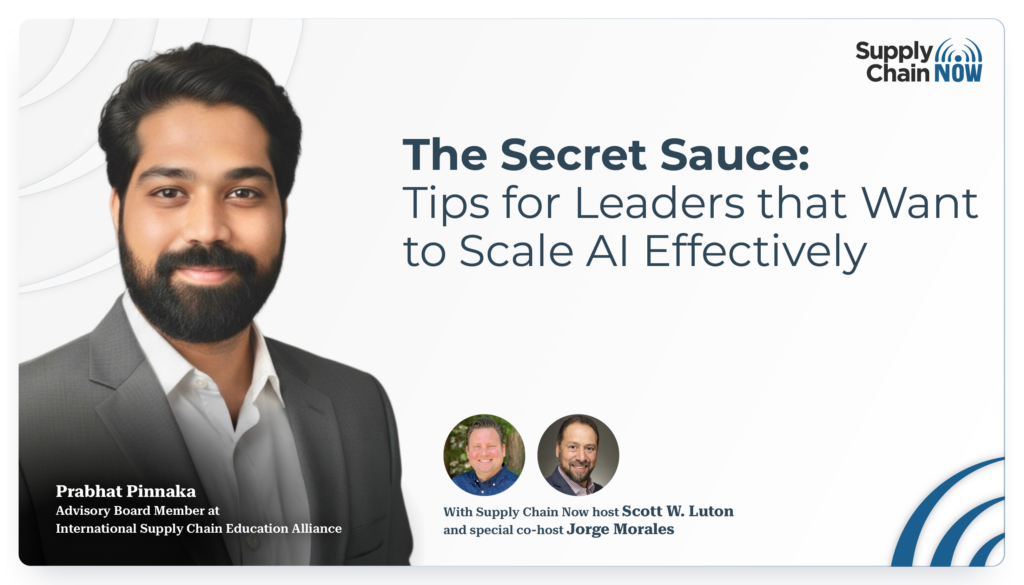
[00:00:00] Prabhat Pinnaka: The hardest part of any transformation. It’s never the technology, it’s actually getting the people to adopt in a way that genuinely changes how the business operates. Supply chains are full of bureaucracy and because of like age old operations methods. the key lesson, which I never forget, is that technology has to fit naturally into how people work and not, how you wish they work, right?
[00:00:37] Scott W. Luton: Hey, good morning, good afternoon, good evening, wherever you may be. Scott Luton and special co-host Jorge Morales with you here on Supply Chain Now welcome to today’s show, Jorge, how are you doing today?
[00:00:50] Jorge Morales: I am great. Uh, Scott. Thank you. Thank you and welcome everyone.
[00:00:56] Scott W. Luton: Welcome, welcome. It’s great to see you again. It’s good to see you. we were last together in Vegas at Manifest and uh, I know we’ve rubbed elbows a couple times since then. I really enjoyed your perspective, but Jorge. you set a high standard with your industry perspective, and I, I tell you, we’re gonna hit it outta the park along those lines with our guests today, because today folks, we’ve got a very practical, deep dive.
[00:01:19] Scott W. Luton: It’s what I’m gonna call it on AI within global supply chain, especially from a. Been there, done that industry perspective, that’s a very valuable perspective. We’re gonna be discussing AI from a variety of angles, including what powers successful scale of AI initiatives, gaps between what I’ll call the AI haves and the AI have nots, and how to bridge those gaps, perspective on critical guideposts that AI initiatives need to have in place.
[00:01:46] Scott W. Luton: Plus, we’re gonna explore a few of our favorite use cases, and Jorge, it always comes back to leadership and people. We’re gonna be discussing how the golden age of supply chain tech is forcing the evolution of the leadership tool belt and the talent management strategies that are out in the market. All of this, and much, much more.
[00:02:04] Scott W. Luton: Jorge, great to have you back with us. Are you ready for today’s conversation?
[00:02:09] Jorge Morales: Yes, of course I’m ready. And I’m very enthusiastic. I, I think we’re living. In very exciting times. things are changing every month, uh, with, uh, this, AI revolution. things are, moving really, really fast. It, it seems like it, it was a, a few months ago, November of 22 when we, were introduced to chat GPT and, in 2024, the standards for applications to connect with this, uh.
[00:02:45] Jorge Morales: AI agents 2025, the agent to agent protocol. Things are moving at a really, really fast pace and, and, uh, it’s exciting to see how things are really happening. And, and, and I’m glad that our guest, uh, today will speak about how things, are happening, what, what’s really happening in the trenches and, and, uh, the real world experience what we’re talking about here.
[00:03:11] Scott W. Luton: Jorge, that’s right. Exciting and challenging, but also innovative. And, uh, the conversation today to your point, is gonna offer some wonderful, actionable perspective. So I’m gonna dive right in. We’re going to introduce our guest first, so our wonderful audience out there. The SEN Global Fam, kind of has some context.
[00:03:32] Scott W. Luton: Prabhat Pinnaka is a product and supply chain transformation leader specializing as we’ve been talking about in ai, digital twins and intelligent and enterprise systems. He has led initiatives across fulfillment, warehouse operations, and enterprise decision support, helping organizations improve resilience, productivity, and operational performance at scale.
[00:03:54] Scott W. Luton: Prabhat’s experience includes large transformation programs, supporting companies such as Lowe’s. Johnson Controls, BASF Dow and Kraft Hez. He’s a frequent speaker and thought leader on AI driven supply chain transformation with a focus on translating er, uh, emerging technologies into practical operating models and measurable business outcomes.
[00:04:18] Scott W. Luton: We all need better translators. Better she at all of that? Please join me in welcoming Prabhat Pinnaka, lead product manager for supply chain at Lowe’s, as well as an advisory board member at the International Supply Chain Education Alliance. Hey, Prabhat. How you doing?
[00:04:34] Prabhat Pinnaka: Hey Scott. Great and uh, thanks for a great introduction. I’m glad to be on this one.
[00:04:39] Scott W. Luton: Uh, well, great to have you and Jorge Prabhat has been busy. That is quite a, uh, it’s quite a journey we, we just shared there, huh?
[00:04:47] Jorge Morales: Yes, yes. Uh, he is a, a very experienced professional and, uh, we’re proud to have him in the ISEA advisory board. he joined us during our panel in Las Vegas, where we met in, in, in manifest in February. And, um, yeah, he is, uh, it’s great to have him here.
[00:05:10] Scott W. Luton: Well it is. And two quick thoughts before we get to the fun warmup. Question number one, I love that element of his background where he translates emerging technologies to those folks that really want to, you know, make it happen for their people and organizations. Blessed are those bridges that, uh, bridge that divide.
[00:05:27] Scott W. Luton: And secondly, folks, you’ve probably heard me talk about this. I’m a big Lows fan. I’m a big Costco fan, but I’m a big Lows fan. I’ll just tell him Prabhat, I’m in the stores. Seems like once a weekend now that Spring has hit Georgia. so we’ll, we’ll probably weave that in somewhere here. But Prabhat, welcome in.
[00:05:43] Scott W. Luton: We got a lot of work to get to Prabhat and Jorge big show. I think it’s gonna offer a lot of actionable perspective and it’ll make people hungry.
[00:05:51] Scott W. Luton: but I wanna do this Prabhat. I want to level set on your professional background, prior to your current role. You know, I mentioned some of the companies earlier in your introduction you’ve worked with, give us, uh, a couple of key roles that really shaped your worldview pr.
[00:06:03] Prabhat Pinnaka: Yeah, it’s been an interesting journey over the last decade. I started really as like an industrial engineer on the shop floor. Doing time studies, kind of hunting for process inefficiencies. that’s where I kind of like, you know, developed a deep appreciation for what technology can do. because often not like, you know, removing waste, kind of like meant like you had to implement some sort of like technology system.
[00:06:28] Prabhat Pinnaka: And, uh, so when it is thoughtfully applied and, I think like technology, uh, can be a game changer as the first lesson that I learned from my industrial internet days. And then further on, like, you know, I kind of like pivoted into a purely supply chain strategy and technology consultant, um, with, uh, couple of big four, consulting companies, working on large scale transformations for Fortune 50 companies in supply chain.
[00:06:56] Prabhat Pinnaka: Right. And the hardest part of any transformation. It’s never the technology, it’s actually getting the people to adopt in a way that genuinely changes how the business operates.
[00:07:08] Prabhat Pinnaka: for example, I had a client, a large chemicals company, go through like, you know, about six advanced planning system implementations. And each one struggled and the technology was good on paper, and was good when implemented, but people never fully embraced it. And as you probably know, right, supply chains are full of bureaucracy and because of like age old operations methods. And that’s what was the key lesson, which I never forget, is that technology has to fit naturally into how people work and not, how you wish they work, right? And that kind of like experience fundamentally shapes how I think about product design and supply chain systems today, in my current role too.
[00:07:52] Scott W. Luton: You know, um, Jorge was smiling during a portion of your response, and I’m sure it’s because he’s heard that. We’ve all heard that challenge time and time again. it oftentimes, and there’s plenty of technologies that that. You know, aren’t great. But oftentimes there are great technological solutions, and the greatest challenge is one of, one of those that you, you called out, and that’s getting our hardworking, talented people to adopt the new technology, the new process, the new new chapter that transformations bring.
[00:08:23] Scott W. Luton: Jorge, I know you, you’ve heard this, quite a few times before, huh?
[00:08:27] Jorge Morales: Yes, definitely.
[00:08:29] Jorge Morales: a lot of people think that, um, we need to be,in the case of ai, which is, uh, you can apply that to any technology, but, AI is something where now all already familiar with. We, we are now all AI aware. So we kind of understand what it is, uh, but a lot of people think we have to be AI proficient and, uh, a lot of people.
[00:08:55] Jorge Morales: Dedicate their whole lives to, to, to becoming AI profession. So that’s a skill that’s difficult to get.
[00:09:02] Scott W. Luton: However, in the middle, there’s the sweet spot in which supply chain professionals should be, which is they need to be AI competent. and what I mean by that is they, they need to be able to, harness, uh, the technology, understand the language, understand what technology can do, what it can’t do, and, uh, be able to like, like if you don’t need to understand.
[00:09:30] Jorge Morales: Uh, made that analogy, some time ago, but you need to understand what’s under the hood of a truck in order, in order to use trucks to move what your business is producing, right? So you can harness the power of trucks and, and, uh, the same thing happens with technology, but you, you need to understand how to use the trucks, what’s around all the trucks?
[00:09:55] Jorge Morales: What, if, uh, even the details when when you get into a curve and there’s a bank and need what speed you get, you need to, but, so those are the kind of things that you need to understand. Were. the limits between being proficient and aware, or, and what you need to know to, to be competent.
[00:10:15] Jorge Morales: And the standards, what are the guardrails,what’s, uh, the knowledge, uh, that’s, uh, really needed in ISCA? We focus a lot on that. We focus, a lot on getting our certification programs, C-S-E-T-P, the technology professional program focused on that. And now we’re getting a spinoff,from that, uh, the, certified professional in supply chain ai.
[00:10:40] Jorge Morales: So that’s, that’s coming, out, uh, very, very soon because things are moving at a really fast pace and people need to understand that sweet spot. They need to understand what, they need to know how technology can be used and, and, um, So, I, I, I love that Parva is been, uh, working with all that and, uh, we, we have, we’re very proud to have people like Parbat in, in our advisory board and, and, and helping us get our, our programs, uh, better and better, uh, every, every time.
[00:11:14] Scott W. Luton: I am with you. All right, we’ve talked about the need to get at least AI competent. You don’t have to become an AI subject matter expert, but I’m gonna try to get my AI competent certification from Prabhat in this conversation.
[00:11:26] Scott W. Luton: Jorge’s already got his, but I think also for important context before we get into the ai, uh, part of the conversation today, Prabhat, if you would tell us more about your current role and what you do at one of my favorite companies being Lowe’s, and then also, uh, I wanna touch on what you’re doing with ISCA, but tell us what you’re doing at Lowe’s.
[00:11:42] Scott W. Luton: First.
[00:11:42] Prabhat Pinnaka: yeah, for sure. And thanks for being a great customer. And, uh, we want to make our stores as seamless for like, you know, homeowners like yourself to come and shop at it and, uh, make it a memorable experience. And, uh, so thank you. so in my current role as, uh, lead product manager for Supply Chain Tech at Lowe’s, what I do is like I focus on building.
[00:12:05] Prabhat Pinnaka: The core systems that power our warehouse operations, which supports our 1700 plus stores across continental us. primarily it is going to be our warehousing management systems, which I call it as like the system of record for everything that moves through our facilities, right? Uh, so you might, so this work is kind of like very foundational, because here’s what I believe, you cannot layer AI or agent intake AI on top of like fragile infrastructure or lack of data or lack of process and kind of expect it to perform.
[00:12:40] Prabhat Pinnaka: So the data has to be clean, the systems have to be well integrated and, and the kind of like logic that powers them has to be like, you know, sound before you can like, you know, trust AI to do like, you know, some sort of like actions on your behalf and not just advise, right? And that’s exactly what we are building a future where AI isn’t, uh, surfacing recommendations, but kind of handling exceptions. Triggering workflows and escalating with the right context, which I call as bonded autonomy which means that AI that operates within defined rules and knows when to escalate to humans. I think that is going to be the key for tomorrow, across supply chain. so the work that I’m doing is laying that foundation and that makes AI futures, uh, safe, effective and governable in terms of execution and tomorrow’s, supply chain environment at low.
[00:13:32] Scott W. Luton: Prabhat I love it. And when you say tomorrow, you’re not talking about Thursday. You’re talking in a, in a greater sense in terms of the next age we’re moving into.
[00:13:39] Prabhat Pinnaka: Yeah, next stage.
[00:13:41] Scott W. Luton: so
[00:13:42] Prabhat Pinnaka: good call.
[00:13:43] Scott W. Luton: hey, and really quick, I tell you, it’s like supply chain u utopia. You paint this picture, clean data, integrated systems, sound logic, man. When you’ve got those three things fundamentally. move mountains, not just in supply chain, but elsewhere. quick follow up, to do all of that stuff and really operate, a successful organization here in 2026. You got to continuously learn new things.
[00:14:09] Scott W. Luton: Right. And of course, we referenced your role as a board member at the, uh, the one and only I-S-C-E-A, which Jorge leads as global COO.
[00:14:18] Scott W. Luton: Tell us about the importance of continuous learning Prabhat.
[00:14:22] Prabhat Pinnaka: I think continuous learning is a principle that every industrial engineer or every supply chain practitioner kind of carries with themselves, right? from that core, principles of like lean thinking. I would say that like, as kind of AI becomes central, right? The role itself is changing and supply chain practices are not kind of isolated from it.
[00:14:44] Prabhat Pinnaka: So what I mean by that is that like your operations or supply chain operations is focused on doing what I call as hands-on coordination task. And that would change into what I call as like, you know, system architect roles, you know, people who design AI systems, govern AI systems and, then coach the surrounding teams on how to like, you know, manage the shift.
[00:15:09] Prabhat Pinnaka: So like your role as a supply chain operator, in my opinion, is gonna shift from like, you know, that coordinator. To more of a systems architect and a coach, and what does that mean from a learning perspective? You have to be prepared for that, evolution of the job role. And that’s where I think like, you know, organizations such as ISEA, like, you know, play a very crucial role.
[00:15:32] Prabhat Pinnaka: you know, they provide like the certifications and the trainings on the, topic like, which are infused from like, latest industry insights, like from people like me and others, on the board. And I also selfishly believe that being part of YSCA, I’m like kind of like sharpening my own skills, by kind of hearing insights, uh, from others on the board.
[00:15:55] Prabhat Pinnaka: And then Simon Danielly helping like, you know, Jorge and his team, like, you know, prepare, the best learning material that could be there for supply chain practitioners so that we can all evolve together, in the age of like, you know, AI enabled supply chains. which is not gonna be very far, I think.
[00:16:12] Prabhat Pinnaka: By 2013, you’re gonna have like, you know, major enterprises working,in a large part of it, like, you know, working on autonomous supply chains.
[00:16:19] Scott W. Luton: Hmm, man. triple win is what I’m hearing there. And Jorge, going back to the continuous, the value of continuous learning, which is almost an imperative. When you and I were talking and I interviewed you in Vegas, you kind of put it bluntly and I, I, I pulled up the blog article here to my right. Adapt. Be left behind.
[00:16:39] Scott W. Luton: Well, the only way to really adapt is be able to train in what you must, uh, learn and train in what you must adapt to. Your thoughts, Jorge.
[00:16:48] Jorge Morales: Yes. as I said, these are exciting times, but, you can either, um, do, uh, the homework, put, uh, roll up your sleeves and, and get into it. You can make that decision and try to remain current to, keep up to date and, uh, keep your job or you, or you can risk, uh, being, uh, replaced by either an AI agent or someone who can harness, the technology in a better way
[00:17:25] Jorge Morales: So I think it’s a, it’s very, very important that we, um. Become, self-conscious to understand more. Not all of us are, familiar with, uh, code programming but we can use them and we can learn to use them very effectively.
[00:17:45] Jorge Morales: by developing these network of agents and using, harnessing these tools, we can make our companies more efficient and make ourselves more valuable for the company.
[00:17:56] Scott W. Luton: Yes. so folks, if you don’t get your, continuous and regular learning opportunities from I-S-C-E-A, get that help somewhere, it’s imperative because as Jorge said, you may not be replaced by ai, but you will definitely be replaced by someone that uses AI better than you do, right? That’s a big threat.
[00:18:16] Scott W. Luton: Not for everybody per perhaps, but, uh, kinda depends on your background and what you do.
[00:18:21] Scott W. Luton: let’s dive in. Prabhat, I want to get into AI because there’s a lot of, far as all the successes out there, there’s still a lot of heartburn and friction, from those organizations trying to find their own right AI gear.
[00:18:33] Scott W. Luton: So. I think you’ve said in the past a conversation is moving thankfully beyond pilots,
[00:18:40] Scott W. Luton: So what separates its organizations that actually scale AI from those stuck in endless experimentation per.
[00:18:49] Prabhat Pinnaka: a lot of, uh, my colleagues think that technology is the differentiator, but like, technology is not the real differentiator. Like it’s the operating model around, like how you enable that technology is the differentiator. So what I’ve seen is that like, you know, companies that get stuck, in pilots, it’s, it’s about like lack of structure and accountability.
[00:19:10] Prabhat Pinnaka: in my experience successful organizations do is they try to embed AI into workflows. With clear defined like ownership and they’re fine with starting with like good enough data and uh, you know, it’s like, it’s a common theme that data garbage in, and garbage out, right? So when it comes to data, if you end up like waiting for like that data to be correct, you will not move beyond that pilot to like production.
[00:19:38] Prabhat Pinnaka: So they take that calculated risk in moving forward with that good enough data. And, uh, one of the other primary things that I have seen, where organizations have become successful in moving AI pilots to productions is setting out like, you know, what objectives that there. Going to chase with this AI decisioning tool or AI workflows, right?
[00:20:03] Prabhat Pinnaka: Either it can be cost of do, doing some activity or the speed of it. Like, how do you measure it effectively and how do you make sure that like it’s actually moving the needle. and this all kind of informs, as to a point where that model is actually successful and it’s kind of like, giving the necessary outcomes that we had decided to be, and when you want to move it to production.
[00:20:27] Prabhat Pinnaka: The real challenge, which I kind of touched upon early on is like change management, right? the difference between AI and some automation capabilities. AI is more of a probabilistic output. And automation is more deterministic in nature. So there’s a little bit of like learning that we need to do as operators in order to like learn, like, you know, how to digest that data point and make decisions upon that data point.
[00:20:53] Prabhat Pinnaka: Trust that data point, right? so ultimately people need to trust and use it. What I’ve seen is that like, you know, the pilot is successful. it takes on all of those goals, but then like, it fails when it moves to production because people are not able to make sense of the data that is being recommended out of the AI model.
[00:21:12] Prabhat Pinnaka: Right. So, and finally one more thing, right? Like, we need leaders who are willing to accept a learning curve. And this technology is kind of new, it’s being implemented in companies, right now. So there’s a lot of like unknowns that are there, right? Like you should be, comfortable with like, you know, the first bump. Let’s say you decide to launch it, but it doesn’t go well, you should be comfortable with that. And, uh, so in summary, I would say like, you know, making AI successful from pilots to production is all about structure, is about ownership, is about defining success from the start and being uncomfortable and going on that learning journey.
[00:21:57] Scott W. Luton: Love it. Now what I heard, I loved your summary too. I’m gonna add my own. This is what I heard from Prabhat Jorge. The data, the targeting of the right problems with ai, change management. Of course, the outcomes and the data outputs have to be actionable and be trusted. And then of course, every, what is not about leadership, you know, leadership is like, uh, I learned in science in second grade that water is a universal solvent.
[00:22:23] Scott W. Luton: Leadership is also the universal solve, and of course has a place when it comes to ai. Jorge, what’d you hear there from?
[00:22:30] Jorge Morales: Yes, I agree with provide a hundred percent on measuring how good are you doing, and, uh, getting the, the results because based on that, you, you have the arguments of, uh, moving forward to going further with, uh, these, uh, initiatives. And, uh, I think what BBA said also, uh, makes sense with, uh, what you said about leadership.
[00:22:58] Jorge Morales: if, if the leadership is. Aware that there are going to be bumps and there, there’s, things are not gonna be working, as expected from day one, things are gonna be easier. it, it’s gonna be, uh, like, uh, Napoleon used to say, dress me slowly because I’m in a hurry. So, so, if, if you want to, if, if you, if you hurry, the, the, if when you’re dressing up, you might do it wrong and,
[00:23:32] Scott W. Luton: right. it’s interesting to call out, but based on both of y’all are sharing here, even with the perfect structure and approach, there’s gonna be bumps and there’s gonna be friction. All them are reason to really do your homework on the front end to driving change with AI using whatever tool is finely tuned.
[00:23:50] Scott W. Luton: alright, so let’s talk about this Prabhat, the biggest gap today that you see between what AI can do in supply chain, right? The art of the possible, or, or what I’ll call maybe the art of the practical possible, right? And what companies are actually implementing and doing with it. what’s important to note about that gap?
[00:24:10] Prabhat Pinnaka: Yeah, I, you know, I wrote a recent article about it and it, it kind of resonated with like, you know, multiple, uh, supply chain leaders on LinkedIn. but the biggest gap that I kind of talk in that article is like, you know, most companies still treat AI as kind of a recommendation tool when it’s kind of fully capable of being an execution engine.
[00:24:32] Prabhat Pinnaka: so here’s what I mean, like, you know, today companies, Use AI models to make surface decisions. For example, demand forecasting. You need to like, you know, order a certain product. and then with the, coming of age of like chat, GPT and LLMs and generative ai, they put a chat bot on top of that like recommendation.
[00:24:53] Prabhat Pinnaka: And now you can query in the natural language, and that’s the most that like most companies have done. But the true power, that I talk about in that article is, is about what I call as compressing the detect, decide, and act loop. So, for example, take this, you have a warehouse,warehouse operations, damaged pallets often show up at the warehouse.
[00:25:16] Prabhat Pinnaka: Today what happens is that typically that gets put aside and it waits for a human to do something about it. Imagine tomorrow, like, AI embedded in that workflow. Like, you know, agent AI could. Immediately place a hold, open a supplier claim, notify the right people all within the right context, all without doing any warning.
[00:25:37] Prabhat Pinnaka: Right? And that is where I think like the real value comes out of is like when you embed AI into those execution workflows. So the technology, to do that is existing today. So I, I, I think it is just an organizational willingness to let, let AI execute and not just advise. And I think the core challenge in that is defining what I call as bonded autonomy.
[00:26:04] Prabhat Pinnaka: So that is being explicit where AI can act independently and where like it needs to escalate to a human. So the whole human in the loop concept and that boundary is not a technical problem. I, I think it’s a leadership decision. So until that companies can make that shift from insight to execution, they’re only capturing a a fraction of like what AI can deliver.
[00:26:33] Scott W. Luton: Yep.
[00:26:34] Prabhat Pinnaka: you know, move from beyond chat bots to execution, embed AI into execution is going to be my biggest advice.
[00:26:42] Scott W. Luton: I like it. Prabhat. Jorge, did you hear that back to your pickup truck, AI can be the execution engine in that pickup truck you were using earlier. What’d you, what did you, uh, what did you gather from what Prabhat just shared about how to, a way, cross the gap, cross the chasm and really realize and, uh, leverage more of what it can be, rather than just that recommendation tool that like 95% of humanity’s using it for, let it be that execution engine.
[00:27:14] Scott W. Luton: Your thoughts, Jorge.
[00:27:15] Jorge Morales: Yes, I, I think the AI agents have, um, the great potential of, uh, autonomy and that opens, a lot of opportunities and possibilities. however, I still think that, we need to be careful, and that’s part of what I was, uh, saying about being AI competent. you need to know what AI can and cannot do.
[00:27:41] Jorge Morales: And, but you also need to understand how and it, in what level can you rely on, on ai and you, you still need to, understand, the issues that must be handled, from the cybersecurity perspective, for example. that’s the reason why it’s, it’s very important to, to learn more.
[00:28:04] Jorge Morales:
[00:28:04] Scott W. Luton: So, Jorge, uh, you’re reading my mind where I won’t go next with Prabhat. ’cause one of the things you’re kind of implying and speaking to there, and you mentioned this earlier in one of your responses, is guardrails, right? Before we can, broadly trust and, and really allow, give permission, give human permission to AI to make or execute those decisions truly autonomously.
[00:28:27] Scott W. Luton: ’cause that’s what is the practical possibilities today provide what guardrails when it comes to data or governance or organizational, what must we gotta put in place? Prabhat,
[00:28:37] Prabhat Pinnaka: I would broadly organize it into two, three layers. the first being around data integrity. Um. about this, autonomous AI decisions are kind of like only as trustworthy as the data feeding them. Like, bad data in, bad data out, right? So before you let a system execute autonomously, not just recommend, you need to know where the data comes from first, how fresh is it?
[00:29:01] Prabhat Pinnaka: Because there’s a concept of like data drift and that leads to a decision drift. And you need to know like what happens when it’s strong. So kind of like have a sale fail mechanism. So most organizations haven’t like answered those questions honestly. So that is like, you know, the first, layer of execution or operational capability that you need to develop is understand data integrity, right?
[00:29:27] Prabhat Pinnaka: And the second, uh, according to me is setting up these decision boundaries. You have to be very explicit about like what AI is allowed to decide versus.
[00:29:45] Prabhat Pinnaka: What requires a human in the loop? Think about like, you know, exception based planning and supply chains, right? It’s similar. you have to do like, you know, exception based autonomous decision making, right?
[00:29:50] Prabhat Pinnaka: and I’ll give you like, you know, one example, think about a system that can automatically reorder $50,000 of inventory is very different from the one that can cancel a $5 million supplier contract. So there’s magnitude of impact that you need to like, take into consideration when setting up these decision contracts.
[00:30:11] Prabhat Pinnaka: And these, boundaries need to be designed deliberately and not kind of discovered after something goes wrong. And that is where I think it’s very important for tomorrow’s supply chain operators to do understand how AI operates and understand what AI can do so that you are enabling these decision boundaries.
[00:30:31] Scott W. Luton: And the third is what I think is about auditability and traceability. what I mean by that is that when a autonomous decision taken by AI kind of causes the problem and, and it is going to bound to happen, at some point you need to, be in a position to explain why exactly the system did what it did. And it’s not for compliance, but actually it’s because you can get the feedback to improve the system and maintain that organizational, trust in it. It goes back to my key point that I mentioned earlier is like any technology is as good as like the organization that adopts it. If you lose the trust, then.
[00:31:17] Prabhat Pinnaka: The organizational adoption goes away, and if you can’t explain that decision, you are not ready to automate it really. So those are the three things, data integrity, decision boundaries, and the ability to audit.
[00:31:33] Scott W. Luton: Yes. And if you don’t have answers to those questions, you’re gonna get in trouble, per bot.
[00:31:40] Scott W. Luton: Uh, also, hey, but really quick, when, when you talk about those decision boundaries, Jorge, and he was using that kind of example, that was a good example, right? The 50,000 versus the 5 million. But also kind remind, reminds me, especially when we think about, you know, how a lot of folks use that like child analogy with AI as it continues to kind of mature and get older and older.
[00:32:00] Scott W. Luton: My brain goes, Jorge, to my three kids and the decision boundaries I have in place with them for their allowances or for any anything, yes, you can buy that $5 cup of coffee, but no, you cannot buy that $500 dress or Amazon order. Jorge, is that, uh, do you have those similar decision boundaries?
[00:32:21] Jorge Morales: Yeah. as you know, I, I have four kids, and yeah, the same thing happens. Uh,
[00:32:28] Scott W. Luton: And for good. For
[00:32:29] Jorge Morales: and yeah, and, and I think, uh, companies are facing,the same issues because, uh, as, as, as Pava said, a AI agents are like having another member in the team. if the rules are not in play in place, and if those, they, if those guardrails are not preventing it from, Doing damage. So it’s uh, uh, yes. the same thing happened with, with, with, with my kids. And of course they, they evolve, they learn. They’re not the same guardrails. They’re for my 9-year-old then for my, those, uh, who, uh, are already, um, graduated and in, in making their own rules.
[00:33:16] Jorge Morales: the same thing will, will happen with eventually.
[00:33:19] Scott W. Luton: And, you know, I love how practical, you kind of capture those three guardrails. when the guardrails and, and think of governance, there’s all kinds of, you know, insecurity, all that. There’s all kinds of usuals. But I really liked your,how you tackled those three exam.
[00:33:34] Scott W. Luton: And there’s a long list of guardrails, but those three data integrity, decision boundaries, and of course that very valuable audibility and traceability, if I capture that right.
[00:33:44] Scott W. Luton: alright, so Prabhat, when it comes all together. Right, because a lot of your journey, you’ve been using all, a lot of what you’ve been sharing here and you’ve been driving outcomes.
[00:33:53] Scott W. Luton: So when you think of one of your favorite recent use cases associated with the implementation of ai, provide, what’s one of your, your, uh, favorite stories here recently?
[00:34:04] Prabhat Pinnaka: Yeah, this is, this is one interesting example, and this comes from a peer study that I did with some of, ISC board members and how, agent AI kind of like is changing the role of like, you know, supply chain operators. so this example comes from like a membership based, wholesale retailer, think high volume distribution centers, processing enormous amounts of inventory daily, right?
[00:34:30] Prabhat Pinnaka: And what they did is that they deployed a computer vision AI to monitor inventory flow in real time, uh, which basically meant automatically detecting defects damages. And kinda like labeling error as product move through the facility. This goes back to the example that I gave earlier in the podcast. So what according to me is remarkable.
[00:34:55] Prabhat Pinnaka: It was not just the, application of the technology, but it was the operational outcome. So these claims used to take days to resolve. Uh, it used to wait for somebody to act upon it, for somebody to like adjust the inventory issue, supply claims, notify the stakeholders. Now all of it is, was being handled by, this AI agent autonomously in minutes.
[00:35:20] Prabhat Pinnaka: So your inspection cycles compress from like days to minutes. And this goes back to the whole concept of compressing, detect the site and act loop, right? Here’s the other interesting aspect. This is the most interesting aspect to me. The manager’s job description essentially wrote itself, right?
[00:35:41] Prabhat Pinnaka: The DC manager went from like personally executing these operational tasks to now governing the edge cases that AI couldn’t handle. Like what are the exceptions that AI needs a human in the loop. So he was just managing now and his work went up in scale of, what I call is like value chain.
[00:36:01] Prabhat Pinnaka: kind of managing like vendor relationships at a systematic level rather than at a transactional level is one example. And he gave me this, uh, statement. He said like, my role shifted from operational execution to strategic governance. And I think that’s a real use case of like ai, not just saving time, but fundamentally changing what a supply chain leader will be doing tomorrow.
[00:36:27] Scott W. Luton: Not, not Thursday in the bigger picture. Next chapter. Sorry, I, I gotta keep coming back to that Prabhat. I love it.
[00:36:44] Scott W. Luton: Uh, alright, so Jorge, I love that example, and here’s why I’m trying to keep up notes fast and furiously. It’s tough to keep up with Prabhat. Uh, you already know this, Jorge. the operational, the sheer operational outcomes, right?
[00:36:47] Scott W. Luton: The efficiencies gained, Compressing that cycle, right? All the days, the manual work, getting rid of a lot of that. You’re gonna be delighting customers and probably some suppliers based on the supplier’s role in, the inventory, decisions be made. And the best part, perhaps per bot in Jorge, which you finished on, which is really elevating the value and the role of the humans as part of this inventory initiative.
[00:37:17] Scott W. Luton: That’s my favorite part, Jorge, your thoughts?
[00:37:21] Jorge Morales: we have wonderful opportunities ahead of, uh, improving, our processes from a different perspective, uh, not just the. efficiency or the making things, uh, faster or, these, uh, repetitive tasks, uh, uh, improving quality because all those will be handled in some way by these AI agents.
[00:37:52] Jorge Morales: But there are many, ways in which our processes will be improved, uh, strategically in terms of innovation, in, in terms of having these minds becoming more creative, be becoming, uh, dealing with what AI is not capable of dealing with. Like, uh, Procedural, uh, competence or, creativity or coming up with completely new things because AI learns very well from the past.
[00:38:24] Jorge Morales: But it, it is our job to envision where we’re going next, where, what things have not happened yet, and how, things can improve in, in, in a different way or finding a new direction. So those are the kind of decisions that, will be made by humans and supply chain professionals capable to understand that and understand where are they adding value to, to, to the company, to the processes.
[00:38:59] Jorge Morales: I think that’s, that’s the, the, the place where we all want to be.
[00:39:02] Scott W. Luton:
[00:39:02] Scott W. Luton: So let’s do this pro bot. We’re gonna put your, your advisor hat on here. Prabhat. Uh, if you’re advising a global enterprise that were starting their AI journey today, they’re getting late. What a late start. But that’s what they’re, that’s what this, that’s what they’re doing.
[00:39:19] Scott W. Luton: If they wanna drive real impact within six months, not six years. What is your golden piece of advice or two that you challenge them with?
[00:39:30] Prabhat Pinnaka: I think, uh, there would be three things that I would tell them immediately. the first is to start with a decision, not like linger upon like a dataset. So I think most companies need to start by asking what data, as most companies do start by asking what data do they have. I think the better question is, is to ask what decisions do we make repeatedly that are slow, expensive, and inconsistent?
[00:39:57] Prabhat Pinnaka: Find those kind of work backward to have the data and the models you need, and that framing alone, like, you know, will save you 18 months. so you, instead of starting chasing data, you should start chasing, like identifying the decisions and the problems that you need to solve. Right? And the second I think is the most important one, is to find a business owner, not a tech owner.
[00:40:20] Prabhat Pinnaka: For every AI initiative. So, I’ve seen this like multiple times. The only person that is accountable for deploying AI is the IT or data science team. It will never actually scale because the scaling part comes as like, you know, moving from pilot to production, right? And that’s where building trust is very important and you need somebody’s, business performance directly attached to that.
[00:40:44] Prabhat Pinnaka: Like, you know, what that AI is gonna do, and that is what is going to move the needle when that AI system is gonna be in production. And the third is, I touched upon this earlier that you should be comfortable with your first deployment being a very, very humbling experience. And this, and what I’ve seen over years is the companies that scale AI and are, aren’t not the ones like, you know, who got it right first time.
[00:41:12] Prabhat Pinnaka: even think about like Google, Google was much more further than chat GPT, but they still waited, waited, waited and chat. GPT got launched by OpenAI, right? So it’s not necessarily that you get everything right the first time, but the ones that are successful become successful because they build the organizational structure and reflexes to learn, fast adapt and kind of keep experimenting. And so in essence, resiliency matters more than perfection in early stages. sticking to the strategy of like deploying ai, and, uh, so this is, this was like one learning that I have had like over years is that enterprises that are good at like doing technology. Aren’t necessarily the ones better with strategy, but they started earlier and they kind of stayed consistent along that journey.
[00:42:05] Prabhat Pinnaka: And that is what is giving them benefits when like, you know, it comes and marries up with business outcomes.
[00:42:12] Scott W. Luton: So per bot, that was really good. Those three pieces of advice, it was so good that you might be tempted to send us an invoice and don’t do that. Okay. I can’t, I can’t afford your invoices per bot, but kidding aside, Jorge, that’s really good. Very practical. Been there, done that advice for companies, you know, just now kind of getting their feet well, uh, wet, and standing up their AI initiatives.
[00:42:34] Scott W. Luton: What’d you think, Jorge?
[00:42:35] Jorge Morales: Yeah, I, I couldn’t agree more. It’s, uh, very important to understand, the problem first, what needs to be solved in, in, instead of, uh, what can I do? Uh, the, the way provide, put it, I think it’s, uh, it, it was, uh, amazing because, Sometimes you, you know what you can do because you have the data or you have the tools or you have access to some other third party data.
[00:43:04] Jorge Morales: But what you can do might not be the thing you need to do. you need to start, start deciding first what’s that need that needs to be, addressed through technology. And, uh, that’s the main point. So I, I totally agree with, with, with Rabat.
[00:43:25] Scott W. Luton: And starting with the illness first one, starting with those decisions, especially if those decisions can be, stressful, regularly interact,inaccurate and multitudes of decisions, taking tons and tons of time. so I like that.
[00:43:39] Scott W. Luton: Um, all right, so for the sake of time, we’re gonna bring it back to leadership.
[00:43:43] Scott W. Luton: I was gonna talk, ask you about talent, but I’m gonna ask you about leadership instead, and then we’re gonna make sure folks know that connect with you, Prabhat, and you, Jorge and Jorge, you’re not getting out of giving me your favorite key takeaway from what all the brilliance that Prabhat is, is sharing with us here today.
[00:43:59] Scott W. Luton: So get ready for that. Your key takeaway, provide. That’s what we said earlier, everything comes back to leadership. Right? one of the big common themes you’ve, you’ve said here about leadership throughout all of your, perspective is how we’ve gotta get comfortable with the bumps and the dead ends and the, the failures as we try to, as we experiment and we try to, to, craft the right strategy that, that brings the desired outcomes, that doesn’t come natural for a bunch of folks or a bunch of leaders out there.
[00:44:30] Scott W. Luton: So, along those lines, how does the optimal leadership tool belt change as we have long since entered the golden age of supply chain technology?
[00:44:41] Prabhat Pinnaka: Yeah, I think, uh, what I’ve, come to understand is that the leadership tool belt changes in a pretty fundamental way. what I mean by that is that in past or in the current environment, a lot of like good supply chain leaders do great is about coordination, right? it’s about like following a across functions, managing exceptions, and like making sure that kind of information moved, from one team to another, right?
[00:45:09] Prabhat Pinnaka: So. It’s about like, you know, driving that operations day in and day out, right? So in the future when, technology is gonna start to take about more of that analytical and coordination work through autonomous agents or robotics. So I believe the leader’s role kind of like shifts upward in the value chain, right?
[00:45:29] Prabhat Pinnaka: So what I mean by that is that this is a concept that I kind of alluded earlier onto is leaders increasingly have to think like system architects and coaches and system architects in the sense they need to design how workflows, data automation, and decisions fit together. And coaches in the sense that the need to help teams learn, adapt, and trust in the systems, right, and know when that human judgment still matters.
[00:46:00] Prabhat Pinnaka: So I would say,the 2030 model leadership tool, belt and supply chain is gonna be less about supervision, more about systems thinking, change, management exception judgment is one more key area, and or, and then guiding, human AI collaboration, uh, that’s to me is a big shift. I think, uh, the work that, uh, Jorge is doing with ISEA kind of like, helps, you know, supply chain professionals navigate that change, over the next few years.
[00:46:31] Scott W. Luton: Prabhat, uh, we’re gonna need a lot more technology. Sherpas and, and, trusted advisors and, uh, a lot more Prabhat AKAs as we navigate, uh, the tons of opportunity, but also tons of change and tons of who Moved My Cheese, like that old book. tons of, of new ways of doing things. It’s all exciting, but it also also creates some consternation for a lot of folks out there.
[00:46:58] Scott W. Luton: Jorge, respond to how Prabhat talked about the evolving optimal leadership tool belt.
[00:47:06] Jorge Morales: I think it’s, uh, very important that, all of us, take, um, our place in, in, or, or, um, embrace the responsibility that, uh, the understand what’s our part in, in, in all of this. Because, yes, leaders need to, to define the direction. Leaders need to motivate their teams. They need to, become, Pro, uh, technology, but ourselves as individuals, we all, we also need to be ready.
[00:47:47] Jorge Morales: And, uh, I think that’s, uh, that’s something, um, very important. And, a key takeaway from, from, from what PAVA said today is, uh, make that decision. But that decision, not just for the company, not just as a company leader of deciding,to, implement or move in the AI direction, but, yourselves, uh, EE every one of us need to make a decision on becoming AI competent on, learning more on, on, on getting into that sweet spot in which all these,
[00:48:27] Jorge Morales: technology jargon is not, like gibberish or, or words, uh, hard to understand that we can understand what, technology people are talking about with not to be proficient with not, don’t have to be that subject matter expert, but we need to understand how to harness technology and, and, uh, I think that’s, uh, very important learning, becoming, uh, certified and also attending, uh, events.
[00:48:56] Jorge Morales: next October we have our supply chain, technology conference. I’m inviting all of you to attend either virtually or in person. It’s now, it’s going to take place in, in Malaysia, uh, because that’s an itinerant event, but you can attend virtually and learn from all these experts. Prabhat was there, uh, last year, and you.
[00:49:19] Jorge Morales: If you register, you can watch his, uh, recording because we’re making all the previous year,recordings available to, to, to those who register for the virtual program. And, um, learn more, get more perspectives, get more, knowledge and on, and, uh, make that decision to change your mindset into becoming AI competent.
[00:49:46] Scott W. Luton: I love it and folks can go, how can they find the sc uh, supply chain tech with site Jorge, for folks to find information on that.
[00:49:54] Jorge Morales: Yeah, it’s, uh, sc tech show.com.
[00:49:59] Scott W. Luton: SC Tech.
[00:49:59] Jorge Morales: more information about that particular event, uh, uh, there, but also on the ISCA global website, isce.org.
[00:50:11] Scott W. Luton: Okay.
[00:50:11] Jorge Morales: you can find more information about, the ISCA certification programs there, the technology certification programs and other certification programs for, supply chain professionals.
[00:50:23] Scott W. Luton: Outstanding.
[00:50:25] Prabhat Pinnaka: actually speaking at the 20 26 1 2 J,
[00:50:28] Jorge Morales: Uh,
[00:50:29] Scott W. Luton: How about that? Okay, late breaking news right here on Supply Chain Now. Late breaking news. Provide,
[00:50:33] Jorge Morales: yeah, we we have a great lineup of, uh, of experts and that’s, uh, we, yeah. Thank you. Thank you Prabhat
[00:50:41] Prabhat Pinnaka: the topics might be interesting to the audience. it’s about like, you know, talking about ontology as an, as an enabling, uh, layer for agent AI workflows.
[00:50:54] Scott W. Luton: Okay.
[00:50:55] Prabhat Pinnaka: so ontology kind of refers to like, you know, stitching upon like all of your data together in a knowledge based graph. So you can put an agent on top of it and then like, have the agent kind of like navigate these decision points across cross domains.
[00:51:11] Scott W. Luton: so it might, it is an interesting topic.
[00:51:14] Scott W. Luton: It is
[00:51:14] Prabhat Pinnaka: call it.
[00:51:15] Scott W. Luton: sc tech show.com for, that fall event. And then also in the broader sense, you can go to i ce a.org. Is that right, Jorge?
[00:51:28] Jorge Morales: That is correct.
[00:51:29] Scott W. Luton: Okay. Alright, so let’s, did you see how sneaky Jorge was? He worked in those key takeaways in that same question. So, and, and those key takeaways, get ready, but not just get ready.
[00:51:41] Scott W. Luton: You gotta lean in and engage and not just because if you’re a leader, like a formal leader, ’cause we’re all leaders, right? We really are. If you choose to be one, we’ve got to really put our own fate and our own success in our own hands, and we all have an opportunity to do that each and every day.
[00:51:58] Scott W. Luton: So don’t let, don’t wait till your organization says, Hey, do you want to go do this? Look for those learning opportunities now. okay.
[00:52:08] Scott W. Luton: So Prabhat, other than your, esteem keynotes that sounds like you’ve got coming up, how can folks connect with you?
[00:52:13] Scott W. Luton: Prabhat Pinnaka.
[00:52:14] Prabhat Pinnaka: you can find me on LinkedIn, Prabhat, Pinnaka, and uh, you know, connect with me there. And, uh, I would be interested in, uh, learning, um, about like others’ problems, uh, the ways that they are doing different from like what I just described. it’s always great to connect, with folks from like, supply chain industry.
[00:52:35] Prabhat Pinnaka: It’s kind of like a very small world. That’s what I realized at Manifest. so I think a lot of, uh, familiar faces and names might be watching this podcast.
[00:52:45] Scott W. Luton: Maybe so, maybe so. I, uh, you know, it’s a, it’s a big, small world, Prabhat. It’s kind of what I’ve, I’ve come to realize about global supply chain. A lot of folks know each other, but you’re, you’re constantly meeting new companies and new, new startups and new leaders. You know, I love the one element about supply chain I really love is it brings people all the time from other. Sectors and other functional areas of, of global business, and that really is a strength of our industry, I believe. Uh, Jorge, how can folks track you down?
[00:53:19] Jorge Morales: You can connect with me through LinkedIn. And, um, also you can, uh, write me directly, uh, to my email, it’s, uh, Jorge or or Jorge m@i.com. So either way, you, you, you can connect with me and also you can, we can all go to, Javier’s in, in, in Vegas because we’re, we’re having, uh, our,ISEA prize, uh, ceremony in, in Vegas next February.
[00:53:55] Jorge Morales: So if, if you’re going to be there for, for manifest, be sure to join the ISCA, recognition ceremony. And, uh, after that we can go to Javiers to have some Mexican food.
[00:54:07] Scott W. Luton: Let’s do it. Let’s do it. So folks, you can learn more about all of that@isce.org. You can also email Jorge. You can also connect with both Prabhat and Jorge on LinkedIn. and they welcome your feedback and they welcome your, what you’re doing in your neck of the woods with ai, with supply chain or learning, you name it.
[00:54:27] Scott W. Luton: And of course, there’s a slew upcoming events that Jorge and the team are hosting, so we encourage you to get connected. okay, what a great conversation. Wide ranging. I think I did get AI competent, as Jorge called it, right? AI competent earlier. So thank you Prabhat for that. and if you haven’t gotten AI competent yet, Jorge, they can give you a call.
[00:54:49] Scott W. Luton: You can swing by in your pickup truck and you can take him to ISCA training so they can get competent. Is that, is that a good Jorge?
[00:54:58] Jorge Morales: Yeah, sure. I’d love to have company.
[00:55:01] Scott W. Luton: Alright. Uh, alright. What a great conversation folks. Hope you enjoyed, hope you, enjoyed as much as I did. One big thanks, uh, to Prabhat, Pinnaka, of course, with Lowe’s and with I-S-C-E-A Prabhat. Thanks for being here, my friend.
[00:55:14] Prabhat Pinnaka: Yeah, the pleasure is mine. and I would close this by saying that tech fluency is a must, and every professional in every industry need to be like tech fluent. And the reason why I say that is chat GPT has made it so easy to use technology, interact with ai, and they are like, you know, close to a billion users.
[00:55:36] Prabhat Pinnaka: So that means like, you know, it is going to be a part of your workflows tomorrow. So start along that journey of tech fluency and, you know, it’s a great show, Scott. I enjoyed being here, with you and Jorge and, uh, looking forward to like, you know, the next episode, whenever that would happen.
[00:55:57] Scott W. Luton: it will happen soon. I appreciate all of your kind words. It was a great episode, great conversation. also big thanks to my esteemed cohost Jorge Morales. Always a pleasure, Jorge, to connect with you. I.
[00:56:08] Jorge Morales: Thank you. Thank you, Scott. It’s a, a pleasure. Thank you.
[00:56:11] Scott W. Luton: it appreciate what both of you are doing in industry to make us all better and unlock all sorts of innovation and, and good change ahead. Um, okay. and by the way, Prabhat mention is challenging folks. Uh, you know, we’ve had all kinds of platforms make it easier, but one thing AI’s not gonna do is drag you outta bed, drag you into learning and workshops, and force you into.
[00:56:33] Scott W. Luton: The opportunities. We still as humans have to make that decision. That’s just how it works. at least for now, we’ll see what next. We’ll see what tomorrow brings Prabhat. alright, so to our SE and global fam, hope you enjoyed the conversation, but you know the homework, right? Prabhat and Jorge both brought some very practical, actionable perspective.
[00:56:52] Scott W. Luton: Take one thing from what Prabhat or Jorge has shared here today. Do something with it, right? Share it with your team. Put it in action. Deeds not words. That’s how we’re gonna keep transforming global supply chain and leave no one behind. And with that said, on behalf the whole team here, Scott Luton challenge.
[00:57:08] Scott W. Luton: You do good, give forward, be the change that’s needed. We’ll see you next time, right back here on Supply Chain Now. Thanks everybody.