Intro/Outro (00:00):
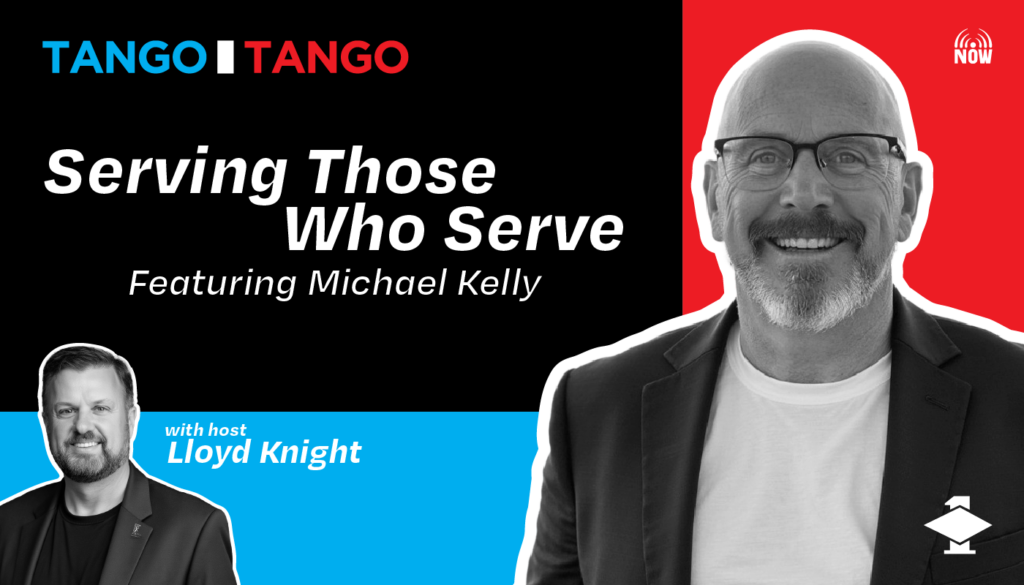
Welcome to the Tango Tango Podcast, real, raw, and unfiltered conversations with veterans and those who support them. Tune in, be inspired, and walk away stronger.
Lloyd Knight (00:14):
All right. Welcome to the Tango Tango Podcast. I’m your host, retired First Sergeant, Lloyd Knight, and this is the Tango Tango Podcast. Tango Tango stands for Top Talks, and Top is an abbreviation or a nickname First Sergeant. So I’m a retired First Sergeant, and First Sergeants are known for honest and direct communication, and that’s what we’re going to have today. So I’m really happy with today’s guest. Today’s guest is a fellow Air Force veteran, a fellow Bush Institute presidential scholar. Oh, he’s got his BLP, he’s a veteran leadership program shirt on. So I followed Mike for many, many years. So Mike is the Deputy of Military Affairs at USAA. And so I followed his career for a long, long time. We’ve met each other several times, but we haven’t really got any good quality time to chat. I’ve been really excited about this show now since we set it up about three or four weeks ago because I want to get to know Mikey better.
(01:13):
So Mike, welcome to the Tango Tango podcast.
Michael Kelly (01:15):
Thank you very much. Glad to be here, Lloyd, and thank you for explaining the Tango Tango. Makes perfect sense. I was going to ask you what that stood for, but you beat me to it. So glad to be with you today.
Lloyd Knight (01:25):
So Top Talks was already used, so I had to get creative, and that’s how we ended up with the Tango Tango. My UPS podcast is called The Landing Zone, which is an amazing title for veteran employment. Yeah, that was a stroke of genius. So I had to get creative with this one. So Mike, Air Force veteran, let’s talk a little bit about your career, but before we get in your career, where were you born and raised?
Michael Kelly (01:52):
I am Pennsylvania native. I say I’m from Pittsburgh only because the town that I grew up in, about 30 miles north is so small, people don’t know where it is. So about 30 miles north of Pittsburgh. Little town called Zelianopa, founded back in the 1700s. So it’s a very historical little town, but I was just one of seven kids, really no savings for college, no opportunity. And I wanted to join the military and go off on an adventure. And that’s what I did at 17. My parents had to sign for me. I brought the recruiter home for dinner and he got meatloaf and mashed potato dinner and a new recruit.
Lloyd Knight (02:27):
That’s awesome. And what career field did you sign up for?
Michael Kelly (02:30):
Well, I was, I won’t say stupid. I would say uninformed, young, delayed enlistment troop. And my recruiter told me at the time that there were no jobs available. So I had to go in open general. And I had scored, I probably had 80s, 90s on all my ASVAB tests. So I could have done anything, but at the time they didn’t have any jobs. So I went open general, silly me, and ended up being a security policeman, now security forces. And I was a flight line guy. I wasn’t law enforcement. I wasn’t a dog handler. I wasn’t anything fun or exciting. Just a plain old security troop, walking the fence or walking around an airplane or guarding nuclear weapons, whatever it might be. But yeah, I joined as a security policeman. I made E5 under four, and then I retrained into public affairs. And I did public affairs for another nine years.
Lloyd Knight (03:19):
So Chief Master Sergeant of the Air Force retired, Joanne Bass, was on two episodes ago, and she actually opened general as well. Really? Oh,
Michael Kelly (03:28):
I’m going to have to talk to her about that. That’s interesting.
Lloyd Knight (03:30):
And that worked out well for her. I actually, as a first sergeant, they were going to give me the security forces squadron and I’m like, no, I don’t think so. I retired. So did you go to tech school in Lackland Air Force Base in place?
Michael Kelly (03:47):
Yep. I stayed, went through basic training at Lackland 1977, stuck around there at the Security Police Academy. And then of course, Airbase Ground Defense School is out at Camp Bolus, which is just literally 10 minutes from my house. I can hear machine gun fire oftentimes in the evening. So yes, I stayed here in San Antonio. I went to Camp Bullis and then my first assignment, interestingly enough, I don’t even know if they do this anymore, we’re in the barracks in the day room and they said, “All right, this is your one good chance to change your orders.” So I had orders for Minot Air Force Base. I was going to be admitted, not what I wanted to do, not where I wanted to go. So they threw us all in the dorm room and said, “All right, if you can find somebody that will trade with you, you can switch orders and we’ll send you to that location instead.” So I thought nobody’s going to want to go to Minot.
(04:36):
So I’m over in the corners just standing there saying, “Minute, mine.” I see this kid running across the day room, jumped over our couch, almost tackled me. He said, “I’ll take it. ” And I said, “Well, hold on a second. Where are you going? ” He goes, “Ramstein Air Base, Germany.” I said, “Okay, we got a deal.”
(04:53):
I avoided a northern tier base and ended up going to Ramsein Airbase as an 18-year-old kid right out of security police training.
Lloyd Knight (05:00):
Yeah, that’s amazing. So that never happens. Yeah,
Michael Kelly (05:05):
It was really bizarre. And I thought, “There’s no way I’m going to get out of this. ” But sure enough, it worked out and found myself in Europe trooping around as an 18-year-old traveling all over the country and just had a great time.
Lloyd Knight (05:16):
What’s one of your fondest memories during your time as a security forces?
Michael Kelly (05:20):
Exercises. So at the time, I got pulled off of full duty. I was a wrestler. So I actually wrestled for the Ramstein Airbase team and I had won the European Championship in my weight class and they did a story about me in the base newspaper. And one day I was coming off a mid shift and my flight chief said, “Hey, you need to report to the commander this morning, as soon as you turn in your weapon.” I was like, “Oh, what did I do? ” I thought I must have done something wrong. So I report to the colonel’s office and he says, “Are you familiar with our community engagement program?” I was like, “No, sir.” He goes, “Well, it read about you and I think you would be a great person to lead our youth engagement strategy.” They called it the officer-friendly program. And I said, “Well, if you want me to be a NARC, I’m not your guy.
(06:03):
If you want me to help these kids, I’m your guy.” He says, “Okay, I think you’d do a good job.” So I ended up being officer Mike for the two years I was at Ramstein. So they pulled me off of light duty, but when the exercises came around, it was all hands on deck. So I was the guy who they gave a Jeep. I had an old World War II Willie’s Jeep. I loaded it with coffee and Kool-Aid and I just went around all of the remote locations, entry control points and just took care of the troops. I took out box lunches. So they ended up calling me Kool-Aid Kelly. So that was my fondest memory of my time in Germany was my time as Kool-Aid Kelly.
Lloyd Knight (06:37):
That’s normally the first sergeant’s job. Something else you and I have common. I wrestle too, but I- Oh, really? Awesome. I did for four years in high school, but I was definitely not good enough to make the base team.
Michael Kelly (06:49):
Well, it’s funny because I won the championship for you safety two years in a row, and then I got selected to go to the all Air Force trading camp and compete for inner service. So I ended up getting beat. I didn’t go to interservice championship. My teammate beat me. We were just really closely aligned. So I’d win one, he’d win one, I’d win one, he’d win one. We ended up going on to the interservice championship and took silver at the interservice championship. So I thought, all right, I did pretty good. And that was the end of my wrestling career.
Lloyd Knight (07:17):
Yeah, very cool. So why you’re in Ramstein, because we’re going to eventually talk about you going to OTS. So are you working on college credits?
Michael Kelly (07:26):
No, no, not at all. In fact, it wasn’t until I got to my next assignment, Hopestead Air Force Base, that I had a sponsor. He was the director of public affairs, actually a captain. And I was still in the security police squadron, but I was doing some writing for the base newspaper. I had done some journalism work and creative writing in high school. So they asked me to write stories about the security police unit. So I did. And the editor told the PAO, “Hey, Mike is going to get out. He’s not going to stay as a security policeman. So if we want to get him into public affairs, now’s the time to do it. ” So he actually was the one, the PAO was the one who encouraged me to start going back to school to apply to retrain into public affairs, and that’s where I started all of that at Homestead Air Force Base.
(08:10):
So I was able to switch out of a critically manned career field, security police, into a balanced career field. And that would’ve never happened if I didn’t have a sponsor, somebody who was looking out for me and willing to go to the mat because it went up to, at the time, Tactical Air Command. And they said, “No, why are we going to let him out of security please? They’re critically man. They need everybody they can get. ” But he pushed hard and they were able to make it happen. So I retrained at Homestead Air Force Base into public affairs.
Lloyd Knight (08:36):
So you become an enlisted public affairs troop?
Michael Kelly (08:39):
Yep, came enlisted as public affairs, true.
Lloyd Knight (08:41):
And did you do that enlistment the whole time at Homestead or did you go to another base?
Michael Kelly (08:46):
No. From there, I went to Kelly Air Force Base to the Air Force Commissary Service. It doesn’t exist anymore. It’s now Defense Commissary Agency. And at the time, Air Force had their own commissary service. So I worked public affairs for that. And then I took a short tour to Korea. I worked for AFEs, believe it or not, in their public affairs function in South Korea. Then I came back to San Antonio to Randolph Air Force Base, and that is where I made the switch to officer and went to officer training school.
Lloyd Knight (09:13):
So how many total years did you live in San Antonio before you retired?
Michael Kelly (09:17):
Well, let’s see. If you count, let’s see, a year, probably six or seven years between assignments. And then when I came time to retire, my wife and I said, “Well, where do we want to go? ” And we both said back to San Antonio because we met here in San Antonio.
Lloyd Knight (09:30):
So talk a little bit about your journey to become an officer.
Michael Kelly (09:33):
It was challenging. Going to school was easy. At the time they had, I think they were paying maybe 75% tuition assistance. So that was easy. Had plenty of time to go to school. What was challenging was getting my leadership at the time to allow me to apply for officer training school. I actually had colonels and all my senior leaders, my direct supervisors were very, very supportive. But the colonel, the commander said, “I can’t afford to let you go, Mike.” I said, “Listen, I devoted my life for the military. I’m just asking for the chance.” Because he said, “You know what? They’re shutting OTS down. They’re closing the doors. They’re going to take in fewer people. It’s just not likely you’re even going to get selected.” I said, “That’s not your decision to make.” I said, “All I’m asking for is the opportunity to apply.” I said, “Will you sign the paperwork?” He goes, “All right, I’ll sign the paperwork, but if you get selected, you still have to do your job.” I’m like, “That’s not how the program is supposed to work.
(10:25):
You’re supposed to be released to go do it. ” But I said, “All right, if that’s what it’ll take, I’ll do it. ” So applied, got accepted and went to Southwest Texas State just up the road in San Marcos, Texas. It’s now called Texas State. But I finished, had 30 hours to finish and I went into the bootstrap program. And then of course the next challenge was getting accepted into officer training school. And again, the commander was like, “Oh, I can’t afford to let you go. ” I said, “Just give me the chance.” So I did and got accepted into that and that began my officer career. So I did 12 years enlisted and 13 as an officer.
Lloyd Knight (10:57):
Oh, wonderful. And what was your first … So you get selected to be a public affairs officer, but what was your first assignment?
Michael Kelly (11:03):
Well, before that, can I tell a funny story?
Lloyd Knight (11:05):
Yeah, absolutely.
Michael Kelly (11:06):
I was actually selected to be … I don’t even think this AFSC exists anymore. It was called a 19XX. It was an operations support officer. It could be command posts, you could be exec officer for a flying squadron. It was just kind of a catchall career field. So I got classified as a 19XX and all of my sponsors, all of my public affairs leaders said, “It’s okay. You’re getting your commission. We’ll get you back. We’ll find a way to get you back into public affairs.” So I’m just waiting around to go to officer training school. I went in August. So around April time period, my commander calls me into his office and he goes, “Mike, I got some really bad news. I’m sorry to share.” I said, “Well, what’s going on? ” He says, “Well, you’re not going to OTS as an ops management officer.” It’s like, “What happened?” I’m thinking they did away with the opportunity for me to go and just close the door.
(11:56):
And he goes, “No, no.” And he really played this out. I was not happy with it. He goes, “Yeah, I’m sorry, but you’re not going to officer training school anymore as a 19XX.” And I was like, “What happened?” He goes, “You’re going as a public affairs officer.” So even before I went to officer training school, they were able to get me back into the public affairs career field. And it wasn’t until four years later when I went back to Ramstein Air Base and I’m talking to another first lieutenant where he’s saying, “Oh yeah, I went to officer training school in the spring of 89.” I was like, “Oh, I went in August.” I said, “Well, what did you go? ” He was a missileer. I saw his missile badge on there. He goes, “Yeah, two weeks before I left for officer training school, they said, you’re not going as a public affairs officer.” He was supposed to go as the public affairs officer and they put him in missile.
(12:42):
So I was like, “Oh, I have to tell him the truth.” I go, “Hey buddy, I’m the guy that stole your slot.” So we actually became very good friends. But yeah, it was an interesting roundabout way of how I got to officer training school.
Lloyd Knight (12:54):
Yeah, that is pretty neat. And what was your first assignment?
Michael Kelly (12:58):
So I was in San Antonio at the time. Officer training school was still in San Antonio over at the Medina College. It’s now the Chapman complex where they do all the special ops training for Air Force, but it was here in San Antonio. And I went to Williams Air Force Base, Arizona, which is now closed. It was a pilot training base. So I was there for four years at Williams Air Force Base, closed it down in 1993. And then I got orders to go back to Germany, Ramstein Airbase again, but this time with a wife and family.
Lloyd Knight (13:26):
And the same unit?
Michael Kelly (13:27):
No, I was at headquarters USAFI at the time in public affairs. I was at the security police squadron when I was there the first time.
Lloyd Knight (13:33):
Oh yeah, that’s right. So now you’re at headquarters at U Safety. Were you doing staff work or were you actually deploying and going on the road and reporting and the whole bit?
Michael Kelly (13:44):
Well, I was just a staff officer, but a week after I got there, I think I had gotten my international driver’s license. My wife hadn’t gotten. She was pregnant with our second and we had a two and a half year old. So two weeks after I got there, they deployed me to Macedonia. This was on Operation Able Century, which was kind of the precursor to going in with I- 4. It was the first time any US troops had been under the United Nations command. So I got my Blue Beret and served under United Nations command under Operation Able Century two weeks after I got to Germany and my wife was not happy.
Lloyd Knight (14:18):
Yeah, I remember those days for sure. And how were you in Macedonia?
Michael Kelly (14:22):
It was a short tour, probably two months. And when you’re stationed in Germany, typically what they do is they’ll push those people that are already overseas out to those deployed locations and then they’ll backfill them with somebody from the states. So I was constantly leaving. One day I had made arrangements to have lunch with my wife and we got a babysitter and I came home a little early and she was like, “What are you doing home so early?” I said, “I got to leave in an hour.” And this time I was off somewhere else. I don’t even remember where it was. So yeah, a lot of TDYs and a lot of unknowns there when I was stationed in Germany.
Lloyd Knight (14:53):
Yeah, I was stationed at Ramstein as well. I was in the, which they call CRGs. My late wife spent four years in Germany and I spent about a year and nine months because I was on the road so much all throughout Europe, the Middle East, Africa. It was a great assignment, but would’ve been sure nice to spend more time at home in Rams.
Michael Kelly (15:14):
Yes. And we didn’t really see much of Europe because with a newborn and a two-year-old, I mean, we did travel. I had kids on my back all the time, but we want to go back and revisit the areas that we really didn’t have a chance to explore while I was there.
Lloyd Knight (15:26):
Yeah. If you go to Ramstein now, it does not look anything like it did when you were there.
Michael Kelly (15:32):
I was able to go back in 2007 with work at USAA and it had changed even a lot and it’s grown since then, but yeah, it’s huge.
Lloyd Knight (15:41):
I was stationed there in 97 to 02 and then went back for UPS about 10 years ago and I got lost on the base. It changed so much.
Michael Kelly (15:52):
It’s easy to do. Yeah. I actually left in 96, so I had just left before you got there.
Lloyd Knight (15:56):
Oh, yeah. Neat. So again, more we have in common. So you leave Ramp and go where?
Michael Kelly (16:03):
I was deployed down to Tusla and then got back and a month later I was on orders and back to the DC area and I was an instructor at the public affairs school, the Defense Information School for four years. So I spent four years there at Fort Meade. That’s where the school’s at. That was one of my favorite assignments. No TDYs, just great teaching the younger generation of communicators what public affairs and public relations is all about.
Lloyd Knight (16:30):
Well, from seeing the way you do your work and seeing you at these conferences and in your job at USAA, I think that you learn a lot in that four years and that four years really molded you.
Michael Kelly (16:44):
Oh, absolutely. Yes. No, it was great because I mean, I’d been doing public affairs, enlisted and officer for probably a good 10 years, no, even more than that, probably 15 years. So it was great to be able to teach it. But even when you’re teaching, you’re still learning and growing and establishing good communication habits. And I just really enjoyed that. One of my proudest moments is they put me in charge of the final training exercise. So we had to build a whole scenario of deployed public affairs people. So there had to be missions. And that was a pretty significant project. And that was really good because I had used my experience being deployed before and building out that final tactical exercise. So that was pretty fun.
Lloyd Knight (17:24):
Yeah. Cool. And so you spent 25 years in the Air Force. What rank did you retire as? I
Michael Kelly (17:30):
Retired as a major at the time. So I actually got stop lost. I retired in 2002. So I was going to retire in 2001. Nine eleven happened. So I got stop lost and stuck around for another year. At the time, they had just made a change to the time and grade requirements to retire in rank. So I only had to wear a major for six months and then I retire as a major. And it was funny because my boss at the time, she was upset. She goes, “I can get you promoted to Lieutenant Colonel.” I said, “Ma’am, I can get myself promoted to Lieutenant Colonel, but if I do, I’m going to have to stick around for another five years.” You forget I had 12 years of enlisted time, so that would put me at third of years. And I didn’t want to retire from the military so old that I wouldn’t really be a viable option for people.
(18:13):
So I got out of
Lloyd Knight (18:14):
That
Michael Kelly (18:14):
Time after 25. Yeah.
Lloyd Knight (18:16):
That was one of your driving points. And where were you stationed at when you decided to retire? I
Michael Kelly (18:21):
Was at Wright Pat. So I was at Air Force Material Command headquarters. I was the chief of internal information at the time. And we thought, because I grew up in Pittsburgh, which was about four and a half hours east. My wife grew up in Kentucky, which was about three hours south from Dayton. And we thought, oh, this is perfect. We’re right in between where we grew up and we bought a house and I retired. I got a job as a defense contractor at the Air Force Research Lab. And after about a year, we were like, we didn’t really like Dayton all that much. So we decided to look for a job in San Antonio, and that’s what took us back to San Antonio.
Lloyd Knight (18:55):
More stuff we have in common. So the Iowa station that right, Pat. My second assignment from 90 to 93, I was in flight test out on the west ramp before they moved us to Edwards. And my late wife and I grew up in Kentucky. So where’s your wife from?
Michael Kelly (19:11):
Grant County, which is south of Cincinnati. So south of Florence, the big water tower, Florence Yale.
Lloyd Knight (19:19):
Florence Yell.
Michael Kelly (19:22):
Florence.
Lloyd Knight (19:23):
So I’m an Army brat. So out of Radcliffe, Kentucky and Ford Knox. Hi, Mom. This is my biggest fan and listens to all these podcasts. So very cool. So you moved to San Antonio. Did you get that job at USAA right away or did …
Michael Kelly (19:39):
Yes. So I actually had two interviews. I came down with two interviews at the … This was in 2003. And at the time, Army just stood up the installation management command, IMCOM, and they were looking for a chief of public affairs. So I had applied for that. I did that interview first. They actually offered me the job right then. I said, “Well, I’ve got another interview tomorrow out at USAA. So can I let you know after that? ” And they said, “Sure.” So the very next day I interviewed at USAA and the following week I got an offer from them. So that’s what brought me to San Antonio was the role with USAA. And just to let you know, I have retired from USAA, so I’m not the deputy anymore. I left USAA in June of 2025.
Lloyd Knight (20:21):
Yeah, that’s right. So the USAA, I’m a big fan. I was actually on the phone with them yesterday and they thanked me for my 24 years of membership. And I was like, “Holy cow, has it been 24 years?” Isn’t that a nice
Michael Kelly (20:34):
Reminder? Yeah. Sometimes it’s like, “Girl, it been that long? Holy cow.”
Lloyd Knight (20:38):
So what do you love about the San Antonio area? What kept bringing you back?
Michael Kelly (20:42):
Well, one was, this is where my wife and I met, so we had very fond memories. And again, she’s not from San Antonio. She was here working. We just happened to meet. Believe it or not, I was finishing up with my degree, my bootstrap program, and I had to do an internship. And I got an internship working in the PR department for the San Antonio Spurs. My wife, not my wife then, but she was working in the marketing department at the Spurs office. So that’s where we met. So we just had really fond memories of meeting and San Antonio. Of course, I’d been at in San Antonio many times before. So it was just a great location, good cost of living. The weather’s great. So we decided to come back to San Antonio and we’ve been here ever since.
Lloyd Knight (21:24):
So you transitioned into it as a civilian in the Department of Defense and then now to a total corporate environment. And I know a little bit about that, but what did that look like for you?
Michael Kelly (21:38):
Well, it was very interesting because if you know anything at all about public affairs, as the chief of public affairs, you’re responsible for communications for the wing commander or whoever your commander is. You’ve got the community affairs, you’ve got media relations, you’ve got internal information, you’ve got environmental communications. So that public affairs officer has to do all of it. Well, I get to USAA and I go to my first meeting and I am just overwhelmed. I am writing things down and I’m starting to get worried that I’m not going to be able to do this. And my boss things over me. She goes, “Are you okay?” I said, “Yeah, I just don’t know how I’m going to get all this done.” She goes, “Mike, you don’t have to do all of this. All you have to do is the military piece. We’ve got everybody to do everything else.
(22:20):
All you need to do is what we hired you to do. ” So that was a real eye-opener for me because I thought I was responsible for all of it. Sorry, I keep going in and out of focus here.
Lloyd Knight (22:28):
So wow. So you had an amazing career at USA. You were there for 20 …
Michael Kelly (22:35):
Almost 22 years, yes. So I got hired into corporate communications to develop their military communications program. And then I built an influencer engagement strategy. Then they put me in charge of veteran hiring and communications around that. And then shortly after that, I moved up to be the deputy for military affairs. And I was still doing all of those other jobs just under the military affairs banner. So that’s where you know me from is my time in military affairs.
Lloyd Knight (23:00):
Yeah, definitely. But let’s go back to some of the hiring. So you’re responsible for our hiring. And I know a lot of transitioning veterans via listen to this podcast. What advice can you offer to somebody who’s maybe six months away from making that transition and looking for civilian employment?
Michael Kelly (23:19):
Well, definitely check into the Hire Heroes SkillBridge program. Got a great program. We’ll help you to find the right company that will fit your skillset. But you mentioned six months out. I would say start earlier, a year, if not more, because it does take a lot of time to make all these things fall into place and you don’t want to be caught short. So I would say start early, plan ahead, make sure you’ve got your finances in shape because a lot of people don’t realize when you leave the military, you’re going to lose … Unless you’re a retiree, you’re going to lose your healthcare, right? You’re going to lose your SGLI, your group life insurance. So you’ve got to plan ahead to replace all of those things. So you got to make sure financially that you’re prepared as well because those things are going to be taxed.
(24:03):
If you get a benefit in the corporate world, you’re going to tax it. In the military, that was all non-taxable, right? Up. So housing allowance, your subsistence allowance, all that was non-taxable. But once you make that switch to the civilian world, everything is taxed. And that’s a real eye-opener when you get that first paycheck.
Lloyd Knight (24:20):
Yeah. And then now you’re paying car taxes for the first time ever as well. Great advice. So what I would add to it is get a great resume. I love Hire Heroes USA for their resumes. You get a mentor through corporate partners. But the big thing is start networking because finding who you know. And service members have closed networks to start building your network. LinkedIn is a great tool for that. And get out in person too. There’s the old 50 cups of coffee, start meeting people for coffee. And I always kid around. Starbucks should sponsor me because of the thousands of lawyers I spend on- Yeah, you
Michael Kelly (24:59):
Invested a lot of money. Yeah.
(25:01):
That’s so important. Yeah. The networking piece, I would say that’s more important than anything else, quite frankly, because if when you apply for a job, you’re probably one of three or 400 or maybe even nowadays, and I’m in transition myself. So I’m looking for my next role as well after leaving USAA and looking at LinkedIn. Some of these jobs will post and within two or three days, there’s 900 candidates who have applied for that job. So networking becomes essential because unless you know somebody at that company, very unlikely that that HR recruiter is just going to stumble across your resume and say, “Oh, I want this guy.” So networking is incredibly important. And that’s actually how I got both of my jobs post-military and hopefully my next job. I was networking. When I retired in 2002, I had 90 days of terminal leave. And I thought, oh, that’s plenty of time.
(25:52):
I’m a public affairs PR guy. I should have no trouble getting a job. The first 30 days, I took the kids to the pool. I had a great tan. The honeydow list was done every day. Next 30 days, I thought, okay, I’ll start working on my resume and start throwing it out there. End of that second month, still nothing. And I was starting to panic. So I started going through all my business cards and my networking and people. And I called this one guy that I had done some public affairs work for, and this was a Friday morning. And I called him up and he said, “Hey, everybody always calls me Mikey. Hey, Mikey, what’s going on? ” I said, “Well, I’ve retired and just calling to see if you had any communications work,” because he worked in communications as well, public relations and at the Air Force Research Lab.
(26:32):
So he goes, “Oh my goodness, I just was getting ready to advertise for a part-time job working on my team for a senior communications and marketing manager. What’s part-time mean?” He goes, “It’s 40 hours. There’s no benefits.” I was like, “Oh, well, I don’t really need any benefits.” So he said, “Shoot me your resume.” This was Friday morning. So I send him my resume, calls me back 30 minutes later. He says, “Hey, come on over and meet me for lunch. Let’s talk.” I go over there and we’re talking and he goes, “Hey, listen, I’ve already talked to my boss. I can bring you on Monday.” And I said, “Well, that’s great. What are we talking about as far as salary?” Because I mean, I had never negotiated a salary in my life. I was 17 years old when I joined the military. So he goes, “Well, I can start you at $35,000 an hour.” And in my head, I’m trying to do the math and everything.
(27:16):
Well, it was certainly more than I was making as a major. So I was like, “Okay, let’s do it. ” So I went from being scared that I’m not going to be able to find a job on Friday morning to having a job Friday after lunch. And then when I left Air Force Research Lab and I applied at USAA, I was at the Air Force Association Convention, came around the corner and then a USAA booth was there. And there was my old friend, Chief Master Sergeant Eric Bankin. So Joanne Bass is what? She’s Chief Master of the Air Force number 17? No. What was G17? I
Lloyd Knight (27:46):
Think so. Yeah.
Michael Kelly (27:47):
Yeah. So he was number 12. We were stationed in Germany together. Our girls went to ballet class at the youth center together. We deployed together. So we knew each other well. And I said, “Hey, I’ve applied for like four jobs at USA.” I haven’t heard anything. And he says exact same words, “Shoot me your resume.” Again, this was a Friday. So I send him my resume. Tuesday morning, I get a call from USAA and they say, “Hey, are you still interested in this job?” And I’m like, “Well, of course I’m still interested in this job.” Found out later after I got hired by USAA that the chief went down to the hiring manager and said, “Listen, I don’t know who you’re looking at, but this guy is who you need to hire.” So when you could have somebody with that level of influence and impact tell somebody that you need to be hired, then that’s good.
(28:31):
So that’s my networking story and how important it is. But here’s the final piece of that. You can’t just find somebody on LinkedIn, send them a note and say, “Hey, would you recommend me for this job?” I mean, I don’t know you, I’d be happy, let’s have coffee, let’s develop a relationship. So you can’t just ask people for something without investing in them as well. So got to take time to get to know people, build a relationship, a relationship funnel. You get more from a friend or a coworker or a family member than you do from a stranger, right? So just reaching out to somebody on LinkedIn and asking them to recommend you is not the best way to network.
Lloyd Knight (29:10):
I love that. I teach networking in my side business. And one of the things I cover is networking is not transactional, it’s relationship building. Absolutely. Yeah, very good. Absolutely. Another thing you have, and I have in common is you were selected as a Mighty 25, so one of the mighty top 25 military influencers in the country, which I think was well deserved. Can you talk about just not the honor of it, because we’re quick to dismiss those honors, but what it took for you to have one of the top 25 voices of the country?
Michael Kelly (29:47):
It was a total shock. I mean, I didn’t even know about it. The folks that we are the mighty, I know you know Mark, and he’s not there anymore, but he’s the one who said, “Hey, we want to nominate you for this role.” I said, “A Oh, great. I didn’t really know much about it at the time. And I said, “Well, do I need to do anything?” They said, “Oh no, you don’t need to do anything at all. ” I knew those guys well and they’d seen me in my work over the years. So they nominated me for it. And when it came out, I was just totally shocked. And everybody was like, “Mike, did you see you’re one of the Mighty 25?” I was like, “No, send me the link. But here’s the thing. I’m just doing what I love and loving what I do.
(30:26):
There’s a country song. I can’t remember who wrote that. Playwalker maybe. Doing what I love and loving what I do. ” And that’s my approach to giving back to the military community. As someone who served for 25 years, I wanted to be able to give back. That’s why working at USAA was so important because that was a company founded by the military to serve the military. And I was able to help people through transition. I was able to help nonprofits to do their job and support the military community. So giving back was always something that was important to me. I didn’t do it for recognition. That’s like being selected for the VLP program, the Bush Veteran Leadership Program. Miguel Howe, who was the previous director for the program, I did not apply the first year because I was also on the San Antonio Chamber of Commerce Executive Board and I was chairman of the Military Affairs Council.
(31:12):
I just didn’t have time. And I was doing my normal USAA work. So I went to the graduation for that first class and we’re talking afterwards and Miguel says, “Mike, you should apply next year.” I was like, “Well, I’ll think about it. ” He goes, “No, Mike, you should apply next year for the VLP program. We need people like you in this program.” I was like, “Okay, I’ll think about it. ” He goes, “No, I want you to apply for the program.” So I did and I got selected for class number two in 2019. And again, and you’ve been there, that imposter syndrome. I was like, whoa, how did I get here? I’m just a punk kid from Pittsburgh who happened to join the military and I’m surrounded by these nonprofit leaders and CEOs and business leaders. And it was just an amazing experience. And what it reminded me of is just be confident of who you are and what you do.
(32:01):
You have to be pretty self-actualized. Maslow’s hierarchy of needs. And it was just a very rewarding experience that was based on my desire and passion and ability to give back to the military community. So it wasn’t anything that I sought. The recognition is amazing. It was funny, when the list came out, and you know Cortez, of course, Mark, and the list came out and I was right underneath Dwayne the Rock Johnson. I’m like, “Oh my gosh, I’m right below Dwayne the Rock Johnson.” And Bark is like, “Mike, it’s just alphabetical.” I was like,
Lloyd Knight (32:33):
“Oh.” So my story, I got up. So I’m an incumbent in this last year. I got up early one day and I’m making my coffee. And I look at my email like I do every morning in this before I take the short drive to the office and I get something from the Military Influencers Conference. And I’m like, “Maybe it’s…” As you get closer to the conference, you get a lot of emails and I almost deleted it. And I’m like, “I better read this. ” And I’m like, “Ah, that can’t get nice.” So I was like, “Let me go grab that coffee and take a couple sips.” And I, holy cow, I got recognized. And it was a huge honor, a great evening, but again, nothing I sought out.
(33:15):
You talked about passion. One of the things I teach too is Japanese have this term ecogue and it’s essentially you very rarely do you get the opportunity to do what you’re passionate about, what you’re good about, what you can get paid for, and then what the world needs. And you and I are blessed. Oh my goodness, so blessed. We’re doing that. And I think when you jump into that, and especially if you’re as passionate as you’re me, you just knock it out of the ballpark. And when you knock it out of the ballpark, you’re going to get attention. And that’s where some of the recognition comes from.
Michael Kelly (33:49):
Yeah. You mentioned the Japanese term. There’s a Yiddish term. You were at the Mick this past year, right? So you might’ve heard me mention this. It’s called a Minch. So a Mench, a female version is a Maven. So it’s a Yiddish or Jewish term. And a Mench or Maven is somebody who’s connected. They love to collaborate. They like to help other people succeed. They’re very altruistic. That’s always been my approach. I don’t ever do anything for recognition. I do it because I care about people and I want to see them succeed. So my approach is always be the Mitch, be the guy who is willing to help, willing to listen, willing to connect them with someone who can help them achieve what it is that they want to achieve, whatever it might be.
Lloyd Knight (34:29):
Well, you certainly were a match at USA because everywhere I went, it was like USAA sponsoring this. And there’s Mike Kelly on the page, USA’s doing this, USA’s doing that. And it’s something I truly admire. I think I had a discussion with you the last time we’re talking. It’s like, I want to do more. I want to do more in place. I want to have a bigger budget. I want to do more at UPS. And a lot of that is because of the trail you set. So yeah, thanks for being a great role model. Thanks what you did for your 22 year career at USAA.
Michael Kelly (35:02):
Thank you. Appreciate that. And listen, you’ve just got to keep that passion. I know you and I know how you approach things. Timing sometimes makes it a difference. When I first got to USAA, I didn’t have a budget. I was an individual contributor. The first couple years I was measured for my performance reviews and success by how much of other people’s money I could get. This was a brand new role. There was no strategy. I had to develop the strategy. So the first year, and this is interesting because I got $150,000 from our chief legal officer to support Hiring our Heroes. So USAA was one of the first sponsors for Hiring Heroes. And that was money that I got from our chief legal office. And then once we established the relationship where I was able to show the justification and I just kept getting, the budget kept getting bigger and bigger because once you prove to them that you’re delivering results and positioning the brand in a way that helps demonstrate advocacy for the military community, they’ll keep funding you.
(35:59):
So you just keep after it.
Lloyd Knight (36:00):
I love it. Yeah. Thanks for the tremendous advice. So why’d you decide to retire after 22 years?
Michael Kelly (36:05):
Well, sadly, it wasn’t my choice. They went through a little bit of a reorganization. We had some new leadership and they decided that I’d been there long enough. I don’t want to speak ill of them. Then I spent almost 22 years there. I was not expecting to leave, but when they reorganized and said my role was no longer needed, I started looking for new opportunities because honestly, I am able to retire. My financial advisor says, “Mike, why do you want to keep working? You don’t have to keep working.” I said, “No, I have to keep working because otherwise I would shrivel up and die because I’ve got too much runway left and too much passion yet to give back to the military community.” So that’s why I’m still looking for what that next role might be so I can continue to get back.
Lloyd Knight (36:45):
Well, I can’t wait to see what you do in that next role. So what does Mike Kelly like to do for fun?
Michael Kelly (36:51):
I like to ride mountain bikes. San Antonio has a series of trails through old dry riverbeds and creek beds. So there’s probably 150 miles of trails. They’re paved trails here in San Antonio. So I like to ride my bike. I have a mountain bike as well, so I do off-roading. I used to have a dirt bike and rode motocross when I was younger, but not allowed to do that anymore because I’ve broken bones and done things and my wife doesn’t want me to get injured anymore. So I can ride a bike, but I’m not allowed to ride a motorcycle. My grandkids, I’ve got three grandkids, so spending time with them is fantastic. They were just over earlier today, so that’s great. My wife and I love to just relax and we walk every morning about two miles. So we’re trying to stay healthy and busy doing that.
(37:33):
And then of course, I just still like to be engaged in the community. Here in San Antonio, they have a organization. It’s called the Bourbon Club. You have to be invited. I’ve probably been a member of the Bourbon Club for the last 10 or 12 years, but it’s senior military leaders, business leaders, influencers, nonprofit leaders. And we meet once a month just for fun and fellowship and bourbon and other brings if you want it. So food, fun and fellowship. So I like to do that as well and stay connected. And then of course we enjoy going to church and being with the grandkids at church as well. So definitely keeps me busy. Yeah,
Lloyd Knight (38:05):
Great. Yeah, I’ve got a five-year-old grandson and that’s my favorite job title. I’m
Michael Kelly (38:11):
Pap Pop. What are you?
Lloyd Knight (38:12):
So I’m Papa Lloyd.
Michael Kelly (38:14):
Okay. Papa Lloyd. I like it.
Lloyd Knight (38:16):
Yeah. Unfortunately, he lives up in Chicago, so I don’t get to spend that much time with him, but I love when we’re able to get together.
Michael Kelly (38:23):
Yeah. Ours are local. So I mean, any given day like today, we weren’t expecting them to come by till tomorrow, but they were out running errands and they said, “Hey, can we stop by?” I was like, “Sure.”
Lloyd Knight (38:33):
Yeah,
Michael Kelly (38:34):
We could see him quite often.
Lloyd Knight (38:35):
Well, love that. So Mike, it’s been a blast. My goal was to get to know you better. So I think we did that. I can’t wait to see you in person. Hopefully you’re going to be at the Military Influencers Conference in Tampa. And
Michael Kelly (38:50):
Hopefully I’ll be there representing a new organization.
Lloyd Knight (38:52):
Yeah. Yeah. Well, keep me posted and hope to break bread with you at that event.
Michael Kelly (38:57):
Absolutely. Sounds great. We’ll break bread and have a glass of bird.
Lloyd Knight (39:01):
It sounds like a plan. So wonderful. And I’m going to close out this podcast like I close out all my podcasts. Be like Mike, be safe, be kind, and be remarkable.
Intro/Outro (39:12):
The Tango Tango Podcast is produced in partnership with Supply Chain Now. Join the Tango Tango community for more inspiring stories. Follow us on Facebook, X, and LinkedIn. Subscribe to the Tango Tango YouTube channel and follow and listen to Tango Tango wherever you get your podcast.