[00:00:00] Tony Zuazo: People are always gonna be the driving force, and they’re always gonna be where innovation is born. And so making sure that you take care of that and you develop it and you foster it, and you position it accordingly regardless of of what type of business you’re in, is critical.
[00:00:16] Voiceover: Welcome to Supply Chain Now the number one voice of supply chain.
[00:00:21] Voiceover: Join us as we share critical news, key insights, and real supply chain leadership from across the globe. One conversation at a time.
[00:00:29] Scott W. Luton: Hey, good morning, good afternoon, good evening, wherever you may be. Scott Luton here with you on Supply Chain Now. Welcome to today’s show, folks. I’ve been looking forward to this show.
[00:00:39] Scott W. Luton: We’ve got a terrific guest lined up, a results driven business leader with more than 35 years of retail industry experience, especially from a supply chain operations leadership standpoint. But he’s a business leader that’s always been focused on giving forward in powerful and meaningful ways, and he is still doing it to this day.
[00:00:59] Scott W. Luton: But today we’re gonna be discussing a wide variety of topics from how the retail industry has evolved over the last few years, and some of the key supply chain principles that has allowed for retail success, including rural-based final mile in the modern era. We’re gonna be sharing an outcomes focused nonprofit that’s doing big things, really across Tennessee and probably the broader region.
[00:01:22] Scott W. Luton: And we’re gonna be exploring a few common themes as to how business leaders are addressing the proverbial big three. People, process and technology, all that, and a whole bunch more. So stick around for a great conversation. It’s gonna offer up tons of actionable insights. You know what, by the truckload, maybe the container load today, we’ll see.
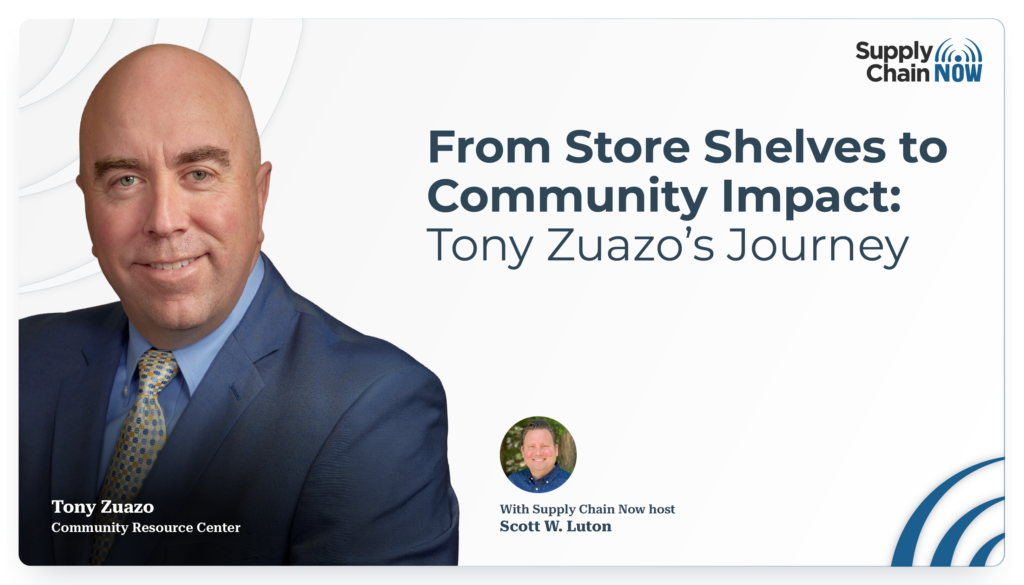
[00:01:42] Scott W. Luton: So I wanna welcome in our distinguished guest joining me here today. Tony Zuazo is currently the Interim CEO of the Community Resource Center. A nonprofit focused on providing basic hygiene essentials to people in need across Middle Tennessee. Now he’s a seasoned supply chain executive and community leader in the Nashville, Tennessee area.
[00:02:05] Scott W. Luton: He previously served as executive vice president of Global Supply Chain for Dollar General Corporation. Where he oversaw transportation inventory and broader supply chain functions rising through leadership roles throughout his tenure. Now, in addition to his corporate career, Tony has been active in local nonprofit work and professional organizations.
[00:02:25] Scott W. Luton: He was a member of the Latino Corporate Directors Association, also known as the LCDA, and served on the board. Of the Community Resource Center that I mentioned a minute ago. Zos background reflects a blend of executive business experience and community engagement, making him a notable figure in both the corporate and non-profit sectors in Tennessee, as well as broader global industry.
[00:02:50] Scott W. Luton: So I wanna welcome in my new friend Tony Zuazo. Tony, how you doing?
[00:02:55] Tony Zuazo: I’m doing great, Scott. It’s great to be here with you today.
[00:02:58] Scott W. Luton: You as well. We, we’ve been, we’ve been working on this for quite some time. It’s great to finally make it happen. And again, as I shared in the Green Room, I really admire not only your industry leadership and experience, uh, and expertise, but your, it seems like your constant focus on helping others and giving forward.
[00:03:14] Scott W. Luton: Tony, we look forward to diving more into that, but first, Tony. I can’t wait to learn more about some of the more personal aspect of your passions here. So there’s a couple things we talked about in the pre-show, basketball, working on cars, and of course family. So I got a little lightning round for the fun warmup question, Tony.
[00:03:37] Scott W. Luton: Does that sound good?
[00:03:38] Tony Zuazo: Sounds good.
[00:03:39] Scott W. Luton: Alright, so basketball first, because you, you’ve been coaching basketball and, and, and helping folks I think get better at basketball for quite some time. What’s one of your favorite seasons? Coaching basketball.
[00:03:53] Tony Zuazo: We’ve had some good seasons, uh, and this year was a great season, but I do have to go back and, you know, when my son’s in third grade, uh, he’d say third grade basketball.
[00:04:01] Tony Zuazo: Wow. That’s, is that real? Yeah, it’s, there is, uh, there’s some real basketball being played at third grade. Uh, although some people are just learning, but the team I had, we had a great season, went undefeated, won the championship, and it was a co-ed team of boys and girls. So I’m just really proud of that because typically you don’t see a lot of the co-ed activities, especially in basketball.
[00:04:23] Tony Zuazo: It usually separates out and. And this was a great team. Young boys and girls came together and, uh, put it together for the title Undefeated.
[00:04:31] Scott W. Luton: Love it. And at that age, I’m assuming it’s less strategy and more help with securing the fundamentals, or is it both?
[00:04:38] Tony Zuazo: Yeah, I would say a little bit of strategy. You have some players that are a little bit more advanced than others.
[00:04:42] Tony Zuazo: You just wanna point them in the right direction and, and make sure they can, uh, you know, play some good defense. So, you know, it’s a lot of fundamental skill work, right? Just to get them to do the, the basics and eventually they’ll score, but, but dribbling and playing some defense was key.
[00:04:57] Scott W. Luton: Tony, you’re gonna have to help me out with my game.
[00:04:59] Scott W. Luton: I, I might be a lost cause, I don’t know, but, all right. So let’s talk about something else. You love working on cars too. What’s one of your favorite cars you’ve ever had the pleasure of working on?
[00:05:08] Tony Zuazo: Yeah, I’ve, um, I’m a, what they call a YouTube mechanic, so I’m not, I’m not gonna, I’m not gonna fix your car, Scott, but I’ll work on my own stuff.
[00:05:16] Tony Zuazo: I would say my favorite project and I still have this car, it’s a 1983 Porsche nine 11 SC that I’ve kind of restored and put a lot of time and energy into it, and it’s hopefully I’ll never sell that car and I’ll have forever and be able to pass that down.
[00:05:32] Scott W. Luton: Oh, Tony, I love it. That’s like an iconic car from the 1980s, right, Tony?
[00:05:37] Tony Zuazo: It’s yes, for sure,
[00:05:39] Scott W. Luton: man. Okay, finally, a little more serious note. I know you are very passionate as most of us are spending time with family. What’s been one recent highlight? Uh, good family time, something y’all have done together.
[00:05:52] Tony Zuazo: Yeah, I would say, you know, it was, it was a trip we took. So I’m originally from California.
[00:05:57] Tony Zuazo: My mom still lives in California, specifically the Bay Area, the, the East Bay near Oakland. And so we go to visit her regularly. Um, and so we did that, but we got the opportunity to visit her, plus we got to go see the Golden State Warriors play one night, and then the San Francisco 49 ERs play the other night in Levi Stadium.
[00:06:14] Tony Zuazo: So it became a great family trip. Got to visit mom, but also gotta see some great. Professional sports, two of my favorite teams, and I got to introduce the kids to, you know, my team’s live where they’ve seen, obviously on tv, but it’s, it’s different when you go see a live sporting event. So. It was a great trick for us.
[00:06:33] Scott W. Luton: Sounds like it. And so just to, um, finish the triple play there, folks, uh, watching or listening to us, Tony, he shared two of his favorite teams, an Niners and the Warriors, but the round out, the trifecta. He’s also, as you might imagine, a big Oakland A fans. All right.
[00:06:51] Tony Zuazo: That’s correct Scott, and you get the right point.
[00:06:53] Tony Zuazo: Oakland A, so I’m, I’m loyal to Oakland for the a’s. I’m sad to see them in, in Vegas, uh, on their, you know, on their way to Vegas. But I’ll always be an Oakland Ace fan.
[00:07:03] Scott W. Luton: Love it as I’ll share with somebody not too long ago, uh, me and my cousins and my brother and and friends would have a, we had to modify a baseball game as kids because we didn’t have two full teams, like most kids don’t have.
[00:07:14] Scott W. Luton: Right. And we played this game and, uh, me and my one cousin named Derek, you know, I always had a eye on Jose and Conseco and Mark McGuire, the Bash Brothers. I think that’s, yeah. We named ourselves the Crash Cousins for related to some of the Homer home runs we did. So anyway, that’s great. Those are some good AIDS teams.
[00:07:36] Scott W. Luton: Alright, so let’s talk business. Tony, you’ve had an incredible career that continues to this day, the impact you’re making. Before we get to what you’re doing now, I wanna talk more about your past a bit. So. As executive vice president, global supply chain with Dollar General, you led one of the largest, fastest moving retail supply chains, at least in North America.
[00:07:56] Scott W. Luton: I think I shared with you in the pre-show, me and my family are in them in our neck of the woods all the time. Feels like every day. When you look at today’s environment though, two part question. What is fundamentally different from when you started at Dollar General from a a retail environment, and then secondly, what really hasn’t changed all that much?
[00:08:15] Scott W. Luton: Tony?
[00:08:16] Tony Zuazo: Yeah, so one of the things that drew me to supply chain was the dynamic, evolving, and multidimensional environment. And so, you know, this, you’re in the space, Scott, but a lot has changed since 2010. But I would, I would key on specifically technology to identify, uh, you know, a few changes there. And the first one would be around automation.
[00:08:37] Tony Zuazo: The material growth that’s occurred outside of the e-commerce space. We know e-commerce drove a lot of automation in, in supply chain, but you saw more recently a lot of activity outside of e-commerce and the provider space has grown globally. Now that’s, that’s the landscape. Costs have come down. In turn, the adoption rates have increased, and so I think that’ll be a continuing trend and I think it’s good for the industry and well, I’m sure we’ll talk a little bit more about that later too, but I think there’s positives there, although, you know, some folks will see that as a negative.
[00:09:09] Tony Zuazo: The second I would say is AI machine learning and the prevalence of it now, it’s part of everyday supply chain lives and becoming more valuable every day. New use cases are being developed and tested on a daily basis and. I think that that environment is ever changing and you know, while there’s some some cons identified, I do think overall the pros are there for supply chain and how it can help in the next iteration of what supply chain looks like.
[00:09:36] Scott W. Luton: You know, it, it is, it is fascinating. It is absolutely fascinating. This, um, this era in global supply chain, certainly in retail. And I, and, and the one thing that I’ve really enjoyed about retail, Tony, is, you know, as a practitioner and a consumer, I love learning about retail and about retail supply chain, just as I interact, you know, from some of my favorite brands.
[00:09:59] Scott W. Luton: Uh, do you still enjoy that? Uh, is that, uh, is that just me or do you enjoy that too?
[00:10:03] Tony Zuazo: Yeah, absolutely. I think that’s, you know, once you’re, once you live it for a long period of time, you, you are always, whether you’re involved in it day to day or sitting on the outside, you know, I’m still a fan of, of what gets done in supply chain and in folks that are doing interesting and innovative things.
[00:10:20] Tony Zuazo: I, you know, I, I’m excited to see that happening.
[00:10:23] Scott W. Luton: Same, same. So speaking of same, uh, you gave us a couple things that have changed quite a bit. Yeah. What hasn’t changed that much at all, you think?
[00:10:33] Tony Zuazo: You know, as I, as I think about what hasn’t changed and everything’s gone through some level of change, but I do think that the.
[00:10:40] Tony Zuazo: The focus on uncertainty is still front and center, and we’re seeing today on the tariff front and the global nature of everything that’s happening in supply chain has created an environment where there’s constant global pressures. And I would say that’s unchanged. There are slightly different each time.
[00:10:58] Tony Zuazo: Whether they’re driven by, you know, government agencies or by natural disasters or things like that, there’s a constant pressure on supply chains globally, and the, the ability to adapt and support that is, is critical to be successful in this space.
[00:11:17] Scott W. Luton: Hmm. Tony, let me, let me ask you something. I, I was just writing about this for the 27th time, I think recently.
[00:11:24] Scott W. Luton: And you’re talking about the pressure and I think one of the pressures we feel in global supply chain, really global business, uh, everyday business is decision making. Right? And I, I was just talking to somebody the other day, uh, ’cause for me. Uh, while decision making remains, uh, one of the challenges, uh, of, of business, it’s not necessarily what a lot of people might think, which is a really big multimillion dollar decisions.
[00:11:49] Scott W. Luton: Sure. That’s, that’s challenging. Right. But for me it is. And in my career, in my journey, it’s been more about the tons of small and micro decisions that we’ve gotta make throughout any day That is. It can be really rewarding and fulfilling. However, it can also be in incredibly complex and, and frankly, exhausting at times.
[00:12:12] Scott W. Luton: React to that if you would.
[00:12:14] Tony Zuazo: Yeah, you’re, you bring up a great point. I don’t think this is, you know, for a lot of the folks that are not in supply chain, they don’t really understand what that means and what you’re saying. And I think some of that also comes from the space that if you’re in supply chain, especially if you’re in a, a multi-business unit leadership role.
[00:12:31] Tony Zuazo: You could be having a conversation about a transportation issue. Right now and 30 minutes later you’re talking about a warehouse space issue, and then 30 minutes later you’re talking about inventory supply constraints. And then 30 minutes later you’re talking about how we’re unable to get product supply from a vendor based on an issue.
[00:12:51] Tony Zuazo: And so the, the gamut of issue you’re dealing with is, is continuous when you think about the supply chain, but totally independent and requires different head space every time. And I think that’s part of where. The, the folks that end up doing a really good job in supply chain can pivot quickly and to your point, make a lot of these micro decisions ’cause that’s what they’re hit with daily.
[00:13:15] Tony Zuazo: And some of the folks outside the space don’t, don’t understand that. And I think that’s where a lot of the supply chain folks have started to get more value and been able to elevate into CEO roles was an example because of that mindset and, and that that ability to, to shift quickly and pivot into different, different head spaces.
[00:13:34] Scott W. Luton: Tony well said. You paint quite the picture, uh, with your response to that and also going back to the initial part of, uh, what’s changed dramatically. You know, technology is also helping at basically all levels of decision making. I would argue, and of course we have great team members and that will never ever be overstated.
[00:13:52] Scott W. Luton: So talking about Dollar General, most folks watching or listening to this conversation are very familiar with Dollar General and know that it operates at a massive scale and often. In rural or hard to serve markets. I wanna ask you, what were some of the non-negotiables that kept that supply chain performance As disciplined as it needed to be, to grow and serve that skill?
[00:14:17] Tony Zuazo: Yeah. When you, when you have a, a business that is perpetually growing annually. Your revenue base is growing, but your store footprint is also growing. You have to plan for the future today because the growth is coming. And if you don’t plan for it, you’re gonna exceed your capabilities. And so, uh, one of the things that we instituted was a, a fi, a rolling five-year plan.
[00:14:41] Tony Zuazo: And this plan addressed physical logistical needs. So warehouse. Warehouse space, transportation, trucking capabilities. It also addressed staffing and what that looked like, and then what the technology platform and footprint was gonna look like in the forward years, depending on what was happening and, and the, the level of growth we got to.
[00:15:02] Tony Zuazo: So having that rolling perspective also helped inform the financial plans of which supply chains are huge consumers. And when I mean a consumer, there’s a lot of capital that goes into a supply chain. And so we had to have a clear view of what the capital requirements were gonna be for those forward years.
[00:15:20] Tony Zuazo: So you can ensure that, that we had that money earmarked and the financial plan for the organization supported it. And that in turn, I think allowed, uh, setting the organization up for success and having that, that forward view of what things could look like and what those potential constraints were gonna be.
[00:15:38] Tony Zuazo: And how do we ensure that the supply chain was gonna be an enabler, not dentistry.
[00:15:43] Scott W. Luton: Hmm. Tony’s fascinating. We, we could sit here for several hours and, and look more at your time at Dollar General and all that. Y’all, you and the team accomplished. I’ve heard it said, I wanna get you to react to something I was sharing with a buddy the other day who, that I was about to sit down with you and he, he was familiar with your background a little bit.
[00:16:00] Scott W. Luton: Uh, and he told me. Folks look at Waffle House and Dollar General, if they wanna get a sense of how of, of how bad things can be, you know, disaster wise, storm wise, if Dollar General and Waffle House are still operating, folks panic less. Totally react to that a bit.
[00:16:17] Tony Zuazo: Yeah, you’re right. I mean, and, and you brought this up earlier, but like in a lot of these small rural America towns, we are the mainstay.
[00:16:24] Tony Zuazo: We are the gen, you know, Dollar General was the general store. There wasn’t a Kroger, there wasn’t a Walmart, you know, there wasn’t a target. So, um, you know, that is the mainstay and that’s where people are going to, to get their everyday needs filled. And so likewise with the Waffle House, it’s comfort food.
[00:16:41] Tony Zuazo: And if the Waffle House and DG are closed, you’re right. I mean, there’s gonna be some problems in that town.
[00:16:47] Scott W. Luton: So true, Tony. All right, so as a follow up to, to your perspective you’re sharing here today, I’ve got a, a broader question to pose to you. So in your experience and from where you sit, two part question.
[00:17:01] Scott W. Luton: Where do leaders in meaning supply chain or otherwise tend to over-engineer things? Right. At the detriment of, of performance maybe. And then the flip side, where do you see leaders regularly and dangerously oversimplify?
[00:17:19] Tony Zuazo: Yeah, great question. And I feel like there’s a theme here and a lot of stuff we’re talking about, but, but I’m gonna tap into technology specifically when we talk about over-engineering and where that occurs.
[00:17:29] Tony Zuazo: There are a lot of great technology solutions out there now, to be fair, I’ve never found the perfect software solution. And so they all have pros and cons. I lean on looking at process management to account for some of those gaps, and then you build your ROI accordingly that helps you understand what the software solution is gonna, is gonna do for you.
[00:17:49] Tony Zuazo: A lot of times over engineering occurs in the, let’s, let’s customize this, let’s add extra code, and you end up going down the slippery slope. And so I think that’s where. You have to understand the role of technology and how much it’s gonna get you, and there are no perfect solutions. So work to get as much as you can out of it.
[00:18:05] Tony Zuazo: Meet your ROIs and, and try to stay on the base platform as much as you can.
[00:18:11] Scott W. Luton: Tony, I, I appreciate that, especially in this era of, uh, I think as you kind, kind of implied, there’s a technology solution for everything big and small and all points in between. Right. And to your point. Very infrequently or maybe ever in, in, uh, our supply chain journey, do we come across that perfect solution?
[00:18:31] Scott W. Luton: Especially on the bigger size, right? Where you got all the be and whistles Yes. That most teams don’t use. I have found that in the category of what’s old is new again, selection, then the selection process. It’s really important. ’cause that’s been around since the, you know, caveman days. Right.
[00:18:51] Tony Zuazo: And it
[00:18:51] Scott W. Luton: how we select processes or techno or service providers or technology platforms or what you name it.
[00:18:57] Scott W. Luton: Yeah. But with the slew of options, it’s really important. We don’t mail that in these days. Tony, would you say?
[00:19:03] Tony Zuazo: For sure. Yeah. Yeah. You’re a hundred percent right. Um, and you know, I think your, your other question around oversimplifying is I would say there’s, there’s a little bit of overlap here on technology, but, but also kind of independent and I think.
[00:19:17] Tony Zuazo: A lot of times we oversimplify the, the need or a change management process and we say, well, we can get by. Everything will be okay. People will love it. And it’s not necessarily the case. Um, people are, you know, adverse to change. And so change management’s a real thing. It does require some real money to be allocated to it and a real process and some expertise in that space.
[00:19:42] Tony Zuazo: So. Don’t oversimplify it. Make the investment, especially when you’re doing large scale initiatives of technology or process change or, or reorganization or mergers, acquisitions, all those don’t leave change management behind and don’t leave the, the associated expertise that comes with it. Treat it like it’s part of the, the implementation plan.
[00:20:03] Scott W. Luton: Tony, well said. And especially on the front end of, of what you shared there. Communicate, communicate, communicate. And when in doubt, communicate again. Right, Tony?
[00:20:13] Tony Zuazo: Right. That’s it. That’s it. You can never, you know, hurt yourself by over communicating.
[00:20:17] Scott W. Luton: That’s right. Well said. Okay. So Tony, I I, as much as I hate to do it, I’m gonna leave that chapter, that really important chapter of your journey.
[00:20:25] Scott W. Luton: ’cause I’m really thankful and grateful and impressed with what you and the team are doing at, uh, the community. Resource center, which is Middle Tennessee’s hygiene hub. Yes. Uh, and there you serve as interim CEO, Tony. So let’s do this. How did this nonprofit, and of course its really noble mission, first hit your radar.
[00:20:46] Tony Zuazo: Yeah, so it was late 2022. I was approached by the, the prior CEO through LinkedIn and she connected with me and, and so I accepted her connection. She messaged me about the opportunity. They were in the process of embarking on a, on an implementation project to put in a warehouse management system, an inventory management system, and a supplier portal system.
[00:21:10] Tony Zuazo: And they were going from Excel and paper to this solution. And so I thought it was a great opportunity where I can bring my expertise and, and help the organization. And so that’s when I joined the board early in 23.
[00:21:24] Scott W. Luton: So, Tony, I gotta ask you, I, I love that, how it hits your radar. And I love when organizations are taking that big leap right in the step ladder of performance and moving from, uh, spreadsheets and, and manual processes to, to systems and technologies, right?
[00:21:41] Scott W. Luton: And the free time. Ideally, when done well, the free time that it unlocks for teens and, and hopefully. It makes their days easier to find the success. Can you share a quick learning about that leap that the nonprofit made that you maybe encourage other business leaders with?
[00:22:01] Tony Zuazo: Yeah. I think, you know, so in this case, because we are a product based organization and not a service, we have products that we need to understand where we are with them, right?
[00:22:11] Tony Zuazo: How many we have, where are they located, how many days supply do we have, and so. All that I would say was not, was not able to be done quickly and effectively in the past. And now we have great information that tells us where we are with each product, what stage it’s in, in, from a production to a to a finished goods state.
[00:22:32] Tony Zuazo: Whether it’s at which warehouse it’s located in and we can quickly identify shortages and then look to replenish those items that we’re short on to make sure that we have supply continuity, which, you know what happens, you either are in feast or famine mode if you, if you don’t end up having good data ’cause you’re making decisions too early or too late.
[00:22:50] Tony Zuazo: And so we’re able to achieve that better equilibrium on where we are with products applied because of the tools that have been turned on. And again. Not super complex, but enough to where there’s visibility and there’s, you know, platform that we can see where our business is.
[00:23:07] Scott W. Luton: Tony, um, been there and done it.
[00:23:09] Scott W. Luton: It’s tough to gather up all the post-it notes with the tick marks on it in the moment. Sure. When you’re trying to make the decisions. Right. Right, right. So, um, I love that. When it comes to the nonprofit itself, again, we’re talking about folks, the Community Resource Center, uh, the CRC, tell us more about core elements of its noble mission and how it goes about the CRC delivers on the commitments and its mission.
[00:23:36] Tony Zuazo: Yeah, so the, the C at the CRC we’re all about hygiene and security, and period prove poverty. So we’re equipping other nonprofits in schools with core hygiene resources, which is products to continue their mission in the field. So they’re, they’re providing support to constituents in the field, and that way they can, they can do the work that they need to do and not have to source those products.
[00:23:59] Tony Zuazo: So that’s the, that’s where the hub part comes in. Uh, we work with 75 plus partners, which it turns into 420 plus locations throughout middle tassi, like I mentioned, school schools and school districts vetted nonprofits and, and actually the library system within Nashville’s another key partners for us.
[00:24:19] Tony Zuazo: We’re here for the community in seasons of ongoing need, and then especially in times of disaster like we recently had with Winter Storm Fern here in Nashville, and so that’s what we do every day here and helping the community.
[00:24:33] Scott W. Luton: Tony, I love that. Love the mission and I know that there’s so much more to what you just described.
[00:24:38] Scott W. Luton: We’ll have to have you come back on and and dive deep. Sure. But a couple observations. Number one, I’m not sure when we started naming Winter Storms, but I’m so glad we did because it’s easier to understand exactly what chapter and we can all relate to Winter Storm in Fern Number two, I love the force multiplier.
[00:24:55] Scott W. Luton: Component to, to, to, to your mission. 75 partners serving 420 locations. I believe so many communities that are being better served to, especially those families in need, thanks to how you support all those partners. That’s, um, that is incredible. Let me ask you this. We’re talking just a second ago about how the, the nonprofit initially hit your radar, right, with its leap.
[00:25:20] Scott W. Luton: From a lot of manual and, and spreadsheet stuff to that next level, that next step up as a current interim, CEO, what is one aspect of the organization that you want to continue trying to make a, an impact on as you continue serving in this capacity?
[00:25:38] Tony Zuazo: Yeah, and you know, part of the role of an interim is a bridge right from, from the prior to the new.
[00:25:43] Tony Zuazo: So that is my role is to be a bridge for the organization, but. I’m always kind of moving and part of my, you know, always moving kind of motto. I’m learning how to be a development person and development in the nonprofit space means raising money. So that’s my goal, to continue to raise money for the organization and, and make it continue to be sustainable.
[00:26:04] Tony Zuazo: So when the permanent CEO is here, they can hit the ground running and they can continue to do the great things and, and keep it going forward.
[00:26:11] Scott W. Luton: Okay. Outstanding. And that search is on, is continuing in terms of the search for the, uh, new permanent CEO, is that right?
[00:26:18] Tony Zuazo: That is correct, yeah. So if anybody out there that’s, that’s interested in leaving the for-profit potentially, or moving into the space or already in the space and looking for something different, the posting is out on LinkedIn, you can find it there.
[00:26:32] Scott W. Luton: Outstanding. Okay. Alright. So this is the, the question that I’m really thrilled to ask you and, and we wanna, uh, put this out there amongst all of our watching and listening audience. Tony, how can folks jump in and help support the CRCs mission?
[00:26:48] Tony Zuazo: Yeah, thank you for that. Um, direct donations, whether it’s monetary product or supplies, since this is kind of geared towards a lot of the supply chain folks, you understand?
[00:26:59] Tony Zuazo: That, that what it takes to run an operation. And there’s, there’s not only the product, but there’s also supplies that go into a shrink wrap, Gaylords. Packaging. So anything that can help in those along those lines is great and we’re always in need of it. Product focus today, we end up having to buy about 60% of the product that we donate.
[00:27:19] Tony Zuazo: And so the more product we can receive from organizations, then that can help our business model and help us grow and meet more of the unmet need that’s out there. And that could be anything from. Perfect product, imperfect packaging, nearly expired goods, discontinued merchandise, oversupply. So I know a lot of those organizations out there have these situations and, and we’re a, we’re an avid recipient of all that.
[00:27:45] Tony Zuazo: We are built for repackaging and redistribution. So we do a lot of transformation. We’ll take a shipper, a displayer of, of, of tampons, and we’ll transform them into a package that we can redistribute to our partners. We’re very comfortable in that space. We do it every day. Um, and we’re also able to collect goods from anywhere in the, in the US and we also do that every day.
[00:28:07] Tony Zuazo: We have a great transportation partner that helps us with that, but we’re constantly searching for goods. And you think about kind of the, the operation being in Middle Tennessee, but we’re going to Wisconsin. We’re going to Florida. We’re going to Ohio, we’re going to California to go collect goods that we can redistribute.
[00:28:23] Tony Zuazo: So, um. Any of those opportunities. On the corporate side, we do a lot of events, and one of the events we do is a hygiene drive, so it’s a physical donation or we’ve also now moved to a virtual donation that we run through Amazon. We can do team, team building events for packing parties, so they, they help us package goods that will in turn go to, to nonprofits and then in turn go to constituents.
[00:28:48] Tony Zuazo: And then we’re doing volunteer work at our facility on a regular basis. So every week we have a contingent of volunteers that comes in and helps us do that redistribution, repackaging, and staging orders for our partners to come and receive. So a lot of opportunities to, to work with us.
[00:29:06] Scott W. Luton: You beat me to it.
[00:29:06] Scott W. Luton: There is a lot, lot of opportunities to find ways to support, uh, the CRC and folks. We’re gonna show this again towards the end of the session here, but uh, you can learn more at the website and that’s crcmidtn.org. And this makes sense. It’s a Community Resource Center, Middle Tennessee. That’s what, that’s why that that acronym comes from, so crcmidtn.org.
[00:29:35] Scott W. Luton: And Tony, my hunch is if folks are kind of on the fence and not, and they’re not sure if they’re able to help or not, I bet you welcome those creative ideation conversations, huh?
[00:29:46] Tony Zuazo: Absolutely. We had two corporate groups in today just to come see the facility, see what we do. Um, a lot of our engagements with, especially in the corporate space, are very specific and how, you know, we kind of meet you where you wanna be met when it comes to that.
[00:30:01] Tony Zuazo: So we’re open to a lot of different things that we can do to gather to, to help the cause.
[00:30:06] Scott W. Luton: Outstanding. Tony, uh, again, appreciate the great work that the CRC and you and the whole team are doing, all the families, uh, in need. That you’re helping. Okay. So earlier in our conversation, uh, you referenced how some themes were emerging.
[00:30:21] Scott W. Luton: So I’m gonna circle back to now because I know you’ve got a, you’ve got an outstanding network, c SCOs and, uh, senior supply chain leaders and, and, and a lot more. And when you, when you, when you engage with those folks here today, uh, here in 2026. And, and beyond some of the things you’ve shared here today, what are some common themes that emerge from their work and their priorities and what they’re doing, especially in terms of how they’re solving or empowering what I call the big three right People, process and technology.
[00:30:51] Scott W. Luton: I always love a good framework. What, what’s some of those common themes you’ve picked up on?
[00:30:55] Tony Zuazo: Yeah, I, I love the, the big three framework. I think it’s, it’s, it’s a. It’s a macro playbook for how you need to run your business and you have it in the right order of priority and importance. So I, I appreciate that.
[00:31:07] Tony Zuazo: ’cause some people don’t always put it in the right order or what I think is the right order, uh, which is some people may wanna debate. But I would say, you know, based on that, the, the organizations and the leaders that are putting. People at the center of, of what they’re doing are winning and will continue to win.
[00:31:24] Tony Zuazo: There’s the importance that they drive in the organization is critical. Now, it doesn’t mean that technology is not important, and we talked about automation and AI and, and those will change the way we work. I mean, that is. That is gonna happen, but people are always gonna be the driving force and they’re always gonna be where innovation is born.
[00:31:44] Tony Zuazo: And so making sure that you take care of that and you develop it and you foster it and you position it accordingly regardless of, of what type of business you’re in, is critical. Hmm. I’m a process guy and I’ve always been, I’ve always placed tremendous focus and value on being process driven. So I would say don’t underestimate the value of process engineering projects that don’t necessarily have a technology, but just how you’re gonna do.
[00:32:09] Tony Zuazo: Things differently. Don’t forget to be hard on the process and easy on the people, at least to start. Then you can work through how people do things, but make sure you, you put a lot of emphasis there. And lastly, I think, you know, we talked about technology and how, you know, has a role you have to treat technology as an enable.
[00:32:29] Tony Zuazo: And there is no silver bullet solutions like we talked about. So I don’t care who’s selling it and what they’re selling. Their solutions are gonna help you run your business, but they’re not gonna solve your business. And so make sure you treat the, treat the technology as the enabler that it’s
[00:32:44] Scott W. Luton: Tony, man.
[00:32:46] Scott W. Luton: Good. That’s a whole podcast series. That one response right there. And I wanna pick something out. ’cause as a fellow process guy, as you put it, I’m gonna see if something resonates with you, as I’ve learned over the course of my career. You know, standardization is not a dirty word, and even if when it comes to the most creative and artistic.
[00:33:06] Scott W. Luton: Uh, aspects of business. I mean, we look at what we’re doing now at Supply Chain Now, you know, content creation. I’m very passionate about the genuine aspect of that. However, being a big process individual, I apply standardization regularly, which helps support artistic forces for not to be too dramatic, but I think, you know what I’m saying?
[00:33:25] Scott W. Luton: You know, I bet there’s folks out there that when they hear standardization. They’re like, oh, the big system. Taking choice and taking art, you know, artistic choice and design. But that’s not the aim, at least from where I sit. Tony, speak to that if you would for a second.
[00:33:39] Tony Zuazo: Yeah, I think you’re right. And, and again, you don’t have to go left or right.
[00:33:45] Tony Zuazo: In one complete direction, right? There could be certain things that you’re gonna standardize and other things you’re gonna give choice to, right? And I think that’s part of what I think about when you talk about re-engineering a project. That’s what you’re looking at. You’re not looking at just saying, Hey, we’re gonna do it this one way, maybe for these five steps is one way, and that’s gonna get those five steps done the most efficient way.
[00:34:06] Tony Zuazo: But these other five, they are gonna have a couple of paths and there is a decision matrix. And so that’s gonna allow that person to be the decider possibly. Maybe at some point it’s an AI decision. Um, but regardless, there is some flexibility that you’re drawing into the process. And I think, you know, having that happy medium of.
[00:34:25] Tony Zuazo: You know, the debate and the conversation, but being open to there is some standardization and then there’s some flexibility, and I think the two of them can get you what you need. And you know, I think also helps in the change management process.
[00:34:38] Scott W. Luton: Yes it does. And we all get better from having that spirited, uh, friendly and professional debate you referenced.
[00:34:44] Scott W. Luton: Yeah. Because, you know what, what’s, what works on Monday may not work the following Monday. In fact, sometimes it may not work the next day on Tuesday. Right. Um, especially this environment. Goodness to Tony. Really enjoy your perspective and gosh. You’re just cool, calm your demeanor. So you get that feedback a lot, Tony.
[00:35:03] Scott W. Luton: Just do, do you have a mellowing influence in those heated supply chain days? Do you have a reputation for that?
[00:35:11] Tony Zuazo: Yeah, I mean, I, I can, I can get pretty passionate about, about things, but, uh, somebody once referenced me as like, you’re. You’re calm, cool. But you’re like the, you’re like the duck. Your feet are going like a hundred miles an hour under the water.
[00:35:25] Tony Zuazo: And so like, I like that analogy. But yeah, you know, sometimes there, there is some passion that comes out.
[00:35:31] Scott W. Luton: Love it, Tony. I love it. I can see it. Okay. So Tony, I know we’re just scratching the surface. Uh, you’re doing a lot of great work out there. Continue to do a lot of big things out there. And again, I love in particular your giving forward and to do good aspect, very, very consequential and outcomes producing for so many families out there.
[00:35:51] Scott W. Luton: How can folks connect with you, Tony, and of course the, the organization.
[00:35:56] Tony Zuazo: Sure. Yeah. So if you can find me on LinkedIn, happy to connect with you all there. That’s my, that’s my media platform for the Community Resource Center. Scott gave you our, our web address. We’re on Facebook, we’re also on Instagram.
[00:36:11] Tony Zuazo: You can hit us up there and follow us. Stay on top of everything that we’re doing. And then once you, uh, go to the website, there’s opportunities to, to connect with us whether you want to donate financially or other ways to get ahold of us, to be a part of some of the other things that we have available to do with partners and in corporate or individuals.
[00:36:31] Scott W. Luton: Tony, I love it. And folks, we encourage you if, if you’re on the fence and you’re not sure if something will help or if it’s not the right type of help, reach out to Tony, have that conversation. And you know what, I’m gonna raise the bar. We’re gonna see who’s listing or watching. So lemme put the website out there first.
[00:36:46] Scott W. Luton: Crcmidtn.org. Again, it stands for Community Resource Center, Middle Tennessee. So crcmidtn.org. If you. Are able and in position to support the Community Resource Center right, and we’ll probably need to come up with a threshold, but hey, I appreciate any, any gift forward gift. Make the donation, give the assistance, and then reach out to us.
[00:37:13] Scott W. Luton: Let us know what you did, and I promise you I’ll, I’m find a way to celebrate that giving forward. Maybe we’ll have Tony and maybe your CEO on or, or, you know, you name it the person that made it happen. And we’ll dive into your mission and of course we’ll explore the great work that you’re helping to support at the CRC.
[00:37:31] Scott W. Luton: Tony. Does that sound like a, a good deal?
[00:37:34] Tony Zuazo: I’m excited. I can’t wait for the follow up meeting. Like I know it’s gonna happen, so like, let’s do it.
[00:37:39] Scott W. Luton: Let’s make it happen. Alright, so Tony Zuazo, the interim CEO with the Community Resource Center. I really appreciate your time, your perspective, and all that you do.
[00:37:52] Scott W. Luton: Tony, great to have you here today.
[00:37:55] Tony Zuazo: Awesome. Thank you
[00:37:57] Scott W. Luton: folks. What a great conversation. The cool, calm, collected demeanor of someone that is fast and furiously moving a hundred miles an hour to help so many others. Love that dichotomy and, and, and love what it produces. So big thanks to our wonderful guest here today, Tony Zuazo, the, again, the interim CEO, the Community Resource Center.
[00:38:17] Scott W. Luton: Learn more at crcmidtn.org to our Supply Chain Now global fam. Hope you enjoyed the conversation. Hey, take me up on that challenge. We’re gonna see who’s listening and, and watching. We wanna celebrate all the great organizations that support the CRC and and and similar nonprofits, and y’all keep the support.
[00:38:40] Scott W. Luton: And the feedback coming feedback is a blessing, Tony. That’s what I’ve learned in my career, even on those days where you, you’re kind of feedbacked out, but still keep it coming folks. But most importantly, take one thing you heard here today from Tony and, and all that they’re doing, and put it into practice.
[00:38:57] Scott W. Luton: Do something with it. Deeds, not words. Right? That’s how we’re gonna keep transforming. Global supply chain and leaving no one behind. So with all that said, Scott Luton challenging all of our listeners and our, our viewers, our SCN global fam, do good, give forward, be the change that’s needed. Be like Tony ’cause the world will be a much, much better place.
[00:39:17] Scott W. Luton: And on that note, we’ll see you next time right back here on supply chain. Thanks everybody.
[00:39:23] Voiceover: Join the Supply Chain Now community. For more supply chain perspectives, news and innovation, check out supplychainnow.com. Subscribe to Supply Chain Now on YouTube and follow and listen to Supply Chain Now wherever you get your podcasts.