[00:00:00] The beauty of AI is that it collapse the distance between understanding and acting. In the past, we will take weeks, maybe sometimes a month to understand why we missed the forecast, why the instock was not good in that region, why it had an issue in the transportation there. Just getting into data and digging into to understand what happened today, it’s pretty fast.
[00:00:20] It can take minutes. So that distance between understanding and actively. It’s one of the beauty of of AI. Welcome to Supply Chain Now, the number one voice of supply chain. Join us as we share critical news, key insights, and real supply chain leadership from across the globe. One conversation at a time.
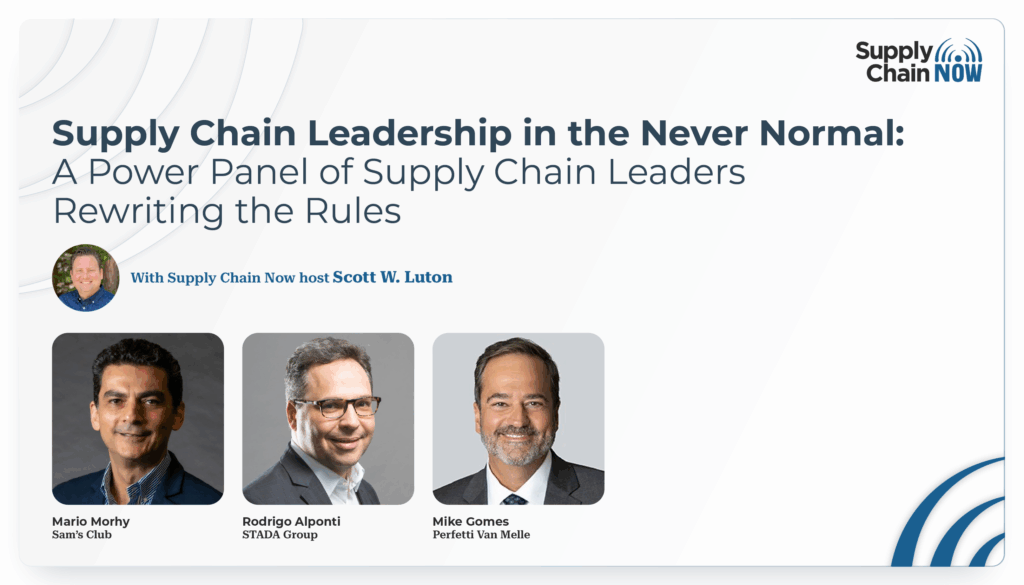
[00:00:41] Hey, good morning, good afternoon, good evening, wherever you may be. Scott Luton with you here on Supply Chain Now. Welcome Last September. We kicked off a new series here at Supply Chain Now where we gathered a panel of elite senior supply chain leaders and we shared their perspective on a multitude of topics.
[00:01:00] All couched under this big theme of this never normal, that global business continues to find itself in a never normal, that mind you. Continues to evolve by the day, sometimes by the hour. The September event was hosted by the one and only Karin Bursa right here on Supply Chain Now, and she was joined by an incredible panel of exceptional supply chain leaders.
[00:01:23] It was a hit. We received a ton of feedback, so I’m delighted to be hosting a second installment of this new series backed by Popper demand. Folks, we got another extraordinary panel and we’re gonna touch on a variety of topics, leadership challenges, customer-centric supply chains, and how they’ve evolved, how AI is transforming organizational performance and much, much more.
[00:01:46] And get ready for the next installment of the Never Normal Series right here on Supply Chain Now. We’re gonna get to work. I’m gonna try to keep up with this power, power panel we’ve got here. I’m gonna introduce each of them, starting with Mario Morhy, Vice President, integrated Planning with Sam’s Club.
[00:02:04] Mario is joined by Rodrigo Alponti, Senior Vice President, global Supply Chain with STADA Group. And Mike Gomes, vice President of Supply Chain North America with Perfetti Van Melle. I bet we’ve got a close to a century of proven supply chain leadership here today. Wanna bring in Mario, Rodrigo, and Mike? Hey.
[00:02:25] Hey, Mario. Good afternoon, good evening, good morning. How you doing? I’m doing well, thank you. Great to see you, Mike. How you doing today? I’m doing fantastic. Uh, thank you for the invitation, Scott. You bet. And of course, Rodrigo, how are you doing today, my friend? Great as well, Scott. Thank you very much and it’s an honor to be here with you.
[00:02:46] Thank you for invitation. Same, same. Well, I’ve really enjoyed the opportunity to get to know each of y’all kind of in the pre-show session a bit. I wanna give our audience a chance to get to know you a little bit better before we get into a lot of big topics. And Mike, I wanna start with you. Tell us a little bit about yourself.
[00:03:00] And organization. Yes. Um, my gom is, uh, I’m, uh, the vice president of, uh, in end supply chain, uh, for Perfetti Van Melle. You probably know all the products. So we, uh, produce, uh, mento, go Mentos, kdi, uh, all the empty tried. Stride, uh, wives in, uh, is the home of my airhead as well. I’ve been very fortunate, uh, to have the opportunity to learn from, uh, great schools in the past, uh, until you, you can, uh, look into my resume and see that.
[00:03:32] And also learn from, uh, from the masters people like J Bars and and, and others. So I’m very glad to be here. I have responsibilities, as I say, for end-to-end and supply chain, basically in general. And, uh, all that is the US. Uh, Mexico in Latin America from manufacturing plan and delivery RDQ, quality recruitment and, uh, safe, uh, health and safety in environment.
[00:03:59] I’m glad to be here, Mike. Great to have you. And by the way, folks, little side, when Mike gets a little free time cooking, bonsai trees in physics, love studying physics, we might touch on some of that later on. But Mike, great to have you here today, Rodrigo. Enjoy getting to know you earlier prior to the show.
[00:04:18] Tell us a little about yourself. Thank you, Scott. So, uh, I am, as you all know, Rodrigo, uh, I am a native engineer and, uh, I have the, the, the pleasure to lead the global supply chain for Esta STA is a, from a German based pharmaceutical company present in more than a hundred countries. We have a three pillar, um, strategy.
[00:04:39] So we sell generics. Consumer healthcare and, uh, specialty pharmaceuticals, which is basically biologicals. Hmm. Uh, our business is, is strongly, uh, present, uh, mainly in, uh, Europe, Asia, middle East, Africa, and a very small part of the business. In Americas, I would say supply chain. Specifically in supply chain.
[00:05:01] We have approximately a thousand collaborators in the community of supply chain, and we are divided into five different towards streams. So we have solution planning. Customer service, uh, supply chain excellence and launches. This is the structure that we have and that the way we are moving supply chain ahead is through mainly three different, uh, strategic choices.
[00:05:23] One is, is the operational excellence. Well, without operational excellence, nothing will happen. Second is innovation and bringing a lot of, uh, new technologies, AI tools that we are going to talk about solutions. And, uh, the third work stream, which I think is the most important one, is, uh, uh, the development of our people from a technical standpoint and from, uh, uh, leadership standpoint.
[00:05:47] And we are going to talk more about that. Thank you very much, Todd. Rodrigo, I loved, especially that last one you touched on, the development of the, uh, the precious and beautiful human element that makes global supply chain happen every single day. And by the way, when you can’t find Rodrigo doing big things in supply chain, uh, movies, including Jerry McGuire and Any Given Sunday and many others, and chasing his kids in the park where he’d like to spend some of his free time.
[00:06:11] So great to have you here, Rodrigo Mario, great to see you here today. Same thing as we kind of round out the panel. Tell us a little about yourself and organization. First all. Thanks again for having me here. It’s a pleasure to be with Rod and Mike. I think I’m gonna learn a lot today on this great leaders, a hundred percent.
[00:06:27] I don’t wanna learn about physics, Mike. I’m good with that. I’m not that level, but a lot to learn to that. Today I lead integrated plenty for Sam’s Club. My career has been entirely in supply chain. I had a privilege to work in. I’m leading industry companies. I had a privilege to work with some good mentors.
[00:06:46] Like Jake Barr and beginner, my career in KG. So I think my progression has been most in the supply chain area. What my team does in Sam, in Sam’s Club, and by the way, for those who are wanting countries where we do not operate, Sam’s Club is from the Walmart family. We are a 90 billion to $100 billion company, and we are a club channel and a club channel mobile.
[00:07:09] We, we serve members in clubs and e-commerce in every single possible way. So my team does. What my team is connecting the dots of the strategy and execution. We bring that, that in place. We do all the demand planning, uh, pieces, the visa, we all know, we also do flow, we do all the, the optimization of inbound.
[00:07:28] So that’s what basically we do, uh, my team does in Sam’s Club. I think that we are facing a lot of great changes now that I love to learn today, which is how we are gonna evolve our supply chain with the AI and how we do different industries. So the beauty of this panel today is Scott, is that. Different industries, different companies, and I can guarantee you that crosspollination is always positive.
[00:07:49] So happy to be here. Ma, you touched on lots of beautiful things there. The cross pollination, how sectors, industries learn from each other. One of my favorite things about these different conversations we have here, and by the way, we’re talking about Rodrigo chasing kids in the park. If Mario chases anybody, he may catch ’em because he specializes in triathlons marathons, and he is running his 10th.
[00:08:11] Chicago Marathon coming up. Is that right, Mario? Yep, that’s right. Yeah, man, I’m impressed. Okay. You have to give us some tips later. And Mike, I wanna start with you, uh, on my first question. So when you look at the last 12 to 18 months, which yes feels like maybe 27 years, what’s one disruption or shift that fundamentally changed how you think about supply chain leadership?
[00:08:34] Mike, great question. I can think about what I call two realities. The first one is, um, the labor reality that we are living, uh, after COVID, and it’s continued to evolve. But, uh, the other one is, uh, the interception, what I’m seeing in particular in the food industry, which I believe is also true for all the industry on the high level of variability that seeing in the supply chain or throughout the supply chain.
[00:09:02] Driven by different factors than many times, reinforce each other. And when I mean, uh, variability, then I’m talking about the extra risk that we have today and the supply chain. We change a lot the way that we used to think about the supply chain. We think about, uh, lower costs, faster blood chain efficiencies.
[00:09:24] We put a lot of focus on efficiencies. And the intersection of those two realities that I’m talking, the leadership thoughts need to start evolving to resilience and business continuity plan. Because I tell you one thing, the more expensive product that we can have is the one we don’t have on the shelf, and the one is not meeting the customer needs.
[00:09:49] So given the high level of variability that at the end introduces and risk. Or leaders today need to be thinking on the different possibilities, probabilities, and scenarios on top of the cost. So cost is not only gonna be driving the decisions, but all those probabilities that you have because again, you don’t wanna get to a point where you fail in the supply chain and then you don’t have the product on the shelf.
[00:10:15] And that will be the more expensive, um, situation that you can have. Then going back to the core of the question, what do we need to do different? Visibility just through all the supply chain is not making it anymore. You need the visibility, but then you need to be comfortable thinking in the different scenarios that can be present down the road, and you need to be feeling confident and comfortable.
[00:10:42] Making decisions in a very volatile environment. And then very important, you need to have, as I say, efficiency cost, but you gotta add the business continuity plan, meaning the short term right now, what are the options and how you wanna plate them. You gotta have them all built very well, digested plan for it.
[00:11:03] But then you need to think in the longer term as this variability continues. Because one important factor that is there driving this is consumer preference has changed. We have, uh, influencers. Influencers, we have, uh, all the endless information coming from different media. We had geopolitical factors happening today.
[00:11:21] Tar for instance, we got regulatory things in food, we got natural colors. So when all these plays together, you see the level of variability and you need to start thinking scenarios, not just static points in the future. And then you gotta build robust plans for, have a resilient supply chain that meet the needs today, can adapt very quickly.
[00:11:42] It has cost effective. Uh, but by knowing the, the cheapest solution that you will have in the past, but also survive to the future. So very interesting, uh, challenge for, uh, for the leaders these days even. Well, we are living day to day, Mike, man, we’re getting right outta the gate. Uh, I tell you what, Mike’s setting the bar high and I tell you two quick things for I get your tape.
[00:12:03] Mario. I loved your comment about the most expensive product is the one that’s not on the shelf, especially when the customer’s ready for it. Uh, and those, those speaking to the customer. Those really fast shifting, ever faster shifting ’cause consumer preferences and expectations, you know, the microbursts we’re seeing man, uh, supply chain not for the faint of heart.
[00:12:24] Okay. Mario, same question. We look at the last, uh, year and a half or so, disruptions or shifts that really have changed your thinking of what supply chain leadership is. I think maybe on what Michael has mentioned about variability, what we face today, maybe it’s not only for the last 18. Uh, month after COVID?
[00:12:41] Well, we see a lot of disruption in how we operate. I think there’s two things change in my perspective. Number one is that they’re thinking about supply chains being more linear. I think it’s gone for sure. I think supply chains nowadays are more like living systems. And, and the way to embrace that is to really create, create, uh, mechanics into the supply chain that can provide flexibility on take care actions, define new ways of working, and it’s sort of only focused on how we are doing, how we are delivering is more on.
[00:13:12] How can we do better on that? So to me, number one is that leaving systems is in place. Okay? There’s not a modern way for us to be a hundred percent sure. Certainty is not there. The learning for sure is. The second component is about what AI is bringing to us, right? The pace of decisions. The pace of how we can have scenarios built has to be parallel how people embrace the same decisions.
[00:13:36] Okay? I think the variability that we see can be managed and tackled by the ai. But how we address organization, how build system to be flexible, agile, and provide autonomy for people to take decisions to me is, is key. We just finished a holiday season at Sams Club, right? An intense, amazing one of the season.
[00:13:54] And I would say that the best way for us to prep for that was not exactly have the right planning in every place. But have the mechanics to be ready in case of any variability to address immediately those changes that we had. And I, I think on another point that I will mention about just a close year from my leadership perspective that I’ve been learning is really is good to have the right questions, not to have the right answer.
[00:14:20] Uh, Mario, we’re gonna, that, that, that is, uh, a brilliant finish and we’re gonna circle back on that towards the end of the session. But just touched on a couple things. I love living systems. Uh, some f folks don’t like it. I think ecosystem is such a, an apropos way of thinking about our supply chains. And you’re right, the pace.
[00:14:38] Oh my gosh, some days I think, man, I could barely keep up with the, um, with my kids’ marathon, much less the Chicago marathon, the, the, the obstacle course race that is, uh, global supply chain. Good stuff there. Mario. Rodrigo, what would you add? You know, Mike Mario kinda shared looking back how supply chain leadership has evolved in their minds.
[00:14:57] What about you? You know, Scott, uh, after talking about after these two, great is not gonna be easy, let try to add something, right? So, so, uh, the way I we have been seeing in healthcare, at least in, in pharmaceutical, is the challenges are coming from, from COVID is longer. Than than 18 months, I would say.
[00:15:18] And the disruptions that we have been seeing, uh, have been significant combined, uh, with a much more granular and integrated supply chain. I have examples of products that, uh, go through four and five or five countries, two or three continents before they reach the patient. And for us to compete the whole production process.
[00:15:40] So the disruptions combined with these more integrated supply chain brings a a a new challenge for us. And just to give you very few examples, so when we had one boot closed in Bel Lados, I, we had to throw to, to find another route of products to Ukraine, uh, through Turkey. Just, and these happen in two days.
[00:16:02] Otherwise we, we could have problems with the product. We also have coaching products. We have some products that, uh, go to, uh, uh, to the hospitals, some, some products that are treating oncology. And in our case, if we don’t reach the final destination in the right timing, we may be disrupting. The treatment of a patient.
[00:16:22] So I would say that when we talk about this, the leadership of supply chain, that environment, we are working and we are going to talk more about that, but we are working on three, uh, main points. One is, is to ensure that the systems, uh, are accurate enough and that we are bringing, we are facilitating the, the decision making of our.
[00:16:42] Planners in one side. The second point is that, uh, we are proving the capability of our planners from a technical standpoint, from a, a leadership standpoint. And finally, we are empowering them to make decisions quicker. So important for us is to get, uh, agility. So the only word that I didn’t hear from, from Mike and from Mario is, is, is.
[00:17:05] That one, uh, extra word that we are working a lot, which is adaptability. So, as I said, another example is that, uh, we had problems in, in the Red Sea, uh, and, uh, we could not send products from, uh, China to uk. We had in one day we had to change the roots to go around Africa. Suddenly, from one day to another, we added.
[00:17:27] 10 days to our lead times. So, so this is also important for us to have in mind. So just adding to what has been said, uh, the adaptability in this, this very different environment is, is one of the key points as well. Rodrigo, I love that and I, I’ll tell you what, I bet the pharmaceutical industry, which I’ve never been a part of, I didn’t lose any of my nine lives in that industry.
[00:17:47] But I bet it’s challenging enough on like good days, much less days where, you know, you’ve got Red Sea problems bubble up or or other, some of the challenges you’re talking about where it’s adding days and you’ve gotta find new ways. Of tackling said complexity and new complexity. So good stuff there, Rodrigo.
[00:18:05] Okay, so Mike, I’m gonna circle back to you here because I’d love to hear your thoughts and the panel’s thoughts on this, on the notion of what being customer centric means and how that’s evolved in the new never normal correct bullet. The core definition of the customer centric service, uh, has not changed.
[00:18:24] Uh, we still. Have the obligation, responsibility, and the expectations to deliver on full long time on the products that they were requested. What is changing though, uh, if I wanna play this in, uh, the different, in the context that I, uh, explained earlier is at the customer side, they have learned also that lower price, fast supply chain means not a lot if, uh, they collapse.
[00:18:53] And, and again, the product becomes very expensive if it’s not available. So the change in behavior that I’m observing in in the last six months is a clear example of this is they are very open to work together with us to sit down with the supply chain and understand what the options are. You know, every time we detect heightened wrist.
[00:19:17] Every time, uh, that we see the different scenario that we were planning, uh, changing. And they appreciate that. So if I turn the table that into what is the leadership behavior that, uh, we should be displaying, it goes along with that. You know, so we gotta be, as I mentioned earlier, being prepared with the manual of options, the many of the scenarios in the short and in the long term.
[00:19:40] Maybe we, we wanna grow the business with them to be able to. In a timely manner. You know, go back to them, raise the flag, you know, and sit down on the table and discuss, discuss in a transparent way. They appreciate transparency. Transparency. What is the situation that we’re seeing? What are the risk that we are perceiving and what is a proposed solution?
[00:20:03] And you will, you’ll be surprised more times than not, we have got to a solution and an option that is in between the one that we were ringing to the day. Well, this is fantastic in my, in my eyes, because. The link and the closeness between the sales, the supply chain, and the customers. I’m seeing closer than ever in my career.
[00:20:24] And in the other end, the true values are coming to the table, which I really appreciate. The customers appreciate timely and transparency, trying information and transparency, you know, and they reward you for that. The other names too, you know, if I, in some cases we miss, uh, the, the communication and we, uh, we were.
[00:20:43] Provide some strong feedback, so we then, as a leaders, then we need to keep this in mind and continue to work on our relationship with our customers, have our scenarios clear and be ready to raise the flag and sit down with them on the table and move. Find solution as we were finding. Mike, I love it. One quick comment that I heard you in my, in my ears at least, is there’s plenty of constraints out there, but we don’t need to create false constraints and assume false constraints.
[00:21:10] And usually there’s more options than, you know, especially if you sit down and have the real conversations, ask questions you need and you’re proactive. Man, nothing creates more options than, than, uh, being more proactive than what we, uh, what some folks are. Um, okay. Mario, same question. How has customer.
[00:21:27] Centricity evolved in, in, in, in your mind. I think I remember Scott, I think it was seven to eight years ago, was in a Gartner conference and in one of the discussions it was said that the, the end game of the supply chains have the, the proof of order. I think it still is, as Mike said, but I think the evolution that we have is the same flow, is to understand that the, the best way to provide good customer experience is to understand the members’ lives and work around them.
[00:21:56] Not necessarily react to them. Okay. A moment of, uh, execution of the supply chain has to be connected with the experience that the member wants to have. I remember that I, and that I, I saw ma de Grande here. We were together in Mount Center there, just to give a different interest experience. We always wanted to be faster to deliver seeds and, and, and insecticide of ides to the farmers.
[00:22:20] But when we did a customer journey, we found out that the farmer takes 40 decisions before just buying and receiving the item. And we couldn’t understand that we could act on prep, pre-buying, testing, selling, storing. So create a customer experience to me is more than just the delivering fact or having the most efficient one, but understanding the journey that that specific.
[00:22:46] Customer member, client is gonna have so that you can embrace the entire journey. And, uh, to Mike disclosure, to Mike’s point, I think the, the gain now for customer centricity is a company’s gain, okay. Is a cross collaboration game. And that’s how I see the combination of journey and be very cross collaborated with how we approach, uh, the survey to the members or customers or clients.
[00:23:12] Mario, I, I appreciate your holistic approach there. And, um, and you know, the, and the focus of course on member experiences or consumer experiences and, you know, we’ve got to, to your point, it’s not all about delivery. Delivery is important, but there’s more, many more, but, but priorities to the modern day consumers that we gotta take into account or leave out at our own peril.
[00:23:36] Uh, Rodrigo, same question. Customer centricity, how has it evolved in your mind? Well, uh, Scott, uh, customer centricity is already in the heart of the vision of Aada. Right. I, I remember years ago that we were talking about, uh, integration, uh, SNOP, uh, and plan together the future. I, uh, and, and I think this evolved to much more than that.
[00:23:58] I think, uh, both Mike and uh. Uh, Mario talked about this. Uh, now we, uh, are planning, uh, and we are doing the risk management together with our, uh, customers because we have in mind that, uh, our ultimate goal is to ensure that our patients are well served and our patients receive the right medicines on the right time.
[00:24:23] So, um. Uh, more and more, uh, this is happening in the, uh, in the environment. And I, I would only add one point, which is that the health authorities in the countries are also getting into this, uh, relationship and this interaction to ensure that the whole ecosystem industry. He tell you and patient is working well because at, at the end, this is the only way for us to improve the, the access, uh, to medicines to to the whole population.
[00:24:56] Yeah, Robert, a great point, A very special trinity, uh, that you mentioned there. And hey, regulatory concerns are, are playing a part, uh, in many, uh, old and new ways moving forward. You know, uh, we referenced the food industry earlier here in the States. We got a big deadline coming up that FDA, uh, traceability wise, FDA has in place, uh, that it’s about two years from now, so we shall see.
[00:25:16] Rodrigo, let’s stick with you for a minute. What comes to mind when some of the, you’ve currently laid out some things earlier, but the biggest challenges right now, your team’s working on? Um, okay, Scott, let me just give you a little bit of a background first. So, startup has been growing at the, uh, double digit in the top and bottom line over the past, uh, five, six years.
[00:25:36] So we are, uh, more or less doubling the company each, uh, uh, uh, four or five years. Wow. And, uh, and for supply chain, this, this becomes a, a, a real challenge, right. So right now in this very highly, uh, he related market, we have 25,000 SKUs with an average of five months of time. So this becomes very complex for us because, uh, then we need to not only to have a good, uh, a good forecast, but, uh, we also need to manage well the risks that we foresee over the next, uh, months.
[00:26:09] The major challenge that I think we have this year is, is related to planning. We are viewing all the process and planning. We are degrading the system and planning. We are moving to IDP, the module of SAP. Uh, and we are also adding AI in the demand and in the supply planning part of the business. So all of this together, so in this represents the first piece of changes.
[00:26:34] The second piece of the change goes into the people. As I said, it’s not enough for us to have a good system and process. We also need to have one, the, the mastery of our people. So all our planners are going to have sipping the certified, uh, production and, and vendor management. A certification at till the end of the, the year.
[00:26:55] And, uh, we are heavily investing in leadership to ensure that they not only know what to do. But they are able to influence the organization in the right way. So all of these together with empowerment, because if they are not empowered, they won’t be able to make the right decisions. So these are the, the, the, the things that I’m say the biggest change that we have in 26 for us to ensure that, uh, we continue or we will allow the company to continue growing.
[00:27:22] And one piece of information that is important is that, that we are also based on. What we call local heroes, these wings that we call to local brands. And, uh, the growth of the company necessarily goes into the increase of SKUs. So that’s why we need to be prepared to avoid becoming a bottleneck in the, in the growth of the company.
[00:27:43] This is my, my challenge in 26. Our biggest one, sorry, Rodrigo, there’s so much gold there and I, for the sake of time, I just wanna pull one out. I love how you talk about the risk of not empowering your people and how you mentioned it’s not good enough to have a strong, excellent system. We’ve gotta invest in our people so they continue to add more and more skills and capabilities.
[00:28:04] Love that. Uh, let’s see here. Mike, tell us your biggest challenge right now. I appreciate, rod, you are making a lot of focus on the people, which at the end, that’s, uh, what’s the most important thing. And my challenge goes in that, in that direction. So, um. Just to make a long story short, uh, we used to operate as a individual and independent countries in, uh, I bringing, uh, started in 25 in, when I finish in 26, all that on their, uh, business unit structure.
[00:28:32] So, which requires, uh, changing the organization, uh, changing processes, changing the behavior of the, of the leaders, bringing a set of standards. All these. So we are building the airplane, the regional Americas business unit airplane. As we are flying it and as we are flying it to our, to, to, through the turbulence that I was describing earlier, there’s a lot of haul.
[00:28:57] So we also follow on the windows and, uh, where we building the airplane. So making sure that the varieties are in place. Making sure that the transition happens, uh, smoothly while we continue to serve the businesses and bring, we are bringing us, Rodrigo, you were mentioning, uh, uh, standard tools like Hannah is four.
[00:29:17] We are coming, uh, after the startup, uh. Four weeks ago or two, you can imagine, uh, a level of activity that, uh, we are going through. So it’s a very interesting times, but, uh, this is what makes your business fun. So it’s, uh, looking forward to a 2026 organized as a business unit with the right leaders, uh, empower, uh, and develop to be really leaders, which is fantastic for.
[00:29:40] Mike Love, love that. And one call one thing out. I think it’s become a luxury to be able to completely build the airplane and then take off. I think it’s become a luxury in today’s global supply chain. I don’t know. Uh, all right, Mario, uh, you’re the home run hitter here of this question. Uh, biggest challenge you’re working on.
[00:29:58] I think that the, on top of what Rod with Micro has said, I think that our biggest challenge here is how do we simplify the decision making environment in such a complex. Supply chain is such a complex situation here. I think that, you know, Walmart has been very much, uh, upfront on the use of ai. We have a strong partnership with Open ai and so just for as example, every single employee in the club, they have open AI in their apps, in their tools.
[00:30:26] So that is powerful, that democratize the use of ai, but also that creates the need of ways of working or how do we align those decisions, right? How do we make. That group, this big group that we have at sim club, organized from the demand up to the execution. So I think that to me is still a challenge.
[00:30:45] How do we simplify that decision when everybody has a, a unique capability? So how do you simplify and organize and make a common theme, a common thread? Because every one of us, you, Scott, Mike, if you work Sam’s Club, can create our own AI tools. But how do they connect and how do they, how do we simplify decision in a way that we bundle that together?
[00:31:07] So to me it is a, is our, our biggest challenge now. I think we always gonna be for the people. I think that, I think good that Ji, when Mike brought the same topic, if go about a Walmart identity, it says that we are a people led company. Enabled by technology. That’s who I think we are. But at some point, I can tell you now, it’s our how do we organize that decision making process.
[00:31:33] I love it, Mario. Hey, you know what? Uh, we gotta be careful not to fall into some of the old traps with ai. Do you remember? We still, I bet we still go to some meetings where everybody has their own spreadsheet. Well, we don’t need to have everybody have their own ai, right? It’s gotta be all synced, to your point.
[00:31:48] And simplicity still hasn’t. And never will go outta style and uh, we can never forget that. Good stuff, Mario. I bet we’ve said ai, like most supply chain conversations, about 27 times so far. I’ve been counting. Mario, when you think about how AI’s gonna continue to transform supply chain performance, right?
[00:32:07] What comes to your mind, Mario? Love that. I think now we are in the seat to be a enabler. Of the company strategy, right? To be enabler of new business models. Not just serving, not just operating. I think that’s the beauty, and I think that AI helps us to do that as well. Yeah, I think the beauty of AI is that it collapse, that this is between understanding and acting.
[00:32:34] Okay. In the past we will take weeks, maybe sometimes a month to understand why we missed the forecast, why the instock was not good in that region, why had an issue in the transportation there. Just getting into data and digging into to understand what happened today, it’s pretty fast. It can take minutes.
[00:32:50] So that this is between, between understanding and active to me is one of the beauty of of ai. I think that AI enabled supply chains are visible, they can be protective, can be adapted. Those were big, was mentioning. That helps us to be much more faster than than the past. But I think that to me, the biggest concept is that ai, I consider the copilot for our people.
[00:33:13] I think it just not a black box and I think helps our people to grow because I think we are gonna use more minds then muscles. Muscles mean exhale, analysis, right? Weak stage, doing that. And that they’re gonna be able to use their brains, their mind. We are hiring very intelligent people from colleges, right, from the best colleges world.
[00:33:33] Three companies are hiring strong people, but then we take them to do Excel spreadsheets. I think AI give them more time to think about the trade-offs, the customer value, the risks, and to be more into the different perspective. I think that’s a lot of. To come. And I, I foresee, um, if we go, can organize a, well, a beautiful era ahead of us.
[00:33:54] I’m with you, Mario. Uh, you paint a, a great, beautiful picture and we don’t even know what we don’t know six months from now. Good and bad probably. Alright, so Mike, same thing. Ai, how it continues to transform supply chain performance? Your thoughts? Well, I’m previous symptom with Mario. I wanna say supply chain has become a competitive advantage for the business.
[00:34:13] So for all the context that we described, the way we manage that, the leaders, we are preparing how close we are getting to the customers, I think we are definitely competitive advantage for the business. And I see more often than less new CEOs being appointed for, uh, the hierarchy of the supply chain leadership.
[00:34:32] Because the challenge today is coming to the supply chain versus the traditional marketing and commercial. So my thoughts are very aligned with, uh, with Mario. I think, uh, and the base, I always was worried about. The percentage allocation of my talent was put in me to try to find the data, try to get to understand what happened, you know, uh, recall 70, uh, thirty, sixty, forty, gimme a percentage, but the majority of the time I found the talent, trying to understand what happened, collecting data, and try to make sales out of that.
[00:35:05] And just a little piece of time making decisions. I think with, with ai, as Mario was saying, we should, that right now. Talented leaders, those don’t want to take advantage of this. So it’s very important to have the willingness, otherwise you stay and I got everything that I need. I take it in easy, can make, expand their brain power and connecting the dots, getting the extra mile.
[00:35:29] Driving the, the business forward to places that they didn’t even thought it was possible. Because more fundamental questions and analysis are being produced instantaneously. So fantastic. And the second one, which helped me super excited, is building capability of my people in the past. I needed to invest in external resources.
[00:35:49] I need to taking best my weekends or my people’s weekend creating, uh, PowerPoint training files, trying to keep all of the today. Almost instantaneously I can create a post, uh, a podcast, uh, of I did recently with, uh, integrated sma, you know, and my people can be, and it’s very professional. You have your file just leading, uh, in the podcast and then you people can even be riding their bike.
[00:36:17] Listen to that and learning. So I use it for things like, uh, introducing S-N-O-P-I think. Rod, you mentioned that we’re doing the same, so. Right now with all the information that is connected in available out there, leveraging ai, we can develop people fast and enough or faster than we ever thought about it.
[00:36:38] I remember talking the days when we say it’s harder to catch up and keep the earlier the people is the speed of the change. Right now we have a tool that will allow us to do that and for that. I’m super excited. Hey, sign me up for the Mike Gomes podcast, talks leadership. I heys I’ll be your first subscriber, Mike, so we’ll make that happen.
[00:36:58] Uh, a lot of good stuff. I’m getting a masterclass from Mario and Mike. Rodrigo, I wanna give you a chance to talk about AI and how it’s transforming performance. Yeah, no, basically, as, as I were saying, we are working a lot in, in productivity and the quality of data, right? Productivity, because, so we need to increase this, this capability, and to avoid us from being a bottleneck in the growth of the company one side.
[00:37:19] The other is the quality of the data, which is important for us, for our planners to make the right decisions, and we’ve, uh, very, very quickly. Right. And, uh, as, as Mike was mentioning as well, I’d like to, one of the examples is that we are creating trainings in minutes. Instead of in days in the past, now in minutes.
[00:37:38] And, uh, we have been able to train people very, very fastly. And it’s, it’s a much better way now to, to get productivity and, uh, be able to move forward with the capacity in, in, with our people. Yeah. Good stuff there. Rodrigo, Mike, and Mario, we could be here all, all afternoon talking about that one question.
[00:37:59] I bet especially do, uh, given some of the great innovative things you and your teams are doing. And Mario, I wanna go to you next, uh, with this next question. It’s a good one. What separates organizations that absorb volatility from those that convert it into advantage? Mario, I think the biggest difference American Scott is, is intentionality.
[00:38:19] And I think some companies embraces and tackle. Our, our ability to survive. All those get us an opportunity to learn. I think what I see more often for the leading companies, like, well, we do a Sam’s Club, we try to learn every single time. I think we are open even to make mistakes. We not, we don’t expect, expect for perfection.
[00:38:38] We don’t go for perfection, but we go for a system where we can embrace that variability. Just to give an example, I think I was mentioning before we had a good holiday season, we had a record breaking in stock in our clubs, so. Yes, we tackle variability, I think was fine. Let’s go to the next one. I’m gonna, no, we’re gonna stop this week.
[00:38:57] We’re doing that right now. Learning, understanding, what have we done that was good? What can we do better? What kind of mistakes we’ve made? Are we better in the competition? So I think that learning the culture helps you to embrace the variability. ’cause resilience is not a buffer, it’s a capability. And how you address that, how you build systems internally to me is super important.
[00:39:19] I’ll come back to the ways of working. Mm-hmm. How you do the collaborative approach and know, Mike was mentioned in the beginning about SMO centricity and I was, it’s a cross-functional game to me. Companies we are happy to be vulnerable in connect, happy to share bad news where they happen and, and open to learn faster than, than the issues come.
[00:39:41] They’re gonna embracing that I, obviously it’s sometime we have fun, right? Just understand what’s happening, what can be done differently. I can tell you we left CO with a very difficult situation at the ports at Sand Club, okay? Lot of containers. Hard to move inventory. Lots of inventory this year, as we all know, by the tariff situation, right?
[00:40:01] There could be a nightmare. I can tell you we had a, an incredibly good operation because of the learning process we had. And I can tell you we took a lot of time using learning what we could have done better. So, and they’re like, we’re not expecting another situation like that. I think the learning process makes you excited for what’s coming and variability sometimes is good.
[00:40:21] You can learn more of that. Mario. Well said. And back to your comment about having fun, uh, that might sound cheesy in some ears, but I think it’s really important because if we stay under pressure every minute of the day and don’t have that release valve, that comic relief and a little bit of fun is.
[00:40:38] Talk about burnout. Oh my gosh. Or worse tomorrow. Great comment there. Arrigo taking volatility and turning into a competitive cost. I say that Mario said everything I, I would mention, uh, mentality, which is basically what he said, right? Mentality is what we, we bring. Having fun For sure. And to add a little bit on what Mario said, we also try to learn from the external.
[00:41:02] So we look at a lot our competitors, we go through, uh, to sessions with Gartner and we find what is going on in the market and we try to learn from others as well. Not only from our mistakes and our successes, but also from, uh, from the external. This is, uh, but I, I like very much this part of the mentality and, and how the mindset and how.
[00:41:25] I am with you. Uh, and, and hey, gather market intel on your competitors or else, uh, elsewhere, out across, uh, the market that’s still really, really important and can unlocked all, all sorts of innovation. Uh, Mike talking vi the volatility, turning it into competitive advantage. Your thoughts? Yeah. Um, I’m gonna be quick and I, I’m gonna do it with an analogy.
[00:41:45] So, um, uh, the fighter jets, the fighter jets are being designed to be unstable. So that’s why with the flyer, with the flyer yet it doesn’t fly with the computers. They go down like a rock, but the computer make it stay at absorbing all that variability. That was by design to be able to maneuver into, have the agility that have in comparison with one of these big gliders that go across the ocean through the storms and up absorb, hold the storm and get to destination.
[00:42:17] I think the question is, do you wanna be. The fighter jet that is using all this technology we have being stable in agile, innovative, and fast, or you wanna cruise through all these and get to your destination. Hmm. I love that. I’m a big old, uh, aviation nerd Mike, and I love that fighter jet versus gladder, uh, analogy.
[00:42:42] We’re gonna have to dive deeper on the Mike Gomes podcast coming to a, Hey, don’t forget then Mike lacks physics, right? So he is good, Brian. Yeah, that’s right. Okay, we’re gonna, uh, I’ve got a couple questions. I wish we had a couple more hours with y’all. But I wanna wrap on kind of some quicker hitters, right?
[00:42:58] And as y’all reflect on your own journey and on and on leadership itself. First question, I think one of y’all mentioned earlier on the, on the front end, the value of the questions we ask Mike. What’s one question leaders should be asking their teams more often, but they don’t. I’m gonna go to a very fundamental question that, uh, one day we’ll have more time, I tell you the whole story, but, uh, shape my beginnings and, uh, I believe who I am today.
[00:43:22] And it was asked to me during the first three weeks when I was in my job and my first job in supply chain. It is a simple question, what are you doing about it? No, I remember being a general manager on the floor Thursday as usual. Very new acquisition, very on site operation. A lot of accidents not to, to enter in a lot of details.
[00:43:43] I was horrified. I wait for the plant manager, shy as I am. I told him. My friend, my manager, manager, this is unsafe and nobody’s doing anything about it. He look straight to my eyes, say, what are you doing about it? Mm. And I realized at that very moment I was doing nothing to make things better, and I have no right to complain about nothing.
[00:44:02] And then from there on, I start saying I’m gonna do my best and then complain. And I found that every time I do my best to solve something I want to complain about is fixed. So the need for compelling goes away. So I think we gotta be asking more people, what are you really doing about it? We gonna spark their mind to think the possibilities.
[00:44:21] And the good ones, the ones that are thirsty, they’re going to stop complaining and they’re gonna move forward and own their own destiny. Mike, love that man. The power of ownership. And when that light bulb goes off of our ability to take, put something in a headlock and do something about it, Mario, question, leaders should be asking more often.
[00:44:41] I think I, I started to put the question, baby two or three years ago to my teams, which is what are we learning faster than the competitors? Right? And, uh, most of the times we’re doing. We’re not learning faster in the competitors. I’ll remember that. So to me it’s a question on everything that we are doing.
[00:44:59] The plans, the strategy, are they set for the win? Are we set to be the best in the industry? And sometimes we are not. So I keep making the question, I mean, what are we learning faster in the competitors that can, are we really sure that we are in the right pace? Sometimes you have to go outside. I love what rod side, I come back to the cross pollination, right?
[00:45:20] I can tell you what we have in Sam’s Club today. It’s a blending. It’s a mosaic of different industries and a lot of collaboration with suppliers. Mike, in the beginning mentioned about collaboration with suppliers. I can tell you we learn a lot from our suppliers. So coming back, and I’m gonna make the question in our end of year review, it’s gonna be January.
[00:45:39] What are we learning faster than our competitors? Hmm. Love it. Uh, and by the way, my favorite Sam’s Club’s right there in Snellville, Georgia. Uh, good. Um, alright, Rodrigo, same thing. What questions should we have be asking? Uh, I, I would say basically two questions, Scott. The first one is, are we aligned, not only aligned with, uh, the strategies of the company, but uh, are we helping the company to reach their goals?
[00:46:05] Right. Are we integrated to the company? We are not separated from the company, right? We are not a supply chain company. We are a pharmaceutical company. So our strategies in supply chain are helping the company to reach their targets and, and their goals for this is the first one. The second one that I ask my team always is the, the operation of excellence is the day-to-day set of targets that you need to deliver.
[00:46:30] So what is the legacy that you are leaving? To your next, uh, person, not only the operational excellence, but the legacy that will last for a long years. This is an important part as well. Rodrigo love that. It’s important to live in the moment, but it’s also important to think about the great thing we’re leaving others.
[00:46:49] Or the big old pile, big old bucket of mud. We might be living others. Um, okay. One thing I’d add folks in, in meetings especially, especially when you got quiet folks that question, what do you think? Seek out the quiet folks. They got tons and tons of ideas. They may not have the confidence to share them though, so I’ll just add that to the great things Mario, Rodrigo, and Mike shared.
[00:47:09] Okay. Fast and furious finish. I can’t skip over this question, so hopefully y’all bear with me to go a minute or two over, perhaps. But Mike, what piece of advice would you give your younger self or the audience here that wants to accelerate and being the senior, uh, leadership offices like all three of y’all are?
[00:47:27] Well, and the advice I, I, I got, uh, I give always really, um, valuable and thirsty is, uh, don’t let anybody define who you are, who you wanna be. So that’s the most important and beautiful part of our professional path. And for life, discovering who you are and then where you are going. And once you know that, just go for it.
[00:47:50] You listen, you’ll learn. And then you leave in your own terms and you produce no harm to no one, but don’t be a big thing. As I mentioned before. Take your life and your control and drive it. Okay? So define who you are and go brainlessly towards that. I love it, Mike. Love it. And by the way, folks, we didn’t mention this earlier, but if you any fellow airhead lovers out there, we have Mike and the team at Proti Van Mail to thank for that.
[00:48:18] That’s one of their many great products. So, uh, for all of my kids, uh, on behalf of all of ’em, thank you Mike. And team, um, Rodrigo. Advice for your younger self or others out there? Um, my, my advice would be to take the lead, be in the decision making table, be the champion, uh, of the, the, the changes in the company, be a protagonist.
[00:48:41] I think this is the way for us to drive the improvements and also grow on the liberal ears. This is my outstanding, my advice. To myself, good advice as well. And Mario, I got so excited talking my airheads, I jumped right ahead. But Mario, your advice you’d give to your younger self or others out there? You know, we have to buy all the mic products in Sam’s Club.
[00:49:04] I mean, uh, big packages for the family, so that’s right. For, we don’t sell your products here, so, but if you do it, if you did, I would tell Scott to set as well. I’ll, I’ll tell the, maybe the younger Mario to optimize for learning, not for certainty. I think I stressed myself a lot trying to be correct from the beginning.
[00:49:22] Even my first years, like in p and g, remember how stressed I was trying to be right all the time. I think you felt optimizer learning is much better than for certainty and I, I think the second piece is about have very clear what’s your purpose. I think, Michael, you brought that perspective. I think that we are international views here.
[00:49:44] We have to face the chart of moving to different countries. And that having the right purpose, you can make it if you are yourself. So no two things. Optimize for learning of certainty and define your purpose. Go for it. Have the courage to live life like this. Beautiful. I would say Mario, I love that, especially that optimized for learning.
[00:50:04] That is such a valuable piece. So all three of y’all brought the advice today, a masterclass here today. I hate to, to start to wrap up the show because I’ve got my 27 pages of notes and I feel like I’ve gotten a, a bit of a degree. But we’ll have you back. We’re gonna have you back. Let’s really quick round the horn.
[00:50:20] I wanna make sure folks know how to. Connect with each of y’all to learn more leadership advice and supply chain. Uh, been there, done that advice. Big thanks to Mario Morhy, vice president, integrated planning with Sam’s Club. Mario, what’s the best, how can folks connect with you? I think we could do LinkedIn or, um, you can also maybe give later onset and mario.morhy@samsclub.com.
[00:50:44] So the best. LinkedIn is always, always there and pretty much available. A lot to interact, to learn from you guys. That is outstanding. And Mario, I’m like you. Great session to bring in the new year and, and hey, from my family to yours, Mario, great to have you here as always. Um, Rodrigo Alponti, senior Vice President, global Supply Chain, start a group.
[00:51:03] How can folks connect with you, Rodrigo? Um, the same as Mario. I, I, I think the best way is through LinkedIn. Uh, my email is at rodrigo.alponti@stada.com. Uh, but, uh, I think LinkedIn is the best one. Outstanding. Well, great to have you here. And thank you for, I know you’ve got a snowstorm where you are, Rodrigo, and you brave through it.
[00:51:23] Yes. So thank you for being here. Uh, and Mike Gomes, the newest podcast star coming to you, uh, a podcast player near you, vice President Supply Chain, north America, Perfetti Van Melle. Uh, Mike, how can folks connect? Likewise, I think LinkedIn is, um, the best way. My email is, uh, mike.gomes@perfettivanmelle.com.
[00:51:47] Um, I track, uh, and I like to interact to link it too, so it’s a good way to get, uh, hold on me. Outstanding, Mike. Appreciate that. Three leaders, three great perspectives. Some commonalities and some very, also very unique, valuable differences between them. I love both. Alright, so folks, one more thing before I sign off here.
[00:52:07] First off, big thanks to the whole panel for taking time outta their busy, busy calendar and sharing their expertise and, and valuable perspective and reflections with us all. If you like this panel though. You know, I’m all about sharing resources. It’s our almost weekly newsletter. You’re not only gonna find upcoming programming, just like today’s super panel, but you’re gonna find wide variety of news, perspectives and tools You can.
[00:52:30] Put to good use. So check that out. Again, big thanks to Rodrigo, Mario, and Mike. Really appreciate. Look forward to having y’all back this year. Big thanks to Joshua and Amanda behind the scenes outstanding production here today, and most importantly, big thanks to our outstanding, our beloved supply chain.
[00:52:47] Now, global fam, we couldn’t, you know y’all why we do all of this. With all that said, folks, you know you got homework. I’ll tell you, Mike and Mario and Rodrigo. They brought the train and backed it up and dumped a ton of actionable takeaways and perspective here today. But your homework, you gotta take one thing, at least one thing they dropped here today.
[00:53:07] Put it in action, share it with your team. Deeds, not words. That’s how we’re gonna continue to transform global supply chain. And with all that said here in the new, never normal. Yeah, we’re all. Don’t like hearing it, but it’s true and it’s evolving by the hour. But on behalf of the whole Supply Chain Now, team Scott Luton challenge.
[00:53:23] You do good, get forward, be the change that’s needed. We’ll see you next time, right back here on Supply Chain Now. Thanks. Bye. Join the Supply Chain Now community. For more supply chain perspectives, news and innovation, check out supplychainnow.com. Subscribe to Supply Chain Now on YouTube and follow and listen to Supply Chain Now wherever you get your podcast.