[00:00:00] Cory Knox: I believe that some of the biggest and most significant challenges that we face are at the seams of those supply chains. So from our suppliers to us, from us to transportation providers, from them to retailers, those scenes are where so many opportunities exist, especially in moments of disruption.
[00:00:19] Voice Over: Welcome to Supply Chain Now, the number one voice of supply chain. Join us as we share critical news, key insights, and real supply chain leadership from across the globe. One conversation at a time.
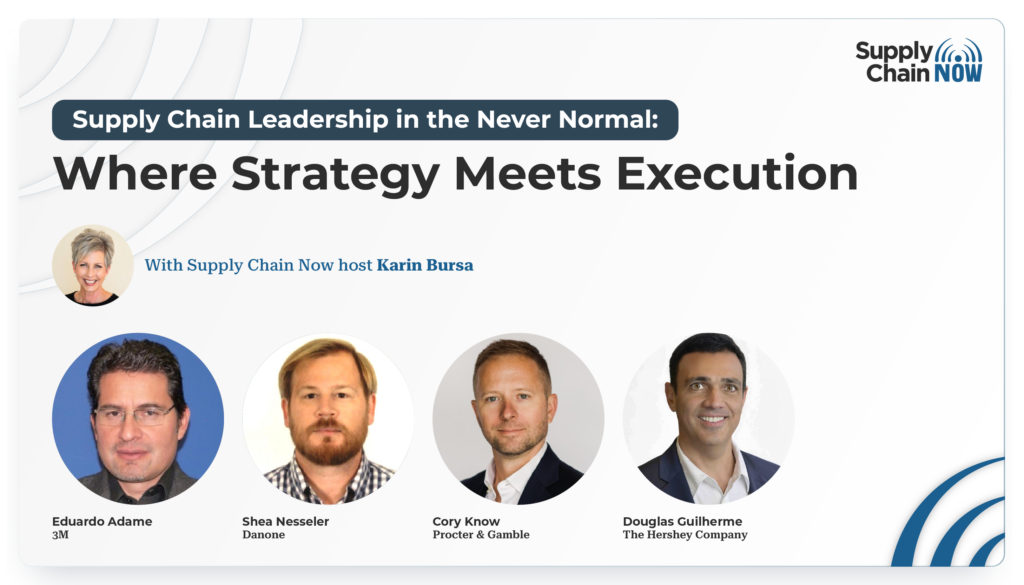
[00:00:32] Karin Bursa: Well, welcome Supply Chain Movers and Shakers, Karin Bursa, and I am thrilled to be your host for today’s conversation on leadership in the never normal world. And today’s focus is going to be on where strategy meets execution. And we have put together another power panel of supply chain executives that have been there, done that, and got the T-shirts. So do I have questions? Because the world’s changed and so has supply chain and leadership as well. And disruptions are no longer these periodic exceptions that we deal with. They have become the environment that we operate in every single day, whether it’s geopolitical uncertainty or dynamic shifts in consumer demands, rapid new product introductions, advances in technology. It’s only been two minutes. I’m going to say artificial intelligence and how we lead and train our organizations to not only tackle these challenges, but to harness new opportunities.
[00:01:36] Karin Bursa: And there’s an exciting thing. And we’re going to hear from our panelists today on how they’re turning some of this volatility into new opportunities for their business, how they’re leading with vision, how they’re connecting that vision to the tactics and execution that happen throughout their organizations. Today’s going to feel a little bit like a supply chain masterclass. We get to hear from four leaders, four different points of view, and some advice they’d even give themself. We’re going to explore some of their defining moments, some of their vision on where they see artificial intelligence making an impact, and how they motivate their team to do new and interesting things. Because I got to tell you, it is a great time to be in supply chain. Let’s bring our panel in. We’ll start with Eduardo Adame. He’s Global Supply Chain VP, Consumer Business Group with 3M. Douglas Guilherme, Global E2E Supply Chain Vice President with The Hershey Company.
[00:02:41] Karin Bursa: Cory Knox, Vice President, North America Personal Health Care Product Supply with Procter & Gamble, and Shea Nesseler, VP Logistics with Danone. Eduardo, let’s start with you. Give us a brief introduction of yourself and the company you’re with.
[00:02:59] Eduardo Adame: Thank Karin and thank you everyone. It’s a great opportunity for me to be here and obviously learn from all the other panelists and from everybody else. So quick things about myself. I obvious work now for 3M. I have had the opportunity also to work for Johnson & Johnson in the past for the medical devices, business and enterprise supply chain, as well as for Procter & Gamble. For many years and in that capacity, I had opportunity to work and lead multiple different teams across the various supply chain functions, as well as organization related to customer services, customer safe facing activities and the likes of AR and accounts receivable primarily. So obviously during this period of time, there is always a number of different learnings and opportunities that I’ve been able to gather and learn from. And again, always happy to share some of those with this team.
[00:03:54] Karin Bursa: Thank you. Douglas, how about a quick introduction of yourself and your role with The Hershey Company?
[00:04:00] Douglas Guilherme: Of course, Karin. And nice to see you again, Eduardo. Eduardo and I are inside the same country and same company. Look, I’ve been working on supply chain for 30 years. I’m giving up my age now. And I started in Avon, moved to AxonNoble in the pharma business. And then P&G was most of my career, 14 years at Procter & Gamble. Then Ecolab for four years, and I’m here at The Hershey Company responsible for global supply chain. I’ve worked in everything from suppliers to customers, plan source, make, deliver 62 countries, all geographies, and always learning, always having fun.
[00:04:37] Karin Bursa: 62 countries. Wow. That’s impressive. Cory, how about you?
[00:04:41] Cory Knox: Good afternoon and great to be with everyone. I’m honored to be a part of this fine panel today. So I’ve been with P&G for 27 years, which is the entirety of my professional career. And in my current role, I lead a full end-end supply chain for our personal healthcare business, which means over-the-counter drugs, dietary supplements, and vitamins for the North American region. So great to be here.
[00:05:05] Karin Bursa: Great to have you. And Shea Nesseler with Danone. How about a quick intro of yourself and your role?
[00:05:11] Shea Nesseler: Of course. Hello, everyone. I’m honored and excited to be here today with all of you. My name is Shea Nesseler and I’m currently the vice president of logistics at Danone. Many of you know, but I think Danone is a world-leading food and beverage company, focused on bringing health through food to as many people as possible. I have 23 years in supply chain industry across many different companies also. I’m looking forward to this panel day with this amazing co-panelist. So thank you for having me.
[00:05:35] Karin Bursa: Yeah. I got to tell you guys, I’m a little starstruck, just so you know. It’s great to have the four of you with us today. And one question I love to ask is really about your career inflection point. When I started my career in supply chain, we didn’t call it supply chain. If you were really sophisticated at the time, it was called logistics, but that was completely separate from sourcing and production. I love how these disciplines have come together over time, but I’d love to hear from each of you what inflection point made you really kind of dig in and decide, hey, supply chain is a place where you’re going to build your career and make an impact on the business. Douglas, let’s start with you.
[00:06:18] Douglas Guilherme: Yes. Let me start with what didn’t define my career. It was not about driving big results, productivity, integration, divestiture. Everybody can talk and related to efficiency and savings, but what really defined my career was seeing the opportunity to touch and improve lives. This was the learning we’ve had back at P&G and the four of us have the same background. I’ll give two examples from many, many, many that I had. So the common link between the four of us here is our friend Jake Barr, and he was responsible for training and developing for leaders at P&G. And he was always there to help us to solve for problems and how to connect to each other to learn and strive to progress. So this humility and willingness to help was something that stuck with me. And the other one was, so I started my career at P&G in the personal healthcare core.
[00:07:15] Douglas Guilherme: Our vice president was Paco Vasquez. And I remember my first time that I had opportunity to have lunch with him for our one-on-one. Before we go from my desk to go to lunch, he stopped and greet for at least 10 people. And then in the way we’re going there, he stopped to greet the janitor, the lady that was the janitor. And he said, “Hey, Maria, how are you? How is your kid? Is he better from Bronchitis?” And I said, “How this guy, vice president for Procter & Gamble knows everybody by name.” And by the way, he knows the janitor names and that she has a kid and the guy, the boy is sick. I said, “I want to be him. I want to be this leader in the future. I want to be someone that can help people to be better.” So that was my defining moment.
[00:08:05] Karin Bursa: I love that. And I love that we are all personally motivated by being seen and knowing that our contributions are important. Cory, how about you? What was a defining moment in your career?
[00:08:17] Cory Knox: Sure. And I’m going to start by saying at the start of what I would call my supply chain career, I think I would’ve had a different answer, but I’m going to take you to a moment and that moment was March 12th of 2020. I was working for P&G at the time, a customer team. So I had worked in every part of our supply chain up until that point, except working directly with a retailer. And I was leading our supply chain team as part of a Walmart sales team. And that was the day that we all got sent home at the start of the pandemic. And it was those first few weeks that I realized that the way consumers shopped and the way supply chains would have to support that had changed forever. And in the almost two years from that point, what I saw was that supply chain as a function was a competitive advantage for some of these large multinational companies that we all work for.
[00:09:11] Cory Knox: It’s an advantage that is required for the business to be at its best and be at the top. And I knew that at that point, what I wanted to do in supply chain, it opened my eyes to the possibilities, but importantly, it made me realize that what I would contribute to the growth of my company was as great as any other function in the company. Yeah, that was certainly a defining moment for me.
[00:09:36] Karin Bursa: Absolutely. I think we can all identify with that experience. And I’ve got to tell you that I’ve been telling family members for decades what I did for a living, but it wasn’t until they couldn’t get toilet paper that they really understood. So it is an opportunity that supply chain took center stage around the world and helped to identify really the hard work that happens every day to make sure that those products are available when and where needed. Shea, I saw you lean in for just a moment when Cory was talking. Did you have a similar moment or what was your inflection point?
[00:10:12] Shea Nesseler: Well, first is your comment hits home, right? I think just the visibility, the understanding of what supply chains are across the mass people now is totally different than before COVID. And I think all of us in the profession have very similar experience that Cory talked about. Second, I sort of popped up because I agree with Douglas. My pivotal moment has to do with, I mean, people matter the most in supply chain. I talk process and systems, but it is all about the people and making them feel valued and delivering the best that they can. I’ve had many pivotal moments, I’d say, in my career that’s really developed my leadership style. But if I had to pick one, I’d say is similar is during my tenure overseas in Europe, I was running a manufacturing plant when a merger happened between two companies. That merger ultimately resulted in the closure of a highly capable facility they’ve been operating for many decades.
[00:10:57] Shea Nesseler: Leading across functional team through this transition underscored the importance of transparent communication and agile decision making. And I think that’s when it really prompted a shift in my leadership style from really directive to servant. That experience really taught me the importance of stepping up, owning decisions and showing empathy, especially when things got tough. Going through this corporate merger and plant closure wasn’t easy, but it showed I think how critical it is to balance the understanding of people, achieving our goals. By doing that, I think things ran much smoother. We were able to deliver on the closure and focusing positive outcomes for each digital person. So really making sure you’re putting people first will help you deliver your business goals. I think that was really the defining moment for me and how I lead and how I work with people.
[00:11:43] Karin Bursa: Yeah, Shea, that’s a great example. And you’re right. I think that we really earn our leadership stripes in some of those very difficult situations like that. So kudos to you for stepping in and increasing your transparency. And as you said, the empathy and connecting with that team, that had to be a challenging moment. I can see where that could help define your career and your commitment. Eduardo, how about you? What was a defining moment in your career?
[00:12:12] Eduardo Adame: Yeah, thank you. There are obviously multiple defining moments. I definitely will agree with my colleagues here. I think when you come to understand the impact that supply chain having in customers, in partners, in employees, it’s obviously the realization of the many things that we can do to improve what we do, the deliverables that we bring to the market in terms of new products and new solutions that will better serve the world. But the one that comes to mind and obviously was a big disruption was also COVID. As you know, 3M has a massive volume that we produce for masks. And that was a very interesting thing because it was very early in my time also in 3M as I was also learning a new industry, but also something so important, so fundamentally critical for many, many countries. And therefore, how are you able to navigate through a supply chain disruption like this with not having enough capacity to satisfy demand globally?
[00:13:12] Eduardo Adame: And what I like obviously is the all hands on that many of my colleagues in 3M, practically everyone were bringing to the table to accelerate and bring solutions and products to the markets, precisely to limit therefore the exposure of people around the world to this devastating situation of COVID. But certainly a very important moment and again, a learning process for something entirely new, certainly something for us to learn and be better, hopefully not anytime soon, but for another potential disruption in the supply chain.
[00:13:46] Karin Bursa: Yeah. I see a common thread between the moments that each of you shared, and that is the human connection, either knowing people’s names or having empathy in difficult situations or pulling together to tackle new working environments, working conditions, or solving problems. Eduardo, like you mentioned, with the personal protection equipment or the masks and products that 3M brought to the market. So people continue to be this essential part of supply chain excellence. So I want to take that and then think about artificial intelligence. If you listen to Kareem Lekane with Harvard Business School, Kareem says AI is not going to replace humans, but humans with artificial intelligence are going to replace humans without artificial intelligence. For me, it’s hard to argue that, but I want to know from each of you, because technology has been a big part of your careers and the supply chains that you’ve helped over your careers, I want to know what excites you most about how artificial intelligence will transform supply chain performance.
[00:14:58] Karin Bursa: And Shea, let’s start with you.
[00:15:00] Shea Nesseler: Sure, of course. Let’s see. While I’m drawn to I think many of the innovative AI topics create and buzz today, I think none of us can read any article without getting something new that’s going to promise to change the world. I’ve learned from experience not to get lost chasing every new trend. Sometimes they don’t work out. That said, maybe I’ll go for more of a boring and flashy answer and say, I see tremendous value in the AI-driven predictive analytical tools right now that build more resilient supply chains. And this technology can forecast risks like supplier delays or logistics disruptions. So companies and our people can respond quickly and avoid stockouts or excess inventory, really building stronger supply chains. As you said though, I think it’s that AI is arming our people to make more intelligent choices and be more reactive is where I see that right now AI is truly making a difference.
[00:15:49] Shea Nesseler: Additionally, this intelligent automation I think takes care of a lot of the routine tasks, freeing up all the people in organizations to work on more strategic work. I see it in day in, day out and all of my colleagues talking, right? These AI powered insights create very clear visibility across operations to help boost efficiency, service quality and sustainability. And to me, it really frees up people to go work on, like I said, more of the strategic work. So semi-boring answer, but I think I’m seeing the real life value of that today and it’s what excites me the most.
[00:16:21] Karin Bursa: Yeah. I don’t think that’s boring at all. I mean, predictive analytics are really important, right? That’s what we’ve been striving for for decades and looking at, I think you said, automating some of the routine tasks as well, right? There aren’t that many freshly minted supply chain professionals that are going to open their interview and say, “Hey, I’d like to spend eight hours a day in Excel spreadsheets. How can we do that? “ They want to know how they can impact and make a difference. Cory, how about you? Where do you see AI making the biggest positive impact on supply chains?
[00:16:53] Cory Knox: When I really take a step back and I think about the full end-to-end supply chain, from the earth to the shelf and beyond, I believe that some of the biggest and most significant challenges that we face are at the seams of those supply chains. So from our suppliers to us, from us to transportation providers, from them to retailers, those seams are where so many opportunities exist, especially in moments of disruption, which is not just a pandemic, but even recently, winter, weather, et cetera. I think that the ability to optimize across the different parts of the supply chain in ways that are still highly manual and where systems just don’t talk to each other because we choose different platforms, et cetera. I think optimizing across the seams of the supply chain, especially in moments of disruption are where I’m most excited about application of AI.
[00:17:41] Karin Bursa: Yeah, I like that. And I like the way you referred to it as the seams within supply chain, the things that knit us together or tie functional areas together. And I think a lot of companies struggle just internally within their proverbial four walls in connecting across applications sometimes or solutions. But when we think about those extended supply chains, when we think about connecting to our trading partners, our customers, our suppliers, our retail partners, and accelerating the flow of information, it’s exciting to see some of the new things that are on the horizon there for those multi-enterprise supply chains or the collaboration between trading partners. So great insights there. Eduardo, a mutual friend of ours told me that you are filled with technical brilliance. So I’m really interested to hear what your thoughts are on where AI might improve supply chain performance.
[00:18:38] Eduardo Adame: So I agree with the two previous comments for sure. I think AI will significantly enhance the speed, accuracy, and improve the quality of our decision taking process and over across the supply chain. When I think about it, ultimately, for me, it’s about the outcomes. How is that AI will basically help us to improve the customer experience, help us to improve all of our internal processes, and how do we add value to the business? And this is more enabled by reliable and predictable supply chain performance. And some of the things that will excite me improve our real time visibility. So when you think of currently, for instance, the many things that we probably act on are more reactive. So I think that AI will help us to aggregate data from suppliers, from logistics partners, production lines and inventory systems to create a single more immediate view of some of those challenges as well.
[00:19:33] Eduardo Adame: There are multiple applications in demand planning or forecasting. Again, as you think of machine learning models that can easily help us to identify patterns and more accurately translate that into better forecasting autonomous planning. For instance, right now we have a number of manual activities that obviously as we progress with AI, we expect this also to help us to move closer to autonomous planning. I think Cory was also mentioning about early detection of disruptions. I definitely feel that it would help us to identify early disruptions, whether it’s a supplier delays or logistics issues or bottlenecks, you name it. I think all that will absolutely help us. So very exciting times, and certainly we need to get ready for it.
[00:20:19] Karin Bursa: So lots of opportunity from what I’m hearing from our three panelists so far. Douglas, with your view, and you certainly hear what our other panelists have to say, but as you look at your business with The Hershey Company, what excites you about the opportunities in artificial intelligence?
[00:20:37] Douglas Guilherme: Yes. So I think the right word is exciting. This is elevating the role of humans and elevating the role that our supply chain practitioners are taking. I’m investing a lot of time and energy on orchestrating supply chain, also moving to this autonomous or self-driven supply chain. And the goal, I see that the excitement and the possibilities is how do you connect from source, plan, make, deliver for the moment he or she grab the product from the shelf, this will give us the indication for what needs to happen in your network. And decision intelligence is helping us to move human from the loop to be out of the loop. And most of the system has been automated. So you have the freedom to pay attention where you have to pay attention and elevate the role of planner of logistics. And you don’t have to invest your time on the tactical day-to-day.
[00:21:34] Douglas Guilherme: So if you think about our past over being here for many years, we used to have our daily direction setting in our all meetings to look for the last 24 hours and see what happened, root cause and action plans. Now you can predict what might happen and you don’t have to make an action. AI can help you to predict and proactively make decisions. So this is really exciting.
[00:21:57] Karin Bursa: Yeah, that is exciting. And the ability to truly be proactive, I think is something new. It’s certainly something we’ve all strived for decades, but I think technology is making that more feasible and allowing us to harness that data to drive those insights and then make some recommendations on the next best actions to take. So I think there’s lots of opportunity. Certainly we’re in the early stages and the early adoption. I do like the new themes around decision intelligence and really a theme I’ve been talking about recently, which is decision velocity, getting that intelligence and being able to accelerate or become more proactive in how we make decisions in the business, both micro decisions that we might be able to automate pretty quickly, but some of those big macro choices or the comparison of multiple scenarios. Along those themes, I’d like to just dive in a little bit with each of you and get a glimpse of the biggest challenge that you’re tackling right now.
[00:23:00] Karin Bursa: And I know the list is probably long, but give us just one area of your supply chain or a challenge that you have prioritized for your business that you can share with us. So Cory, let’s start with you.
[00:23:13] Cory Knox: Yeah, it’s a great question. And I must say that I look forward to hearing from my colleagues on this one because I think we’ll probably each have something a little bit different. Many challenges, and I won’t get caught up on the microbe and there are things like disruptions in winter, weather I mentioned earlier, those kinds of things. But really the biggest challenge for me personally is deciding and strategizing how I continue to invest. I have the right CapEx plan for a business that’s growing very well. I mean, we’re one of the top growing businesses within the P&G portfolio in a more global supply chain in which there are so many regulating bodies, boards of health, et cetera. So truly global with each country almost having very different requirements for highly regulated products. So my strategy for the next decade on how I invest, where and what capabilities taking into consideration all of those requirements, that’s the biggest challenge for sure.
[00:24:10] Cory Knox: And it’s one that AI is helping with, but hasn’t fully replaced that kind of decision making. So the need for esteemed people like this, supply chain leaders, I think will continue to be there for years to come. I haven’t found how to automate all of those decisions yet.
[00:24:26] Karin Bursa: Yeah. I’m not sure we can automate leadership. I think you’re right because there’s so much creativity and kind of cognitive aspects that come into play. I also think your example that you gave with regulatory compliance and opportunities is an interesting one that many companies face as well. And tying together both the strategic initiative as well as some of the tactics or stepping stones to get there. Cory, how do you break that down?
[00:24:52] Cory Knox: I wish I could give you just a simple formula for that. It starts really with partnership with my business leader and understanding where we’re going as a business, where do we think the consumer is going? What does it take to win? And this is where the supply chain function really is front and center in this process because what we’re going after, that person can’t design what a supply chain should look like supporting that in the future. It’s truly a partnership of understanding the business vision. And then all of the various scenarios that I’m playing at … By the way, and I should say this, it’s key for any supply chain leader to stay really, really involved externally from the business. And I can’t emphasize that more. And what I mean is, as I think about the types of decisions and strategies that I’m developing, I need to be connected personally to the regulatory bodies, the emerging trends in the industry.
[00:25:45] Cory Knox: I need to understand what supply chain capabilities and capacities exist outside of my company. What may I tap into that I don’t own? We have a large portfolio of external business partners we do business with and understanding them and what they do and where they play and how they navigate this is super important. So I think each of us would probably tell you we are as externally focused in our roles as we are internally focused.
[00:26:10] Karin Bursa: Yeah, that’s great insight. And I also think a theme that each of you have mentioned a little bit is leaders learning from other leaders. You never know where that inspiration’s going to come from or how somebody else has tackled a problem or done something innovative or sometimes just something simple that is right before our eyes. Douglas, how about you? What’s the biggest challenge that you’re working on right now?
[00:26:33] Douglas Guilherme: I’ll connect with something that Cory mentioned in my previous answer on by faving AI and automating decision, we are elevating the role of our supply chain practitioners and they will have more time, but it’s not to go deeper on the execution of their part of the network. The need for to have the systemic view and understand the business and connect with the business and understand the needs for customers and consumers will be paramount. So the biggest challenge I have now is how do we sit in this decision table and help the company to grow? I believe that supply chain has a very, very critical role on growth and margin expansion. And it’s not just about having faster decision, it’s to be smart. And also an analogy I can make here is I have a Tesla and it’s amazing to drive a Tesla in a perfect road.
[00:27:26] Douglas Guilherme: But when you have portholes and when you have black ice, it’s not about faster decision. It’s about quality decision. It’s about smart simplification. It’s about understanding what’s needed before you accelerate.
[00:27:39] Karin Bursa: Yeah. Hey, great analogy. One, I think we can all identify with this time of year when it comes to black ice, but driving a high performance vehicle or tool or team, but how do they respond in the moment when conditions change, I think is a great analogy for us. Shea, how about you? What’s the biggest challenge that you’re working on?
[00:28:00] Shea Nesseler: Yeah, I mean, similar to what Cory and Douglas said, I think you said rightly in the intro. Supply chain disruptions are the norm we deal with every day now. I would say my biggest challenge I work on every day is how to be boringly consistent, right? I’m really focused on building true supply chain resiliency and in the face of this geopolitical uncertainties, shifting trade policies, and specifically my current logistics role, a rapidly evolving transportation market, figuring out how we deliver the basics over and over in this time of disruption is getting harder and harder. So it’s AI tools, if it’s a communication, if it’s any possible technologies out there. As core said, it’s focusing on the deciding the best use of CapEx investments to enable this. There’s so many solutions out there, learning from our peers, being externally focused and understand what is the right tool to be, as I like to say, boringly consistent is really our focus at the moment.
[00:28:51] Karin Bursa: All right. I’m going to have to work on your marketing positioning there, but I do like the outcome of boringly consistent. I like that predictable, consistent delivery and maybe being a little bit boring if the news is good every time, let’s put it that way. But that’s a great way to think about. We should all strive to be boringly consistent in driving outstanding outcomes for a business. Eduardo, how about for you? What’s the biggest challenge that you’re working on right now?
[00:29:18] Eduardo Adame: Well, there are obviously multiple challenges at any given point in time as usual. And there is very ambitious growth plans for the companies and associated that with NPIs and obviously that associated with profitable growth. But as I look into that and specifically, when I think of what is core to us, we’re also having a very ambitious plan for a supply chain transformation and without multiple initiatives associated to that. And specifically on that context, and we were mentioning that in the previous conversation, is modernizing our planning, our supply chain planning through advanced digital systems and AI enabled tools. That is something that definitely is core to some of the ambitions that we have in front of us. We have a very complex systems landscape at the moment, super old system in many instances, not integrated. And you overly can imagine that that creates a lot of extra challenges in the way we work, the way we plan, where we actually are able to see the end-to-end supply chain challenges.
[00:30:22] Eduardo Adame: Now in that context, as we embark into this modernization that I was alluding to, that will absolutely help us know. Alongside with that, it’s not only the tools and the systems, it’s how do we prepare our teams and developing talents as a very important part to make sure that we invest time, quality, resources, education, money to really bring our resources to the next level, help them to grow together with how technology is evolving and therefore developing the technical analytical skills that we need for now and for the future, because things will continue to evolve.
[00:30:56] Karin Bursa: Eduardo, that’s so important as we look at talent development and carving out that time consistently to help and have that training time or to help improve use of tools that are available. I’m just always curious, it’s hard to look at your plans and know that you’re going to carve out a significant percentage of time for that training and to make that a priority, to lean into that, I think is something that as leaders, you guys are all known for putting that time aside and making sure and kind of protecting it amongst your team and the priorities that when they’re busy firefighting or in the midst of their daily activities to make sure we’re still preserving that time that’s going to help them make an even bigger impact in the future. I’d like to get a little personal for a moment, guys. And each of you are known to be great leaders, to be good people leaders, not just process leaders or function leaders, but to help motivate your teams to do more, go the extra mile.
[00:32:00] Karin Bursa: I’d like to have you maybe turn that around for just a minute and think back to your younger self early in your career and share with us maybe one piece of advice you wish you could give yourself early in your career that you think would’ve maybe helped move faster or look at opportunities differently. I think Douglas mentioned this just at the start of our discussion today, but you guys all share one common touchpoint in your connection in the Procter & Gamble system and with Jake Barr, who we call here on supply chain now, the John Wayne of supply chain. So it’s interesting just to know, again, the impact that individuals can have as they’re training their teams or helping them build new skills or carve out that time to make sure it is set aside, to learn about different aspects of your business or work with trading partners more closely or adapting new technology.
[00:33:00] Karin Bursa: But as you look back at your career and from the vantage point, obviously of where you are today, if you could give yourself one piece of advice, what would it be? Douglas, let’s start with you.
[00:33:13] Douglas Guilherme: If I had an hour, I’d have advice for advice to keep giving here, and I’m dumping a lot of advice for my kids. So they are taking all of the advices that I couldn’t take in the past. But look, if I have to summarize in one. So early my career, I thought that the solution was having all the answers or being the problem solver or stay close to the work and overwork until you find a solution. And I came to realize, and I will go back and give this advice to younger self on the real leadership comes from the designing the systems, developing the people, and sometimes just let it go. Stop trying to be indispensable and try to build systems and develop talent that will outperform you. So develop the thing that will be way better than you.
[00:34:05] Karin Bursa: I like that. On a personal level, a piece of advice I got in one of my first reviews, it kind of hurts, but it makes me laugh at the same time. My manager told me not to take myself so seriously, that I was so driven and so pushing all the time and trying to get to that next level that her recommendation to me was to breathe more, listen a little bit more, and not take myself so seriously. But that is, for me, was very valuable advice and certainly something I’ve passed on to team members over the years as well. Eduardo, what’s one lesson that you wish you knew from the start or that you would coach yourself on today?
[00:34:47] Eduardo Adame: I was alluding previously precisely to also the point Adula was mentioning as it relates to talent development, I think that’s absolutely critical. I think it’s important that we stay current, that we push ourselves to be adaptable, to learn fast and much as possible about what is happening, be it technology, trends, customer expectations, how things have evolved, and how are we able to navigate those particular different phases that we have in our professional experience. Alongside with that, I think it’s also super important to make sure that we recognize that there will be different skillsets across the multiple individuals that we work with. And therefore, how do we there leverage all those different skills to build very strong cross-function and relationships early that would help help us to create a greater good for the benefit of the entire enterprise? I think those would be something that will always be close to me.
[00:35:42] Karin Bursa: Eduardo, you mentioned that you had moved 10 times or 10 different countries and that you have your own personal United Nations. How has that experience helped you to connect as a leader in your organization to bring different cultures, different approaches maybe together?
[00:36:02] Eduardo Adame: Yeah, it’s a great question. And something that I learned through the many opportunities I have to relocate and learn is first of all, be open-minded and be open to learn, to hear, to listen and to respect the way people think, act and work, learn from others, and make sure that you, at the end of the day, are able to bring the best out of individuals and making sure that, again, you help them to leverage their skillset in a way that they will translate that into credit outcomes, better performance. And therefore we mirror or we marry the two, the employees’ expectations together with the skillset. And through my different cultural experiences, I learned that in many ways, together with the errors that I made, what I think was obviously an opportunity and something that I definitely encourage and learn a lot from.
[00:36:57] Karin Bursa: I know personally, I’ve learned more from my mistakes than from some of my successes, for sure. But that empathy that you’re describing in looking at cultural differences, Shea, that reminds me of what you shared about your inflection point in gaining empathy with folks, especially in challenging leadership times. What advice, Shea, would you give your younger self early in your career?
[00:37:21] Shea Nesseler: Yeah, I think we’ll get there in a second. I really resonated with Douglas’s point of just loving the concept of building something that will outlast you and leaving a legacy that Eduardo said on really is learning from your mistakes. So I think those are two fantastic bullet points for people to learn. I’d say if I was going to give myself some advice from younger self, I’d say being comfortable, being uncomfortable. My most rewarding and I think highest capability building roles I’ve had in my career is when I think I took the largest risk to do something I wasn’t a master of versus safe and easy route. And that could be internationally of going to different function like manufacturing, but those are where I saw, I learned and I grew the most. I wish I would’ve taken a few more uncomfortable roles and choose my next opportunities, but I think that’s where the most growth came from.
[00:38:03] Shea Nesseler: When you continue to put yourself in these situations where you’re forced to learn, you build many capabilities and you understand more parts of the supply chain and how to be a better partner upstream or downstream. It’s much more rewarding when you step out and you leaned into the growth and I’ve really enjoyed it. So I’d say that’s the one piece of advice I’d say is it’s okay to be uncomfortable and that’s usually where you grow the most.
[00:38:21] Karin Bursa: I like that. Get comfortable being uncomfortable. I do like the way that resonates and certainly that’s something that’s applicable really at all stages, I think of our career. I think we get uncomfortable in different situations over time as we take on more responsibilities or maybe have a larger team or a bigger product portfolio that we’re working with. Cory, how about you? What advice would you give your younger self?
[00:38:46] Cory Knox: Yeah. So what Shea said mirrors very close to what I was going to say to that question, which is having courage to try new things and know that you may stumble, you may have some challenges, but that’s okay. You can do this. But let me, a slight twist on that. The point on courage, it can come to roles and opportunities you accept, and that’s certainly, I would tell my younger self, but maybe related part, but it feels different is seeking mentorship. And the reason I will say that is because the younger me felt like it would be a burden to ask more senior leaders to mentor me. I was afraid to do that. I was a burden, I don’t have time for this. And now all these years later, I find myself in this position and I like nothing better than to be asked by someone to be a mentor and to help teach them things that I have learned because one, it shows the interest that they have in growing.
[00:39:40] Cory Knox: And two, it’s a way for me to take some of the skills and knowledge I’ve built over decades and keeping it going the next generation. So I wish as a young leader in the organization, I would’ve sought mentorship and been bold about it asking for it and seeking to learn from the senior leaders.
[00:39:57] Karin Bursa: Yeah, that’s great advice. I like that. And stepping up and asking for it. It’s not always going to come to you. You may need to put that opportunity in front of somebody you admire in the business or even in a different business, but you admire their skills or the way they manage their business or their responsibilities as well, that you are definitely, each of us are responsible for our own career development. We can’t outsource that. We’ve got to take an active role and active part in that. So I want to thank you guys today for the information that you shared with us. And just think for a minute maybe about a final thought, something you would want to leave with our audience today. I think this has been a great discussion, but I feel like we’re just getting started. I would love to continue the conversation and go a little deeper on a couple of these topics.
[00:40:47] Karin Bursa: We’ve covered everything from your career inflection points and defining moments to some of your vision around artificial intelligence, some of your leadership philosophy that I think has been really important. And what I love is some of your recommendations are so simple. Every one of us can learn and adopt and give it a try in our own environments. Just pausing for a few minutes to connect and have empathy with those around us. Everybody’s busy. We’re always going to be busy, but it’s the people and the connections that really make the difference in our careers. And I love the stories that you’ve shared. I also like the fact that each one of you are in a position with your companies where you’re carrying significant responsibility, but you’re able to connect that with that strategy with execution steps, what needs to happen at different levels and different areas of the business.
[00:41:41] Karin Bursa: So connecting this strategy to execution, I think is really important. So thank you for your time today. Give us one last thought and then let me know how our audience can connect with you. Let’s start with Eduardo.
[00:41:56] Eduardo Adame: So one last thought as I was sharing, important to the audience to keep ourselves current, to be able to navigate through the many challenges that we experience every day. But more importantly, always try to find what is the optimal solution that will bring the best outcomes to our customers, to the company, to our stakeholders in the most optimal way. I’m available in LinkedIn, so always happy to connect and learn from many of you in the audience as well as here in the panel.
[00:42:24] Karin Bursa: Great. Thank you for that. So LinkedIn is a great way to connect with Eduardo if you want to be sure to see the updates that he shares or learn from him further as well. Douglas, how about for you? What’s the final thought from you and what’s the best way to connect?
[00:42:39] Douglas Guilherme: So connect via LinkedIn is the easiest way. Now, I’ll take on this, try to get out of your comfort zone, but in a different way. I remember as I was progressing my career, sometimes I didn’t know what I didn’t know. And trust your leader, trust your mentor, trust your company that sometimes a new role can be a good role. It’s something that you have to trust. So I took procurement and it was not on my … I didn’t want to. I thought it was a bad move for my career. It turns out that it wasn’t great. So sometimes you have to trust your company, trust your mentor, trust your leader because you don’t know everything that is ahead of you. It’s a balance.
[00:43:23] Karin Bursa: Absolutely. And I think that’s important too, especially as executive leaders in supply chain, you want to be as transparent as possible, but you can’t always tell everybody everything, right? You’re privy to plans and knowledge that may not be in the public domain yet. So having those good relationships, those mentors that you trust and valuing their recommendations, I think is vitally important. Cory, how about from your perspective? Other than more time on the golf course, which I’m sure you’d recommend for all of us, right? For me as well. What final piece of advice would you like to share with everyone and what’s the best way to connect with you?
[00:44:04] Cory Knox: Yeah. Well, certainly LinkedIn, like everybody else, you’ll find me there. I respond pretty quickly, so please feel free to reach out. I’ve been doing the supply chain work like the rest of these guys for a long time, but I feel like we’re just starting. Some of the innovation right now is in its infancy. And if I were starting this whole journey over again, this whole thing called a career from day one, I would do it all over again and be in supply chain. I really do think it’s a fantastic field for problem solvers, people who love people, people who are unafraid. I would do it all over again. And I think if you’re young, you’ve got a fantastic future ahead of you.
[00:44:39] Karin Bursa: I love that. And I’m often heard to say it’s a great time to be in supply chain. So I agree with you. I think good things are happening, that the focus on supply chain and really the strategic advantage it provides to companies around the world, we’re just scratching the surface. I think there’s more to come. So I love that. Shea, how about from your perspective? Final piece of advice and the best way to connect with you.
[00:45:00] Shea Nesseler: Yeah. As everyone talked, I think LinkedIn is probably the easiest way to connect, so please feel free to connect on that platform. I think the resounding theming app that I was going to say, I think there’s no better time than to be in supply chain. I think it’s a wonderful career for anyone looking to what they want to do. It’s extremely exciting and ever changing and then it’s a great time to put your fingerprint on it because no one knows where it’s going. There’s a lot of different options, cool technology out there. So I think it’s a great place to be. And I’d say two piece of advice really is invest in yourself and becoming externally focused, right? Continue to build your skills as we’re changing and even more, as you see the four of us, we’re all going through the same things, right? It’s moving so fast.
[00:45:40] Shea Nesseler: Don’t reinvent the wheel and try to get externally focused and benchmark and learn what other people are doing. Reapplication is a lot easier than trying to reinvent the wheel. So thank you for having us today. It was great. That’s just the advice I leave us with.
[00:45:52] Karin Bursa: That’s very valuable. And I think coming to the table, somebody said, we didn’t know what we didn’t know, but thinking in terms of asking more questions versus always having the answers, asking and pulling back the layers around opportunities, it is an opportunity for all of us to learn from each other. So a big thank you to each of you for being with us today. I really believe that the smartest people in supply chain, the smartest supply chain leaders, they learn from each other, that they’re asking questions, that they’re curious, that they’re always learning. And I think today’s conversation really underscores that. It is a great time to be in supply chain. There’s lots of exciting things on the horizon, and it does give you an opportunity to connect, not just with that customer promise, but with so many cultures around the world, so many new opportunities and product innovation.
[00:46:46] Karin Bursa: I’m Karin Bursa, and until next time, keep thriving in this never normal world, and don’t forget to plug into Supply Chain Now, the number one voice in Supply Chain.
[00:46:58] Voice Over: Join the Supply Chain Now community for more supply chain perspectives, news, and innovation. Check out supplychainnow.com. Subscribe to Supply Chain now on YouTube, and follow and listen to Supply Chain Now, wherever you get your podcasts.
Use the episode title, not the guests’ names. I have updated this already