Supply Chain Now’s Guide to the Red Sea Crisis
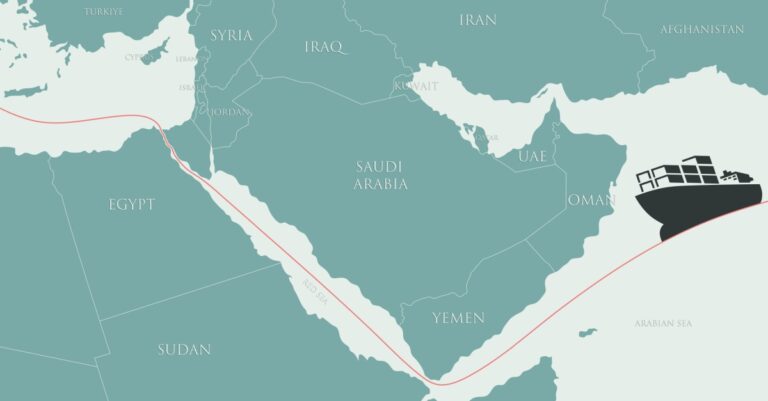
An estimated 12% of global trade worth more than $1 trillion traverses the Red Sea each year. When Houthi rebels started attacking commercial vessels in November 2023, ocean carriers began rerouting container ships around Africa’s Cape of Good Horn rather than through the Suez Canal on voyages from Asia to Europe. That greatly increased travel time and costs.
As of March of this year, shipping through the Red Sea was still down 70% from before the attacks began, according to The Economist, with many ocean carriers still avoiding the Bab el-Mandeb Strait, which separates the Red Sea from the Gulf of Aden and the Arabian Peninsula.
Maritime Industry Caught in the Crosshairs
Houthi rebels launched attacks on ships in the Red Sea in response to Israel’s military operations in Gaza. The Houthis attacked more than 100 cargo ships between November 2023 and January 2025. The attacks, with missiles and drones, sunk two vessels and killed four sailors.
In late October 2024, a headline in gCaptain read, “Red Sea Is Now So Dangerous Even NATO Warships Are Avoiding It.”
“The United States Navy continues to send warships through the Red Sea, but its mission to protect merchant ships – Operation Prosperity Guardian – is considered a failure by several naval experts we interviewed and has significantly diminished in scope and size,” gCaptain said. “As a result, even many US-flagged commercial vessels – which the US Navy is obligated by law to protect – are opting to divert their routes around Africa.”
Global freight forwarding company Freight Systems conducted a deep dive on the Red Sea Crisis. It said the attacks on container ships have resulted in:
-
- More than a 30% increase in container freight rates.
- A 20% increase in insurance premiums. The Red Sea crisis “has unleashed a tidal wave of higher insurance premiums, threatening to swamp shipping budgets and leave businesses facing squeezed margins,” Freight Systems said.
- A two-week increase in shipping time by rerouting vessels around the Cape of Good Hope. “This strategic shift reflects the significant impact on shipping routes and underscores the importance of addressing emerging issues in maritime logistics,” Freight Systems said.
- Port congestion, longer wait times, and delays. Freight Systems pointed out that “increasing dependence on alternative routes strains available resources, such as port facilities, which can lead to capacity constraints and bottlenecks.”
More Container Ship Attacks Possible
In mid-March, President Donald Trump launched intense airstrikes targeting the Houthis as he goes after Iran, the rebels’ main benefactor.
The Houthis said they will continue to target Israeli ships traveling through Mideast waterways because of that nation’s blocking of aid to the Gaza Strip. And there is speculation that the U.S. airstrikes could result in Houthi attacks beyond the Red Sea, with the Associated Press pointing out the rebels previously targeted oil infrastructure in Saudi Arabia.
“Although the U.S. has been striking at Houthi targets for over a year, the scope and scale of this new campaign, including the targeting of senior Houthi figures, marks a significant escalation in the conflict,” analysts at the Eurasia Group said.
Stay Informed About World Events With Supply Chain Now
Supply Chain Now is the source for supply chain news, trends, and information, and our listeners trust us to keep them informed about the events that affect them through our podcasts, livestreams, and webinars. The attacks on container ships in the Red Sea greatly affect the global supply chain industry, and we’re committed to closely monitoring the situation and keeping supply chain stakeholders up to speed.
That’s what we’ve been doing since the crisis began, with podcasts such as “Windward’s Vision: Navigating Red Sea Crisis with AI Excellence in Global Supply Chains,” in which Windward CEO Ami Daniel explained how AI and digitalization can be used to effectively manage ocean supply chains even during uncertain times.
Our informative, thought-provoking supply chain podcasts include:
In addition, our library is packed with supply chain news you can use. Listen now.
More Articles

Beyond the Mic: How to Maximize Your Supply Chain Podcast’s Reach and Impact