Intro/Outro (00:02):
Welcome to Supply Chain Now, the number one voice of supply chain. Join us as we share critical news, key insights, and real supply chain leadership from across the globe, one conversation at a time.
Scott Luton (00:14):
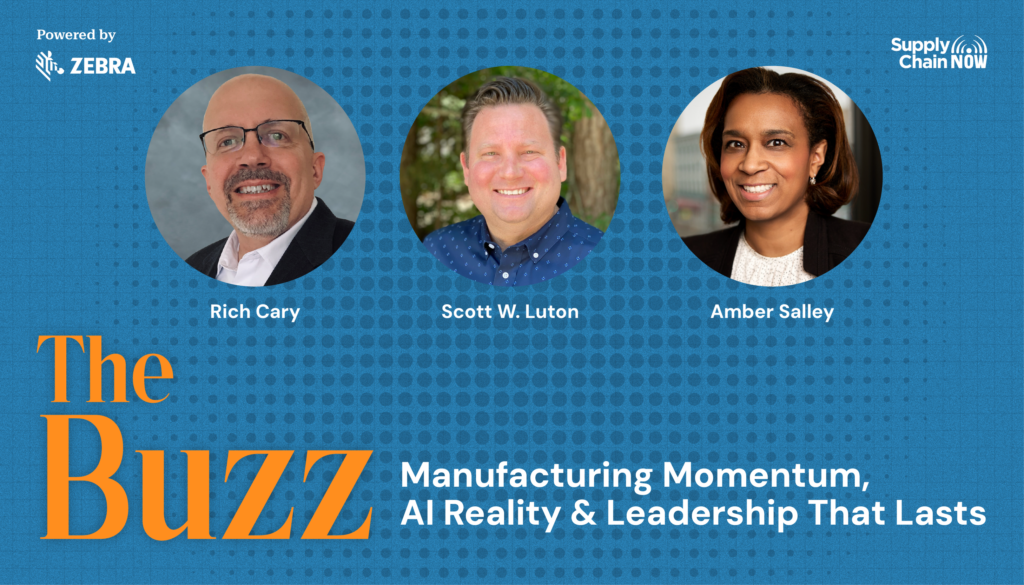
Hey, good morning, good afternoon, good evening, wherever you may be. Scott Luton and very special guest co-host, Amber Salley with you here on Supply Chain Now. Welcome to today’s livestream. Hey, Amber, how you doing today?
Amber Salley (00:26):
I’m doing pretty good, Scott. Thank you for having me on. I’m really excited to talk about everything supply chain today.
Scott Luton (00:33):
Oh, I’ll tell you what we’d be here for 18 hours and we’d still be just hitting the tip of the iceberg, but we’re delighted to have you here, Amber. I’ve really enjoyed learning from you in recent months. And folks today, y’all know what it is, it’s the buzz where every Monday at 12 noon Eastern time we discuss a variety of news developments from across global supply chain and business. News that matters is what we like to call it. Now folks, you should know that the buzz is powered by our friends at Zebra Technologies throughout the month of July, hot month of July. Zebra is the world’s foundation for intelligent operations with hardware, software, and automation solutions and services that empower your frontline. To learn more, visit zebra.com. All right, so Amber, got a great show teed up here today. We’re going to be talking about the USNCA, the health of the US manufacturing industry, all the AI noise in global supply chain, all that, and much, much more.
(01:30):
And Amber, as if that’s not good enough, we’ve got the Amber Sally for a whole hour here, but we also have the Rich Carey with mfg.inc. I’ve known Rich for a long time. We’re all going to enjoy his perspective as well. So Amber, big show here today. Are you ready to go, my friend?
Amber Salley (01:46):
I am ready.
Scott Luton (01:47):
You are ready. It’s just that simple. You are ready to go. So folks, book up for a big edition of The Buzz powered by Zebra Technologies right here today on supply chain now. So Trisha, thank you very much. Says happy buzz day. Say hello. Let us know where you’re watching from. Thanks for joining us here today. That’s right, Trisha. And I see Jean. Jean is somewhere. I can’t find their comment. We’ll track it down, but Trisha’s also dropped the link to learn more about our friends at Zebra. Appreciate that. Okay, so Amber, we got three things to work through prior to Rich joining us here today. You already said it. You’re ready to go. You’ve had your Wheaties this morning. You’ve had a good breakfast. Is that right, Amber?
Amber Salley (02:31):
Ready to go, yes. Energize, let’s go.
Scott Luton (02:35):
Let’s start with that said, our almost weekly newsletter that published over the weekend. We had tons of good stuff in this edition. Let’s see here. We started with an overview of four interesting stories from really across industry, including Walmart securing nuclear generated electricity for one of its newest distribution centers. Folks, new age of nuclear power right here at the beginning of it. Also, we included a variety of economic barometers from the Associated Press, such as how the International Monetary Fund, IMF last week downgraded its projections for the world economy in 2026. That’s not good news as it now expects 3% growth versus a 3.5% it projected last year and even down from a 3.1% it projected in April. We also included news on Change 2026, which is powered by our friends at ASCM and lots of resources including one of my favorites, help from SEM Dojo on mastering procurement negotiation.
(03:35):
Tricky procurement negotiation, all that plus our upcoming live events. Give with that said a read and let us know what you think. Amber Sally, I bet you had a jam-packed weekend, but did you get a chance to peruse with that said?
Amber Salley (03:50):
I did. I did. And lots of interesting findings. I think the thing that was the biggest aha for me was what you started with of Walmart and creating their own source of energy. I guess I hadn’t thought about companies starting to think about the need to maybe self-source energy to keep their own operations running because over the past couple of years we’ve seen parts of the country have challenges with energy, with energy grids going down. And from what I’ve been hearing, we just expect that to increase because infrastructure has not been invested in, especially energy infrastructures. So this idea that companies are going to start to think, oh, I’m not going to rely on the grids that I have been relying on for decades. I can just now build my own. So I’m wondering to what extent we’ll see more of the nuclear energy that Walmart has?
(04:45):
Will some companies start to think about solar and start to build solar panels all over their warehouses to self-generate energy for their operations? That was a really interesting find for me.
Scott Luton (04:59):
Amber, I’m with you. I think we’re already talking more so much more about energy, which I think is a great thing. I think we talk about, and we’re going to touch on the autonomous era, the AI era, all these different monikers we put on the age, but the energy era, I think we’re going to be having tons of new conversations because we can’t, to your point, here personally where we live in the Metro Atlanta area, we had our longest power outage that I’ve experienced in years a week or so ago. And I’ve noticed ever since, given the heat wave across the states, I’ve noticed flickers, which I think is probably tied to a power infrastructure that you referenced that’s being maxed out. So we’ll see. I’m intrigued with nuclear power and where it’s heading. So we’ll see if that’s one of the solutions, Amber.
Amber Salley (05:45):
Yeah, right, right, right. And to your point, growing up in the 1980s, every once in a while energy would go out in our house. I lived in South Jersey growing up. Shortergy would go every once in a while, but no big deal. You knew it was going to come back on. But 2026, you don’t expect that to happen anymore with all the advances in technology. So to hear that you’re still experiencing that makes you think, oh, okay, well, I guess we have to think about how we’re going to be innovative to prevent that from happening again or just ensure we have backup plans that aren’t just generators.
Scott Luton (06:18):
That’s right. Protect that access. Protect that access to energy. All right, so folks, all of that and more you can find in the latest edition of With That Said, so go check it out and let us know what you think. All right, so number two, Amber, before Rich Carey joins us here in a few minutes, I’ve really enjoyed, as I mentioned, learning from you in a variety of conversations that go back really several years as a matter of fact. And you write on this topic all the time. Folks that are tuned in via YouTube and other social can see this, all the noise about AI out in supply chain. Now I get from our conversations that you aren’t discounting some of the powerful ways that focused organizations are leveraging artificial intelligence, but rather you and I both are exhausted with all the fluff out there.
(07:04):
But Amber, when you write and talk about the noise in supply chain related AI, what are you talking about?
Amber Salley (07:11):
I was a keynote speaker at a software event and one of the other keynote speakers was Billy Bean of Moneyball Fame. Wow. He was the former general manager of the Oakland As, and he was known for bringing an analytic approach to managing a baseball team. So using machine learning to look at patterns and the data that came out of all of those findings is what led Billy Bean to make decisions of who to hire, what makeup to have on the field at any one time. And that led to the A’s having a lot of success. At one point in time, they had a 20 game win streak, which was the longest win streak in the over 100 plus years of baseball. So he was talking in his keynote about all these great results. And then someone in the audience asked, “Okay, so you’ve done tremendous things with your team, so why haven’t you won a World Series?” And his answer was, “Well, whenever you get into the playoffs, it’s just different.
(08:13):
We can’t use the same models we used in the playoffs that we use in the regular season because every year you have a different makeup of teams that are in the playoffs. So the model that you would have created for the regular season, you can’t apply into the playoffs. And I think that’s a pretty good analogy for how we think about supply chain because you can use AI to solve, again, these repeatable things like autonomous purchase order creation and approval, lead time prediction. But if you’re trying to connect all of those different pieces together and then bring in all of the uncertainty and variability that you have into the real world, it’s very hard for AI to even determine what the patterns are because it’s different from day to day. Week to week, month to
Scott Luton (09:01):
Month. Amber, I love that. And folks, I told you, The Amber Sally sharing a stage with The Billy Bean and that Moneyball, that movie from so many different perspectives is such a great one. Of course, the reason Amanda watches it with me is I think for Brad Pitt. She won’t admit to that, Amber, but I think so. But I remember that scene, 20 wins in a row, which is next impossible in the regular season. But to your point, it’s been said by many smarter folks than me, the playoffs and that part of the Major League Baseball season, it’s like a crapshoot. You got to get hot at the right time because to your point, the model changes and that’s such a great parallel to so much in global supply chain, Amber. So folks, give us your take. Amber’s talking about some of the AI-induced noise in global supply chains, a good bit of it.
(09:49):
Give us your take. We’d love to hear from you. All right, so Amber, one more thing before we bring on Rich Carey here today. Folks, I want to share this item from our friends at Zebra Technologies. Folks, we all know that running a high throughput distribution center these days, well, that means that every single second counts. False jams, package recirculation, missed SLAs, they can cost you big time money. Our friends at Zebra Technologies can change the game with powerfully simple machine vision powered by AI. Zebra makes machine vision easier to access, simpler to deploy and infinitely scalable. So whether it’s streamlining dock door operations or speeding up pack bench scanning or detecting conveyor jams, those pesky conveyor jams, Zebra takes you from pilot to production with total confidence so you can fix your toughest warehouse challenges today. Zebra Technologies, vision made easy, powerfully simple, ways scalable.
(10:48):
Learn more at zebra.com. All right, so Amber, Sally. All right, I wish, I’ll tell you, we could again be here all week between your perspective and our guest perspective. So I’m going to introduce Rich Carey here today. He’s very passionate. Amber, you probably picked up in the green room. He’s passionate about developing people and improving processes. He combines site and corporate level change management experience with a proven track record of progressive leadership experience from frontline leader to vice president of operations. He served in a variety of key leadership roles in companies such as Dover Corporation, Parker Hannifin and Honeywell, amongst others. He’s a fellow United States Air Force veteran. We were also colleagues years ago at a robust firm that drove big change. It was called Definity Partners, but now Rich is part of a big venture called mfg.com or mfg.inc, where he serves as the organization’s director of leadership and operational learning.
(11:43):
He has observed that his title is director of LOL. We all need a director of LLL, Amber. Please join me in welcoming Rich Carey with mfg.inc. Hey, hey Rich, how you doing?
Rich Cary (11:55):
Scott, thank you for having me on. Amber, it’s so nice meeting you and it’s just a privilege and it’s humbling to be able to join you today. Thank you for having me.
Scott Luton (12:03):
Amber, we’ve been looking forward to this and I’ll tell you, we’ve got a great opportunity to learn from you, Amber, and Rich’s perspective. But really quick, y’all can’t see this folks, but Rich put in a private chat when we were talking about the money bomb. Rich said, Brad who? Amber, in your household, is Brad Pitt the draw that it is here?
Amber Salley (12:23):
Not really in my household.
Scott Luton (12:25):
Okay. All right, fair enough.
Rich Cary (12:27):
I promise you my wife would know who he is for sure.
Scott Luton (12:31):
All right, so we’re going to start on a similar note, a little fun warmup question. And folks, this is a new one. This is a new one. Y’all know I’m a history nerd, so I’m going to pop this visual up here. So on this day, July 13th, back in 1923, the famed Hollywood sign would be dedicated. Now it was originally built by LA Times publisher Harry Chandler in order to promote his upscale Hollywoodland real estate company, which is why it originally said Hollywoodland. The letters L-A-N-D would later be removed. But get this, it was only meant to last for about an 18-month promotion, a year and a half, and it’s now endured over a hundred years. So here’s the funwarmup question here, Rich and Amber. I would argue that Hollywood sign is one of the most iconic places in the US, maybe the world. I don’t know.
(13:23):
I want to ask you, what has been one of your favorite iconic places in the US or the world that you have ever visited Rich?
Rich Cary (13:32):
Well, I’ve been blessed to travel a lot and see a lot of amazing places. I tend to remember the people even more than the places. I think I would say as a fellow history nerd, Mount Vernon is one of my favorite places to visit. Just made it there last summer again. They’re doing a big reconstruction and rehabbing of George Washington’s historic home. But I know it’s our 250th anniversary, so this is timely, but I have great admiration for George Washington. Studied his leadership of collected his biographies dating back to the very first authorized biography in 1804 and just tremendous respect for him as a person. But one thing as I’m getting older, I came to appreciate was he saw himself as a farmer. That home was his first love and certainly his family that was there. And so it’s just such a great opportunity to go see that firsthand.
(14:27):
Rich,
Scott Luton (14:28):
Wow. Okay. I’ve got to add that to my bucket list. Amber, similar question. When you think of the iconic places, your thoughts?
Amber Salley (14:35):
I think of an iconic place that I think most of our listeners would recognize on site is Falling Water in Western Pennsylvania. And there’s a little bit of a family tie there that makes it iconic for me. So Falling Water was owned by the Kaufman family, which is one of the big families in the Pittsburgh area where my family is from. And back in the ’50s, ’60s when they still lived there, they had a team of staff that work in the house. Well, when the Kaufmans would go on vacation, they would tell their staff, “Hey, have friends over, have parties. We don’t care. Just make sure you clean up after yourself.” Well, my grandparents were friends with some of the staff members of the Kauffman’s family. So my grandparents would get invited to parties at Falling Water. Wow. And my grandfather was in his 90s.
(15:28):
We made a trip to take him and he probably hadn’t been there in decades. And it’s really cool because as we’re walking through the house, he would say, “Oh, whenever I used to come and hang out here, there was a jukebox there. It’s not there anymore anymore. And that chair used to be over there.” So it was really fun to go through a tour of Falling Water with my grandfather to hear his experiences from when he was younger. That
Scott Luton (15:54):
Is awesome. And folks, to connect the dots, because I didn’t really, I had to Google it real quick while Amber was sharing her story. That is the fame. If you see it, you’ll recognize it. It was designed by Frank Lloyd Wright and it’s easily recognizable, but it’s called Falling Water. I had no idea, Amber. That is so cool. I’ll tell you, we sit down with our grandparents. We can learn so much cool stuff. Tell you what, Amber and Rich, a lot of good stuff. We got to get into tons of news stories here today. So where are we going to start? Well, we’re going to start with this one topic that was one of the headlines last week. We’re going to talk about the USMCA. Of course, I’m referring to a trade pack agreed to back in 2020. It’s hard to believe. It feels like it was 30 years ago, but it was six years ago.
(16:34):
It replaced its predecessor, NAFTA, which you may have heard of as well, which I think came into play in 1994. As reported by Supply Chain Dive, after months of tariffs and tough talk, goodness, a mutual decision was made by the US, Mexico, and Canada to not immediately extend the agreement for 16 years. That decision was made on the deadline of July 1st. So they had an opportunity to just immediately kick back in. It was to be extended for 16 years. It was baked into the agreement. That decision not to immediately extend now triggers a more involved annual review process. Now, there’s plenty of takes on the USMCA, and we all have one, I’m sure, but generally speaking, I’m in favor. And as I’ve shared here time and time again, I believe that North America is one of the most unique and powerful trade zones in the world.
(17:21):
National Association of Manufacturers, President, and CEO Jay Timmons, who I interviewed in Las Vegas last year, seems to be one of the USMCA proponents. Timmons was reported as telling Bloomberg, “The administration’s goal when USMCA was put into place during the first Trump administration was to pivot manufacturing away from Asia and into the North American continent. That has largely happened. We see the ISM numbers today proving that to be the case, but there are still some issues. It has worked so well as a trilateral agreement that I’m hoping that we can get back to that point.” Okay. So Rich, you’ve been in manufacturing, as I mentioned in your intro, years and years and years. I’m curious your take on the USMCA and its potential renewal.
Rich Cary (18:04):
Well, I had to laugh. The first article I saw about this lack of a renewal announced that it was injecting uncertainty into the global supply chain. And I got to thinking in the last 30 years, when was there a period of certainty? Because I’m not sure I remember that era of supply chain certainty. So you have to laugh. I guess it gets clicks. But I think at the end of the day, I was in manufacturing through the years of NAFTA. I saw how it became an exercise in finding legal loopholes. It was largely plagued by unintended consequences, particularly on US manufacturing. It drove a lot of the offshoring outsourcing, some of the decisions that were not in the best interest of us long-term. So as a believer in PDCA, I would say it’s wise to take a pause, take a look at it, and I’m glad to see so many industry leaders feeling the same way, that it’s worth taking the time to make sure we correct the errors and get it right.
Scott Luton (19:06):
Good stuff, Rich. And folks, you know we love our acronyms. He’s referencing Plan, Do, Check, Act, right? Very measured approach. I like that, Rich. And yes, you got to laugh to keep from crying sometimes on the front end of your response. Amber, your take on where we are with the USMCA and where we might go from here.
Amber Salley (19:24):
Yeah. So piggybacking on Rich’s comments about the uncertainty piece of it, from where I sit of focusing on supply chain from the planning side of things, this notion of the uncertaincy and the increased uncertainty, it makes it more difficult to think through how do you integrate more broad uncertainty into the plans you would be creating for your supply chain as a whole. So by having an instance where the agreement has to be renewed every year makes us a yearly exercise for figuring out, well, how do we make sure that we are incorporating all of this change in uncertainty into our model rather than more prolonged consistent understanding where you don’t have to do that as frequently as would be required by constant change? So whatever happens happens, but the effect on how much or how often you have to think about managing your plans would be impacted.
Scott Luton (20:31):
Amber, I think that’s a great call out. And Rich and Amber, when I think about when you first see the 16-year period, at first you’re like, “Man, that’s a long time, kind of a weird, unique number.” But then you think about here in the States and maybe in Canada, Mexico, all the different administrations that might cover, which to your point, what I heard there, Amber, rather than planning for, okay, are we going to renew it year by year? It gives you that consistency. Whether you like it or you don’t like it, at least you can plan for it. And so we’ll see where we go from here. Just my take, I hope we can make whatever tweaks are needed to be made and still lean into this very unique part of the world from a business standpoint. So we’ll see. Really quick, we’re about to move to a deeper dive on the state of US manufacturing, but my friend Andrew popped in here and you’re not going to be able to see this folks because it’s behind a security thing here, that’s the British flag.
(21:25):
Andrew popped as Rich was talking about George Washington. Andrew says, “Hey, it was a response to George Washington. Don’t worry. Lloyd’s of London covered a loss of tea at Boston. Andrew, great to see you. We look forward to you joining us as a cyber guru in October during cybersecurity month. And it’s also folks on different topic. Trisha’s dropping links to all these stories we tackle here today. So you don’t have to take our word for it. Go check it out and give us your take. So I mentioned in that last article that Jay Timmons, who leads the National Association of Manufacturers was right. He was one of the voices quoted in that read. There’s lots of takes from USNCA folks, but he referenced the state of the US manufacturing industry. I want to dive in deeper here because as reported by Reuters, US manufacturing activity actually decreased a bit in June after hitting a four-year high in May 2006 just a little bit.
(22:18):
It’s still above 50, which is meaning there’s expansion according to ISM data. So other observations that ISM reported on from the data in June 2026, that big activity in May, the four-year high, well, it was largely due to businesses front loading orders to avoid disruption stemming mainly from the military conflict in the Persian Gulf. They also see manufacturing activity being fueled by the continued AI investment boom, including the exploding data center buildout. The surveys also showed that more manufacturers were hiring. Now that’s a new thing we’ve heard about here lately. There’s been tons of layoffs in manufacturing elsewhere, so that represents a bit of a new trend. We’ll see if it sticks. Also last month, according to ISM, les manufacturers reported pricing volatility associated with Iran War to be a challenge, but it’s all about context. 57% in May said it was a challenge, still 50%.
(23:18):
True less, it is less, but still half of manufacturing’s polled cited that to be a challenge in June. And of course that’s subject to change here in July based on current events. So all right, so that’s just a tip of the iceberg, folks. Go check out the link. There’s a lot more there. But Rich, what are you seeing in the US manufacturing sector? Well,
Rich Cary (23:37):
I’ll tell you from the companies we work with, we’re seeing the challenges of growth space, adding people, retaining talent, building new systems and capability and leading through those challenging times. So I’m thrilled to see overall from where I sit, the strength of the US manufacturing industry and globally as well. And it’s good to see because I have to be honest, back in the early 2000s working in manufacturing, interviewing people that had had three jobs in three years because of layoffs and offshoring and everything that was going on, to see the growth and to see the industry where it’s at now sure makes it a lot easier for me to encourage my family and people I love to go into manufacturing. There’s a bright future and it’s great to see. I’m excited.
Scott Luton (24:20):
I shared that, Rich, in many ways. I love the manufacturer industry. Of course, it offers such a terrific career opportunity. But Amber, what are you seeing in the sector?
Amber Salley (24:29):
Yeah, so the increase in manufacturing around AI in data centers is what I had been observing before I read the article. And that’s not a surprise at all given all of the spend on data centers. And I was at a conference recently for a software vendor where a large number of their customers in different sectors were expressing a challenge that they were experiencing with a lot of increased demand or orders related directly to data centers. I mean, the nice thing for them is they actually are expecting this increase to expand and to last for a couple of years, which is great for them. But then I think they also know eventually things might ramp down. At least they have the time to figure out how are they going to fill in the potential gap whenever the data center build out dies down, which gives them good time to see what’s next for us?
(25:29):
How can we sustain ourselves after this big increase?
Scott Luton (25:33):
Yeah. How long would the bonanza keep going Amber? What comes to mind in light of your comments? But we’ll see.
Amber Salley (25:40):
Scott, maybe it’s energy with all of these need to build up nuclear facilities for companies to create their own energy sources. The next big thing.
Rich Cary (25:50):
Amber connects to the Walmart discussion earlier, doesn’t it? Yeah,
Scott Luton (25:53):
That’s right. To that end, and I wish I’d looked up where this is, but there was a big nuclear project in my home city of South Carolina that sat due to overruns and all this stuff, it sat dormant, I want to say for two decades. And wouldn’t you know they have petitioned to restart, I think it’s just outside of Columbia, to restart that nuclear center. And that’s probably one of many brownfield sites whether it became fully operational or not, that will be re-looked at once more due to access to energy and the off the charts demand for electricity. So we shall see. One more thing. Rich and Amber, I don’t think we’ve ever talked about this, but folks out there know I’ve been tracking this Rivian megaplant project in Georgia. So we’re still waiting to see if that we’re talking I think 55 or 6,500 jobs, Rich and Amber.
(26:43):
If it comes to fruition and all signs are showing that it will, even though it’s really years late, it will truly transform the state and the region. So we shall see. So Amber and Rich, we are going next to the autonomous supply chain. I love this article, Amber that you wrote. Me and a lot of other folks, Rich and many of the commoners, you wrote recently it focused on some of the biggest themes that come out of Gartner Supply Chain Symposium in May. And the Autonomous Era was certainly one of those themes that’s evidenced by the interviews that we conducted. And I think we’re going to drop a link to some of our interviews there. But Amber and Rich, much like flying cars, which if you remember the movie back in the ’80s, Back to the Future, I think by 2015 or something, they envision a future.
(27:32):
Everyone’s got a flying car or Rich may have what? Colony on the moon. We’re not quite there yet. Amber in this article shares that we may well be further away from a true autonomous era further than we all may think at a very high level, and Amber says this much more eloquently than I can. Amber points a governance, root cause analysis and data management challenges all presenting roadblocks to realizing the full art of the possible. But Amber, it was your perspective. Please do tell us more.
Amber Salley (28:03):
Yeah. And so Scott, to your point, I did write this after the Gartner Symposium, and it wasn’t just because of what Gartner has been expressing about autonomous era, but this is what we’re hearing in the market overall. And my perspective is, okay, this autonomous era is interesting to hear, but a lot of companies don’t even have high levels of automation yet. So how can we really be ready for this autonomous era? And the three areas that I touched on in the article are one, the need to be actually data-driven, having the data lead to you to making decisions. And most technology stacks that companies have are actually not built to be truly data-driven. And it’s going to be a large investment I think for companies to actually have the technology in place to truly be data-driven because most of the vendors that are out in the market right now aren’t able to support data-driven.
(29:00):
They probably don’t want me to say this, but it’s true. There are only a handful that can actually do it. The second thing is you need to be able to see the cause and effect of decisions that you’re making where a lot of autonomous use cases that we have are very discreetly focused on one single problem or one single part of a discrete part of the supply chain. And yeah, you might be able to have autonomous demand sensing, which you would have, but being able to understand the cause of why a shipment was missed and the effect of the different options that you have. Most companies aren’t able to do that right now, at least not do it at scale. And then the third is the internal governance piece. And in my article, I reference research by someone named James Altweiss who talks about how your biggest supply chain risk is internal and not external to your supply chain that looks at incentives, governance decision rights, and how most companies aren’t for Focusing on those right now and as they try to get more autonomous, that’s going to be a challenge to reaching for autonomy.
Scott Luton (30:08):
Well, Rich, before I share lots of good comments that respond to Amber’s take and her perspective, what was your reaction as you read through her point of view here?
Rich Cary (30:18):
Amber, it was a great article. I’d suggest anybody get out there and read it. It really was insightful. I think that one of the things that’ll stick with me was early in the article you mentioned being data driven and the reality is we’re more data justified than data driven. And that really resonated with me as a Six Sigma guy from way back. We always talked about, I’m God we trust all others bring data. But I can tell you it resonated with me because throughout my career I’ve seen data as something you collect to reinforce and justify what you’ve already decided to do or what you’ve already decided is reality. So AI could be used the same way, just like the internet. I need to go out and find data to justify what I already believe to be true. And that’s just human nature. So I think that really resonated.
(31:06):
That’s what I’m going to remember very much from the article and challenge myself because I think we all have that tendency to seek out what we’ll reinforce rather than to go into the data with an open mind.
Scott Luton (31:18):
Rich, I’m going to try to make my 12th grade psychology teacher happy, Ms. Hayes, the late Ms. Hayes. I think you’re referencing confirmation bias. I think I’ve got that right. And that’s basically Amber and Rich, I’m probably preaching to the choir, where we look for data or other perspective just to bolster what we already believe is to be true or the next step, decision to be made or what have you. Amber, that’s such a great call out in this read. Data justification you call it, right Amber?
Amber Salley (31:48):
Yeah. Yeah. And if I could just jump in to piggyback on Rich’s comment there. So Scott, one of your recent guests, Laura Cesari, has saying where she says, “You can’t AI stupid.” And I love that because a lot of people are thinking, “Well, let’s just put bolt AI onto what we’re already doing.” But if what you’re already doing is not very good, then you’re just hastening up a bad process.
Scott Luton (32:12):
That’s right. Well, that’s a great call out. And Laura, folks, if you have not checked out Supply Chains to Admire for 2026, go check that show out, go check the research out and give us your take. It really is, I think for its 14th year in a row, it’s really good work. All right, Amber and Rich, two final things and then we’re going to move into three final things. We’re moving to a new thing. Number one, if I see this truck on 285 in Atlanta, I’m going in the opposite direction, Amber and Rich. Just let y’all know, we are also dropping a link to, if you have not read Amber’s piece, go check it out. Trisha, drop a link right there. And we also dropped a link to, I think we conducted about 12 interviews in Orlando at symposium this year. Go check it out.
(32:55):
We have some really good stuff. And you’ll find some of the common themes that know Amber wasn’t just talking about Gartner, but you’ll see it play out in some of those conversations. Finally, before we dive into more leadership transformation and all kinds of topics with Rich. Oh, this is what I want to share, Amber and Rich, these comments. So Amber, you probably had a dozen or so comments folks reacting to your article, including Andrew who said, “Hey, great piece in addition to blockchain, advanced analytics and cloud, other earlier supply chain capabilities that never truly match the hype could be EDI and RFID in the late ’80s, early ’90s and stuff there. Art Mesher, legendary Art Mesher. Maybe he’s on, I know you’ve shared a stage with him as well, Amber. Art says there’s a difference between reflexive and autonomic within autonomous systems, which makes one bit feasible and the other more than a bit dangerous.
(33:49):
My dentist straps my arms down for a reason. And then William McNeil, who joined us on a couple shows here, him and his colleague doing great things. William says,” I don’t think you’re that far off. I remember when a vendor told me they were going to replace EDI in the transportation industry by 2020. “And Will says he just laughed. So good stuff there. Amber, it’s got to be rewarding for folks to chime in and celebrate your
Amber Salley (34:12):
Perspective,
Scott Luton (34:13):
Huh?
Amber Salley (34:13):
Yes. Yes.
Scott Luton (34:14):
All right. Tsquared holds on Fourforts on YouTube says broken processes and dirty data won’t be helped by AI on autonomous. You got to get elbows deep to clean up before implementing. Good stuff there, Tsquared. All right, so I want to move right along and we’re going to be diving into some cool topics from our esteemed guest, Rich Carey. Amber and Rich, I think we all love the manufacturing industry and that’s kind of what we’re going to dive into here because Rich, as we were talking about earlier, you’ve spent a bunch of your journey in leading in the manufacturing industry. You’ve seen all sorts of manufacturing organizations transform themselves and unlock exciting but challenging new chapters of growth. So I want to ask you, Rich, this probably is not a fair question given all that you’ve done, but if you had to create a shortlist of some common threads that you see in those manufacturing leadership teams that truly and successfully navigate change, what will be on that shortlist, Rich?
Rich Cary (35:15):
Well, to boil that down to a shortlist is a challenge for sure. I’m a big believer in servant leadership. So I think at the core, creating a culture around servant leadership. I was sharing with someone earlier this morning that early in my career, I was actually counseled by a boss that I was doing a really poor job maintaining the professional distance that I needed to maintain for my people. And the context of that statement was spending two days in a hospital waiting room because I had an engineer that had a stroke and ultimately died from a stroke they had at work. And that engineer’s mother and daughter both work for our same company and it didn’t seem like a waste of time or something that was unwise. And I’m really glad to see the recognition that command and control leadership is not going to get us where we need to go in the 21st century.
(36:06):
There are a lot of models of transformational change and change management, whether it’s based on strategic frameworks or change management models and there’s good in all of them. But the one that especially I think has spoken to me in recent years is called ADKAR, A – D-K-A-R. Stands for awareness, desire, knowledge, ability, and then reinforcement. And it creates a model that aligns so well with what we call run, improve, grow our core operating system within mfg.inc and servant leadership. And just very quickly, because people can go learn more and I’d encourage them to do it, but awareness means over-communicate so that the teams that have been successful in driving transformation over-communicated and they respected people enough to share why we’re making this challenge or making this change in this transformation, respect for people right out of the gate. And then when it comes to desire, it’s not just telling people why they should care, but helping them discover why they should care.
(37:06):
And I think a key element of that is what we call quick wins. Quick wins early and building momentum for those quick wins. And just very quickly, one of the best examples I’ve ever seen, we were introducing daily management to one of our clients that we’re growing very quickly. And in every daily huddle we call it, we ask the question, what went well? What needs improvement? And initially we don’t get a lot of engagement. That has to be built through habits and consistency. But after that very first huddle meeting, modeling the leaders what that should look like, I followed one of the senior machinists back to his CNC machine. And I just told him as respectfully as I could, I said, “I really want to hear your ideas. I know you’ve been here a long time. You tremendous respect, so please share.” And he turned to me and I’ll never forget his response.
(37:53):
He said, “I’ve been asking for a mat to stand on in front of my machine for a year so my feet aren’t killing me at the end of the day. And as you can see, I have no mat. Why would I share my ideas with you? ” It was a great question. I thanked him for letting me know that. I told him, I said, “I want to earn your trust.” And then I practically ran off the shop floor to my car. I went to a Granger store that was 15 minutes away and I said, “I don’t care what color it is. I don’t care what size it is, but I’m going to leave here with an ergonomic mat.” That enabled me 30 minutes later to go back out to the floor with that mat rolled up under my arm. And I asked that same machinist, I said, “Can you give me 30 seconds?” And I got down on my hands and knees and I taped that mat to the floor.
(38:35):
And then I stood up and said, “Great, what are your other ideas?” And he laughed out loud and said, “Well, I’ll think about it. I’ll share one tomorrow.” Which gave me permission then to engage him in that next day’s huddle. And I did share that because that was the simplest quick win that I can remember because we had to earn trust. He didn’t really care about sitting in a conference room and hearing about our transformation plan and our five-year strategy when his feet hurt every day.
(39:06):
So I think that built a desire for him that if that thing can hapen that fast when nobody was listening, what else could we accomplish together? And it built a desire. And then we moved to knowledge and ability. And I think this is the mistake many leaders make is they jump straight to training people on new things.
(39:24):
I remember standing on a shop floor talking about taking data and turning it into a Pareto chart with a frontline team leader. And I was encouraging her, if you would just take your performance and create a Pareto chart of your biggest issues, it’ll really help us in our problem solving. And she stopped me and she said, “What’s a Pareto?” And I told her, I said, “Well, have you ever kept a tick sheet?” It’s basically like keeping a tick sheet by category. And she said, “Well, why didn’t you just say that? ” And again, we are jumping straight to knowledge and making assumptions where in the reality we need to keep it simple, not because they didn’t get it, but because sometimes we get all puffed up in our strategies and our tools. But then being there to coach, that follow-up to create ability. And then reinforcement is the R.
(40:10):
And that is more than just auditing. It’s creating a bigger strategy than this year’s financial target, creating a vision for the future that we can stay aligned with and reinforce for many, many years. So I think there’s a lot of lessons there around quick wins, servant leadership, listening to people, respecting them.That’s more important than ever.
Scott Luton (40:29):
Rich, we can have a whole podcast series I think based on that response. But Amber, whether it’s something Rich shared, what he’s observed about those teams that can really drive change effectively or what you’ve seen in industry, your thoughts.
Amber Salley (40:41):
Yeah. So the piece that resonated the most with me was the piece about trust and the story that you shared, Rich, about trust because you see that echoed over and over again. And very recently, Andrew Vayer, whose comment you had posted up, Scott, a few months ago, I was at a CSCMP Nicholas Roundtable conference that he had co-planned. Andrew has spent decades and he had brought a few Procter & Gamble VPs to present. And one of the stories that I remember is a VP sharing how he built trust at every plant that he went to because he knew how important it was to get buy-in from everybody to be able to achieve the goals that were laid out by P&G for each particular plant. And trust seems like, oh yeah, obvious trust, but I think it’s hard for a lot of people to know how do you gain trust in the teams that you lead?
Scott Luton (41:39):
So true. And folks, go check out the Adkar. A – D-K-A-R. I found it right there on Google and let us know your take. All right, so Rich and Amber, I got at least three more questions for you. Now this next topic, we could talk for hours because I think three of us share. We love the beautiful human workforce. It still powers everything here today, even in this golden age of supply chain tech. But Rich, when you think of what the workforce really needs in this particular era, whatever you want to call it, what comes to your mind, Rich?
Rich Cary (42:09):
Well, we’ve talked about technology and you hear that AI is going to usher in this golden age of technology just like MRP and ERP and about a dozen other TLAs that I’ve heard over the years. And at the end, it keeps coming back to what Amber shared there. What I have come back to continually, it’s building trust. It’s building trust with people. So just to piback on our AI discussion, I read a great book that was just published earlier this year and I’ll highly recommend it’s a Harvard Business Review called More Human: The Power of AI and How It Can Transform the Way You Lead. And for me, it really resonated because such an advocate of leadership and how can AI help us be better leaders? And the title of the book is More Human. Helps us be more human. So I think about supply chain.
(42:56):
When you mention a buyer or supply chain leaders, one of the things that comes to my mind based on the last 30 years is somebody in their office pouring over spreadsheets, not necessarily somebody who’s out in the operation, who’s visible, who’s engaging, who’s communicating. And it’s so nice to see the tools coming in place that allow that shift to happen. Some of the most powerful things I’ve seen in trust building is that buyer, that supply chain professional that shows up at that 60 AM huddle meeting in the CNC area share the fact that I’m aware that we have a shortage going on and here are the steps we’re taking to fix it, to be more human in their communication rather than just allowing the technology to make the decisions for them and communicate those decisions. So I think a key that comes to my mind, what do we need?
(43:43):
We need technology to free up our time and capacity so we can engage and do more things that are human. And one thing I’ve learned is the things that are human are rarely efficient. They take time, they take focus, they take going, getting out of the office, engaging with people and value our frontline. If we want to retain talent, it’s the way we do it. We’ve become more human in our leadership and we allow technology to do that. So I’m naturally skeptical when I hear that we’re going to automate everything. And that’s where I think Amber’s article did a great job saying that we’ll get in our own way if we try to do that. Let’s let the systems do what they’re designed to do so we can free leadership capacity. Number one constraint in the companies we work with to growth is leadership capacity.
(44:32):
So stuck in the run that they don’t have the time to do the more human things that need to be done to grow, including building relationships with strategic suppliers.
Scott Luton (44:41):
Rich, a lot of good stuff there. And you touched on the run, improve, grow model at the end. Folks, you have to Google that folks. I promise you need to Google that. Amber, the question I pose to Rich there is in this whatever age you want to call that we’re in, what are some of the key needs of our very talented human workforce?
Amber Salley (44:59):
I’d say that humans don’t want to feel like they are an item on a balance sheet. We’re hearing a lot of news these days of companies having massive layoffs. We also hear a lot about on the manufacturing side, plant closures. We had a lot in Illinois in the past year or so because of mergers of two companies and as part of that merger, a plant has to close down. And those things are inevitable to some extent, but at least while the workers are there, having some sense of humanity, feeling like they are part of the mission and not just seen as an additional cost to help the company achieve their overall financial goals. And in what I’ve been reading, it feels like the new generation that’s coming up, that’s extremely important to them. I mean it’s important to every generation gap, but for the new folks that are coming up who are going to be the leaders of the future, it’s more important for them.
Scott Luton (46:06):
The command and control approach is much less relevant and effective these days. And what is important though to your comments, both of y’all’s comments is, hey, what’s in it for me with them? As we’re explaining change and why we’re doing certain things and how it’s going to impact our team members. If we can’t tell the stories and effectively communicate to those important questions, making good change is going to be a lot more challenging. So good stuff there, Rich and Amber. I feel like we could have a whole change management hour maybe next time here on the buzz. So I’m going to skip, I had a crystal ball question for you both, but for the sake of time, because I know y’all have got some hard stops, for the sake of time, we’re going to answer that next time. I want to spend the last few minutes here.
(46:51):
I want to talk about the launch rich of mfg.inc. So tell us more. What are y’all up to there at mfg.inc, Rich?
Rich Cary (47:00):
Well, again, mfg.inc is not just a website, but it’s the name of our company, our new company. It’s interesting you could say that yes, we’re a startup. Mfg.inc is new. Run, Improve, Grow and the 750,000 hours of work with clients that have been done over the last 30 years is not new. So you may go to the website and feel like this doesn’t feel like a startup and it’s because it’s not. The method behind mfg.inc. Run, Improve, Grow has been around a long time. We just republished the book, Run, Improve, Grow is now available on audio. I’m grateful that Ray Attia, the author, trusted me to do the audio for the new book. I told him my mother always said I had a face made for radio, so it ended up being a good fit. So it’s now available on audio and print on demand through Amazon and every other bookseller out there.
(47:53):
You want to learn more about what we’re talking about there. But I’ve spent over the last 30 years, I’ve spent probably 19 of the last 30 years in some type of role driving Lean, Six Sigma, operational excellence, whatever we want to call it. And I can tell you from my experience, Run Improve, Grow has been the most powerful way to approach continuous improvement and transformation of any approach I’ve been exposed to. And I think it’s because it’s leadership led operational excellence. I did a survey last year of the global OpEx team around the world at my former company, and one in three of them replied that their single biggest challenge to driving transformation and improvement in the business was a lack of leadership engagement and support. And Run Improve Grow brings those things together because most leaders don’t want to be bad leaders. They are just trapped in the firefighting and the run and they don’t have capacity to be more human and to drive transformation.
(48:51):
So regaining that, building stronger teams to gain leadership capacity to grow, and we like to say to grow without the grind is really what our business is about. So mfg.inc’s a great place to learn more. The last thing I’ll say, I’m working right now on developing a frontline leadership curriculum that is going to launch very, very soon here in the fall in September. Awesome. It’s really going to hit the key roles and skills that frontline leaders need to drive performance, to drive that run, improve, grow model. We’re strong believers that frontline leaders manage 80% of the workforce at most companies, manufacturing otherwise, and they are the company to 80% of the people that work there. So the better frontline leadership we have, the stronger our company’s going to be. And for supply chain people on the call, I hope you’ll appreciate that the better operations leads to more reliable supply chains.
(49:43):
That’s
Amber Salley (49:43):
Right.
Rich Cary (49:43):
So it’s a great partnership and we’re excited about that. Pre-registration’s open for the course, so get out there and get your name on the list and I’ll look forward to hopefully seeing you in the fall.
Scott Luton (49:54):
Outstanding. So folks, to learn more, go visit mfg.inc. That’s what we’ve been saying all of this time. We help manufacturers grow without the grind. I love that, Rich. And also Amber and Rich. Amber Rich referenced a book by Rayatia. And I just want to point out, I’ve got mine probably from 20 or 25 years ago. I think in its first edition called The Fearless Frontline: The Key to Liberating Leaders to Improve and Grow Their Business. You can see with my notes, my eyesight hasn’t gotten any better. That’s why the notes are so big. But brilliant read and it’s being reprinted. I think ads grow and improve grow. So folks go check that out. Amber, you’re up to some really cool things. Before I wrap, I want to make sure folks know how to connect with you. We did share folks go check out that article where they can hopefully follow and connect with you on LinkedIn.
(50:44):
But Amber, how can folks track you down?
Amber Salley (50:46):
Yep. So in addition to going to my LinkedIn profile, my company, Amber Sally Advisory Group has a website. It’s sallyadvisory.com, where you can go to learn a little bit more about what I do, how I help companies, and pay attention to it because we’re going to be putting more out there, more articles, more though leadership.
Scott Luton (51:08):
Outstanding, Amber. I cannot wait. We’re going to drop links to that in the comments. Amber and Rich, I really enjoyed y’all’s perspective as I knew we would. We also are including Rich, your LinkedIn right there. Your one click away folks. And I bet we’re going to drop Amber’s LinkedIn here in just a second. But folks, we encourage you to connect with Rich and Amber. You’ll be glad you did. So as we start to wrap here, The Buzz, it’s great to be back live. Challenges and all, it’s great to be back live. We had a great recorded session of The Buzz last week, but there’s nothing like live programming. I want to thank Rich Carey, the director of ol@mfg.inc. Rich, great to reconnect with you again. Thanks for being here. And Amber Sally, can’t wait to see who you’ll be sharing the stage with next as you’re out and about at events and keynotes and you name it.
(52:00):
Amber Sally, thank you so much for being here today.
Amber Salley (52:03):
Great, thank you. It was great.
Scott Luton (52:05):
It was terrific. I’m with you. So folks, I want to thank again, Rich Carey, Director of Leadership and Operational Learning at mfg.inc, and Amber Sally with the Amber Sally Advisory Group. Folks, make sure you connect, follow, you name it with both Amber and Rich. Big thanks to our friends at Zebra Technologies. Be sure to connect with them at zebra.com. Thanks to Amanda and Tricia. Somehow they kept up as I knew they would. They always do. They are the engine behind our production team here at Supply Chain now. Big thanks to them both. And of course, most importantly, our global audience out there for being with us. I know we couldn’t hit everybody’s comment here today. We never can in an hour, but thanks for being here. You’re while we do it all. So here’s your homework, Rich and Amber. I might surprise them, but our audience knows their homework.
(52:48):
You got to take one thing you heard here from Rich and Amber here today. They gave you tons and tons of actionable options. Take one thing, share it with your team, do something with it, put it into practice. Deeds, not words. That’s how we’ll continue to transform global industry. And with that said, on behalf of the entire team here at Supply Chain Now, Scott Luden challenging you to do good. Give forward. Be the change that’s needed. And we’ll see you next time right back here on Supply Chain Now. Thanks everybody.
Intro/Outro (53:15):
Join the Supply Chain Now community for more supply chain perspectives, news, and innovation. Check out supplychainnow.com. Subscribe to Supply Chain Now on YouTube and follow and listen to Supply Chain Now wherever you get your podcasts.