
This week has been packed with so many great stories! What was your favorite episode? Make sure you tune in next week for more great conversation, timely topics, and exceptional guests on Supply Chain Now!

This Week In Supply Chain Now: October 18th – 22nd
Stay up to date on all the latest conversations, interviews, and episodes we released this week here at Supply Chain Now!
We kicked this week off with a new episode in our Supply Chain Real Estate Series produced in partnership with Prologis. Scott Luton and special host Ward Richmond welcomed Managing Partner Will O’Donnell and Vice President Todd Lewis from Prologis Ventures.
For Monday’s This Week In Business History episode, Scott tells an interesting story of one of the most captivating and influential movie rental businesses in American history.
On Tuesday, we released a new episode of TEKTOK, with host Karin Bursa. In this episode, Karin talks with Ben Cubitt, SVP of Consulting and Network Services for Transplace. They discuss the future of supply chain logistics into next year, from continued network disruptions to taking smart steps today to regain a proactive footing.
On Wednesday’s Supply Chain Now episode, Scott and special guest host Crystal Davis welcomed the Vice President of Transportation for Home Depot, Sarah Galica, to the show. She gives insight on some of the improvements that resulted in $34 billion dollars in growth for The Home Depot.
For Thursday’s Supply Chain Now episode, Scott and guest host Cathy Morrow-Roberson welcome the Senior Vice President of Sales and Markeitng for RateLinx, Nate Endicott. During this episode, they discuss why analytics and diverse partnerships are essential for companies trying to succeed in today’s unpredictable business conditions.
On Friday, we released the Supply Chain Buzz with Scott Luton and Greg White. They are accompanied by Kevin L. Jackson the host of Digital Transformers and Ray Wang the author of the best-selling book, “Everybody Wants to Rule the World: Surviving and Thriving in a World of Digital Giants.”
And to wrap up the week, we released an episode of Veteran Voices produced in partnership with Vets2Industry. Scott talks with United States Army veteran, Brendan Krasinski. During this episode, Brendan gives advice to military individuals who are transitioning to a civilian career path.
More Articles
supply chain podcast
Articles
April 8, 2025
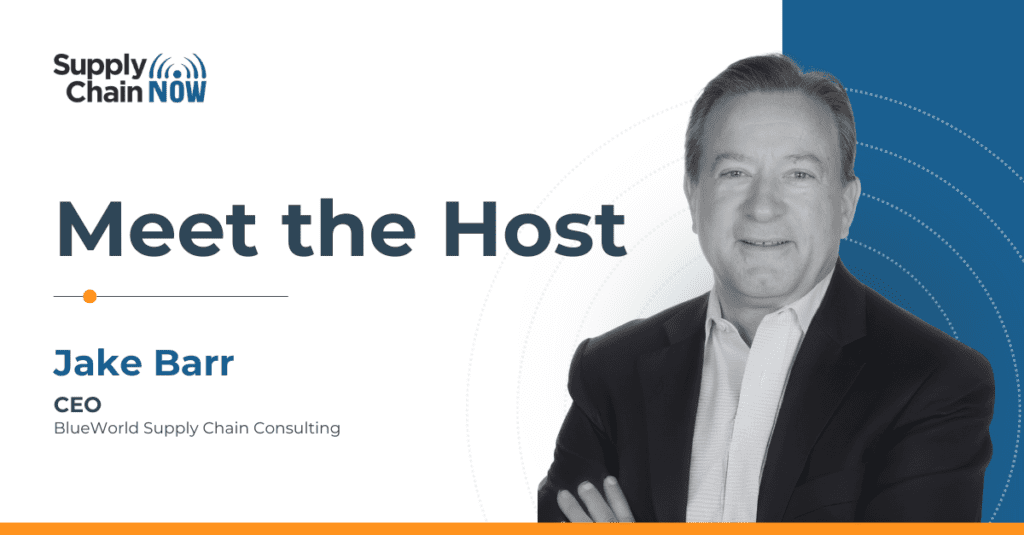
Meet the Supply Chain Now Host: Jake Barr
Supply Chain Now is the voice of the supply chain industry, and our hosts are experts in the field. Podcast listeners and webinar viewers tune in to hear the sage advice of host Jake Barr, heralded as an architect of global supply chain strategy and creator of “profit powerhouses.” Earning His Spot on Stage Barr today is the CEO of BlueWorld Supply Chain Consulting, which provides support to such Fortune 500 companies as Cargill, Caterpillar, 3M, PepsiCo, and Pfizer and helps them bring products to market. “We place a premium on accelerating speed to market by leveraging supply chain transformation,” he says. “The result is better operating margin performance and the opportunity to drive faster growth in revenue.” During his more than 33 years with Procter & Gamble, Barr served as the global director of supply network operations and led the end-to-end planning transformation project, which created control towers that now manage the daily business globally and earned him recognition as the architect for the company’s demand-driven supply chain strategy. He served on the MIT Center for Transportation & Logistics advisory council for its Supply Chain 2020 Project, was named to the League of Leaders for retail and consumer goods…

supply chain
Articles
August 23, 2024
New Kids on the Block: Three Voices Transforming the Supply Chain
Supply chain management is constantly evolving. Whether you see the glass as half full or half empty, this dynamic environment brings both challenges and opportunities to the fore. The good news is that, while challenges continue to emerge, experts and thought leaders who offer insights and strategies are changing the industry, too. This article highlights three such visionaries — Searoutes Co-Founder & CEO Pierre Garreau, Noodle.ai Chief Operating Officer Michael Ciatto, and Owlery Co-Founder Travis Downs — who not only offer fresh perspectives but are also driving change through their innovative approaches. Three Voices Transforming the Supply Chain These experts have emerged with pragmatic solutions to many of today’s logistical problems, ushering in the potential for a more effective supply chain operation. True, many might consider them “new kids on the block,” but their thought leadership already resonates well across the entire industry. Pierre Garreau, Searoutes “Today’s businesses are under pressure to improve visibility over carbon emissions, as regulators and consumers alike place greater emphasis on emissions reduction. However, businesses struggle to build accurate visibility over emissions, instead turning to greenwashing and estimation as a means of signaling decarbonization efforts. Searoutes uses the physical characteristics of vessels, planes, and trucks,…