Share:

This Week on Supply Chain Now: September 5th – 11th

It might have been a short week for some, but at Supply Chain Now, it was chock-full of great interviews, conversations, livestreams, and episodes!


For a bonus episode on Saturday, Scott and Greg welcomed Tyson Steffens with Pallet Alliance and Jom Fechner with USG to the podcast to talk about building a national procurement program and optimizing your spend.


On Monday, Scott dug back into the archives for This Week in Business History, and gave us all the story behind Labor Day.


On Tuesday, Jamin Alvidrez joined Scott as co-host, and welcomed a couple of amazing people in logistics and transportation, Trey Griggs with Lean Sales and Nicole Glenn with Candor Expedite.


Tim Judge with Agillitics and Nate Endicott with RateLinx joined Scott and Greg on Wednesday for a great conversation on agile decision making in supply chain.


On Thursday, Mark Morley with OpenText joined Scott and Greg for a conversation about the “biggest company you’ve never heard of,” and leveraging the information advantage.


And we wrapped up the week with Greg’s TECHquila Sunrise as he shares some of his opinions on the anniversary of September 11th.


Which was your favorite episode? Never miss an episode by subscribing to Supply Chain Now! Make sure you tune in next week for more great conversation, timely topics, and exceptional guests.

More Articles

freight tech
Articles
June 28, 2024

FreightTech Round-Up: 9 Solutions Changing the Game
It’s an exciting, transformative period for the global supply chain. After several years of disruptions from the pandemic, high-stakes labor challenges, and unstable global trade, supply chain innovators are looking to future-focused solutions that can help logistics professionals not just survive, but thrive in this complex environment. In this article, we explore nine FreightTech solutions (in no particular order) that are making a significant impact in 2024. 1. Axle: Streamlining Back-Office Operations with AI Axle Technologies is modernizing the logistics industry by leveraging artificial intelligence to streamline time-consuming back-office operations. Their universal data platform simplifies access to logistics data, enabling companies to optimize deliveries, reduce fuel costs, and enhance the sustainability and profitability of trucking. Axle embraces diversity, collaboration, and the 80-20 rule, understanding that customer feedback is essential for innovation. By wrangling diverse data sources into a universal schema, Axle is building the transportation infrastructure of tomorrow, making the industry more efficient and resilient. 2. EAIGLE: Enhancing Visibility with AI EAIGLE uses AI to provide unprecedented visibility into operations at gates and yards. Their end-to-end AI platform works with existing or third-party hardware, including optical and infrared cameras and radar sensors. This hardware-agnostic approach ensures superior accuracy, eliminating false…
supply chain sustainability
Articles
July 2, 2024

Guide to Sustainability in Logistics: Implementing Eco-Friendly Practices

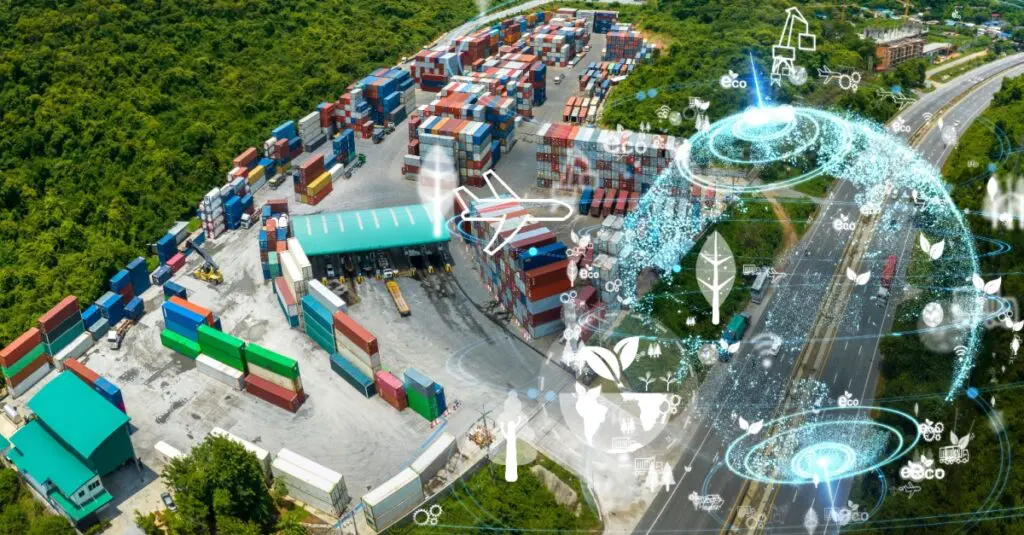
The logistics and transport sector contributes about 24% of global CO2 emissions. Considering the push for supply chain sustainability across different sectors, the need for lower emissions has been heating up in recent years. With roughly a quarter of the world’s emissions tied to logistics, this industry will possibly be the final frontier to tackle regarding sustainability. While different strategies can be leveraged to reduce the impact of logistics operations on the environment, integrating eco-friendly practices and reducing Scope 3 emissions are some of the most pressing initiatives at hand. This article serves as a guide that will provide actionable steps for companies to embrace innovative solutions and navigate the transition toward a greener future. Scope 3: Understanding Supply Chain Emissions Modern supply chain management outsources different parts of the operation to leverage the expertise of different suppliers and stakeholders. Logistics operations are usually outsourced to third-party providers, and exercising control over their operations and monitoring their sustainability practices and emissions can be challenging. Here’s the harsh reality: no matter how well an organization manages to reduce Scope 1 and 2 emissions, the unaddressed Scope 3 emissions can bring the entire process to a screeching halt. This is especially true…