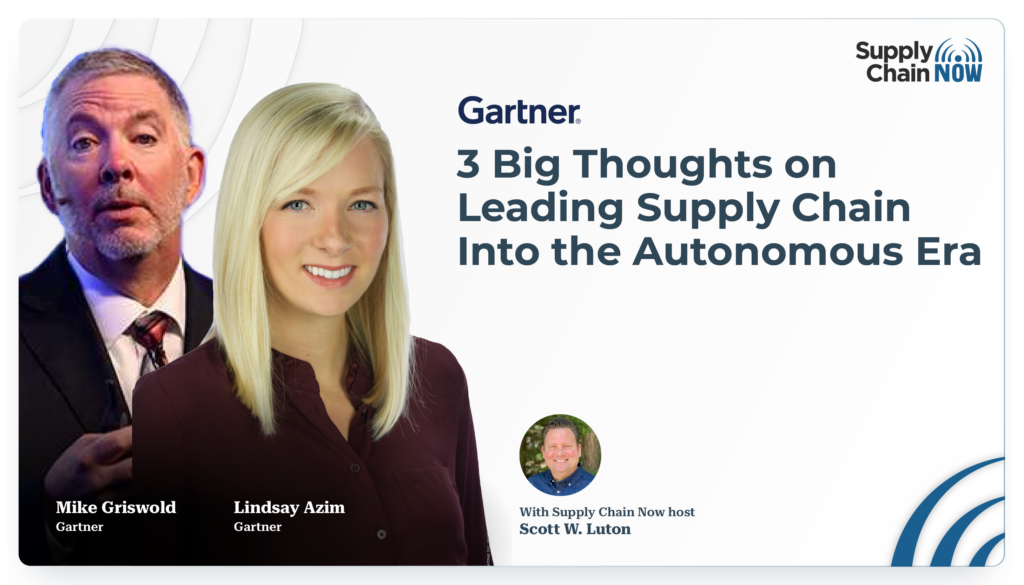
[00:00:00] Lindsay Azim: AI should not be necessarily a strategy in and of itself. The goal is not to implement AI first, fastest, or the best. It is a enabler to what we are calling the autonomous business era and transitioning into this new era. What is your vision of the future and why you are putting AI onto certain tasks?
[00:00:25] Voice Over: Welcome to Supply Chain Now, the number one voice of supply chain. Join us as we share critical news, key insights, and real supply chain leadership from across the globe. One conversation at a time.
[00:00:37] Scott W. Luton: Hey, good morning, good afternoon, good evening, wherever you may be. Scott W. Luton and special co-host, Mike Griswold with you here on Supply Chain Now. Welcome to today’s show. Hey, Mike. How you doing today?
[00:00:48] Mike Griswold: I’m doing well, Scott. It’s as always everyone, great to see you and I’m very excited about today’s show.
[00:00:54] Scott W. Luton: Me and you both. And did you hear? I worked in a little bit of a promotion for you. You’ve been from special guest to special co-host, Mike.
[00:01:02] Mike Griswold: Yeah, we’ll see how that works. This could be my one and only special guest host opportunity. So I’m going to try not to screw it up, Scott. I
[00:01:10] Scott W. Luton: Love it. I love it. Well, hey, this is, of course, folks. We are continuing our longest running and one of our most popular series here, Supply Chain Today and Tomorrow with Mike Griswold with Gartner. Mike, of course, serves as Vice President Analyst with Gartner. And today, we’ve got a special guest, which is probably why Mike is excited. And we’re diving into a variety of topics to include how chief supply chain officers are leading their teams into the autonomous era. Plus, we’re going to have some fun making pop culture infused predictions on what we might see in the global supply chain in the months ahead. So all that and much, much more. Mike, you’re always ready for these discussions, and I got some evidence of that in just a second, but are you ready for today’s?
[00:01:52] Mike Griswold: I’m really excited that we get a chance to talk in more detail about our upcoming symposium. And Lindsay’s the perfect person to have on today’s episode to talk about that.
[00:02:02] Scott W. Luton: I agree. I look forward to meeting our special guest here in just a second. So folks, stay tuned as we walk through a outstanding discussion here today on Supply Chain Now. So before I bring on our esteemed guest, I want to recognize a couple folks that have tuned into this series, Mike. We were talking about this pre-show. The first is Jay Joshi. I’m hoping I’m saying that right, Jay, who is a Senior Strategic Sourcing Specialist. Jay shared this on LinkedIn that he was listening to me and Mike discussed some key takeaways from a big supply chain event earlier this year. And Jay says, quote, “One thing Griswold said stuck with me. The conversation and supply chain has shifted from whether AI works to what organizations actually do with the capacity it creates.” That’s exactly the question procurement needs to be asking itself right now. So that’s one, Mike.
[00:02:52] Scott W. Luton: I’ll plug that with you and then I’m going to share one more and I’m going to get you a quick reaction here. So Jay, thank you for that. And then I’m going to switch over to Johnny Smith, who’s the CMO over at Ripple. He had reached out and mentioned how he enjoys Mike’s perspective on these chats. No worried about mine. That’s okay. I’m kidding Johnny, I’m kidding. And Johnny mentioned how he’s seen a lot of the themes and discussion points play out in their own ecosystem. So Johnny, look forward to learning more from you there. But Mike, between Jay and Johnny, number one, it’s rewarding to see folks kind of weigh in on the things we talk about, but what’s your quick reaction there?
[00:03:27] Mike Griswold: Yeah. First of all, thanks to both of them for taking the time to provide a perspective and to listen to the episode. I think we’ve had the conversation multiple times, Scott, around AI, AI impact. And I think it’s now becoming more and more prevalent that people are asking themselves, what’s the outcome of us continuing to push through with AI from a people and a process perspective? And I think that is probably one of the fundamental issues that we’re going to be tackling from a research perspective is what is the impact of AI on the workforce, right? Not only from the impact it has potentially on the number of bodies, but how does work change? And I know Lindsay will talk a lot about this intersection between people and technology. And I think that’s at the crux of those two observations is what is the impact going to be on our workforce now that we’re seeing more and more use cases emerge around that AI technology.
[00:04:26] Scott W. Luton: Well said. Well said. And Johnny, I would just point out, by the way, and thank you, Jay and Johnny. Mike Griswold’s crystal ball works better than anyone’s out there when it comes to global supply chain. That’s how it works. All right. So let’s introduce our esteemed guest here today. I’m excited to meet and learn from Lindsay Azim for the first time here today on Supply Chain Now. She serves as Senior Director Analyst, Supply Chain at Gartner, specializing in end-to-end supply chain risk management. Now, Lindsay has advised Gartner clients on a wide range of topics, including chief supply chain officer priorities, sustainability, executive influence, and procurement management. Lindsay is a Gartner keynote speaker and will present the upcoming Gartner Supply Chain Symposium in Orlando coming up. Well, we’re publishing this on May 4th, so it’s already begun. In fact, she’s delivering the opening day keynote today and is going to hit it out of the park.
[00:05:21] Scott W. Luton: I look forward to being a part of that. Previously, Lindsay worked in procurement at Unilever, managing the foods and refreshments category. So with all that said, I want to welcome in Lindsay Azim with Gartner. Hey, hey, Lindsay, how you doing today?
[00:05:36] Lindsay Azim: How are you? Good to be here. Thanks for having me.
[00:05:39] Scott W. Luton: You bet. Hey, Mike.
[00:05:40] Mike Griswold: Hi, Lindsay.
[00:05:42] Scott W. Luton: We know Lindsay. Once Mike said, I said, Mike, we got a short list of folks that we need to bring on in your ecosystem. And Lindsay, I think you’re one of the first names he shared. So we went hard to work working with your agent, got you booked, and here you are, Lindsay.
[00:05:57] Lindsay Azim: I’m excited to be here. Honored. Honored that I made the shortlist and I was at the top.
[00:06:02] Scott W. Luton: You did.
[00:06:02] Lindsay Azim: Honored. So
[00:06:04] Scott W. Luton: Mike, you know where we’re going to start. Little fun and warmup question. And Lindsay, we’re talking about this pre-show and it’s a good one. So today folks is May 4th. It is World Give Day, celebrating acts of generosity worldwide. Love that. It’s National Weather Observers Day and International Firefighters Day. Kudos and tip of the hat to all those professionals that do great things there. It’s also National Orange Juice Day, which is great unless you get heartburn like I do. So it might be a day you skip, but it’s also May the 4th be with you. May the fourth be with you. Now, when this started a couple years back, it took me a few years to understand why it was May the 4th, but I get it now. I get it. I’m a little bit slow sometimes. So I ask both of y’all, because it’s Star Wars Day, right?
[00:06:51] Scott W. Luton: Star Wars Day. Lindsay, when it comes to either Star Wars or sci-fi TV or movies or you name it, what’s one of your faves out there?
[00:07:01] Lindsay Azim: Scott, I’d have to say we are a big Star Wars family. I’m a boy mom. I have a daughter too, so I love the latest Star Wars movies. Rey has to be my favorite character. Love a girl boss. Just took a trip to Disney with the kids, got a picture with Rey, got to meet some of the Stormtroopers, even went on some of the rides. So that’s definitely my pick.
[00:07:23] Scott W. Luton: Lindsay, I love that. And I tell you what, she was quite the girl boss. And I think a couple movies, if I’m not mistaken, I’m kind of losing track because we got 37 Star Wars movies out there. But I love that, Lindsay, and they do a great job down there at Disney, baking in all the Star Wars themes and characters. Mike, Rey’s a good one. How about you, whether characters, movies, you name it, your favorite?
[00:07:46] Mike Griswold: Yeah. Yeah. Rey’s a good one because the evolution of the character from when she was first introduced to how she ended up, I think was very well done in terms of the evolution of her as a character. I’m going to take us way back to what is the very first one, which actually is episode three. Lindsay will appreciate this. As an ISTJ, putting these movies out of order really messed me up. Three, four, five, and then one, two, three, and then seven, eight, nine. That just didn’t sit well with an ISTJ. But I go back to the very first one, episode three, and I saw it with my parents. And I remember walking out of that being kind of a history nerd as well. And my dad taught European history. He and I were reflecting on the different aspects of that movie that were all folded into one.
[00:08:38] Mike Griswold: You had elements of a Western, right? When you had Han Solo in the Cantina scene, you had elements of your classic World War II airplane movie when you had all of the space fighting going on. And you had ultimately the good versus evil. So I just thought for that movie, that was a great way to kick off the franchise with all of those different dynamics and all those different types of genres all rolled up into one movie.
[00:09:10] Scott W. Luton: Yes. Excellent astute analysis as always, Mike. And Lindsay and Mike, can we just agree on two things? Two things. We’ll see. You’re talking about a third installment. That would be in the original trilogy that’s the Return of the Jedi. And folks, Ewoks was the worst move that Star Wars has ever made, but that’s debatable, but that’s point number one. But point number two, and this is something, Lindsay, you referenced your kids and Mike, you referenced seeing it with your parents. Back then in the ‘80s and ‘90s, movies had, especially sci-fi movies, had simpler plots, right? It was good folks, bad folks, problem, and then Save the Day. These days, I’ve got to take my son and he’s got to unpack the multi-universes that are all in play and the origin stories of 37 characters. Lindsay, it’s gotten very complex. Do you see the same thing?
[00:09:58] Lindsay Azim: Yeah, but the thing is, is they’re used to it. I think that our kids, this is different for us. We’re seeing this evolution of movies, but they got thrown right into more complex plot lines.
[00:10:11] Scott W. Luton: Well, that’s a
[00:10:12] Lindsay Azim: Great
[00:10:12] Scott W. Luton: Point. So
[00:10:13] Lindsay Azim: My son gets it.
[00:10:16] Scott W. Luton: And they may just be smarter than us too. I think that’s at play too. Mike, same thing. Complexity, good, bad, indifferent. What?
[00:10:23] Mike Griswold: Yeah, no, I agree with Lindsay. It’s just what they’re used to, although we could probably have an offline debate between Ewoks and Jar Jar Binks in terms of who are the worst ever introduced characters in Star Wars history. But there were times, because I have, I would say a passing interest in the Marvel stuff, but I’ve had to go to my son who’s in his 30s and say, “Hey, okay, explain to me this whole Avengers thing and how are these all tied together?” And even to some degree, I’ve had to go online even for some of the Star Wars spinoff, like the Mandalorian. When does Mandalorian take place within all the other Star Wars universe? So at some point I may just give up, Scott.
[00:11:06] Scott W. Luton: I already have. I’m waving the white flag. So we’ll see what’s coming up. But regardless, folks, I promise we’re going to be talking about supply chain just a second. We had a little fun. And Lindsay, again, great to have you here today on Supply Chain Now. I’m really looking forward to your keynote and some of the feedback you get from knocking it out of the park on opening day. So let’s do this. Let’s share some context on the front end, Lindsay. If you would, level setting with our SCN Global FAM out there, share a little bit about your professional background prior to Gartner, if you would.
[00:11:34] Lindsay Azim: Yeah. So I had a little bit of a, not a straight road path to supply chain as most careers go, but I found my way to supply chain through sustainability. I was working in finance and tech, and I at the time was exposed to, which was required back in 2012, conflict minerals reporting of all things. So I was working on supply chain auditing, how to get those reports into a consumable format so they could then be sent off to the SEC. So that’s how I got introduced to supply chain. It was a little bit later, I decided I’m going to go back to school and get my master’s in sustainability. And from there, I focused in my master’s program on sustainable supply chain operations. I went on to Unilever. I worked in logistics for a minute. I ended my career there in procurement. I was a category manager, did some innovation work, and then I moved on to Gartner, and I’ve been here for seven years.
[00:12:35] Lindsay Azim: I love that every day my job is to learn and to teach clients what I learned, which is why I’ve been here for so long.
[00:12:43] Scott W. Luton: Lindsay, I love it. And Mike, really quick, I love the big themes that make up a big part of Lindsay’s background, logistics, sustainability, procurement, innovation, change and transformation probably on top of those. What’d you hear there, Mike? And how cool is that lens based on what Lindsay’s doing now? Very helpful. Your thoughts?
[00:13:02] Mike Griswold: It is. I mean, I think one of the things that we try to do on the Gartner side is bring people in with broad experiences, both within the supply chain and outside of the supply chain, and experiences in areas that are up and coming and going to be emerging with our clients so that they have the ability to relate to those challenges, as well as provide insights that we learn from talking to people all the time.
[00:13:27] Scott W. Luton: And of course, Lindsay, you also mentioned as part of your background, working at one of the world’s most admired companies in Unilever, and we can all learn a lot from that organization. Expound a little bit more on your current role at Gartner, Lindsay, if you would.
[00:13:41] Lindsay Azim: Yeah, sure. So as you already mentioned, I’m a keynote speaker. I love going to a conferences doing some of the big stage speaking. So that’s a big part of my role. But my day job is talking to our clients on risk, on how to implement an end-to-end risk strategy. How do you prioritize risk? How do you understand risk appetite? What risks are acceptable? What’s not? How do you focus your mitigation efforts? So that’s a lot about what I talk about. And then it also seeps into, just because of my role in doing keynotes, I get to talk about leadership, influence, communication, storytelling. So that’s also a fun part of my job. I dabble in a little bit of everything, or at least I try.
[00:14:22] Scott W. Luton: I love it. Baskin Robbins approach. And I’m envious, Lindsay. What a great role and what a special role, rewarding role to have. Mike, of course, risk. And as she mentioned, in risk strategy, I think that’s factored into all the conversations we’ve had for six years now, Mike. And that’s a good thing. Leadership, communications, storytelling, right? That might sound cliche to some folks, but it’s taken our industry, I think, a long time to really figure out how to be much more effective storytellers. And we still got lots of heavy lifting to do. Mike, your thoughts?
[00:14:55] Mike Griswold: Yeah. It’s interesting that we have Lindsay on today’s episode. Lindsay did a breakout session three years ago at Symposium in Orlando on the topic of storytelling. How do we educate CSCOs and teach CSCOs how to tell stories? What are the literal mechanics of telling a story, using data, making personal connections so that you can convey the point that you’re trying to convey? And I think Lindsay and I both were chuckling that she did a great job, and I think we both thought that would be the end of it. Fast forward three years to now, we do strategy sessions. My team does strategy sessions. Storytelling is the most popular strategy session we do across all of our clients. We probably do 20 storytelling strategy sessions a month, and it is becoming more and more evident the power that being a good storyteller has for you as a CSCO.
[00:15:57] Mike Griswold: I’m sure Lindsay will touch on this. We have data that tells us where CSCOs sit kind of in the pecking order with their C-suite brethren and sister. And it’s not great, to be perfectly honest, right? The CSCOs are not seen the way they would like to be seen by their peers. And the ability to use storytelling to connect with your C-suite peers is really important. And I think it’s part of the reason we have this little … I joke about this cottage industry around storytelling that Lindsay launched three years ago. It’s definitely one of those unintended consequences in that, yeah, I think Lindsay and I both knew it would be an interesting session. I think Lindsay sent me something. It’s like 500 people in the room. Mike, what am I going to do? It was unbelievable. And Lindsay knocked it out of the park and here we are today still
[00:16:51] Scott W. Luton: Talking about-
[00:16:52] Mike Griswold: Still talking about it. Still talking
[00:16:54] Scott W. Luton: About it. So Lindsay, really quick. We’re about to talk about the current supply chain landscape, but Mike shared a lot there around storytelling and some of your research and best practices you’ve shared. What’s one thing Mike shared that maybe more folks got to know when it comes to storytelling and where it fits into our supply chain leadership roles?
[00:17:13] Lindsay Azim: Yeah, it’s a good question. Let me go back to the pop culture reference for a second. For those of you who are Pixar fans, Pixar has 22 rules of storytelling. There’s essentially a formula behind every Pixar movie. And so what I try to do with this very popular breakout is put a formula behind storytelling because supply chain leaders, I find that they want something to grab onto. It’s a very challenging topic. So we put rules around it, which is you got to know your audience. You got to put structure around the narrative, which in a lot of cases is the hero’s journey, the typical Star Wars hero journey, but it doesn’t have to be that. Personal stories are great stories, but there’s a lot of ways we can tell a story. It’s also, data is not the main actor, it is the supporting actor. There’s a whole formula that we have around this and it’s been really fun to get supply chain leaders up to speed.
[00:18:07] Scott W. Luton: Okay. I got to sign up for this the next time that y’all are for this because this is fascinating and I got to learn more of these 22 rules of storytelling that Pixar offers. But that last comment you mentioned there, I think folks, that’s a key takeaway here. Data is really important. We all know how data is important, but if we can’t build the storytelling apparatus and vehicle to communicate it, we don’t have a shot at communicating the critical data. And as she mentioned, data is not the main character, right, Lindsay? But the supporting actress or actor. Okay. So Lindsay and Mike, we got a lot to get into here today. And I’ll tell you, Lindsay, this next question for you is not a fair one because we got to have the Galaxy’s biggest radar to track everything that’s going on in the current supply chain landscape.
[00:18:55] Scott W. Luton: But if you think of a short list, especially those shortlist items that are common threads that arise in your conversation with leaders out there making it happen, what’s on that short list, Lindsay?
[00:19:07] Lindsay Azim: Yeah. So I would say it’s definitely AI. How do I use the AI investments that I’ve made to its folds potential, which leads into the second one, which is autonomous business. How do I prepare? And then specifically for my conversations around risk, there is a lot going on right now. So how do we prioritize? How do we think about some of the conflicts that are happening on the geopolitical landscape? That’s my short list.
[00:19:32] Scott W. Luton: So Mike, before we maybe get another comment or so from Lindsay on that short list, AI, autonomous everything, right? And we’re going to talk more about the autonomous era here in a minute perhaps. And then of course risk and risk in all of its different definitions and incarnations and iterations. Mike, what comes to mind?
[00:19:52] Mike Griswold: Yeah. One of the things we’ve tried to do within our content architecture is to really identify three mission critical priorities. And they are that architecture we use across all of Gartner. So if you’re talking to a CIO, what are his or her mission critical priorities when we talk to a CSCO in our case and the people that Lindsay talks to and builds the keynote presentation around the three we have AI for sure. Lindsay talked about autonomous business, which is AI related, but it’s also this idea of how do we take friction out of a supply chain? How do we make it easier to work? Certainly AI plays a role in that, but also what skills we give people, how we organize, that leads to less friction or can … Well, I guess if you don’t do it well, it leads to friction. If you do it well, it leads to less friction.
[00:20:46] Mike Griswold: And then the third one is this general idea of cost, which people will say, “Well, that’s not really new, Mike.” The new angle that we’re taking is how do you think about non-traditional cost levers? So it’s not just about, how do I take costs out of my business? It’s about what are the levers that I can pull to ensure that any cost I take out is sustainable. And some of that comes back to the frictionless supply chain, but it’s also being mindful of other levers like organization as an example. Can you structure your organization in a way that you’re becoming more efficient and then by that efficiency, you’re taking cost out? I think the other, the last point I’ll make is we encourage people to not necessarily equate people in cost, meaning I have to lower costs, which means I need less people. That may be an outcome that could be a byproduct, but that usually from our perspective is not plan A, right?
[00:21:49] Mike Griswold: Plan A should not be just looking at how do I take people out of the business. It’s how do I make a more efficient cost structure within the business? And the supply chain plays a key role in that.
[00:22:00] Scott W. Luton: Thank you, Mike. Now Lindsay, we’re going to talk about your opening day keynote in just a second and some of the key takeaways you’re going to be hoping folks leave that massive auditorium, 50,000 people in attendance maybe, almost. But on those three things that are big common threads with your conversations across the supply chain landscape, AI, autonomous and risk. What’s one thing that might be counterintuitive to some folks related to one of those three things? Or react to what Mike shared there. Your thoughts, Lindsay.
[00:22:32] Lindsay Azim: The one thing I would say is counterintuitive is, and we talk about this in the keynote, is that AI should not be necessarily a strategy in and of itself. The goal is not to implement AI first, fastest, or the best. It is a enabler to what we are calling the autonomous business era and transitioning into this new era. So a lot of times I will get a strategy review around, here’s my AI strategy. And my question always is, okay, let’s back up. What is your vision of the future and why you are putting AI onto certain tasks?
[00:23:08] Scott W. Luton: Answering that why is so important. And it kind of goes back to the storytelling because if we can’t tell that story effectively about why we’re doing anything related to AI or any other initiative, then maybe we’ve already failed at the first starting point. Would you agree with that, Lindsay?
[00:23:25] Lindsay Azim: Yeah. And the challenge that we see is it leads to what we call AI sprawl. There’s kind of individual tasks that are being automated, but they’re not connected in any way. It’s really challenging to communicate the value exactly what you said related to storytelling. How are we communicating the benefits to our employees and our operations?
[00:23:48] Scott W. Luton: Well, you’ve mentioned a keynote. We’re about to go there next, but really quick, Mike, AI sprawl, we’re going to AI everything to death and only about 0.1% of that works. Talk about the dangers and the risks associated with AI sprawl, as Lindsay mentioned.
[00:24:04] Mike Griswold: It’s a great description of what we see. And I think the challenge we have is one that unfortunately we’ve seen before. It’s just AI is the latest iteration of this where we have a technology running around the organizations trying to find a problem as opposed to other way around. We have a specific problem. Is AI the right solution for this particular problem? To Lindsay’s point, she said it very well. Is AI the right vehicle to get to the strategy that we are able to articulate? We’ve used this analogy before, Scott. If I have a hammer, every problem looks like a nail. So it’s really important. And we could go back to my retail days with RFID. We could go to blockchain where we had these new shiny technologies that were kind of pitched as they will solve everything. So let’s go acquire it and then we’ll sort it out later.
[00:25:02] Mike Griswold: I think the other, if we’re thinking with movies, I would suggest that we not take a Field of Dreams approach with AI. If I have AI, they will come. That’s not really the way we want to be thinking about it. We need to Lindsay’s point, what’s the strategy and overall business supply chain strategy, what role does AI play in that? And I think depending on how you want to segue this, Scott, that will be one of the key tenets I think in what Lindsay talks about on stage.
[00:25:31] Scott W. Luton: That’s perfect because that’s where we’re going next. Lindsay, I can’t wait to take in your opening day keynote. And I think we’ve got the graphic here we’re going to share. Gartner opening day keynote again at Supply Chain Symposium, leading supply chain into the autonomous era. And again, we’re dropping a podcast here today on May 4th. And Lindsay opens at today, 10:00 AM Eastern Time. So folks would love to get your feedback on Lindsay’s keynote if you’re there and make sure you stop by and say hello to us. But Lindsay, I know this is probably, like everything else, it’s hour by hour based on what’s going on in the industry, but as
[00:26:07] Lindsay Azim: It
[00:26:07] Scott W. Luton: Stands today, as it stands today, what’s a couple of key takeaways? Let’s call three key takeaways that you’d love the audience to leave from your presentation.
[00:26:16] Lindsay Azim: I’m really excited. Of course, this has been my baby for a couple of months now and we’re labeling it the most important 45 minutes in supply chain this year. We’re setting the bar high, but there’s three key insights that I am going to discuss on stage, and it is autonomous ready operations, autonomous ready intelligence, and autonomous ready workforce.
[00:26:40] Scott W. Luton: Okay. All right. So before you go a little deeper on each of those, autonomous ready operations, autonomous ready intelligence, and autonomous ready workforce. My favorite already is a third one. Mike, do you have a favorite and comment on good things always come in threes, comment on what we heard there.
[00:26:56] Mike Griswold: Yeah, I think those are the three things that we’re getting asked about on the Gartner side. I think it’s three things that people are really internally wrestling with some of the intended and unintended consequences of these things that we’re labeling autonomous. And I agree with you, Scott, again, we’ve had lots of conversations around workforce ramifications. And I think this idea of the autonomous workforce, I think there are many nuances to that and many layers to that, some of which Lindsay can touch on and some of which will require part of those most important 45 minutes when she gets on stage.
[00:27:38] Scott W. Luton: That’s right. And lots of opportunities out there for an autonomous ready workforce as well. So Lindsay, now let me just say something before you go a little deeper on each one of these. I am so glad it’s you that has to deliver the most important 45 minutes of supply chain of the year. So I’m not envious of that. I’m glad I get to sit down and maybe get a Diet Coke and listen to your perspective. But if you would, let’s start with autonomous ready operations. Tell us a little more about that.
[00:28:06] Lindsay Azim: Yeah. Also, you asked for feedback on the keynote. I think that’s going to be the number one point of feedback is, was it really the most important 45 minutes? So maybe I shouldn’t have said that, but we’re all friends here.
[00:28:19] Scott W. Luton: We are.
[00:28:20] Lindsay Azim: Okay. So autonomous ready operations. So what we’re first discussing is before we kind of get into the meat of what an autonomous ready operations means is it’s a mindset shift from the automation mindset. A lot of what we talked about with our point around AI sprawl, which is we are automating individual tasks that humans once did, our people once did. Moving to the autonomous mindset where we are strengthening our human and machine partnership, and it is a shift in not how things are done, but in who does things, which tasks are taken on by our people, and then which are taken on by our agents.
[00:29:04] Scott W. Luton: On that last point, Mike, we’ve talked about this before, that human machine partnership and an extension of that we heard at Gartner, the planning event in the last year, is leading organizations are deliberately crafting that human machine strategy on a related note Lindsay just shared there. But your thoughts, whether it’s the mindset shift she was talking about or that human machine partnership or what goes into truly an autonomous ready operation?
[00:29:32] Mike Griswold: It really, I think, is the mindset shift. And I’ll bring us back to some degree a little bit to the principles of storytelling, because this mindset shift is about helping people understand what are we going from to where are we going to? And the mindset shift, I think, is really around where is it okay and where does it actually make sense to delegate some of these decisions to agents? It’s where a human can’t really value add to that decision based on whether it’s experiences or data or whatever it might be. And being comfortable in articulating why agents are going to make these decisions and why we still need people to make these other decisions. Where do we in this process, we being people, where do we add the value? I think oftentimes when people think about, and Lindsay phrased it well, kind of this automation discussion, it tends to diminish the value of people in that process.
[00:30:40] Mike Griswold: Oh, we’re just going to automate it and we’re going to let a machine do it. And I think the mindset shift that Lindsay will talk about is how do we help people make that distinction between what makes sense for these sets of reasons to have an agent do versus a person do because of these other reasons. And I think it comes down to value and where do people add value and get us a better decision and a better outcome?
[00:31:09] Scott W. Luton: So we’re just getting started. We got two more to go, Lindsay. And of course everything else that’s going to be in the keynote here on May 4th. Autonomous ready intelligence. I think that was number two. Tell us more, Lindsay.
[00:31:21] Lindsay Azim: Yeah. So this is the perfect segue of everything Mike said into the second section. Autonomous ready intelligence, it’s two things. It’s data and it’s also our people. And the knowledge, the tribal knowledge that they have sitting in their brains that maybe isn’t written down. And this is my favorite section, so I’m going to get really excited about this. But what we find is that organizations, when they think about preparing for the autonomous business era, we’re going to go look at our tech stack. We’re going to focus on building or investing in the right tools. What we are introducing is this concept of a decision stack, which has people right at the heart of it. So at the bottom layer of the decision stack is the foundation of all good decisions, which is our data. It is unstructured and structured data. Data quality has been an age old problem.
[00:32:16] Lindsay Azim: We know AI doesn’t need perfect data, so that can’t hold us back anymore. So in the center of the decision stack is knowledge assets. It’s everything that’s in our heads, the hallway conversations. And I tell a funny story about everybody knows that guy named Dave who has the coffee stained sticky note on his desk that is our business continuity plan. So if a server catches fire, that sticky note is the only thing that’s separating us from absolute chaos. So it is taking all of the human judgment, the knowledge that we’ve built, it’s documenting it. It’s making sure that we’re writing this all down. And then at the top of the stack is mapping out our decisions. It’s not mapping out process, although it’s important to understand how we are mapping different types of process that are mapped to outcomes and value, not necessarily individual tasks that are potentially sitting with your logistics team versus your procurement team.
[00:33:21] Lindsay Azim: We are mapping towards broader organizational outcomes. We are understanding who’s making these decisions. Why are we making these decisions? When do we say, “Hey, this is a decision that Lindsay needs to come in and weigh in on or Mike needs to come in. “ It’s essentially everything around why are decisions made and can we bring 15 decisions down to six decisions or five decisions?
[00:33:48] Scott W. Luton: All right. So Mike, we’ve covered two thirds of the triads, so to speak, between autonomous ready operations and autonomous ready intelligence. You heard there Lindsay unpack the decision stack, which I like. I might steal from her. Mike, your comments.
[00:34:02] Mike Griswold: A couple. The first is, Lindsay touched on this. We tend to think about things in technology stacks. And if I just have the right technology, everything else will become easier. And I think the mindset shift that Lindsay’s talking about is around how do we use technology to help us think about decisions differently. I’m also going to ask people to go back because Lindsay was at the forefront of this last year at our planning summit when we talked about this idea of decision shapers. And we talked about through the lens of our planning summit that demand planners needed to be thinking more like decision shapers. How do I take all this information that I have from a planning orientation and use it to shape decisions? I think right now that mentality around I need to be a decision shaper now that we have things like AI and we have this decision stack that Lindsay alluded to, it is becoming more and more about how do I make decisions.
[00:35:05] Mike Griswold: And that to me is probably number one on the list of things to do of a CSCO is I have this list of decisions I have to make today. How am I going to make them? And to Lindsay’s point, are there ways that we can take that list of decisions down for a CSCO so that he or she are really just focused on not the 150 they got to make today, but what are the six that are really going to shape the business on a day in and day out basis?
[00:35:37] Scott W. Luton: Well said, Mike. And folks, that’s one of the empowering parts of this conversation that Mike just shared that clearly Lindsay has been a part of, that we introduced here at Supply Chain Now with some terrific presenters last year, and that’s the power of decision shapers. And no matter where you are in a supply chain organization, if you’re in a C-suite or if you’re not, you’ve got the opportunity to be a critical decision shaper. So how you do that? Well, you have to go back and find Lindsay and Mike’s. Sign up for those workshops. Lindsay, you’re going to have lots of workshop requests. So here it comes.
[00:36:10] Lindsay Azim: Bring them on.
[00:36:12] Scott W. Luton: Going back to the finish off the triad, autonomous ready workforce, which again is one of the key insights coming from your keynote, your opening day keynote. Tell us more about that.
[00:36:23] Lindsay Azim: Yeah. So the idea behind an autonomous ready workforce is preparing for job chaos, not job apocalypse. And it’s the rise of the versatiles. It is the individual in the organization who can bridge the gap between the business and AI, our technology. What we’re saying is that siloed functions, if we are mapping our decisions correctly, not to specific tasks, but to outcomes, we need to now work more cross-functionally and make individual siloed business units a thing of the past.
[00:37:01] Scott W. Luton: That is music to my ears, Lindsay. And Mike, I am so glad. I consider myself a versatilist, if I’m saying that right, Lindsay. I’ve done many things in the industry, right? I’m not deep dive on technologist or coding or technology implementation. I’ve solved a lot of problems come across the board. So Lindsay, it’s very validating that a rise of that type of talent is coming to the table. Mike, your thoughts? I love that. And by the way, I love job chaos versus job apocalypse. That’s going to help me sleep better at night. Mike, your thoughts?
[00:37:35] Mike Griswold: One of the things I think people come to us at Gartner for is we will tell them the truth. Job chaos is coming. I think what we also need to do is we need to walk people off the ledge a little bit because all they see are the headlines of people cutting thousands and thousands of jobs tangentially because of AI. Now, we all know that a lot of that has nothing to do with AI, but AI is in the headline. So it’s that fine line between, look, we’re going to keep it real and say, yeah, there’s going to be a lot of turmoil around how work gets done and how decisions get shaped and how decisions are made, but it’s not going to be apocalyptic. But like the versatilists, there are skillsets that need to emerge in your organization that some of the non-technical, more people type of skills that are going to emerge as being really important.
[00:38:31] Mike Griswold: And if you do not invest in them now, then a couple of things will happen. One, someone else will, and you’re going to find people exiting your organization. And then secondly, you will just not get the value and the outcomes that Lindsay alluded to through all these initiatives that you want to work on if you do not take the time to reinvest in your people. So it’s coming. I tell people all the time, you can either do things or you can have things done to you and the latter is not where you want to be. So acknowledging this idea of chaos, trying to get ahead of it, listening to our insights around what are some of the things you can do to become more versatile, those are all things that will be part of Lindsay’s most important 45 minutes.
[00:39:21] Scott W. Luton: So Lindsay, and really quick, I love Bearers of Good News and you’re going to share a lot of that as part of your opening day keynote. And one of my favorite parts that might reassure some folks is, “Hey, amongst everything else we’re dealing with, at least there’s not going to be a job apocalypse.” That is good news, Lindsay. That is good news. So folks, again, we’d love to get your feedback if you’re there at Symposium on Lindsay’s opening day keynote. We’ll probably talk about it in our upcoming podcast or two. Lindsay will have to have you back soon and we’ll unpack that and many, many other themes. But really quick, I want to share this piece of feedback that a leader from the Coca-Cola company shared about Supply Chain Symposium, quote, amazing conference that has shown time and time again, it’s worth its cost 10 times over.
[00:40:07] Scott W. Luton: Folks, if you hadn’t made it out to symposium yet, you’re missing out. I’ve been fortunate to be there four or five times. And as me and Mike have talked about, amongst many, many other things, it’s the best supply chain happy hour that you’re going to find. That’s the truth. But Lindsay, really quick, I’m getting both you and Mike to weigh in. What is your number one reason folks should consider attending Gartner Supply Chain Symposium? What’s that number one, Lindsay?
[00:40:32] Lindsay Azim: It’s the energy. It’s the energy of bringing, and I always say I’m a supply chain nerd, a bunch of supply chain nerds together in the same room who are trying to tackle the same challenges. You can feel the energy everywhere.
[00:40:46] Scott W. Luton: Yep. Lindsay, I wholeheartedly agree with you there. And we’ve gotten a lot of feedback around that. When I sit down with leaders, one of the biggest reasons they’re there is to compare notes with other leaders faced with similar and different challenges. So excellent point, Lindsay. Mike, what’s your number one?
[00:41:01] Mike Griswold: It is the only place where you will find an equal mix of challenge, meaning, “Hey, here’s things you need to be thinking about as well as affirmation. Here are things that I’ve been thinking about. I’m listening to my peers who are doing the same thing. I’m listening to Gartner tell me this is the right thing to do. “ So it’s one of the few places where we will challenge you. Lindsay talked about the mindset shift, right? We will challenge you to think differently, but we will also give you opportunities to validate and affirm the things that you’re working on. And I think that’s important for people, particularly as Lindsay said, with the peer group that we assemble, it’s a great way to get both of those experiences.
[00:41:44] Scott W. Luton: Well said, Mike and Lindsay. Okay. We’re going to have a fast and furious finish here this afternoon. And Lindsay, we’re going to end where we started and that’s talking about pop culture because Lindsay, one of me and Mike’s favorite shows we’ve done numerous times through this six year journey has been to use pop culture to give us supply chain analogies and combine, get our cake and eat it too a bit and have a little fun while we do it. So the question there, Lindsay, is when you think of how the rest of 2026 may play out, maybe even into the next year, right? What movie or TV show or song, you name it, comes to mind that may be a pretty accurate representation?
[00:42:26] Lindsay Azim: That’s a good question, Scott. I think I’d have to say Iron Man. Tony Stark, if we’re talking about the Human Machine Partnership, that is the ultimate human machine partnership, and we love Marvel.
[00:42:40] Scott W. Luton: Lindsay, I think I shared this with you earlier. I’m so jealous. I didn’t come up with that sooner. That is perfect. And if my son Ben were here, he would wholeheartedly agree with you. Mike, it’s going to be a tough top that, but what analogy for you comes to mind?
[00:42:55] Mike Griswold: I’m going to just steal Lindsay’s. I think Iron Man, not the Black Sabbath song, because I’ll date myself. Iron Man, the movie. Movies is a really good example. I also, while I’m not super well versed in all of them, the character I think also has kind of a personality that we need as supply chain professionals. Let’s not take ourselves too seriously. Let’s be willing though to place some big bets. Let’s be willing to take some chances and let’s be willing to kind of live with the consequences. So I think it’s an excellent example.
[00:43:34] Scott W. Luton: I completely agree. And so Lindsay, your ears are going to be burning as you use that analogy you shared here today. And I would just add one more. And it’s not the same vein that what Lindsay and Mike shared, but The Naked Gun, right? That is a cheesy movie, but it still remains popular and it’s had installment after installment. And it always reminds me, even if the dad or the mom jokes get old, we got to maintain a healthy sense of humor. Here, we’re recording this in, I think it’s International Stress Awareness Month. And one of the best ways to deal with stress and the friction and the pressures we feel as we do what we do day in and day out is to lean into our coworkers and the camaraderie, but also that sense of humor so we can laugh a couple times a day.
[00:44:20] Scott W. Luton: And Lindsay and Mike, I tell my kids, no lie. I love car line logistics. I try to take them to school whenever I can. I’ve got some rules I share with them. And one of them is I challenge them to find a way to laugh at least once an hour. They reluctantly recite some of those rules when I drop them off. But anyway, nevertheless. All right. So folks, as we start to wrap here, hope to see many members of our SCN Global fam at Gartner Supply Chain Symposium starts today, runs through May 6th here for 2026. Of course, the sister event for symposium, I believe that is the following week. Now check me if I’m wrong here, Mike and Lindsay. The following week, right? Two weeks. Two weeks.
[00:45:00] Mike Griswold: Two weeks.
[00:45:01] Scott W. Luton: Two
[00:45:01] Mike Griswold: Weeks in Barcelona.
[00:45:02] Scott W. Luton: Barcelona. So folks, I know it’s short notice, but if you miss us in Orlando, you can join us in Barcelona in a couple of weeks. And kidding aside, if you’re not there this year, begin to look at 2027. And if you’re at symposium this year, come say hello as me and the gang will be conducting lots and lots of interviews. You can learn more at gartner.com. Okay. So Lindsay, let’s make sure folks, beyond catching your keynote, your opening day keynote, the 45 minutes, most consequential 45 minutes in all of global supply chain. We’re building that up a little bit bigger, a little bigger each time. But Lindsay, how can folks connect with you?
[00:45:41] Lindsay Azim: Yeah, just friend me on LinkedIn, send me a note. I’d love to hear from everybody.
[00:45:46] Scott W. Luton: Just that easy, right? It’s just that easy. Lindsay Azim. And Mike, I get a two-part question for you. Lindsay shared some great stuff, some actionable perspective here today, things to be on the lookout for that’s current state and future state. If you had to pick one thing out that was your favorite key takeaway from what Lindsay shared, please share that and make sure you let us know how folks can connect with you too.
[00:46:09] Mike Griswold: The keynote is meant to provoke thinking. It’s meant to provoke different ways to think about things. So my ask of people is to go into the keynote with an open mind. It’s very easy to think about as a CSCO. I’ve been running my supply chain for 30 years, and that’s all well and good, but a lot has changed. A lot has changed in the last two years. So having an open mind when you go into the keynote and our other breakout sessions for that matter, have an open mind about what is possible and recognize that we spend a lot of time talking to CSCOs and the things that we talk about and we share aren’t things that we just lay awake at night and just make up off the top of our head. There’s a lot of research and insight behind that. In terms of getting ahold of me, LinkedIn is good.
[00:47:01] Mike Griswold: Email, mike.griswold@gartner.com. I’m old school. So would love to hear from folks around what was some of their big takeaways from the event. We talk about this as the world’s largest gathering of supply chain professionals. I don’t think that’s hyperbole. I think you’d be hard pressed to find that many supply chain professionals in any one place for three days, and we hope to see people there.
[00:47:26] Scott W. Luton: Mike, some element of that might be hyperbolic, but what I think folks could take to the bank at a minimum is it’s definitely the world’s largest collection of supply chain leaders and CSCOs and VP of supply chains for sure. And then secondly, what I shared earlier, folks, you’re going to have to seize your inner courage and just jump into the supply chain happy hour. It is perhaps the biggest one, at least this side of the Mississippi, if not globally. We shall see. And Lindsay, did you see what Mike did? He’s fearless. He said he’s old school. Throw in his email out there. I got to applaud his bravado there, huh?
[00:48:03] Lindsay Azim: Lindsay.azim@gartner.com.
[00:48:05] Scott W. Luton: Both of y’all. Man, okay. Well, all kidding. All in good fun. Lindsay Azim, Senior Director Analyst, Supply Chain at Gartner. Lindsay, I’m so glad that you could join us here today. I can’t wait to check out the opening day keynote and all the other sessions that you’ll be sharing in the months ahead. Thanks for being here, Lindsay.
[00:48:25] Lindsay Azim: Thanks for having me.
[00:48:26] Scott W. Luton: You bet. And Mike Griswold, great episode. Thank you for bringing some of your intelligent, talented friends. I look forward to the next edition already.
[00:48:35] Mike Griswold: Oh, yeah, it’s great. My list of intelligent friends is pretty long, so it’s good to have smart people, Scott. You know that. So yeah,
[00:48:44] Scott W. Luton: Excited
[00:48:44] Mike Griswold: To connect with you again.
[00:48:45] Scott W. Luton: That was Mike Griswold, Vice President Analyst with Gartner, of course. Folks, I’ll tell you, you got lots of options here. First off, I hope you enjoy the conversation as much as I have. I learned a lot from Lindsay and Mike. And homework is simple. You got to take one thing that Mike and Lindsay shared here today. Share it with your team. You know the power of deeds not words, right? Put it in action. And with all that said, first off, hope we see you at symposium. Make sure you come by and say hello. But if we miss you, Scott W. Luton here challenge you do good, give forward, be the change that’s needed, and we’ll see you next time right back here on Supply Chain Now. Thanks everybody.
[00:49:19] Voice Over: Join the Supply Chain Now community for more supply chain perspectives, news and innovation. Check out supplychainnow.com. Subscribe to Supply Chain Now on YouTube and follow and listen to Supply Chain Now wherever you get your podcasts.