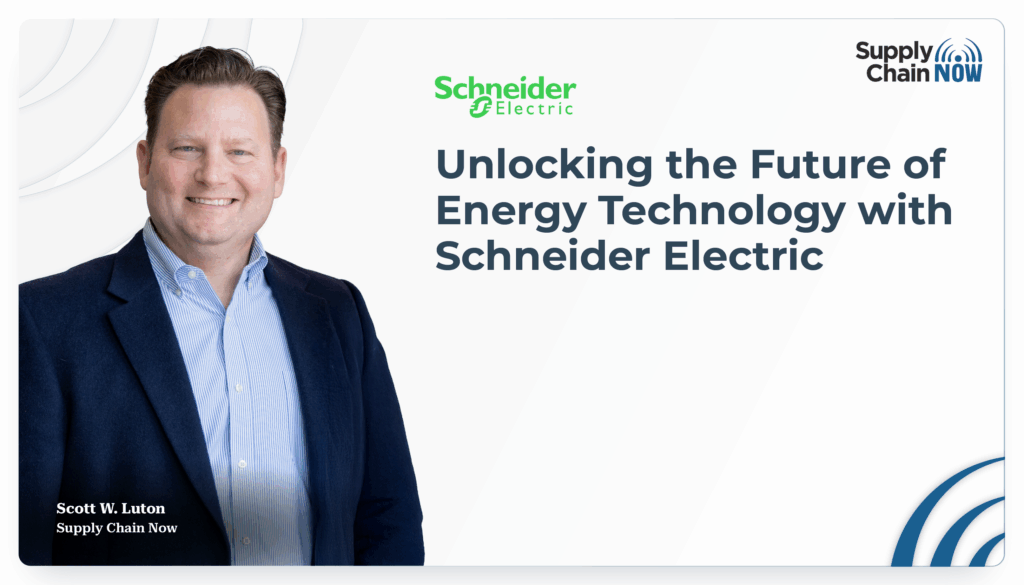
Scott Luton (00:03):
Hey, good morning, good afternoon, good evening, wherever you may be. Scott Luton here with you on supply chain. Now. Hey, I ventured out to Las Vegas in mid-November where I thoroughly enjoyed Innovation Summit North America 2025. It was powered by our friends at Schneider Electric who brought together more than 2,500 business leaders and market innovators to accelerate electrification, automation, and digitalization at the forefront of energy and technology. In the next few minutes, I’m going to be sharing three of my top 37, maybe 57 takeaways. I’m framing it up as the why, the what, and the so what. So when it comes to how we generate, manage, and distribute electricity, we’ve got to take a much different approach To that end, let’s talk about the why. First, we’ve got a problem, a big growing problem. The world’s demand for all sorts of power is dramatically growing exponentially.
(01:06):
As a matter of fact, and the US alone considered this, the US will need to find some 200 gigawatts of new energy capacity by 2030. But how much is 200 gigawatts of power? You may ask, I know I did. This figure might help. So one gigawatt hour of energy would power roughly 750,000 homes for an hour. It’s not a perfect science and it’s got lots of variables, but that’s a good general rule of thumb to follow. Half of that new demand, that 200 gigawatts of new energy capacity by 2030, half of that new demand is driven by artificial intelligence. But I bet you already knew that. As we all know, data centers, which are being built out everywhere with a fuel AI technology, which further fuels our need for energy. As Amir Paul with Schneider Electric recently shared data centers now consume 4.4% of US electricity more than some entire states, and will reach double or even triple that amount, that 4.4% by 2028.
(02:19):
It’s just around the corner. That’s incredible, right? But here’s a good, did you note data centers that power AI can create up to 10 times as much heat as those that don’t? And of course all of that heat, well, it requires tons and tons of new cooling and management technology. So as you can see, our thirst for power generation is growing by the minute and has other ripple, all kinds of ripple effects, and especially as we continue to leverage the innovative power of artificial intelligence. Alright, so now that we’ve covered at least a portion of the why, let’s talk about the what as in what is being done about this immense energy challenge? Well, a variety of industry leaders and innovators are driving progress in their markets around the world. But in Las Vegas, the Innovation Summit, north America 2025, I enjoyed the opportunity to learn more about what Schneider Electric is doing to advance energy technology and optimize the integration of electrification, automation, and digital intelligence really across buildings, data centers, industrial applications, power grids, and much, much more.
(03:34):
For example, the company’s open AI powered ecostructure platform creates intelligent ecosystems to fuel real-time insights, resilience and efficiency. The platform’s foresight offering is specifically geared towards buildings who collectively uses some 40% of all energy consumption in the United States. That’s right, buildings 40% of all energy consumption in the US As Manesh Kumar, executive vice president of Digital Energy with Schneider Electric, put it, quote, energy saved in buildings can power the AI factors. That’s a great way of looking at it. Schneider Electric debuted the one digital grid platform, an AI enabled platform that unifies planning, operations and asset management for utilities, improving reliability and managing those rising costs. And finally, as a powerful example, that is perhaps my favorite, I love how Schneider Electric invests into the relationships with suppliers and customers alike, which helps create wins and unlock innovations across the ecosystem. In fact, this really important element is a long time fundamental aspect of the culture at Schneider Electric.
(04:54):
I recently sat down with Steve Woolite, executive vice President of Schneider Electric Advisory Services, where we touched on several of these intriguing relationships, specifically with Marks and Spencer and Levi Strauss and company Marks and Spencer recently announced the launch of Repark, a new supply chain decarbonization program developed in partnership with Schneider Electric. The initiative is a critical part of the Marx and Spencer’s plan, a sustainability strategy, which is laser focused on achieving net zero emissions across its value chain by 2040, Levi Strauss and Company partnered with Schneider Electric to launch a program they call leap the Levi Strauss and Company Energy Accelerator Program leap. This initiative aims to increase access to renewable energy throughout the famed fashion and apparel company’s supply chain ecosystem. LEAP is targeting a 42% reduction in supply chain emissions by 2030. I also enjoyed a case study that showed how Knight Swift, a leading transportation company that logged some 1.8 billion miles a year.
(06:05):
Well, how they’re working with Schneider Electric to surpass its CO2 reduction goals, their goal had been 5%, they achieved over 8% remarkable. I also enjoyed speaking with Carlos Rez Allard about how Schneider Electric is working with the Boston Athletic Association to help the famed organization reduce 42% of its scope one and two emissions by 2030. And if you don’t know, the Boston Athletic Association is the team behind the iconic Boston Marathon. One more thing. Earlier this year, Schneider Electric launched ZO Hub, a new digital platform that makes it easier for companies of all sizes to decarbonize their supply chains. The hub is designed with helpful capabilities to engage suppliers, build customized decarbonization programs, set targets, and much, much more. Ziga Hub also allows for companies to track decarbonization progress individually by supplier and keep this in mind. Decarbonization doesn’t just reduce emissions, it reduces energy waste cleaner supply chains are almost always more efficient, more resilient, and cheaper to operate.
(07:18):
So now that we’ve talked about the why, the rising energy demand, the AI driven explosion and power needs, and of course the enormous strain on our grid, we’ve talked about the what innovations, partnerships, technologies that Schneider Electric is bringing to the table and other companies for that matter. But I want to finish up with the so what as in why this matters for all of us. The future we want can’t happen without a modern energy foundation. Olivier Bloom, CEO of Schneider Electric recently said, we are at a unique point of time. What AI is bringing is taking digitalization to the next level, giving us a massive opportunity to make energy much more efficient everywhere in the world. That’s so true. But every breakthrough we’re chasing AI automation, electrified fleets, digital supply chains, climate resilience, all that much, much more depends on energy and more and more of it depends on electricity, not someday, but today, if we don’t modernize how we generate, manage, and distribute power, we don’t get smarter factories cleaner, our supply chains, safer communities or faster innovation.
(08:36):
In fact, everything stalls because energy efficiency is imperative in this era. In a recent report that Parks Associates conducted with Schneider Electric, here’s some of the findings. 86% of US households rather want to reduce energy usage at home, but only 50% are actively taking steps to do so. I bet a lot of those Americans and American households need more ideas and practical guidance and tools and technologies, right? Every income bracket though that were surveyed by the research said they feel the financial impact of continually rising electricity costs, which is probably why the survey showed that over 15% of US internet connected households now own solar own battery storage, smart panel or EV technologies. But beyond our homes, energy efficiency is a competitive advantage in industry. Companies that reduce waste, electrify intelligently and partner across their ecosystem don’t just cut carbon. They reduce costs, they boost resilience.
(09:43):
They become the suppliers and partners everyone wants to work with. They become organizations that top talent wants to work in. In fact, I’ve heard some say that 2026 will be the year AI moves from competitive advantage to competitive table stakes. Well, I’d add that energy efficiency is becoming much, much the same. Collaboration, not isolation is how we solve the energy equation. No single company utility or innovation can handle what’s coming. This challenge is way too big for silos. We’ve got to bust up all those old and new silos. The power of Schneider Electric’s approach is that it doesn’t stop at its own four walls or at the edge of the enterprise. It extends to suppliers, customers, utilities, buildings, data centers, entire industries, platforms like Ecostructure Z Go Hub, and programs like Leap and Repark show what’s possible when an ecosystem moves together, when one company reduces energy waste, that’s great.
(10:47):
When thousands do it together, that’s transformational because the choices we make now determine the energy future that the next generations inherit. The way we design buildings, the way we digitize our factories, the way we reduce emission, the way we prepare for AI’s, massive growth and impact, the way we innovate, the way we lead, all of that becomes a foundation of the next generation’s economy. This is no longer just about solving today’s problems, it’s about shaping tomorrow’s opportunities and reality. That’s the so what from where I sit at least part of it. And Schneider Electric isn’t just responding to an energy challenge as your trusted energy technology partner of choice. They’re helping architect and energy transformation that will fuel a bright future for all folks. All that is really good news to me. And you know how big of a fan I am of good news. Hey, I welcome your thoughts on any of these topics I shared here today. What’s your why? What your what? Or better yet, maybe what is your so what? And hey, this is on behalf of the whole team here at Supply Chain now, Scott Luton, as always challenging you to do good, give forward, be the change that’s needed, and we’ll see you next time. Right back here on Supply chain now. Thanks.