[00:00:00] Rami Goldratt: The way forecasts are becoming less accurate, which increases the need to read and react very fast. Fast feedback loops to how reality unfolds and improve the flow of operations and delivery. That’s the reaction time. and technology can help us exactly on both aspects.
[00:00:17] Rami Goldratt: How to decipher noise and signal and read the right signals. And how to react very, very fast to them because that’s what, keeps an adaptable system. That’s what it’s all about. That’s the adaptability we need to develop.
[00:00:44] Scott W. Luton: Hey, good morning, good afternoon, good evening, wherever you may be. Scott Luton and special co-host Kim Humphrey with you here on Supply Chain. Now welcome to today’s show. Hey Kim, how you doing today?
[00:00:56] Kim Humphrey: Great. Great, Scott, how are you?
[00:00:57] Scott W. Luton: Wonderful, wonderful. Great to see you. I tell you what, we got a big show here today.
[00:01:02] Scott W. Luton: we always have a big show whenever, if Kim joins us, you know, it means flaring red lights. We got a big show. Is that right Kim?
[00:01:10] Kim Humphrey: Absolutely.
[00:01:12] Scott W. Luton: All right, so on today’s show we’re gonna be talking a lot about leadership, one of my favorite topics, and we’re gonna be focused on one particular proven methodology that is perhaps more relevant than ever before the theory of constraints.
[00:01:25] Scott W. Luton: In fact, we’ve got a very special guest that is more closely connected than most across the globe, really to this school of thought that has driven so much global business success over the years. So folks, stay tuned for a fascinating discussion. And Kim, as I mentioned, it’s great to have you back with us.
[00:01:42] Scott W. Luton: This is a special show. What are you looking forward to the most?
[00:01:47] Kim Humphrey: Well, Scott Rami knows I’m such a big fan of the Theory of Constraints and as a matter of fact, a fun fact is um, his father’s book, the Goal was that one of the first production books I read when I started my career in automotive many years ago. So it was my honor to meet Rami a couple years ago, and I’m so thrilled that he’s gonna be on this show today.
[00:02:07] Scott W. Luton: That’s right, Kim. We’ve got an outstanding conversation here today. One’s gonna offer up tons and tons of actionable insights with a really big guest, and it’s all bring it to you by the truckload today.
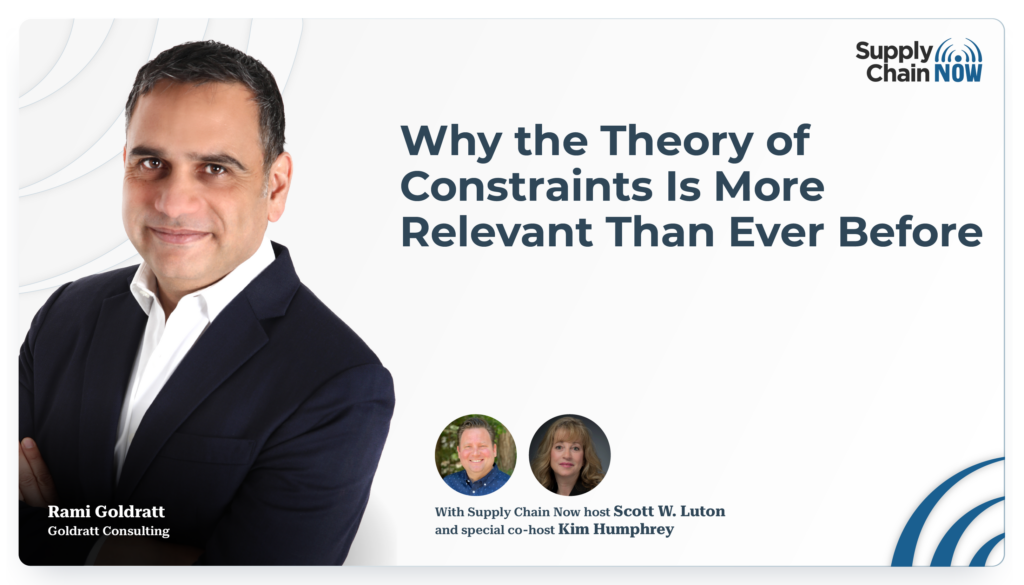
[00:02:18] Scott W. Luton: So I wanna welcome him in our wonderful guest joining us here today, Rami Goldratt is the CEO of Goldratt Group, a global consultancy, widely recognized as a leading authority in the application of the theory of Constraints and with operations across the United States, Japan, India, and Latin America.
[00:02:35] Scott W. Luton: The Goldratt Group supports organizations in achieving breakthrough performance by focusing on what truly matters. Their growth and, and what, what truly limits their growth at that carrying forward the legacy of his father, Dr. Eliyahu Goldratt. Rami has become one of the foremost voices in advancing theory of constraints into modern business environments.
[00:02:59] Scott W. Luton: His work spans industries including retail, automotive, manufacturing, engineering, and services, all helping leadership teams unlock significant gains in throughput, reduce lead times, and accelerate strategic execution. I need, we need all that help. Uh, so let’s welcome in. Rami Goldratt, CEO of Goldratt Group.
[00:03:20] Scott W. Luton: Rami, how you doing, my friend?
[00:03:22] Rami Goldratt: Hello everybody. Very good. Thank you very much.
[00:03:25] Scott W. Luton: It is so great to finally meet you. And Kim, I’m gonna owe you big time because we’ve talked about, um, getting this interview, um, here on supply chain now, and you’ve done it. So Kim, we’re in for a treat today. Huh?
[00:03:38] Kim Humphrey: Absolutely, absolutely. I’m a big fan of Rami and, and what they do at the Gold Rock Group.
[00:03:43] Scott W. Luton: Well, and, and, you know, Rami, your ears have been burning because, uh, for as long as I’ve known Kim, uh, and I know you’ve delivered some incredible keynotes and done other work with AME, and no doubt you gotta be what? Chair of the North American Rami Goldratt Club, Kim. Is that right?
[00:04:02] Scott W. Luton: Did you know this?
[00:04:03] Scott W. Luton: Rami? Did you know
[00:04:04] Rami Goldratt: Oh my God. Such high expectations.
[00:04:09] Scott W. Luton: Well, all kidding aside, uh, appreciate you being here. Appreciate more importantly what you do out in the industry, you and your organization, Kim looking forward to it. So let’s start with a fun warmup question. And Rami, I tell you, uh, Kim mentioned you, your frequent flyer miles.
[00:04:24] Scott W. Luton: There’s no telling, how many billions of them you have because you’re traveling around helping organizations, you know, get those breakthrough moments. But when you’re not doing that stuff, cycling, reading books, spending time with your kids are all important. I’ve got one specific question that might surprise some folks.
[00:04:41] Scott W. Luton: What is one of your favorite books that you go back and read pretty regularly?
[00:04:45] Rami Goldratt: when people ask me this question, the answer is surprising because they expect me to say the goal. my favorite book, which I’ve read numerous time, is actually Winnie.
[00:04:54] Rami Goldratt: the P. I recommend anyone here who have not read this book as an adult to read it again.
[00:05:01] Scott W. Luton: again, that’s not a book on my bookshelf and I can’t save, I’ve even skimmed that one. What do you think is the big message that even adults can really garner from that, that great legendary book?
[00:05:13] Rami Goldratt: I think as when you read the book as an adult, you discover that each character in the book is really Like a personality that we know, and we all know different personality, but it really typifies some personalities with what drives them and what concerns them and how they view the world and how they’re communicating.
[00:05:33] Rami Goldratt: It’s really a psychological and philosophical book?
[00:05:37] Rami Goldratt: if you, when you read it as an adult. So I really recommend anyone that have not read it as an adult to to read it again.
[00:05:45] Scott W. Luton: Rami. I love that. And Kim, my brain goes straight to Eeyore because we probably all, hopefully we’re not the Eeyore’s in other people’s journeys, but Kim, I’ve never thought about that. And now that I do Rami, it makes perfect sense. Kim, have you read Wendy the Pooh lately?
[00:06:03] Kim Humphrey: I have not. So it’s on my book list right now.
[00:06:06] Scott W. Luton: and what’s gonna happen, Rami and Kim one, folks, uh, as it was, we published this episode, we’re gonna see personality tests, Winnie the Pooh personality tests be launched into the market. Rami, I can see it now. Can you?
[00:06:19] Rami Goldratt: Winnie the Pooh is the, the personality that is not very complicated. It’s just who he is. for him, the world is the world. Reality is reality. Not too complicated
[00:06:29] Scott W. Luton: and not worried like piglet, uh, and not, but not quite as carefree as, um, Tigger. Uh, man, it’s been a while since I’ve thought about those characters, bro. That’s a, that’s a great, great, insight.
[00:06:40] Rami Goldratt: lines about Winnie the poor personality, he says, people say nothing is impossible, but I do nothing every day.
[00:06:50] Scott W. Luton: It’s the simple things in life, folks. It’s the simple things in life. Let us know your thoughts on, uh, Winnie de Pooh and all the characters as it applies, especially to our modern journey. Uh, Kim, along Summer lines, you and I talk a lot about movies and one of your, um, favorite snacks, popcorn. what’s been one of your favorite movies you’ve seen since you and I last got together?
[00:07:12] Kim Humphrey: You know, I see a movie almost every week. So I am, I’ve got my favorites, obviously from childhood as well, Rami, so you kind of brought me back to The Wizard of Oz, which is one of my favorite movies. But most recently, I just saw the new movie, Michael, uh, Michael Jackson. And for those of you that grew up like me with that music, everybody in the movie theater was singing and dancing and it.
[00:07:34] Scott W. Luton: Oh, I can’t wait. I cannot wait to see that. Uh, Rami, are you a big Michael Jackson fan?
[00:07:40] Rami Goldratt: Of, course I’m in the same generation, you know?
[00:07:43] Rami Goldratt: you remind me that when you go to see the play in Mama Mia, they always ask the audience, please don’t sing alone.
[00:07:52] Scott W. Luton: well if I’m not, if I’m in that audience, that they ask me three times not to sing along. So, uh uh. All right. Well, a lot of good stuff. Rami and Kim, really appreciate y’all entertaining my, my fun warmup questions. Uh, you’ve given us some th new things to think about and do more importantly, I wanna get into, uh, this great leadership discussion.
[00:08:12] Scott W. Luton: Rami, again, I’m, I really appreciate what you and the team are doing. you know, I use some really powerful verbs as I was introducing you, uh, you know, unlocking and breaking through, and that really, those are some of my favorite, aspects to what we must do with our organizations here in these very disruptive times.
[00:08:29] Scott W. Luton: I wanna level set a little bit on your professional background. Um, would you share a few highlights of your professional journey, especially a couple of leadership roles that really shaped how you view the world? Rami?
[00:08:41] Rami Goldratt: Sure. So before I was the CEO of Goldratt group, I had another consultancy, it was called Solutions for Sales. And we were working with salespeople to address a, a major constraints most businesses have, which is sales, right? So how do you grow sales? how do you design a valuable offer, a value proposition, and all of that.
[00:09:05] Rami Goldratt: And the reason that we started this, consultancy is because many times, you know, when you apply TOC, and it’s focused on the operations constraints. So how can we produce faster? How can we reduce lead times, increase productivity, all of that. But. You are so focused on your operational constraints, you are missing that, that there is another constraints out there lurking which means that if you don’t really worry about how you can get more sales into the business and you achieve all those operational improvements, if, if sales do not come in, not only that you are, your business obvious is in problem, everything you’ve gained in operations will derail.
[00:09:46] Rami Goldratt: And so just to generalize it, what it really, you know, shook my world is to say, it’s not only about focusing on your current constraint, your real tough challenge that you need to focus on, but you always need to know what will be the next one. What will be your future constraint? And sometimes you need to deal with it before it becomes your constraint.
[00:10:07] Rami Goldratt: So that’s like, something I always take with me asking myself what’s the future constraints and how and should I deal with it already now? And. The second one really comes to my current position, running a consultancy business. You know, like any consultancy, it’s basically a business of people.
[00:10:26] Rami Goldratt: You have, experts, consultants that, that knows how to analyze environments and how to lead the change. But these type of environments are very difficult to scale because your constraints eventually, if you do the job right, will be your top experts. The one that, that knows how to use their judgment to evaluate the circumstance and, and make the right decisions.
[00:10:49] Rami Goldratt: And these experts takes time to develop. They need to accumulate experience, and it’s not so easy to plug them from the outside world and recruit. So to generalize it again, how do you, how do you scale a business that is inherently not scalable if you make a the wrong decision? immediately, the service level that you provide and, and the value you provide, will, will derail.
[00:11:14] Rami Goldratt: So you constantly need to think about different ways, solutions. Some of them are operational solutions, some of them are strategic solutions. How do you scale such a business? it is continuously, it’s not a one time thing.
[00:11:29] Scott W. Luton: we could probably discuss both of those, uh, worldview shaping roles for the next, uh, several days. But Kim wanna call a couple things out before we level set on what the Goldratt Group does. number one, I love Rami’s comments about we can’t focus completely on the current constraint. We gotta keep at least half an eyeball down the road, to expect and predict what comes next, within the business and challenge for the business.
[00:11:55] Scott W. Luton: And then number two. You know, the change management that has become such a, highly difficult aspect of it. And it’s never been easy, but I think it’s gone off the rails in the last couple years it seems like. Kim Rami Assumably and he’s about to tell us what his organization does, but I think he lives nonstop in powering change management.
[00:12:19] Scott W. Luton: I do not want Rami’s job. Kim, do you want Rami’s job?
[00:12:23] Kim Humphrey: Not in the least, but I love his message. I love his message.
[00:12:28] Rami Goldratt: with the age of AI, that consultancy, are we worried? And I say, well, you know, consultants that all their job was to do excels, then they should be worried.
[00:12:37] Rami Goldratt: we know very well that just to do Excels doesn’t drive results. If you want results, you need to change, you need to make some changes.
[00:12:44] Rami Goldratt: It’s all about change management.
[00:12:46] Scott W. Luton: It is, getting off our spreadsheet addiction, kind of to your point. So tell us this, um, the Goldratt Group, a lot of folks out there knows what y’all do, but for folks may be new, uh, new to industry, tell us what that organization does.
[00:13:00] Rami Goldratt: So the Goldratt Group was founded by my father, as you mentioned, Dr. Eliyahu Goldratt, the founder, the creator of the Theory of Constraints. And obviously what we do is we apply this body of knowledge methodology. To help companies across very different industries. So it could be from service to manufacturing, to engineering, to supply chain companies, logistics.
[00:13:22] Rami Goldratt: We work with airlines, we work with government agencies. And in all cases, what we’re trying retailers, what we’re trying to do is to understand what are the key, major constraint for the business to grow. and not every obstacle or every problem is a constraint. It’s this one area, one, point, let’s say in the system where concentrated efforts can give you a very big impact.
[00:13:46] Rami Goldratt: So that’s in, in a gist what we are doing. So we are helping managers to find these constraints, to focus on it, to align the entire organizations to get more out of these constraints and manage it better. we have these methodologies applied in very different industries.
[00:14:02] Scott W. Luton: Rami’s last comment there, I think illustrates the power of theory of constraints and, and their work, because it really is applicable in all sectors, in all businesses. it truly is universal. and Kim, you know, that’s, I think in part the beauty of continuous improvement, right?
[00:14:20] Scott W. Luton: Because that is also universal. But, but your thoughts, Kim.
[00:14:24] Kim Humphrey: Yeah, well, Rami, you’re, you just Hit it. Um, the highlights are keeping it simple. Identifying the constraints, exploit those constraints. Everything else is secondary. And then elevate it, but then repeat, you know, and continuous improvement is about repeating, keep looking at the next opportunity. So that’s why I really think constraints is so relevant right now.
[00:14:45] Scott W. Luton: Well, you know what? We’re gonna touch more on that, Kim. That’s a great point. Uh, a lot of what you just shared there, the five focusing steps, uh, we’re gonna get Rami to, to weigh in on that. That’s a, a powerful closed loop, cycle that is, uh, applicable. To any industry, any sector. Um, alright, so, Rami, you mentioned your, your father, which of course is adored around the world.
[00:15:06] Scott W. Luton: author along with a co-author, Jeff Cox was his co-author, I think for the goal. I’ve got my copy that I need to, need to do a better job reading from front to cover. But when it comes to your legacy, so many people know your father, Rami. this is probably my favorite, one of my favorite questions we’re gonna pose to you here today.
[00:15:22] Scott W. Luton: When it comes to the immense legacy of your father Eliyahu Goldratt, what do you cherish the most?
[00:15:30] Rami Goldratt: So beyond the breakthrough solutions that you developed in so many fields, project management, supply chain, production, et cetera, distribution, what? What I cherish the most, the most is his way of thinking, which was really focused on simplicity. And there is a principle that he always talked about. He called it inherent simplicity.
[00:15:54] Rami Goldratt: He said, no matter how complicated the scenario looks, the level of complexity, he said, what is complexity? You see a lot of factors and different elements that interact that impact each other, right? You touch one area, it has effects elsewhere. And he said, actually, because of these interactions, which give us a, a feeling that it’s very complicated, if you really understand the cause and effect that governs the flow of value in the system, you will find few leverage points.
[00:16:28] Rami Goldratt: that’s his notion of simplicity. Few areas that if you touch these areas, you will impact the entire system. So if you’re about continuous improvement or if you’re about getting a huge leap in performance, if you want to understand an environment. Try to understand the interconnections from the perspective of looking for these leverage points.
[00:16:51] Rami Goldratt: We call them constraints. and that was always the way he was thinking about it. That was, for me, it was always, amazing to see people come and tell him, we have these problems and these problems very complicated. Every time way he ask why this is a problem, they give him a very long list.
[00:17:09] Rami Goldratt: But he was very quick in understanding, okay, these are the reasons, the cause and effect. Okay, that’s your main issue.
[00:17:15] Scott W. Luton: Yes, that’s right. And, and it’s so different and it runs so counter to so to, to the rest of industry. And that that’s one of the powerful, things that made him so unique and, makes such an impact across global industry and Kim, when as Rami shares that aspect of, Ellie’s legacy, you know, I think it’s incumbent upon leaders, especially in a highly complicated, highly friction field world, to make things as simple as possible.
[00:17:42] Scott W. Luton: And it’s easier said than done. But Kim, would you agree? And what you hear there from Rami.
[00:17:46] Kim Humphrey: I absolutely would, and I loved to hear simplicity because that’s really what continuous improvement is all about. Also, you know, those simple, small steps to improvement and it’s all around the people. So making those few areas that will impact the entire system and listening to the voice of the people is extremely impactful.
[00:18:04] Scott W. Luton: Yeah, no doubt. No doubt. And people are at the center. alright, so lemme do this. We’re gonna talk more about the theory of constraints. So folks, if you’re new to Theory of Constraints, no worries.
[00:18:13] Scott W. Luton: We’re gonna level set with you. Again, Rami’s already kind of shared a couple of key, aspects to it, but we’re gonna make sure everyone’s with us here in the conversation. But before we get there, Rami, when you think of, you know, I’ve referenced a couple times, it’s a pretty challenging time right now, uh, for global business and its leadership and its people.
[00:18:30] Scott W. Luton: what top trend or challenge or you know, what’s on your short list, when it comes to what you find most intriguing about this chapter in Global Bus business?
[00:18:39] Rami Goldratt: so if I look at common challenges that we see companies face today, the first thing that comes to my mind is actually coming from an opportunity which is ai. So all the companies out there know that they need to leverage this new technology that companies that will not leverage it will not survive the future.
[00:19:03] Rami Goldratt: And actually, I think it’s right, and this is not the type of. Trends that you say, let me just bow my heads and try to, you know, pass it. And no, you need to think how to, how to leverage it. But the challenge is that everywhere we look, almost everywhere there is a big gap between, technology and results. A lot of efforts, a lot of investment. And if you look at the real results, which is measured at, you know, performance level, profit went up, sales went up, OE went down, inventory went down, you don’t see like notable results. And that’s a, a big challenge that we see and that many companies face.
[00:19:48] Rami Goldratt: of course it’s part of our job. That’s why we see this challenge. So when we come and analyze and see where is the constraints, are you really focusing on where your constraint is? Or maybe you’re just busy automating what you can, not what you should, and all those kind of things. I don’t wanna go too much into it, but That’s like a major challenge.
[00:20:05] Rami Goldratt: We see. the other one is, not a new challenge. It’s something we always saw, but, but now maybe again, because of the ai, it’s more than ever is overflow of initiatives. every organization we are, we’re looking at, you see this vicious cycle of trying to apply too many initiatives. Because of that, you spread your resources and your attention too thin.
[00:20:32] Rami Goldratt: You’re not getting the results you are getting. Some of these initiatives are like local improvement. So anyhow, you’re not gonna get the results., when you look at bottom line you always are underperforming relative to what you want, and you launch more initiatives. so that’s why you have this vicious cycle of more and more initiatives and, and spreading your attention even thinner and, creating a lot of chaos and bad multitasking and things like that.
[00:20:57] Rami Goldratt: So, everybody agree that it’s much better to focus, to understand which one really gives an impact and focus there and get it done in the right way. it’s simple to understand that it’s very difficult to implement. One of my father’s favorite saying is, simple and easy is not the same thing.
[00:21:14] Rami Goldratt: So simple means you know where to focus, and what to do. But it, it doesn’t mean that it’s easy to do it. If it was easy, it would’ve been done right. So to break this vicious cycle is tremendously difficult.
[00:21:27] Scott W. Luton: I gotta comment on a couple things you’ve shared here thus far. And Kim, I’d love to get your comments too. The, the first, one of the things he mentioned there is a gap between tech and results. And it made me think really quick. Remember in the back of the comics, my son was a big, still big lover of comics.
[00:21:42] Scott W. Luton: I had some, some comics as a kid. Back in the comics you had all kinds of ads. And one of the ads that was in every issue was for x-ray technology, glasses. But everyone knows that never worked. So folks will be paying for that technology and it would never bring outcomes. And that’s kind of a fun way of poking a little fun at what we’re seeing though on the serious side.
[00:22:02] Scott W. Luton: Rami, across this, this age of technology, everything’s not bringing the outcomes, the desired outcomes with it. That leads to the second great thing you mentioned, and I’ve out of probably five or six items there, you got leaders out there, Kim, that are automating what they can versus automating what they should.
[00:22:21] Scott W. Luton: And it’s probably to make a general blanket statement, it’s probably ’cause it’s easier to automate what you can versus what you should. Kim, what’d you hear there in some of things Rami is observing and tracking?
[00:22:32] Kim Humphrey: Yeah. Rami, those were good points. Our, our members at a ME are, are facing the same challenges, and I.
[00:22:38] Kim Humphrey: get questions all the time about how to utilize AI and exactly what you were saying, a lot of ’em are just saying, we need to implement ai. And the first question is, what do you want the results of that to be?
[00:22:49] Kim Humphrey: And so they don’t think that far ahead, they’re just hearing about ai. So I love that you brought that up. And of course, I think we all struggle with the too many initiatives I, myself included, and I really, that’s a really good thing to really focus on. How many initiatives can you really, really impactfully use?
[00:23:06] Kim Humphrey: so I think that’s a good reminder for all of us.
[00:23:08] Scott W. Luton: Yeah, Kim. Less is more. It, it sounds so stupid and cliche, but oftentimes things become cliche for a reason.
[00:23:17] Scott W. Luton: so Rami, let’s do this. I know you’ve shared a couple of, of key elements, uh, the heart of Theory of Constraints, uh, in some of your earlier responses, but for folks brand new, they haven’t read the goal, they haven’t heard of Theory of Constraints. Maybe they’re new coming into the industry, and they’re, piecing the world together.
[00:23:35] Scott W. Luton: How would you describe TOC for folks out there?
[00:23:39] Rami Goldratt: maybe I’ll describe it by sharing my father’s latest work. my father passed away in 2011 from lung cancer. We found out what he had, uh, in March, and he passed away in June.
[00:23:52] Rami Goldratt: and before he passed away, during this three months, he started to write a new book. I even remember going with him to the doctor and my father asking him, doctor, look, I need to know if I have enough time to finish the book.
[00:24:03] Rami Goldratt: Of course, the doctor said, you can, unfortunately, he managed to write just the introduction, a page and a half. He called this book The Science of Management. Uh, by the way, if you wanna, uh, hear him reading this introduction, you can go to YouTube and you just write Goldratt Science of Management and you will hear a recording of him.
[00:24:22] Rami Goldratt: Anyway. In this introduction, he summarized what theory of constraint is all about. By starting to describe three, he called them fears. So three fears that bring us to manage systems in, in the wrong way, in a way that doesn’t fulfill their potential. The first one is the fear of complexity, which we briefly discussed.
[00:24:46] Rami Goldratt: So you see all these interactions and elements, this, and it’s very complicated. you cannot make quick decisions as a manager. And then he says, okay, how do we typically manage this complexity dealing with this fear? we are breaking the system to subsystems let’s take each subsystem, each part and try to optimize its performance according to some local measurements.
[00:25:08] Rami Goldratt: We put local measurements to purchasing, to finance and to production and to, sales and to logistics, whatever. And then engineering. And then each subsystem there are more subsystems. And we’re trying to simplify the environment to manage it better with this dissection. but the problem is that the interconnection still remain and many times what is good for the subsystem is according to the measurements that you gave, it is not good for the system as a whole.
[00:25:37] Rami Goldratt: For example, if purchasing, buying big batches in order to get a better price, it’s good for purchasing. It’s not necessarily good for the company as a whole. When you increase the lead time of purchasing to accumulate the inventories and when all these kind of things, and I just picked one example to illustrate it.
[00:25:56] Rami Goldratt: So Theory of Constraints offers a different way to manage the complexity. It says try to understand the cause and effect that govern the flow and find these leverage points, these constraints. Because that’s what really governs the performance of the whole system. And the way to manage the complexity is always to focus your mind on the constraint and what impacts it and how it should be managed.
[00:26:23] Rami Goldratt: The constraints could be of different ways. It could be an expensive machine that because it’s so expensive, you cannot afford too much of it, and the capacity slowing you down of this process. The constraint could be top experts, like in the case of Goldratt, which I mentioned, or the experts could be top IT engineers or could top welders or whatever they, the capacity of these experts can slow you down.
[00:26:48] Rami Goldratt: The constraints could be complicated processes. Whatever is the constraint is that’s the leverage point. So that’s like, and I’m sorry if my answer is too long, but that’s the first thing about DOC. Manage the complexity, but understanding where the constraints are and manage them better. And the second thing is the fear of uncertainty. we need to manage the system with some predictions and projections about what the future will hold, how much I’m going to sell accordingly, how much I need to produce, how much I need to, buffer all those kind of decisions to buy. if you’re managing a project, they need to make some estimations when the project will, will end.
[00:27:28] Rami Goldratt: But there is a lot of uncertainty as every manager knows. And by the way, more and more today, in today’s world, the common way to manage the uncertainty is to have very detailed planning. So to apply a very high resolution, okay, to, if I take my project plan, I will have thousands of tasks with really exact estimation, how long each will take.
[00:27:49] Rami Goldratt: And, if I wanna manage my supply chain forecast, I will talk to every sales person and understand how much is gonna sell. And accordingly, I will accumulate and aggregate and make my decisions. Of course, we need to plan. We cannot work without planning. But according to tsi, as my father used to say, forecast is wrong the moment you write it.
[00:28:12] Rami Goldratt: doesn’t mean don’t do forecasting. Of course you should, but you better assume that the forecast, no matter how good you try to be, the forecast will be wrong. And the way to manage the uncertainty is by buffers and by fast feedback loops. You need to know how to, position the buffers.
[00:28:31] Rami Goldratt: When I say buffers could be inventory or cash or capacity, protective capacity. We call it where and how to manage these buffers and how to quickly react reading from reality the right signals as quickly as possible. By the way, that’s where technology can really give you a lot of value, how you read the right signals from reality very quickly and react to these very, very quickly.
[00:28:55] Rami Goldratt: The faster the feedback loop, the less buffers you also need to have. the third fear he mentioned is the fear of tag of war. Tag of war is a situation where you have two conflicting requirements. It could be two different stakeholders or just, you know, requirements that you need to manage.
[00:29:11] Rami Goldratt: Like, the cost of the product and the quality of the product or the inventories you have and the service levels that you need to provide. Okay? could be just stakeholders, right? Like production, want to maximize its efficiency and I don’t know, sales that want to have very fast reaction times.
[00:29:29] Rami Goldratt: So our fear of this tag of war, these oscillations between the two extremes that pull each, to satisfy their own need is bringing a lot of conflicts into the environment. And the problem is that we try to deal with conflicts by finding a compromise. That’s our tendency. We don’t want tug of war, let’s find a compromise.
[00:29:51] Rami Goldratt: But my father always said. Compromise on core conflicts. Okay? If it’s not a big conflict, okay, you can compromise go go on with your life. But if it’s a core conflict, compromise give you the the illusion that you found the solution, but it’s never a solution. The conflict is still there and it’s building up until you will face a crisis.
[00:30:15] Rami Goldratt: So you really need to find, we called it win-win solutions to conflict and not compromise it. So again, to wrap it up, TOC, how to manage complexity by looking and focusing on the constraints and govern and fixing the flow on the system level, how to manage uncertainty with buffers and feedback loops, and how to manage core conflicts by finding win-win solutions and not compromise.
[00:30:37] Rami Goldratt: Is.
[00:30:38] Scott W. Luton: Rami, I love, loved your response. And Kim, I feel all three of those fears. I think that’s a, that’s a Tuesday for me. Uh, how about you, Kim?
[00:30:46] Kim Humphrey: Absolutely. Absolutely. I love, I love some of the, the comments you made too about the forecasting and we were talking about technology earlier and you said, you know, here, here’s your opportunity to use AI and technology to handle one of those fears that we have.
[00:30:59] Scott W. Luton: That’s right. Well, and, and it is also as Rami implied ’cause planning is. So, you know, it’s who we are as a global supply chain industry, but it’s like Rami implied, you know, just because the forecast is wrong doesn’t mean you don’t plan. We benefit so much from the planning processes and how we continue to innovate and transform, especially in this, in this remarkable technology age.
[00:31:21] Scott W. Luton: But at the end of the day, for your forecast is gonna be wrong. Rami, lemme have a couple follow up questions here. maybe a couple quick hitters and then we’re gonna get, uh, a couple examples where we’re seeing TOC make. There’s countless, big transformative, uh, gains for organizations.
[00:31:35] Scott W. Luton: But Leaders can oversimplify sometimes, right? Or they can misunderstand what the constraints are. Does an example or two come to your, your mind there? Rami.
[00:31:45] Rami Goldratt: first of all, when the most common misunderstanding I I, I see with managers that talk about bottlenecks of constraints is that they think that every temporary challenge or bottleneck that they face is a constraint. And theory of constraints is all about just finding the bottlenecks and removing them.
[00:32:07] Rami Goldratt: And that’s a misunderstanding of theory of concern. It’s part of it, but it’s not the core. So like in TOC, most problems are not a constraint. And in TOC, a constraint is not something bad, it’s just reality. Every system will have a constraint and you need to treat it as a leverage point. A constraint is the area that if you fully load it, you’ll get the maximum throughput from the system and you need to find it and you need to strategically design it and identify where it is and that’s your control point.
[00:32:43] Rami Goldratt: It’s not just about the bottleneck, that’s only like part of the theory.
[00:32:48] Scott W. Luton: that’s a great illustration of what I would consider an, uh, an oversimplification, which is, is indeed a, a challenge and a disservice to organizations when we, when we oversimplify, we’re not trying to talk out of both sides of our mouth, but it’s important to simplify, but we gotta keep the important things, the important things.
[00:33:06] Scott W. Luton: I’m gonna get one more question in Rami and then I’m gonna get you, uh, Kim, your thoughts here, if you would. You mentioned the tug of war earlier. That’s the third fear. If you can speak to the longstanding debate or tug of war between efficiency and flow, your quick thoughts there, Rami.
[00:33:22] Rami Goldratt: to make it even more, maybe a little bit more precise, it’s not about efficiency versus flow as about local efficiency versus global impact or global performance. Because the real tension is that we think that in order to get the maximum out of my system, productivity from the resources I have, I need to maximize the local efficiencies of every resources in my, chain, let’s call it.
[00:33:51] Rami Goldratt: and that’s where you have the tension. Because when you try to maximize the local efficiencies, you accumulate working process, you’re creating bottlenecks, you’re missing priorities because everyone has their own efficiency considerations. I can give a lot of case studies, maybe later we’ll talk about it.
[00:34:08] Rami Goldratt: that’s where you have the, the problem. the way out according to TOC is to say, what is important is not the local efficiencies. What you’re really after is the global performance, including efficiency. I wanna get the maximum from productivity from the whole system. That’s global efficiency.
[00:34:25] Rami Goldratt: Okay? How fast and how much value I’m producing with what I have. And then there is no tension. The solution for it is to abolish local efficiencies, to understand what really governs the flow, where’s the constraint are, and to subordinate the other, functions in your organizations to enable you to get the most out of the constraint.
[00:34:46] Scott W. Luton: that makes perfect sense to me. Rami, I’ll tell you, you can take some very complicated, uh, longstanding battles put it in a way that I think anyone can understand it as a superpower. Kim, what you hear there, we’re talking about oversimplification, we’re talking about misunderstanding constraints, and we’re talking just there about those local efficiencies versus global performance.
[00:35:08] Scott W. Luton: And I might be oversimplifying, what’d you hear there, Kim?
[00:35:11] Kim Humphrey: No, I think it’s, you know, just from theory of constraints and, the goal, it’s very simple. You know, just identify the constraints, make sure you can exploit it, make sure that it impacts you globally and it just doesn’t impact a certain area. And then just keep looking at repeating that and repeating that.
[00:35:26] Kim Humphrey: So I’d love that.
[00:35:27] Scott W. Luton: I do too. Um, alright, so Rami, we’re gonna keep driving here with a little bit of time we got left with you. Uh, I’m sure you’ve got your next change management, and transformation battle to have, uh, and I mean battle in a good way. so in your view is theory of constraints more relevant than ever before?
[00:35:44] Scott W. Luton: Especially given this backdrop of what I’ve mentioned a couple times. The golden age of, I’ll call it supply chain technology ’cause I’m a big supply chain nerd, but it’s really the golden age of, of global business tech. Your thoughts.
[00:35:58] Rami Goldratt: I mentioned before that forecast is wrong the moment you write it, and supply chain performance is all based and driven by forecast. Now, it doesn’t mean that we don’t need to do forecast. We need to do the best we can, but we better assume it’s wrong. What does it mean? First of all, maybe, maybe we should understand why the forecast is becoming tougher, because honestly, it’s a mystery.
[00:36:20] Rami Goldratt: We have better technology, right? We have more data to learn from. One would expect that the forecast accuracy will improve over the years.
[00:36:28] Rami Goldratt: No, I’m not talking about forecast of trains or forecast of, averages. I’m talking about the real forecast. We need, how many of specific products I’m going to sell at a specific time, at a specific location, right?
[00:36:41] Rami Goldratt: These are the focus we need to make managerial decisions, how much to buy, how much to produce, how much to allocate, when to replenish, when not to replenish, all those things. I speak with hundreds of managers worldwide every year in different events, et cetera. And, and I always ask them, is the forecast accuracy improving?
[00:36:59] Rami Goldratt: are we getting it right? better than before. And again, not on the average or in the aggregate, on the trend, but on the specific locations. And people never tell me that it’s getting easier. Sometimes they tell me it’s getting even tougher. And that’s despite the technology and the data that we have and.
[00:37:20] Rami Goldratt: The interesting part is when you start to understand why this is happening, you also understand what is the solution for this, and how technology today more than ever, can really help you to apply this solution and why it’s, it is a golden age to manage it in a better way. So first of all, why?
[00:37:36] Rami Goldratt: Why the uncertainty is increasing, why forecast accuracy is reducing. It’s because of three trends that are starting with consumers behavior. Because supply chain at the end of the day, are all, you know, built in order to serve consumers, right? So there are three consumers behaviors that are deteriorating the accuracy of the forecast.
[00:37:56] Rami Goldratt: The first one is that consumers are becoming more and more picky and choosy. They want the products that fits their individual desires and tastes. Would you agree to this statement?
[00:38:06] Scott W. Luton: I do. Kim, you agree.
[00:38:08] Kim Humphrey: Yep. Yep. We have more options now, don’t we?
[00:38:11] Rami Goldratt: Exactly. This pushes providers to increase the variety of their offering because different consumers want different things. Now, I cannot offer only two colors. I cannot offer only two designs. I need to customize my products. I need to hold more options and to offer more options because if I don’t do it and the competitor does, I will lose my market share.
[00:38:33] Rami Goldratt: the more options I’m offering, the less accurate is the forecast because I will have to hold more options that are slow moving, that are not selling so quickly, and it’s impossible to make a accurate forecast on slow moving products, on things that I’m not selling a lot and very repetitively.
[00:38:54] Scott W. Luton: ’cause all of us are consumers everyone listening and watching are consumers. And I, and I’m, we gotta keep it real because we are Hoosier and pickier and in some cases harder to please. You know, a lot of folks reference the Amazon effect and that sounds cliche ’cause it’s been around for 15, 20 years, but it’s still at play.
[00:39:12] Scott W. Luton: And while Rami and Kim, while I see, you know, we do have more options, although we’ve seen some, you know, skew rationalization take place for the last three or four years. Where I see it really play out is with delivery timeframes. it’s almost a race to the bottom. I mean, who needs socks next hour?
[00:39:30] Scott W. Luton:
[00:39:30] Rami Goldratt: what you’re saying, Scott, is exactly the second because there I said there are several trends. The first one is operate more options, just offer more choices. yes.
[00:39:39] Rami Goldratt: you need to rationalize and then you are pushed again to offer more choices because the competitor does. the wider the range, the less the accurate the forecast, everybody that with experience will agree.
[00:39:49] Rami Goldratt: And the second one is exactly what you said, that consumers expect to get the products fast, if not immediate. we call it consumer tolerance time. The time they’re willing to wait
[00:40:01] Rami Goldratt: is reducing. And of course, this means that we need to throw more money on the rollette table upfront. We need to put more inventories.
[00:40:09] Rami Goldratt: Not only that, we need to hold more, we need to spread them, we need to hold it closer to where consumers are. And the more we spread the inventories, again, the less accurate the forecast. I, I don’t have the aggregation of the different fluctuations.
[00:40:22] Scott W. Luton: I’ve got one more thing I’m gonna add, but you, what’s the third one? I think good things coming through Rami, I think you had a third one.
[00:40:29] Rami Goldratt: The third one is what we call product lifecycle. So consumers are expecting to see something new. and this drives us to introduce more frequent new products into, into the system and new modules, new technologies, new versions, et cetera. Now, new products have zero history of consumption you to learn from
[00:40:51] Rami Goldratt: most new products are not the next Harry Potter book.
[00:40:53] Rami Goldratt: You don’t know if it’ll be a fast mover or a slow mover. You have until you put it out there. You don’t know how many of these design you will sell. And, of course, the more frequent we need to introduce new products. even the products that were already there and you came to learn about their consumption patterns, even the, the relevant ones will now be shaken, Right.
[00:41:16] Rami Goldratt: You introduce a new product. we are forced to operate with wider variety to deliver very fast. So we need to scatter the inventories and we need to introduce faster new products. So in each one of these dynamics deteriorating the accuracy of the forecast that we have to make.
[00:41:31] Scott W. Luton: and all of that boils up to the, the greater point that Theory of Constraints is as relevant as it ever has been before. Uh, because all of those pressures you pile on top. Historic uncertainty according to all the experts and data analysts out there. constant friction challenges, old and new.
[00:41:50] Scott W. Luton: Some that you have, uh, a heads up on. Others happen tomorrow or happen next hour. and one last thing I’d add, Kim. We’ll get your thoughts here. It’s kind of related a little bit to Romney’s third point there, but it’s not talked about as often. That’s returns. the places where we’re seeing consumers we’re adding to a tidal wave of returns and unfortunately it’s been invisible.
[00:42:12] Scott W. Luton: Whereas my dear friend Tony Sheroda says, the dark side of, of supply chain, because it’s, it’s largely ignored, but fortunately there’s more innovation. There’s, there’s brighter lights being shined. So hopefully we can continue to divert more and more from landfills and, and bake more circularity into our thinking there.
[00:42:32] Scott W. Luton: But Kim Rami just shared again, he backed up, uh, by my account. That’s the ninth truckload of really good stuff here in this conversation. Kim, what’d you hear from Rami
[00:42:42] Kim Humphrey: So, Rami, thank you for that. Um, it just keeps reminding me that we as industry have to be more adaptable, be more agile now and, and practice theory of constraints and everything else right now, just to, to support the consumer requirements because they’re changing rapidly.
[00:42:57] Kim Humphrey: And I think you made some great points there. So thank you for that.
[00:43:01] Scott W. Luton: Leverage points. Every organization, as Rami said, every organization has constraints. You gotta find those leverage points, which isn’t bottlenecks. Don’t confuse the two. It’s bigger than that.
[00:43:10] Rami Goldratt: just to summarize, so the way, forecasts are becoming less accurate, which increases the need to read and react very fast. Fast feedback loops to how reality unfolds and improve the flow of operations and delivery. That’s the reaction time. and technology can help us exactly on those bo both aspects.
[00:43:30] Rami Goldratt: How to decipher noise and signal and read the right signals. And how to react very, very fast to them because that’s what, keeps an adaptable system. That’s what it’s all about. That’s the adaptability we need to develop.
[00:43:44] Rami Goldratt: I think that companies that will not use technology to do that will simply not survive the future.
[00:43:49] Scott W. Luton: that’s not a hyperbolic statement. I think that I, I tend to agree with you and you know, we’ve seen, we’ve seen organizations, retailers, service providers. not to pick on any, any, anyone in particular, but I think a blockbuster, it refused to change.
[00:44:03] Scott W. Luton: They had a, they had a tremendous opportunity. I dunno if y’all knew this, they had a tremendous opportunity to acquire Netflix.
[00:44:11] Scott W. Luton: That’s right. so every organization has a choice. And it may, sometimes it’s not as as clear cut like that it is in the rear view. But we all have a choice. Do we wanna operate like it’s 1982 or do we wanna operate like it’s 2035?
[00:44:27] Rami Goldratt: it’s very interesting you mentioned Blockbuster because we often say people are not like stupid people are good. So if you really think about why Blockbuster didn’t go and buy Netflix at the time, Netflix was not the streaming service. It was delivering, you know, rental DVDs, et
[00:44:47] Rami Goldratt: cetera. But this competed with their asset of Blockbuster, which was the rental video stores. Or what I’m trying to say is, many times you, you don’t break inertia or you, or you’re stuck in inertia because you have assets that you want to protect. But trying to protect these assets you don’t make the necessary changes in the future devours you.
[00:45:12] Rami Goldratt: So it’s not because people are stupid, it’s about inertia. You need to really understand why are you stuck? What are you trying to protect, and think about a solution for that.
[00:45:23] Scott W. Luton: Rami, that’s an excellent, excellent point. That inertia, because it oftentimes, it’s that inertia, not the stupidity even the lack of due diligence. Oftentimes we stick to how things are doing. So for the sake of time, Rami, I wish we had a couple more hours with you here today, but we know that you’re a very busy individual.
[00:45:40] Scott W. Luton: I’m really curious. me and Kim had the great fortune of, of interviewing, Lieutenant General Andy Bush retired. US Air Force Lieutenant General Andy Bush, uh, last year I think it was. And he shared a lot of great use cases when it comes to the power of Theory of constraints. And one of my favorite,
[00:45:56] Scott W. Luton: there’s lots of different examples he shared, but one of my favorites being a air Force and an airplane nerd, aviation nerd is C five, the galaxy of massive aircraft. He was leading operation that dealt with, uh, some of the, uh, depot maintenance. And he and his team using Theory of Constraints, cut the maintenance cycle time down these massive aircraft from 340 days, right to hundred and 10 days a third of the time.
[00:46:24] Scott W. Luton: That really stood out to me, and that was a great conversation Kim and I had. So thank you, uh, for bringing, Lieutenant John Bush here, uh, Kim. But Rami, when it comes to some of your favorite use cases, what comes to mind?
[00:46:36] Rami Goldratt: Lieutenant General. Andy Bush is amazing person and leader. I remember this implementation we have done. it was really outstanding results. And, and by the way, you know, and we are coming as a consultant so we can suggest the change and explain it and do all the change management, but without internal leadership that says we have to change, we cannot accept the status quo or nothing happens.
[00:46:59] Rami Goldratt: So unfortunately, by the way, most of the, many of the customers come to us when they don’t have a choice when they’re facing a crisis. And one of them, for example, is an, an implementation that is always in the back of my mind. We have done with Mazda Automotive,
[00:47:18] Rami Goldratt: okay? In two, in 2012, they had one year left, until the company’s bankrupt.
[00:47:26] Rami Goldratt: It was after four years of losing money and Ford pulled back from their joint venture. There was hyper yen appreciation at the time, and all their older, um, factories and their suppliers are in Japan, in Hiroshima, so their expenses are in yen, but the revenue coming from outside, so yen appreciation doesn’t help them.
[00:47:49] Rami Goldratt: and the most, uh, critical thing for them that was a crisis was the fact that they, you know, they pride themself, they call it the zoom zoom culture. So yeah, it’s passenger vehicle, et cetera, but it’s more like sporty features. And they were very proud of their internal combustion engine, et cetera. But if you remember, 2012, that’s where the hybrid technology started to pick up.
[00:48:11] Rami Goldratt: And they had no, presence there. the market started to look at fuel efficiency as a prime decisions for purchasing and all of that. So they had one year to survive. They were already losing money for four years. Their fuel efficiency vehicle were well, performance was terrible compared to the competitors, and they could not start decide, okay, now let’s invest in hybrid.
[00:48:34] Rami Goldratt: It was not their DNA at the time, and they don’t have the resources or the time to do it. So this was a huge crisis. But this crisis also forced them to break inertia. That’s when they started to apply to OC. So they said, okay, what? What can we do about it? Let’s focus on fuel efficiency in C. If we can have good performance vehicles like internal combustion, but with fuel efficiency, that is at least at par with the hybrid technology of the time. And then they decided to focus all their engineers. I remember the chief engineer telling me, we first look at what our engineers are doing about fuel efficiency and the number of fuel efficiency project was the same as the number of engineers we had. Everybody was working on a different thing talking about like overflow of initiatives, right?
[00:49:24] Rami Goldratt: So we put everybody in the room, we decided on the on one initiative that we are focusing on that can Really.
[00:49:30] Rami Goldratt: do this, that can keep an internal combustion engine because we don’t have the time to go to hybrid, but make it bring the fuel efficiency to be like hybrid at the time. And they designed a new engine, they call it sky active of how to do it, doesn’t matter like how they reached it, but put everybody mind on this.
[00:49:50] Rami Goldratt: And then they aligned all the engineering and development resources of the company to come up with this engine and apply theory of constraints, critical project management design, project management solution. Anyway, they managed to come up with a new engine. It’s a new powertrain in one year. The world record was two years,
[00:50:11] Rami Goldratt: and it saved the company.
[00:50:13] Rami Goldratt: I mean, we have a big poster, a picture that the CEO gave us. You see all their new lineup of cars. It was called a, CX five, CX three, all those, and it says made by TOC. that’s like a powerful implementation that I remember
[00:50:29] Scott W. Luton: Breaking World records, Kim, you know what, no one asks me in any engine development conversations to give them a hand, because that’s way above my pay grade. but Kim, I’m, you know, if it’s two years is the world record to develop a, a modern engine and to bring an organization as big as monster together help them use the power of focus to cut that world record in half during a time when the basically the company’s livelihood was at stake.
[00:51:03] Scott W. Luton: Kim, that is a massive, massive win. Your thoughts?
[00:51:07] Kim Humphrey: I was just gonna say, this is why I am such a big fan of the theory of constraints and what you are doing, uh, Rami and your team is doing. I mean, those are incredible results and so, you know, we just need to make sure that we can apply those, those theories to every organization and make them stronger and more powerful.
[00:51:23] Scott W. Luton: Kim, that’s a great comment. ’cause if, Rami’s work and his team’s work with a great organization like Mazda, leveraging theory of constraints, if it can take a problem that complex, ’cause Rami’s given us a Reader’s Digest version or the TikTok version, right? There’s so many more pieces. But if it can drive transformational results like that, it, it makes me think, what can it do in your business out there, folks listening or watching, uh, Rami.
[00:51:48] Scott W. Luton: Again, I wish we had a couple more hours with you. We’re right here at the end of our, our time together. But I, I’ll tell you, you’ve been, even better than advertised Rami. I had really high expectations. You have cartwheeled over the expectations
[00:52:01] Scott W. Luton: here.
[00:52:01] Rami Goldratt: much my friend. Thank you very much.
[00:52:03] Scott W. Luton: So, Rami, let’s make sure folks, again, you do, you and your team does work around the world.
[00:52:08] Scott W. Luton: how can folks connect with you and whether they wanna bring you in for a keynote, whether they wanna work with uh, the Goldratt group, or got questions based on anything you shared here, how can folks connect with you? Rami.
[00:52:20] Rami Goldratt: I think the most simple option will be LinkedIn, so just look for Rami Goldratt on LinkedIn. You’ll also see a lot of posts that I’m uploading about case studies and opportunities to learn like collaborations we’re doing with AME to introduce theory of concern throughout the nation. So LinkedIn will be the best option.
[00:52:39] Scott W. Luton: It’s just that easy, outstanding, Rami Goldratt. Really appreciate you being here. Kim, before we wrap up here, I’ve got a very difficult question for you. Uh, and I’m not envious of this question, I’m not envious of you having to answer this question, but Rami has shared a lot. I’ve really good stuff with us here today.
[00:52:57] Scott W. Luton: I’ve got almost wore up, my pen’s almost given up the ghost. I’ve been taking all these notes. Kim, what has been one of your favorite takeaways from our conversation with Rami Goldratt
[00:53:07] Kim Humphrey: Yeah, so, so again, you know, I’m a big fan of Theory of Constraints and, and I think you did a really good job today of just simplifying this Rami. ’cause theory of constraints is not that difficult, but to learn the principles, you know, you really have to be able to come and see it. And, and I would share that, the Goldratt Group and AME are big partners.
[00:53:26] Kim Humphrey: So if you want to learn more, we’ve got two opportunities right now in person. We’ve got one in Milwaukee in Wisconsin. June 22nd, and here you’re gonna see how much traveling Rami does, and then a couple of days later, he’s gonna be in Washington state with us on June 20. Fourth, I believe, Rami And then August, fourth and September 2nd.
[00:53:46] Kim Humphrey: So you can go to ame.org and uh, look at all those and sign up for them. And you can join us at the AME Milwaukee conference, October 26th through 29th. where we’re gonna talk about something you mentioned today, Rami people first and then the progress together.
[00:54:00] Scott W. Luton: Outstanding. And folks, you may or may not know that Kim Humphrey is the president, CEO of, AME and you can learn more as she mentioned, her ame.org. And I tell you, if you’re bringing, if any organization’s bringing in. Power hitters, power speakers like Rami Goldratt, you know, they’re doing something right.
[00:54:18] Scott W. Luton: And I think it’s really important also to call out AME’s not operating like it’s 1982. It’s not just for manufacturers. You got folks from all walks of life, all industries, from healthcare, professional services, supply chain, manufacturing, you name it. So AME is for everybody. So go to ame.org and learn about some of those great events.
[00:54:38] Scott W. Luton: Rami Goldratt, so delighted to finally meet you. I really appreciate, as I, I completely agree with Kim. You have made it very approachable, Rami, and that’s a great sign for many things, but of effective leadership. When you can take something that’s very complicated in a world environment that’s incredibly challenging and make it really approachable, I think anyone with any degree of experience can understand and follow along.
[00:55:02] Scott W. Luton: So, Rami Goldratt, really appreciate you being here on supply chain.
[00:55:05] Rami Goldratt: Thank you very much. My pleasure.
[00:55:08] Scott W. Luton: Folks
[00:55:08] Kim Humphrey: Rami
[00:55:09] Scott W. Luton: Go connect and follow Rami Goldratt, right on LinkedIn. Go do the same with Kim Humphrey, but also go to ame.org. Learn more about their upcoming programming. Kim, well folks go to ame.org. That’s the best way to connect with you, is that right?
[00:55:22] Kim Humphrey: That’s right?
[00:55:23] Scott W. Luton: Alright, well, Kim Humphrey always a pleasure to collaborate with you, my friend.
[00:55:27] Kim Humphrey: Thank You Scott.
[00:55:28] Scott W. Luton: You bet. Uh, folks, I’ll tell you what, hopefully y’all have enjoyed this conversation as much as I have. I’m, I’m not lying. I’m, I’m 18 pages of notes and this pin right here is all my favorites, is run out of ink. but big thanks, uh, to our wonderful, uh, guest here today, Rami Goldratt against CEO of Goldratt Group, and my team co-host Kim Humphrey, who again, is doing big things over
[00:55:52] Scott W. Luton: But folks, you know your homework. you got lots of great options here today. Take one thing, just one thing that Rami and Kim shared here today. Do something with it. Put it into practice deeds, not words, folks. Help your organization overcome those three basic fears that Rami shared. ’cause it’s so true, right?
[00:56:10] Scott W. Luton: It’s so true. let’s build a better industry. And with all that said, Scott Luton challenging all of our listeners out there. Do good, give forward, be the change that’s needed, and we’ll see you next time, right back here on supply chain now. Thanks everybody.