

More

workforce readiness
November 19, 2026
The Talent Gap Starts in the Classroom
Supply chain employers keep asking for graduates who can think end-to-end, manage trade-offs, and collaborate under pressure. Here is how one university is actually delivering that and what it means for the profession. Every year, supply chain organizations hire new graduates who know what a bullwhip effect is but have never felt the pressure of deciding whether to dual-source a critical component when a supplier goes dark. They can define safety stock but freeze when demand spikes 30 percent and production capacity is already maxed out. They understand S&OP in theory but have never sat in a room where sales, operations, and finance are pulling in three different directions and someone must make a call. This is not a criticism of graduates. It is a structural problem with how supply chain has traditionally been taught. At the Neeley School of Business at Texas Christian University, we spent years recognizing this gap in our own classrooms before deciding to do something about it. What follows is what we learned and why we believe it matters for the profession as a whole. “They can define safety stock but freeze when demand spikes 30 percent and production capacity is already maxed out.” …
AI in supply chain
March 2, 2026
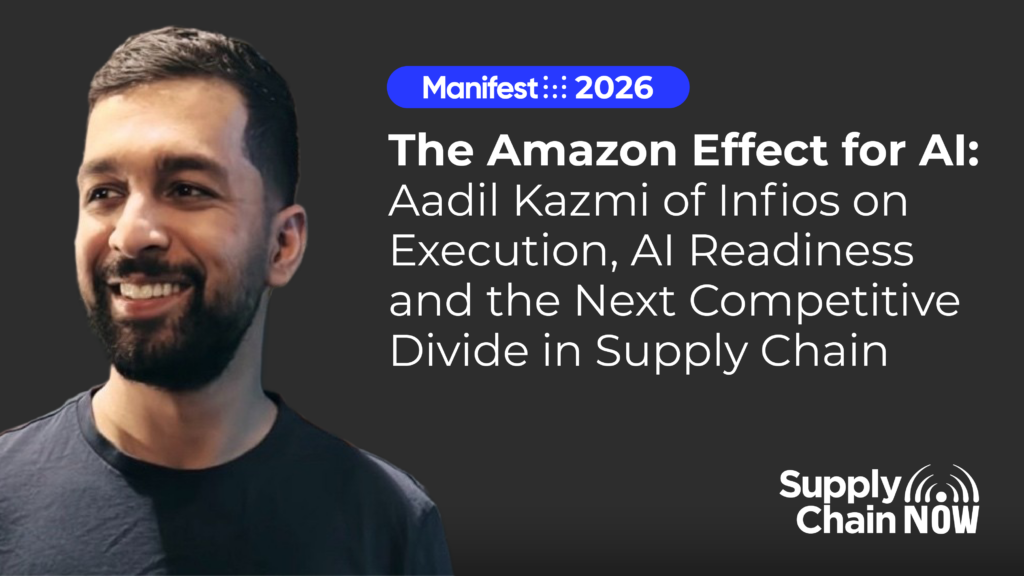
The Amazon Effect for AI: Aadil Kazmi of Infios on Execution, AI Readiness and the Next Competitive Divide in Supply Chain
Execution Is Everything At Manifest 2026, Scott Luton spoke with Aadil Kazmi, Head of AI at Infios, to discuss the next chapter of intelligent supply chain execution. Infios provides an integrated suite of supply chain execution software: order management, warehouse management, and transportation management – all running on a single data model. “When a supply chain runs on a single data model, you can make better decisions,” Kazmi explained. Fragmented systems require expensive data lakes and normalization efforts before even basic BI is possible. An integrated ecosystem simplifies intelligence from the start. For Kazmi, AI is not about flashy demos. But rather, it is about execution. The most advanced technologies mean little if companies cannot execute faster, smarter, and more resiliently in the real world. Disruption Isn’t Going Away Reflecting on 2025, Kazmi did not sugarcoat reality. Ports closed. Trade wars escalated. Wildfires disrupted domestic production. Shipping lanes tightened. “We don’t believe that supply chain disruptions are going away anytime soon,” he said. Volatility is becoming the baseline, not the exception. But what is changing in 2026 is mindset. Kazmi describes what he calls the “Amazon effect for AI.” Just as Amazon forced retailers to rethink last-mile execution a…