

More

supply chain podcasts
October 1, 2024
Why Invest in Supply Chain Podcasts?
Today, podcasts rival streaming television programming in terms of the number and variety of offerings. Perhaps that’s because podcasts are the ideal vehicle for businesses to deliver thought leadership and expand brand visibility. Professionally produced and informative supply chain podcasts provide companies and industry experts a way to engage with targeted audiences and build credibility and trust with customers and business stakeholders. Podcasts Represent a Growing Trend in a Dynamic Media Landscape “Podcasting is no longer a niche medium,” according to Statista, which said nearly 70 million people in the United States listened to podcasts in 2023. The audience for podcasts is expected to continue to grow and is forecast to reach 110 million listeners by 2029. And there’s room for more supply chain-focused businesses to invest in supply chain podcasts to share their messaging and build brand authority. Three Reasons Businesses Invest in Supply Chain Podcasts “Podcasts are often viewed as a relatively easy way for anyone to tell a story. But actually getting an audience for that storytelling is more difficult, and podcast producers use several means to grow and connect with their audiences. Most of the top-ranked podcasts studied are available on four major listing sites –…
AI-powered supply chain solutions
March 5, 2026
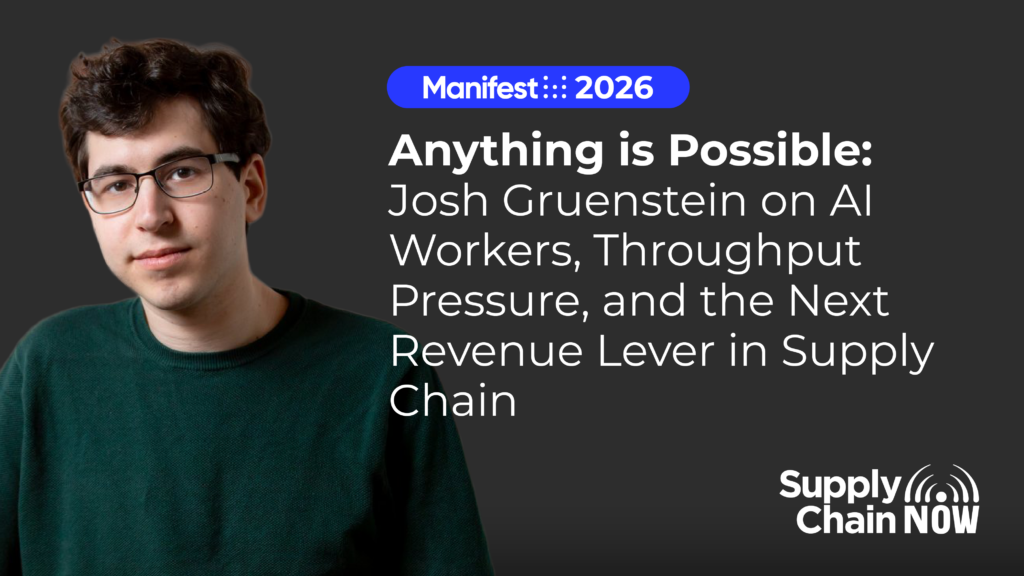
Anything is Possible: Josh Gruenstein on AI Workers, Throughput Pressure, and the Next Revenue Lever in Supply Chain
At Manifest 2026, Scott Luton spent time with Josh Gruenstein, Co-Founder and CEO of Tutor Intelligence, to talk about a future that’s no longer theoretical: AI-powered robot workers operating inside America’s warehouses and factories. And this isn’t a science experiment. It’s already happening. From MIT to the Warehouse Floor Gruenstein and his team came out of MIT’s Computer Science and AI Lab with a bold idea: build AI-powered robot workers that can handle the manual labor people don’t want to do. “We build physical robots,” Gruenstein explained. “We build AI models that enable robots to perceive their environments, and then we deploy those robots into factories and warehouses across the United States to do manual labor that people don’t want to do.” Unlike traditional automation projects that require massive capital outlays, Tutor Intelligence operates on a robots-as-a-service model. Companies can engage a Tutor robot for roughly $14–$18 an hour, creating a flexible, scalable path to automation without multimillion-dollar implementation risk. Automation Isn’t New. AI Is Changing the Playbook. When asked about dominant supply chain themes, Gruenstein pointed to a constant drumbeat: automation. But 2026 feels different. “Automation is obviously a constant theme,” he said. “What really seems different…