

More
demand spikes
May 26, 2026
When Demand Spikes Overnight: A Practical Guide to Demand Signal Management
Demand can change in an instant. A flash promotion takes off faster than expected. An influencer post sends a niche SKU into the stratosphere. A heat wave flips seasonal demand on its head. And suddenly, your forecast—carefully crafted weeks ago—feels like yesterday’s weather report. This is where demand signal management earns its keep. Instead of reacting too late or overreacting too early, it helps supply chain teams interpret what’s really happening and respond with confidence. For retailers and consumer brands navigating constant demand volatility, it’s the difference between chasing noise and acting on insight. The problem: demand forecasts lag reality Traditional forecasting has a fundamental challenge: timing. Forecasts are built on historical patterns and planning cadences that move at a measured pace, but demand levels today won’t wait for the next planning cycle. Modern demand shocks often arrive without warning: a promotional discount goes viral, a competitor runs out of stock, weather drives sudden regional swings, or a trend outpaces merchandising plans. In these moments, planners face a familiar tension. React too slowly, and shelves go empty. React too aggressively, and you’re stuck with excess inventory once the spike fades. What demand signals are (and what they aren’t)…
execution
May 4, 2026
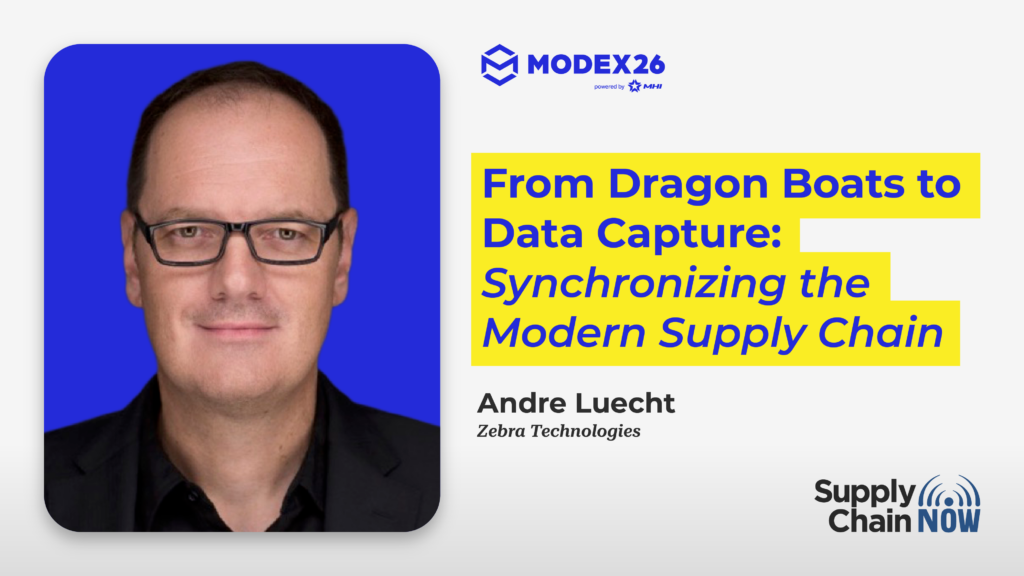
From Dragon Boats to Data Capture: Synchronizing the Modern Supply Chain
At MODEX 2026 in Atlanta, Scott Luton sat down with Andre Luecht, Global Strategy Lead for Transportation, Logistics & Warehousing at Zebra Technologies, to explore how synchronization, visibility, and practical innovation are shaping the next phase of supply chain performance. Interestingly, the conversation began not with technology, but with competitive dragon boat racing, a hobby of Andre Luecht’s that he enjoys in his free time. For Luecht, the analogy is clear: success depends on alignment. “The team that is the most synchronized team is the one that wins,” he explains, a principle that applies just as much to supply chains as it does to sport. Turning Data Into Decisions At the Edge Zebra Technologies has long been known for enabling visibility across supply chains, from barcode scanning to RFID and beyond. But today, the focus is evolving toward something more powerful: decision-making at the edge. Luecht describes a world where frontline workers are empowered with real-time intelligence directly on their devices. “AI… is what you can build into a device in the hand of someone who has to decide what truck a certain pallet goes onto,” he says. This concept, what Zebra calls “frontline AI”, brings intelligence closer to…