Share:

Leading Transformation in the AI Era: Why Digital Success Starts with People

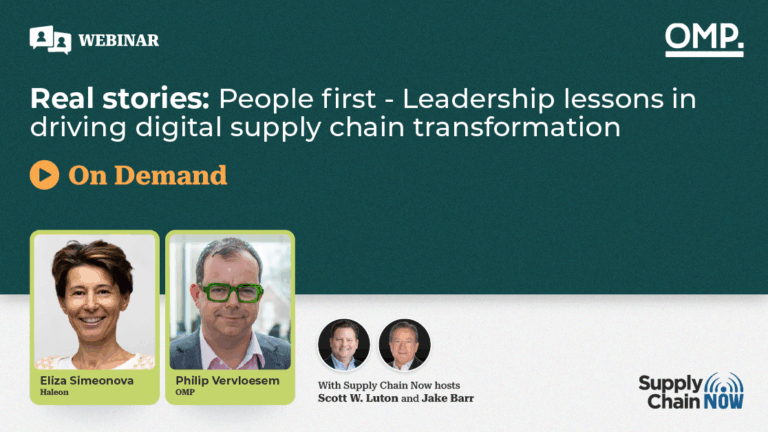
In today’s supply chain landscape, digital transformation is no longer optional—but as the panelists in the latest Supply Chain Now webinar revealed, it’s also not just about technology.

Hosted by Scott Luton and Jake Barr, this conversation brought together two powerhouse leaders: Eliza Simeonova, Quality Supply Chain Operations Officer at Haleon, and Philip Vervloesem, Chief Commercial & Markets Officer at OMP. Together, they tackled one of the most pressing challenges of our time—how to lead meaningful, people-centered transformation in an age increasingly defined by AI.

A few insights stood out:

  • Technology isn’t the hero—people are. True digital transformation begins with clarity of purpose, disciplined simplification, and leaders who stay close to the work.

  • AI amplifies human intelligence, it doesn’t replace it. The most successful organizations empower their teams to collaborate with technology, not compete against it.

  • Waiting for perfection is the biggest risk. Progress comes from experimentation, agility, and the courage to act before every variable is known.

From redefining leadership mindsets to practical strategies for upskilling teams, this discussion offered an inspiring roadmap for supply chain leaders ready to embrace what’s next.

Watch the full webinar on demand: Register to view the replay »
Download the companion resource: 5 Must-Know Planning Strategies for Supply Chain Leaders »

More Blogs
supply chain war room strategy
Blogs
February 26, 2026

Inside the Supply Chain War Room: Max Garland on Backup Plans, Delivery Costs & the Human Side of Innovation

At Manifest 2026, Scott Luton shared a cup of coffee with Max Garland, Senior Reporter at Supply Chain Dive, an Informa TechTarget publication, for a boots-on-the-ground perspective from one of the industry’s most plugged-in observers. Garland covers freight, logistics, retail fulfillment, and parcel delivery: the parts of the supply chain where strategy meets reality. And after a bruising 2025, he sees an industry that’s not just reacting anymore. It’s recalibrating.   From Plan B to Plan D If 2025 had a theme, Garland says it was contingency planning. “Last year was when a lot of companies were putting together those Plan B’s, Plan C’s, and Plan D’s,” he explained, pointing to tariff upheaval and shifting trade policy that forced leaders into constant reaction mode. Companies prioritized flexibility: diversifying sourcing, adjusting procurement strategies, and preparing for fires wherever they might spark. In 2026, that flexibility remains. But the tone has shifted. Now companies are “firming up their plans, fine-tuning, making sure those back-up plans are cost-effective as well.” It’s no longer just about avoiding disruption; it’s about operating efficiently within it. In other words, supply chain leaders aren’t just jumping over candlesticks anymore (like Jack from the old nursery rhyme). They’re…
supply chain decision making
Blogs
February 16, 2026

2026 Is the Year of No Excuses: Why Calmer Conditions Could Expose (and Reward) True Commercial Leadership

A Shift in the Narrative for 2026 In a recent conversation, Scott Luton spoke with Mark Gilham, Vice President & Head of Global Advisory at Enable, about what supply chain and commercial leaders should expect from the year ahead. While many annual outlooks attempt to forecast the next major disruption, Gilham offered a different lens: 2026 may become the “year of no excuses.” After years defined by a global pandemic, inflationary shocks, geopolitical instability, supply shortages, and the rapid rise of AI, organizations have already endured extraordinary volatility. Businesses not only survived, but in many cases adapted and grew. According to Gilham, that reality weakens the argument that disruption alone explains underperformance. Disruption is not disappearing, he cautioned, but leaders can only lean on it for so long.   Why a Calmer Year Raises the Bar Gilham argued that if external conditions stabilize even slightly, the pressure on leadership actually increases. A less chaotic environment removes convenient explanations and shines a brighter light on internal shortcomings. Process gaps, misaligned incentives, and execution failures become harder to ignore when the world is not on fire. Rather than waiting for certainty, Gilham believes leaders should act decisively. This does not mean radical…