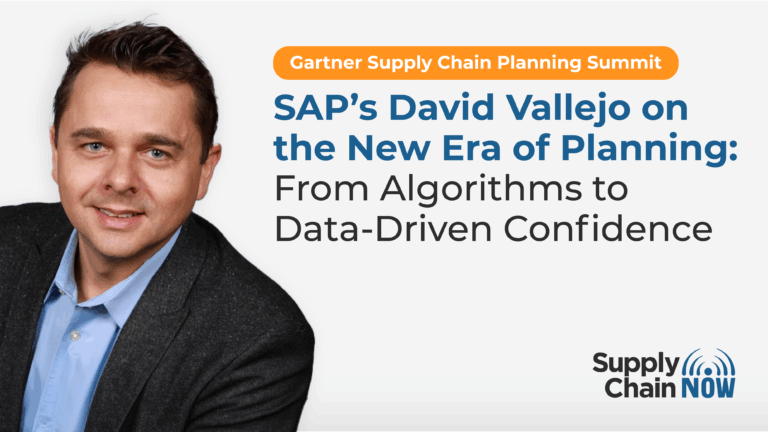

SAP’s David Vallejo on the New Era of Planning: From Algorithms to Data-Driven Confidence
In a rapidly evolving global supply chain landscape, SAP’s David Vallejo believes the most exciting innovations are happening in planning—and that the industry is entering a fundamentally new era. At the Gartner Supply Chain Planning Summit 2025 in Denver, Vallejo, who leads global product marketing for SAP’s supply chain portfolio, joined Scott Luton to discuss how planning is transforming, why data now sits at the center of competitiveness, and what SAP is doing to help organizations make faster, more confident decisions.
A Shift From ERP-Centric to Data-Centric
Vallejo described his team’s role as one that constantly scans the market—identifying trends, customer expectations, and the problems companies will need to solve next. Those insights help shape new innovations across the SAP ecosystem.
He noted that SAP has moved decisively from an ERP-centric worldview to a data-centric one. This shift is essential, he argued, because the biggest advantage in modern planning lies in having the right data—clean, connected, contextualized, and ready to drive decisions.
As Vallejo put it, “It’s all about the data that I need to make better planning decisions.”
Planning Models Are No Longer Static
Reflecting on how planning has evolved since he entered the field two decades ago, Vallejo described a dramatic shift. Historically, organizations built a static model of their supply chain—suppliers, stocking locations, customers—and ran algorithms to generate a plan.
Today’s world no longer allows for static assumptions. Trade uncertainty, shifting supplier networks, evolving consumer expectations, and generational changes in the workforce mean the “model” itself changes constantly.
Modern software, he explained, must reflect a world that evolves daily. That requires flexibility, agility, and a new level of responsiveness far beyond what traditional optimization engines were built for.
The New Competition: Confidence Through Data
For years, software vendors differentiated themselves through algorithmic capabilities, then through dashboards and user experience. According to Vallejo, the next competitive frontier is something deeper: empowering planners with the confidence needed to make decisions outside traditional norms.
To achieve that, organizations must integrate not only their operational data, but also financial, environmental, economic, and geopolitical signals—together forming a centralized data foundation.
With this foundation in place, companies can finally unlock AI in a meaningful way.
Vallejo emphasized that this isn’t about replacing humans; it’s about augmenting them. Grounded AI can analyze vast and diverse data streams, surface insights, and act as an intelligent assistant that guides users to stronger, faster, more informed decisions.
Meeting the Expectations of the Next-Gen Workforce
Vallejo also highlighted an important cultural shift: the growing expectations of younger workers. They want technology that guides them, teaches them, and accelerates their success. Intelligent assistants and AI agents are no longer “nice to have”—they’re what the next generation expects from modern enterprise systems.
SAP, he said, is positioning itself to deliver agents that not only support planning, but draw insights across logistics, manufacturing, and customer operations. The goal: a true, orchestrated supply chain.
Where to Learn More
Vallejo encourages leaders to explore SAP’s latest innovations at sap.com/scm and to connect with him directly on LinkedIn, where he regularly engages on supply chain transformation topics. Check out recent Supply Chain Now webinars featuring SAP leaders speaking on topics such as logistics optimization and supply chain orchestration.
We also invite you to listen to the full audio version of this interview with Scott W. Luton and David Vallejo: click here.
More Blogs
2026 Is the Year of No Excuses: Why Calmer Conditions Could Expose (and Reward) True Commercial Leadership