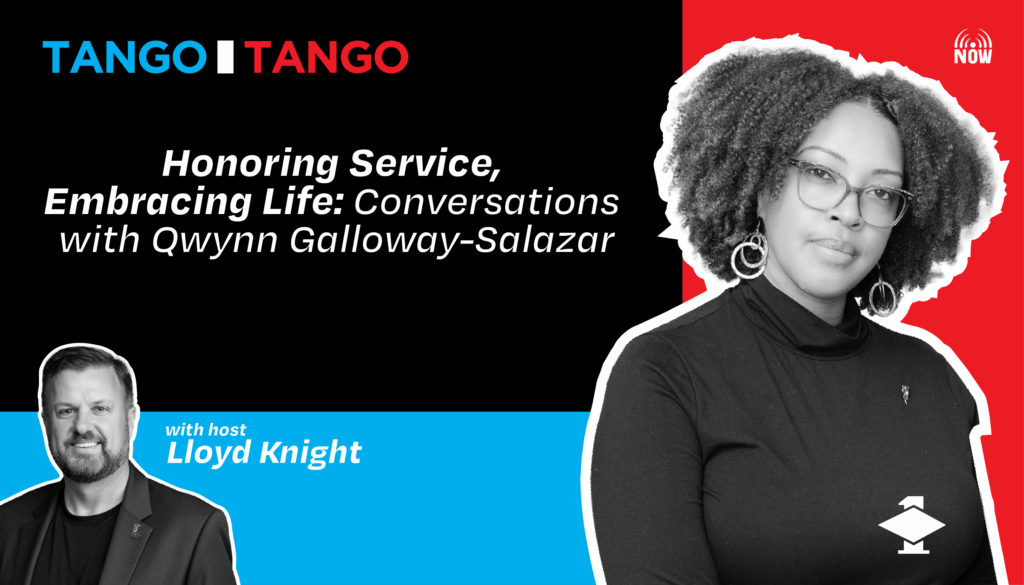
[00:00:00] Dr. Qwynn Galloway-Salazar: We put these uniforms on, but under those uniforms we’re people and we love and we have fears and we’re afraid of things, and sometimes we just need someone to hold that space and hear it and affirm who we are.
[00:00:20] Voiceover: Welcome to the Tango Tango Podcast. Real raw and unfiltered conversations with veterans and those who support them. Tune in, be inspired, and walk away stronger.
[00:00:37] Lloyd Knight: Welcome to season two of the Tango Tango podcast. I’m super excited that we’re in season two. I’m even more thrilled on my special friend, Dr. Qwynn Galloway-Salazar joining us today. Welcome, Qwynn.
[00:00:52] Dr. Qwynn Galloway-Salazar: Good morning, Lloyd. How are you my friend? Thank you so much.
[00:00:56] Dr. Qwynn Galloway-Salazar: Thank you. Thank you. Thank you for having me on.
[00:00:59] Lloyd Knight: I’m doing wonderful. ’cause I have you on the show. So Qwynn is. You remember the old beer commercial, the most interesting man in the world. You are the most interesting woman in, in the world. Presidential scholar, army veteran. A uh, you got a a, a big role in corporate America.
[00:01:19] Lloyd Knight: You’ve got the, uh, the whole DOA thing going on, which we’re gonna talk about. You’re into the arts as well. You’ve done some drama stuff, so I’m really pumped to get to know you, uh, a little more, although we spent some good quality time together this year, which we’re gonna talk about. But I’m, I’m comp not only to, for my listeners and viewers to get to know you, but for me to dig in some, some details and hear some stories behind.
[00:01:45] Lloyd Knight: All this interest let’s it, are you ready to get started? Let’s do it. I’m so, let’s do it. So Qua like me lives in the greater Atlanta area here in the great state of Georgia. But where’d you grow up? Did you grow up from this area?
[00:01:59] Dr. Qwynn Galloway-Salazar: No, I did not. I am a New Yorker, so I was born and raised in Queens, New York.
[00:02:04] Dr. Qwynn Galloway-Salazar: I moved to Georgia in 2000 for college.
[00:02:07] Lloyd Knight: Wow. So, Queens, New York, if you know me, I, I came into, uh, the Atlanta area. Which is like New York South and, um, literally it’s New York South. And I really didn’t have a great a, uh, friends or anything like that. I, I actually didn’t have a great opinion of New Yorkers, and now I’ve been here for 19 years and oh my gosh, some of my greatest friends.
[00:02:33] Lloyd Knight: From the greater New York area, so yeah, yeah,
[00:02:37] Dr. Qwynn Galloway-Salazar: yeah. What a place, what a time to be alive. When I look at time now, I’ve been in Georgia longer than I was in New York, so I’m kind of dating myself, but I will always be a New Yorker.
[00:02:50] Lloyd Knight: You’re too kind and nice to be a new or holy, so. So do you get back to New York often?
[00:02:56] Dr. Qwynn Galloway-Salazar: So I try to go home at least once a year, and that’s about all that my system can handle. Because you’re right, right? Like I’ve been in the south too long and when I go home I’m like, whoa, things are moving too fast. People are moving too fast. People don’t just stop and say hello. So, you know, I’ve, I’ve grown out of that season and kind of have maneuvered into that southern way that speak to someone on the street and just ask them how their day is versus being in New York and you speak to someone on the street and they’re thinking, you’re getting ready to bug them.
[00:03:29] Dr. Qwynn Galloway-Salazar: Like that part of my life is. It’s so behind me,
[00:03:33] Lloyd Knight: but Sarah and I went to a, uh, New York to see the Rockets and, and a couple other Broadway shows, uh, yes. About this time last year. And we found ourselves one night in Grand Central Station on midnight, taking the train back to the, uh, our hotel. And it was sensory overload.
[00:03:50] Lloyd Knight: Yeah. It was like, oh my gosh, you got this group playing over here, this group here, this group here. Somebody trying to get you to play cards. And they, yeah. It was like, oh my gosh, my, my, I, I can’t handle this. It’s, it’s just too much. So I gotta ask you, what, when you, you get up to New York, you’re there for a couple days.
[00:04:07] Lloyd Knight: Do you pop back in the York mode? Or do you stay in year to I do. I,
[00:04:11] Dr. Qwynn Galloway-Salazar: I do. It’s really funny when I, even till this day, if I meet someone and they’re from like New York City, not like upstate New York, it’s like automatic. My accent comes back like I just left New York. But yeah, when I go back home, right, and it’s, it’s a joy.
[00:04:27] Dr. Qwynn Galloway-Salazar: There’s so much rich culture and history and good food and good fashion that. Home is home and I do pop back. And then when I come back home, I remember where I am.
[00:04:41] Lloyd Knight: So what, what high school did you graduate from?
[00:04:43] Dr. Qwynn Galloway-Salazar: Yeah, so I graduated from St. John’s Preparatory High school in Astoria, New York. So I went to a Catholic high school.
[00:04:52] Dr. Qwynn Galloway-Salazar: Okay. Um, in York. Yeah. So my education from kindergarten to 12th grade was Catholic school.
[00:04:59] Lloyd Knight: Okay, and let’s talk about your journey to the Army. How in the world did that happen?
[00:05:03] Dr. Qwynn Galloway-Salazar: Whoa. My journey into the army, I think my story starts like many other young folks, right? Having that recruiter sitting outside of your college, telling you that you can see the world if you join the military, this was in 2000.
[00:05:21] Dr. Qwynn Galloway-Salazar: I apologize, 2001. So I enlisted into the Army in April of 2001. Wow. What a year or to, uh, join the army. What a year. To join the Army. Here’s the thing, Lloyd, and once again, I’m dating myself again. The last major conflict was Gulf War, and I was like, in the third grade, I had this thought that I can do my time in the military, I can go to college, get it paid for and not have.
[00:05:48] Dr. Qwynn Galloway-Salazar: A reason to go anywhere or have to leave college. Right. I was a reservist, but I was called up shortly after nine 11, um, in 2003. Now, what’s very unique is the fact that I am a New Yorker, um, and my family was still in New York when the towers came. And that was a real defining moment. I remember that day.
[00:06:13] Dr. Qwynn Galloway-Salazar: You know how there are events in history, you remember where you were, what you were wearing, who you were with. I was living in Atlanta and my duffle backs were still packed. I just finished my training for the Army and watched the towers go down on the news, and it changed the trajectory of my life.
[00:06:37] Lloyd Knight: Yeah, I’m really dating myself. So I was year 14 in the Air Force out over 20 years, and I, I was in Germany, so it was at the end of the day and I’m watching it go on, on, on tv. So we watched it for about an hour and I was in a special unit that would deploy at a moment’s notice. And then after watching ’em for an hour, our commander sent us all home to go pack our bags.
[00:07:02] Lloyd Knight: And most of the, the group were, uh, gone three days later. Yeah. Amazing. Yeah, I, I have those moments too. Um, let me think. The, one of the big ones for us was the, uh, princess Diana die. And, and, you know, that was, that was different, but right up there with the, with the pivotal, you know, um, yeah. So you got activated.
[00:07:26] Lloyd Knight: Talk a little bit about your activation.
[00:07:29] Dr. Qwynn Galloway-Salazar: So I was activated in January, 2003. Our unit was, we did not deploy, so we backfilled Fort Bragg and what a time, right? So this was during high deployment times where we were setting soldiers left and right overseas. My MOS was finance, and so, you know, I was in the grunt of it, making sure that soldiers paid.
[00:07:55] Dr. Qwynn Galloway-Salazar: Were correct before they left ground. What was really interesting about that time was I had the opportunity, Lloyd to get classified in postal work and I took over the mail room and taking over the mail room. That’s where when people start asking, how did you start like this wild career in supporting service members, veterans, and their families?
[00:08:23] Dr. Qwynn Galloway-Salazar: It started there. I cannot tell you the number of soldiers that would come to get their packages and to get their mail. That would just sit and talk. Talk about the fact that they had babies on the way. Talk about the fact that they were in school like I was and got activated. Officers who came in and talked about, they were afraid of going overseas, afraid for their troops.
[00:08:52] Dr. Qwynn Galloway-Salazar: There was just this thing that I didn’t know that I had where people felt comfortable telling me their stories, and this was about a good year that I was in the mail room, just listening to stories day in and day out. And it caused me to see service in a different way. It caused me to see service in a way where we put these uniforms on, but under those uniforms we’re people and we love and we have fears and we’re afraid of things, and sometimes we just need someone to hold that space and hear it and affirm who we are.
[00:09:40] Dr. Qwynn Galloway-Salazar: And at 20, I think it was 21. Oh my gosh, that feels like a lifetime ago. I was like 21 when I was working in the mail room, and it gave me such a breath of what folks were like underneath their uniform that I went back to school. I finished my bachelor’s degree in criminal justice and I went back to school and pursued a master’s degree in counseling because I wanted to support our service members.
[00:10:10] Dr. Qwynn Galloway-Salazar: And that’s what started my journey over 20 years ago.
[00:10:13] Lloyd Knight: Yeah. Amazing. And if you ever have the privilege and honor of meeting the, uh, Qwynn in, in person, she’s absolutely so empathetic. And somebody that, that hears you, which is, yeah, I think I figured that out really quick. When, uh, we met and then, you know, we have the bond of people.
[00:10:34] Lloyd Knight: So do you know the motto of the Air Force First Sergeant, which I have, my big diamond behind me is people are our business and, you know, the, uh, coming into UPS after a 20 year career in the Air Force, you know, I was really successful. Part of it was because of my drive and my work ethic, but a big part of it was I, I was able to find the right people, hire the right people, and put everything I could in, in mentoring and developing those people.
[00:11:03] Lloyd Knight: Absolutely. And the, uh, it’s, yeah, people are so important. So, uh, yeah. You spent how many years in the, in the, uh, in the army? Six. Six, six years. And, and why did you decide to a, uh, hang it up?
[00:11:17] Dr. Qwynn Galloway-Salazar: I was a mom and at the time I was a single mom. Okay.
[00:11:21] Lloyd Knight: Wow.
[00:11:22] Dr. Qwynn Galloway-Salazar: I was a single mom and I had to make some really hard decisions.
[00:11:26] Dr. Qwynn Galloway-Salazar: Right. I think the military’s come a long way. You know, back then of course you had to sign a family care, family care plan and all of those things, and as a single mom, I didn’t have the level of support that I needed. To have a full fledged career in the Army, and so I had to make a really tough decision.
[00:11:50] Dr. Qwynn Galloway-Salazar: I had to make a decision to choose my daughter. After an honorable discharge, I still stayed connected. Listen, Lloyd, when I got home from active duty, I took my uniform off, I chucked it to the side. I said, I’m done. I’m done. I’m done. This was a season of my life. But I never would’ve imagined that season of my life would have carried on for decades.
[00:12:18] Dr. Qwynn Galloway-Salazar: Right. Outside of uniform, but still serving in the space of supporting the military.
[00:12:25] Lloyd Knight: Absolutely. Let’s, let’s talk. You’ve had an interesting career path. That ended up putting you on a collision path with me, which I think is wonderful. Yes. But I, I’m looking at your LinkedIn profile and you are a jail diversion, and from a recovery state project director and consultant in Atlanta, what a big job in.
[00:12:45] Lloyd Knight: I gotta ask you why, like, why that job? And, and then a, um, and then what did you learn in that role? Whoa, learn in that role about yourself?
[00:12:56] Dr. Qwynn Galloway-Salazar: Straight outta grad school. I had Similac still behind my ear. I didn’t know what I was signing up to do. All I knew at that time was I was being offered a position to take my criminal justice background and my counseling background and make them intersect.
[00:13:12] Dr. Qwynn Galloway-Salazar: And I was like, sign me up. But here’s what I learned. I learned how trauma can impact our veterans in ways that can cause them to interface with the criminal justice system. And if they don’t receive the care and the supports that they need, that recidivism rate. That chance for them to spiral into substance abuse, into other forms of violence just creates this continuum, creates this cycle.
[00:13:47] Dr. Qwynn Galloway-Salazar: So being able to take on that role as jail diversion director, I had the chance to see how veterans entered into the criminal justice system from interfacing with law enforcement. I had the chance to train police officers on how to. Intervene in crisis, right? So I started training as a crisis intervention trainer working with law enforcement in the Atlanta area, all the way to going to the jails, into the jails.
[00:14:16] Dr. Qwynn Galloway-Salazar: What’s the intake? Are we asking people, have they served in the armed forces? Not if they’re a veteran, but have they served in the armed forces? To figure out what veterans are in our criminal justice system. So I worked from law enforcement all the way to reentry, right? And everything in between. And the courts, training the courts, what trauma looks like, how to become trauma informed, educating our judges, educating our attorneys, educating social workers that were embedded in mental health courts and veteran treatment courts on how to support.
[00:14:54] Dr. Qwynn Galloway-Salazar: And how to be culturally competent as it relates to caring for veterans in the criminal justice system.
[00:15:00] Lloyd Knight: Wow. Wow. That is a absolutely a amazing, and then you, we, I’m just reading some of your roles here. You, you went on to be a research manager at Emory School of Medicine. Yep. Then state program coordinator for a, uh.
[00:15:15] Lloyd Knight: Or it looks like the Georgia National Guard. Let’s fast forward to 2017 when you took on the role of treatment court liaison as the Georgia Department of Bay of U Health. Yeah. What was that role all about? What’d you learn about yourself in that role?
[00:15:29] Dr. Qwynn Galloway-Salazar: So I took a second stab at working state government again, and what I learned, it allowed me to go back into the criminal justice system, but from a broader space.
[00:15:38] Dr. Qwynn Galloway-Salazar: Right. So that specific role wasn’t solely focused on veterans, it was focused on. Just mental health, substance abuse, just diversion and treatment as a whole for all adult populations. What it taught me, once again, goes back to the time when I was working in the mail room. People are people, and sometimes they just want to be heard.
[00:16:03] Dr. Qwynn Galloway-Salazar: And listen to, and oftentimes there are reasons why people end up in the criminal justice system, in the mental health treatment courts and the substance abuse, uh, drug courts, right? There are reasons why, but when we are intentional with the way that we design our programs and the way that we design the care that they can or should receive.
[00:16:27] Dr. Qwynn Galloway-Salazar: They’re able to recover. They’re able to reunify with their family. They’re able to live lives that are free from substance abuse, that are free from crime, that allow them to say, yes, I may have this mental health diagnosis, but I’m not gonna let that stigma stay with me. And I’ve learned that. I’ve learned my husband is in law enforcement.
[00:16:51] Dr. Qwynn Galloway-Salazar: And it, it never fails Lloyd. We’ll go somewhere and something will happen and his, his officer hat will kick in and my, my mental health crisis intervention hat will kick in. And we are like this duo team, right? That can just like deescalate something on a drop of a dime. But it’s taught me how to be present with people at their lowest points and not judge.
[00:17:18] Dr. Qwynn Galloway-Salazar: And just validate their human
[00:17:20] Lloyd Knight: experience. Wow, what a tremendous opportunity. And then your, your next role, I, I don’t know if you know this about me, but I absolutely love history, love, love, love history. I’ve got George Washington bobble Anne right there. So you, you got a role, I think this is just fascinating.
[00:17:37] Lloyd Knight: I, I want to hear how you got into it and then what the role was all about. You’re the co-principal investigator for Brooklyn College of Veterans History Project. So tell me all about that. I’m, I’m intrigued.
[00:17:51] Dr. Qwynn Galloway-Salazar: Yeah. So there was a season in my life where I wanted to dip my big toe in oral history. Wow.
[00:17:59] Dr. Qwynn Galloway-Salazar: Specifically on the lives of veterans. And so that’s what we did. We, I helped co-lead a class or two at Brooklyn College, virtually during the pandemic, and really had the chance to teach students on how to interview veterans. What are some of the questions you wanna ask? Whether some questions that you shouldn’t ask, right?
[00:18:21] Dr. Qwynn Galloway-Salazar: But what stemmed out of that opportunity was to co-author a chapter in a book specifically focused on compassion fatigue, secondary trauma. As it related to caregivers caring for veterans, my colleague, Dr. Napoli, Phil Napoli, we co-wrote that chapter and we really journeyed into what it was like for those caregivers.
[00:18:44] Dr. Qwynn Galloway-Salazar: But what we got out of doing that research and that work was wow how the stories, both of us and the lived experiences we’ve heard over the years have shaped and impacted us. See and how vicarious trauma and how compassion fatigue can show up in the person that’s doing the interviewing and how important it is to have self care and care for ourselves while we are opening ourselves up to listening and taking in those stories to share with larger audiences.
[00:19:22] Lloyd Knight: Yeah, compassion fatigue. That’s uh, yeah, something I didn’t know existed and something that. I, I’ve ended up having over the years. Can you talk a little bit more about that, what it is and, and how you specifically combated it?
[00:19:35] Dr. Qwynn Galloway-Salazar: Yeah. For me, you know, when I think about my career, I’ve, I’ve went from a multitude of levels of working with veterans and service members with trauma all the way to the space of suicide prevention.
[00:19:48] Dr. Qwynn Galloway-Salazar: And everything in between and hearing those stories for so long, right? I started feeling that burnout there were, there were it ebbed and it flowed where it was moments of burnout and that compassion fatigue because it’s like, and I’m gonna make this unethical for a moment. Sometimes you just wanna take that person, wrap them in your arms really tight, and just hug them and love them and tell them that they’re gonna be okay and bring them home and put them in a bubble.
[00:20:16] Dr. Qwynn Galloway-Salazar: But realistically, we can’t do that. And there were moments where I really got tired. My soul was just really weary from the work, and I had to find an outlet. And what became an outlet for me was the arts. What started out for me in the arts was having an art table. So on the other side of my office, I have a art space, and it was spending intentional time, painting and drawing and writing and doing pieces of art with wood.
[00:20:49] Dr. Qwynn Galloway-Salazar: That became the place where my anxiety lowered. That became the place where I was able to detach from my work. To renew, to restore what I want it to feel and how I want it to show up. Also, for me, taking time away, right? Like I will take a vacation, I will take a break when I know I need it. Because if I don’t, I’m not doing anyone any good.
[00:21:16] Dr. Qwynn Galloway-Salazar: I’m not serving to the best of my capacity, and I’m no good for my family, right? Like my family didn’t sign up for the task. That are my life, right? So I always wanna make sure I show up. Sometimes it means going out for a walk every morning. I watch the sunrise because I have to remember that there’s a mission, there’s a purpose.
[00:21:40] Dr. Qwynn Galloway-Salazar: The work that has chosen me because I don’t believe I chose it, needs me to stay well in order to continue to do it.
[00:21:50] Lloyd Knight: I know. So in 2021. And as I jokingly kid around with you, you became Dr. Qwynn, medicine woman. Yeah. And you earned your PhD from Walden University and you became a director, I’m sorry, a doctor of philosophy in industrial and organization psychology.
[00:22:09] Lloyd Knight: Yeah. So Wow. So what, what grew you into getting your doctorate? Yeah. Especially in that field. And they, uh, talk a little bit about, you know, that a, uh, that was six years of your life. They talk a little bit about that process.
[00:22:26] Dr. Qwynn Galloway-Salazar: Yeah. So when I came home from active duty, I came home. I was a single mom. I didn’t have a job lined up.
[00:22:36] Dr. Qwynn Galloway-Salazar: And I was in search of employment, and I’ll never forget the very first interview that I went on. I was in Buckhead. I’m not gonna say where I was, but I’m just gonna say I was in Buckhead. Now imagine this soldier who just came from Fort Bragg, who was working in a World War II Barrack for the time that they were there.
[00:22:54] Dr. Qwynn Galloway-Salazar: Goes to Buckhead for an interview for finance. I walk in Lloyd, people are riding around on razor scooters. They’re popcorn machine. I’m looking around like, what is this? Is this Disney? What is this? I’m thinking because I was financed in the military, there would be, you know, some similarity. And I’ll never forget sitting in that interview.
[00:23:20] Dr. Qwynn Galloway-Salazar: And it was a panel of interviewers and quite honestly, they didn’t know what to say to me. And I didn’t know what to say to them. And I will never forget my parents took my daughter to Disney, speaking of that week, right? My daughter was maybe like two, maybe one, two, maybe one or two at the time. And I chose to stay behind for this interview.
[00:23:46] Dr. Qwynn Galloway-Salazar: And I remember getting to my car because I knew I bombed that interview. I was not prepared. My resume was probably, my resume was crap. Let’s just say it. Right. It did not translate the way it needed to translate in terms of hard skills and soft skills that I acquired from the military and how I was going to translate those skills into the civilian workforce.
[00:24:10] Dr. Qwynn Galloway-Salazar: I got into my car and I cried. I was a black woman who was a veteran who felt so invisible that I did not know what to do. And so I went back to what I knew best. I started working for the military again. Right. And I’m grateful because that’s been my trajectory. But I remember sitting in my car and the soldier in me came out after crying for about a good 10 minutes, snot and everything all over the place.
[00:24:40] Dr. Qwynn Galloway-Salazar: And I said, I don’t know how, and I don’t know when, but I’m going to make an impact as it relates to women veterans in the civilian workforce at some point this life. Yeah. Amen. And you have, and so I went back to school for my PhD and my dissertation was actually focused on post nine 11 women veterans transition from the military into the civilian workforce.
[00:25:07] Lloyd Knight: Wow. You gotta share that with me. Yeah. So the, uh, because I’m, I’m in the transition space and Yeah. And, uh, hey, look, a transition is, is hard. It’s whether you’re transitioning after four years of service or 40 years of service. It’s hard. It, it, it’s, it’s, it’s extremely difficult. It’s, and it’s always the great equalizer too.
[00:25:28] Lloyd Knight: ’cause like look, you can be like a, an average troop that gets out, out to four years that you are an E three and you can succeed. Uh, right. And you can be a full bird kernel that’s getting out after 30 years. And bond those interviews. Yeah. So the transition from the military to civilian world becomes the great equalizer.
[00:25:49] Lloyd Knight: It, there’s a lot of things to figure out. Uh, you were like me, so I, I, I retired in 2007. There simply wasn’t the support that there is now for me. Really. I had a GI Jobs magazine. Oh wow. That was my support. I would read that thing cover to cover and now holy cow, there’s so much supports, you know, here in Georgia you gotta work for Warriors across the country.
[00:26:16] Lloyd Knight: You have higher Heroes, USA and four Block and Higher Heroes Foundation. Yeah. And the, uh, American Corporate Partners. So there’s a lot of organizations that help veterans figure it out, but at the time we transitioned, we were pretty much on our own. Yeah, we, we, we had the TAP program. Which is still average at best, but back then it was really poor.
[00:26:41] Lloyd Knight: Um, it’s come
[00:26:41] Dr. Qwynn Galloway-Salazar: a long way, you know? Right. I mean, back then you just wanted to go home. Right? Like you just wanted to, you wanted them to check that box, sign it, because that’s one step closer to me going home. Speaking for myself. That’s all that I was thinking of was I wanted to go home, not thinking about, okay, when I go home, I’m not in this uniform anymore.
[00:27:02] Dr. Qwynn Galloway-Salazar: I don’t have the supports that I had when I was stationed at Fort Bragg. I’m back in my community where I’m just gonna blend in, even though I have these experiences and this expertise, so to speak. No one’s gonna know that unless you share it. And honestly, coming home and having that experience and a few other experiences, I stopped.
[00:27:30] Dr. Qwynn Galloway-Salazar: I didn’t share that I was a veteran.
[00:27:33] Lloyd Knight: Yeah. Wow. That breaks my heart for several reasons. We, we should always be proud of our military service. Yeah. And then as a somebody who works in the. Veteran talent acquisition space. I can tell you, we look for veterans, right? So we, we, we look for veterans, not only because it’s the right thing to do and we’re patriotic and we have all that going on, but veterans strongly feel they give us a competitive advantage.
[00:28:00] Lloyd Knight: Right. You know, our veteran workforce as a whole is gonna come and, and knock it out. And then they have all this training. Yeah. And then real life experience. All the, these amazing things that we look for. Right. And yeah, sometimes we struggle with the transition, getting a good resume, translating our, our experience.
[00:28:21] Lloyd Knight: We have to learn what a profit and loss is that come work in a corporate America. Yeah. I mean there are some very specific things you have to learn about your industry. Yeah. But for the most part, and veterans are killing it, you know, they’re leading and they’re managing and they’re. The, uh, so never be ashamed of, of your veteran, uh, experience your military experience and understand what a competitive advantage it brings to you.
[00:28:47] Lloyd Knight: Yeah. You, you’re gonna have to do some additional things. You know, you, if you want to go work in corporate America, you gonna likely have to get a degree. You’re have to gain some additional skill sets. But as a whole, corporate America is, is we value. Yeah. And we want you.
[00:29:02] Dr. Qwynn Galloway-Salazar: And to your audience. I want your audience members to hear that so loud and clear.
[00:29:08] Dr. Qwynn Galloway-Salazar: You know, take it from someone who didn’t identify when she came home. Please do. Because there’s a service member that’s getting ready to come up the ranks that may have similar attributes to you. We need you to be that, that, that voice, right. Raise that platform to say. I served. It’s so important that we’re able to tell our former selves, tell those troops that are behind us.
[00:29:37] Dr. Qwynn Galloway-Salazar: It’s okay to say that you served, actually, it’s pretty critical to tell folks that you served.
[00:29:43] Lloyd Knight: Yeah, absolutely. So, hey, then you took a big step in 2021, you started your own business and you’re the CEO in their honor, LLC. So this is. One of the things that really, I think I’m just so impressed and so honored to know you for what you do in this business.
[00:30:05] Lloyd Knight: So can you cover it with our listeners and viewers?
[00:30:08] Dr. Qwynn Galloway-Salazar: Sure. So as I was writing my dissertation, focusing on qualitative studies, right? Once again, I love, I’m a story collector. I love stories, I love sparsing out themes in stories, but I had a mentor. By the name of Dr. Kate Hendricks, Thomas and Kate was a, can I use one?
[00:30:30] Dr. Qwynn Galloway-Salazar: Yes. Colorful words. Kate was a badass. Marie and Kate was a researcher, and Kate’s work was centered around one of Kate’s major pieces of work was centered around women veterans. And so Kate decided to be a mentor for me while I was working on my dissertation. Kate is diagnosed with stage four metastatic breast cancer, and during the journey of me writing my dissertation, I began to see Kate’s health decline and our conversations started changing from research doctoral candidacy to existential conversations.
[00:31:13] Dr. Qwynn Galloway-Salazar: Kate knew that she was dying. And I will never forget, we started having conversations. And mind you, this was during the pandemic. And I had a question. I, I asked her, how does military experience resurface at the end of life? And boy, that was such a rich conversation where she shared about her time deployed and burn pits.
[00:31:36] Dr. Qwynn Galloway-Salazar: And if you know your listeners are listening, you can find Kate’s story, almost Google it and you’ll find Kate’s story. But I remember it just took me, like, it took hold of me in a way that said, huh, I wonder if there’s something I can do about that. So what I didn’t share was after I transitioned from active duty, I contemplated for a few minutes going to school for mortuary science.
[00:32:06] Dr. Qwynn Galloway-Salazar: So I’ve always had this interest in death and dying from the time I was a little girl, right? Like it’s just. It’s been something with me. And I remember doing an apprenticeship at a funeral home and I did it for a summer and then I said, okay, I didn’t have the support that I kind of needed at the time because you start talking about death and dying and people really shut down.
[00:32:26] Dr. Qwynn Galloway-Salazar: They really don’t want about, they really don’t wanna hear about your experiences in a hearse, right? Like they don’t wanna, they don’t want to. But that it stayed with me. And so. I had a colleague say to me, Hey Qwynn, have you ever heard of a death doula? And I’m like, what the heck is a death doula? And I looked it up Lloyd, and when I looked it up, in short, it’s a companion, right?
[00:32:51] Dr. Qwynn Galloway-Salazar: It’s someone that journeys alongside of someone that has a serious illness or terminal illness, their family, their loved ones, through that end of life continuum. And it was almost like there was a picture of me, right? Like if there was a picture, the picture would’ve been my face that I saw. And I jumped into it, right?
[00:33:09] Dr. Qwynn Galloway-Salazar: I jumped into it. I told Kate I wanna become a death doula, and I will never forget one of our last conversations, Kate said to me, I need you to change to shift the way veterans receive care at the end of life. And that was heavy because I’m like, what am I supposed to do? Right? Like, I don’t know how to do that.
[00:33:34] Dr. Qwynn Galloway-Salazar: So what started out in their honors started out as a passion project in Gwinnett County where I wanted to support veterans that were at the end of life and hospice. I would’ve never thought what four? It’s been about four years that the work that I started in 2021 is shifting globally, where countries are reaching out to say we wanna do a better job.
[00:34:03] Dr. Qwynn Galloway-Salazar: In providing dignity, support, and care to our veterans, and I don’t care what part of the world you’re in, there are warriors all over the world that deserve to be seen, heard, honored, and supported.
[00:34:24] Lloyd Knight: Qwynn, that is such a big deal because the other countries simply don’t take care of their veterans like we do in, in the United States.
[00:34:34] Lloyd Knight: Look, we, we have issues with, with veteran service in the US so there’s no doubt about it, but the United States. Recognizes veterans. We provide so much support through the government support, through nonprofit support, through individual contributor support a million times than most countries. So the fact that these other countries are reaching out with interests.
[00:34:57] Lloyd Knight: Yeah, that is huge. Clinton, that is a, a huge hit hack, so, so kudos to you all that.
[00:35:03] Dr. Qwynn Galloway-Salazar: I appreciate that. I tell people there are days where Lloyd, I sit and I’m like. I’m gonna bring my faith into this. I’m just a vessel. I’m just a vessel. I was simply minding my mission and to get messages from the UK and Canada to say, can we do something together to take on an international role to support doulas who are caring for veterans?
[00:35:38] Dr. Qwynn Galloway-Salazar: That blows my mind because all I wanted to do was in Gwinnett County, right? Mass support veterans in my city, in my county, in my state, and it has taken off and grown in ways that I could have never imagined. Yeah,
[00:35:57] Lloyd Knight: so, so absolutely amazing. And thank you for what you do in, in that role. And then I gotta ask, yeah, so you do always amazing things like, right.
[00:36:06] Lloyd Knight: And then in 2024, I have no idea my time for this, but you become senior VP of engagement and transformation at a company I, I, I admire is psych armor. So can you talk a little bit about that role and actually what Psych Armor does?
[00:36:22] Dr. Qwynn Galloway-Salazar: Yeah. So Psych Armor is a national nonprofit. Where we train, our goal is to transform the way our society sees our military connected communities through training, right?
[00:36:35] Dr. Qwynn Galloway-Salazar: Whether it’s virtual or in-person, we cover the gambit. If you go to the psych armor platform, you’ll see over, I think we’re over 250 courses, like micro courses that you can take for absolutely free. 99, my favorite
[00:36:51] Lloyd Knight: F word.
[00:36:52] Dr. Qwynn Galloway-Salazar: Free, free, free, free, free, free. Right. One of our signature, well our flagship course is 15 things Veterans want you to know.
[00:37:01] Dr. Qwynn Galloway-Salazar: Most corporate companies, that’s kind of like their, their go-to when it comes to how do we get our, um, employees to learn a little bit more about veterans, right? They use that in the corporate America. They use that in academia, they use it in healthcare, right? They use it in hospice and palliative care.
[00:37:20] Dr. Qwynn Galloway-Salazar: The minute I say like armor, and then the minute I say 15 things, veterans want you to know the light bulbs go off. Right. It feels so good because it’s so great to know that a course like that has shifted the paradigm in the ways that people become competent about military culture. Right? Competent.
[00:37:41] Dr. Qwynn Galloway-Salazar: Bringing that sense of cultural sensitivity, bringing that sense of cultural humility to the stage to say, okay, if we have a veteran that’s in our workplace, how do we show up for them? Right? How do we acknowledge their service? How do we get an affinity group or ERG started that? They can feel that belonging, that connection?
[00:37:59] Dr. Qwynn Galloway-Salazar: How do we just show up? And I love that psych armor is providing this platform to let our bigger community. Find ways to do that. But I got into psych armor, actually, the CEO of psych armor and I were great colleagues, good friends. And when Kate died, I reached out to her and I asked her, I wanted to know.
[00:38:25] Dr. Qwynn Galloway-Salazar: What communities were doing to support veterans through the end of life. I didn’t want her to tell me what the VA was doing. I didn’t want her to tell me what healthcare organizations were doing. I wanted to know if every time a civilian saw a veteran, and you can utter the words. Thank you for your service.
[00:38:42] Dr. Qwynn Galloway-Salazar: What were you doing to thank them for their service? And I’ll never forget if you ever meet Dr. Tina Aall. She’s the most soft spoken, warmest person on the face of the earth. And she looked at me and she said, what are you gonna do? She threw it right back at me. Shortly after we were able to receive an angel donor and they funded us to do a project called Caring for Veterans through the End of Life.
[00:39:07] Dr. Qwynn Galloway-Salazar: And it’s a collection of courses for communities, healthcare providers and caregivers on how to care for veterans through the end of life. So that was kind of like my first take at Psych Armor. Right. I was the lead advisor on that project. Then I became Psych Karma’s creative advisor on all of their work, especially their e their equity portfolio.
[00:39:26] Dr. Qwynn Galloway-Salazar: Their equity portfolio, and their aging and longevity portfolio and caregivers. And then little bit over a year ago, Tina said, Hey, would you be willing to come on? Um, we really want to make sure innovation and storytelling, and we’re engaging our audiences because we know that if we don’t keep telling these stories.
[00:39:47] Dr. Qwynn Galloway-Salazar: We don’t want our military community to be an afterthought. So I came on, and everything that I do comes from the lens of heart-centered work. How can we bring our audience members here? It’s so important to have them here, but how do we bring them here? How do we transform the way society sees our military connected communities?
[00:40:10] Dr. Qwynn Galloway-Salazar: And that’s the work I get to do on a daily basis alongside Garmer. And it’s, it’s. No day is the same, right? Like I just went to Seattle, Washington to film some courses on minority veterans. I’ve done work with A-I-A-N-L-G-B-T-Q, you fill in the blank at psych armor. I’ve been able to shape some of those portfolios of work and it’s an honor to do that.
[00:40:34] Lloyd Knight: Wow. And uh, storytelling. You’re great at storytelling, so I, so you, you’re, whenever I’ve. Seeing you speak. It’s, it’s always, always amazing. But you didn’t, you take some drama lessons. Thank you. Yeah. Did you take some drama lessons? You know,
[00:40:53] Dr. Qwynn Galloway-Salazar: I wish I could say, I wish I could say that. Here’s the say no, not really.
[00:40:59] Dr. Qwynn Galloway-Salazar: I stumbled across, well, I did not stumble across it. Here’s what’s really interesting. My church that I attend, Evangel Community Church in Snellville, Georgia, had asked me would I play Mary? For Good Friday, I think two years ago in a monologue, and I said, I don’t know anything about monologues or acting or performing like I’m academic.
[00:41:24] Dr. Qwynn Galloway-Salazar: Like, no, I cannot do that. But I said, let me pray about it. Let me think about it. Long story short, Lloyd, I didn’t know that I could write monologues and I did not know that I could perform, and I did it. And I wanted to do it again and again and again. And I have, and it allows me, you know, when people say, Qwynn, you work in the deaf and dying space, isn’t that like sad and depressing and all the things, and I’m like, there are moments.
[00:41:59] Dr. Qwynn Galloway-Salazar: But when I’m able to sit in production and I’m able to sit in theater and bring lived experiences to life in a way that educates my audience, it gives me life, all pun intended, it gives me life. I love being able to produce stories and do it through theater, applied theater at that.
[00:42:26] Lloyd Knight: Neat. So yeah, so neat.
[00:42:29] Lloyd Knight: So you have so much going on. You got more roles than the PO is. Who would I always say you kind of thing about myself. And that goes for For you as well. And then in 2025, our intersections cross. Yeah. You become a presidential scholar at the George Bush Institute and their stay in the Veteran Leadership Program.
[00:42:51] Lloyd Knight: Wow. So talk a little bit about your journey to becoming a presidential scholar.
[00:42:56] Dr. Qwynn Galloway-Salazar: It took. Three applications that I didn’t press send on. Wow. You did not press send.
[00:43:02] Lloyd Knight: So it took me four applications hitting send. It took me four years to get into why in the world would you fill out an application to not hit send?
[00:43:12] Dr. Qwynn Galloway-Salazar: I
[00:43:12] Lloyd Knight: didn’t think I was gonna, oh my goodness. But I want you to hold,
[00:43:17] Dr. Qwynn Galloway-Salazar: sit with that for a
[00:43:18] Lloyd Knight: moment.
[00:43:19] Dr. Qwynn Galloway-Salazar: And I wanna sit with that for a moment because. I’m hoping that there are some folks who are still thinking about applying because we have about less than a month. Just do it. Whether it takes you one or four times, you are enough.
[00:43:36] Dr. Qwynn Galloway-Salazar: Do it. Do it. And if you don’t get in, try it again, right? Lord, I remember. Here’s the thing, you are the first person I met in person. Let’s go back, right? Yeah. We send each other pictures of ourselves, right? Like, Hey, this is what I look like today. The first people to like you and I met first, and I remember sitting in that space at the institute that first day with such imposter syndrome.
[00:44:09] Dr. Qwynn Galloway-Salazar: Why am I here? Yeah, and to only realize that there were many people in the room with us that felt that same way. But what I realized after this whole amazing five months, six months in spaces like that, we were allowed to germinate and to grow alongside other leaders. To continue to do the work that we’ve been destined and purposed to do.
[00:44:42] Dr. Qwynn Galloway-Salazar: And I think back, you know, and I cannot believe it’s been a month. It’s almost been a month, well, it’s been a month since we’ve met altogether, and just how every month we got together we were picking. Picking up tricks of the trade on how to be better leaders from leaders, right? Like not just the leaders that we saw on the stage, but from each other, and that was such a gift.
[00:45:10] Dr. Qwynn Galloway-Salazar: We were able to sit together and say, this is hard. There was some significant. Moments in history. Right. And the current affairs that happened within those five months. Right. Like down, oh my goodness. All these things happened. Yeah. They shut down on Charlie
[00:45:28] Lloyd Knight: Kirk’s murder and Yeah. Oh my
[00:45:30] Dr. Qwynn Galloway-Salazar: goodness. Yeah, there, there was just so much.
[00:45:33] Dr. Qwynn Galloway-Salazar: Right? So much political. There was this, there was that, but what we were able to do was we all rallied around each other, different races. Genders, beliefs, political affiliations, you name it. We all came together around a common good. Yeah. And we were able to show, really the researcher in me would love to spend this time at the Bush Institute with this level of research, how this is a model to save our world.
[00:46:06] Lloyd Knight: Yeah, absolutely. There’s big elements of it for sure, that a, uh. Can do that. The connections they make, like right from the beginning, we all talk about that. We got some secret sauce. Maybe it’s that they kept the classroom at 62 degrees
[00:46:23] Dr. Qwynn Galloway-Salazar: to keep us awake, right.
[00:46:27] Lloyd Knight: Huddle up and, and, and figure things out. But the connections, and honestly, I think the best value. Of the class. W wa was not the speakers on stage. They were great, they were motivational. They, you know, parts of the curriculum gave us some new tools, but it was each other. It was each other. So it was each other.
[00:46:45] Lloyd Knight: I would just, I’m gonna repeat what you said. We, we learned so much from each other, you know, tricks of the trades and connections and how to do this. And I loved it. I, I, I was, it gave me confidence. ’cause I figured most people needed me to be a mentor in that. That, uh, that class. And so I was able to really help molt some people.
[00:47:06] Lloyd Knight: Then, man, I met so many amazing new connections. Yeah. You know, the, uh, you know, Dr. Qwynn, medicine woman and Lydia Foreign born spouse and or Victoria who did this incredible documentary that was on season one of Tango Tango. And, you know, one of my new best friends, Mark Riley, who leads the Washington tattoo.
[00:47:29] Lloyd Knight: And does this amazing thing with music and you know, yeah, we were in the same space together, but for the most part, our lives were not gonna intersect. And because our lives intersected through this incredible program, it’s a force multiplier and not only a force multiplier in the veteran space, but as you mentioned, a force multiplier in fixing some of the ills that this, that the world or the United States has.
[00:47:54] Dr. Qwynn Galloway-Salazar: Without a doubt, I truly. When you’re able to bring people together to do good, when you take some of those layers off, and we’re just thinking about humanity, so much can shift. I just, I sit and I still feel that, right? Like there were moments where we talked about pluralism and democracy and we had opposing views right across the room, but we all came back together and was able to hug each other, love on each other and get back to the work.
[00:48:28] Dr. Qwynn Galloway-Salazar: Without hearing the fabrics of who we are down.
[00:48:33] Lloyd Knight: Yeah. Let’s talk about some humanity and, and, and, and some of our Bondi and, and I’m gonna take it back to, to module four. We had the opportunity to go spend module four in Washington, DC and, and you and I and, and, and two other. Classmates have this incredible opportunity to lay the wreath at, at the, uh, tomb of the Unknown Soldier in Arlington.
[00:48:56] Lloyd Knight: But I, I want to even go back. Before that, you had the opportunity to visit your metro that you talked about and go pay respect. Can you walk us through that, if you don’t mind? Because it was just, it just showed the humanity of the class and not only, not only your story. But you know, there was unfortunately several of our classmates, you know, visited their, their fallen, yet the troops.
[00:49:22] Lloyd Knight: And then we had a classmate that ran into one of their former soldiers during the, uh, the changing of the, of the guard. So take us back to that a moment and then I’ll kind of cover, you know, how special it was for me as well.
[00:49:36] Dr. Qwynn Galloway-Salazar: Yeah. It was shared that I, I wanted to go visit Cape and before I knew it, I had people saying, Hey.
[00:49:44] Dr. Qwynn Galloway-Salazar: Do you need a battle buddy to come with you? My intention was to go by myself, right, and have a minute and go by myself, but I didn’t realize how much I needed companions. The work I do, I companion people all the time and didn’t realize that in that moment I needed a companion. And I’ll never forget Jason.
[00:50:10] Dr. Qwynn Galloway-Salazar: We’re at the Calum Marium and Jason says, I have a towel for you if you wanna sit on the towel. I brought a towel for you. That intentional thought of having my, a few of our co, our fa, our family, come with me and hold that space. Let me cry. Let me tell them who Kate was in my words. I’ll never forget that moment.
[00:50:40] Dr. Qwynn Galloway-Salazar: To the point where I promise you, I took a bracelet off and I placed it on the edge. And as I got up, my phone rings, I pick up the phone and oh my gosh, I think it was Heather. And she says, they need you to come back because they want you to be one of the people that lay the wreath. And I’m like, wait, what?
[00:51:06] Dr. Qwynn Galloway-Salazar: And I’m like, like what is going on? Right. But I remember, let me back that up again. Putting that bracelet there, putting my hand on the stone and saying thank you, because the day prior, I remember Todd Connor said something about who do we need to thank? And I needed to thank Kate. And as soon as that happened, I get the call and we’re, we’re pretty much running back to friend of Arlington to get there.
[00:51:38] Dr. Qwynn Galloway-Salazar: And I’ll never forget, I’m flustered, I’m red, and I’m just like, okay, God. Okay. This is an honor of a lifetime. And to do it with y’all, knowing that each one of us represented a different part of history, her story, our nation’s story, it almost took me out, right? Like the, the feeling that I felt. Was one where my ancestors dreamed of that moment.
[00:52:16] Dr. Qwynn Galloway-Salazar: And there was a subtle breeze that happened when we were up there and it was just this moment of serene peace. And I’ll never forget. And I remember we marched back up and we all hugged and there’s a picture of us hugging. It’s one of my favorite, oh, it’s my favorite picture. Yeah, mine too. Of all thousands of pictures.
[00:52:42] Dr. Qwynn Galloway-Salazar: That picture, yeah. Was just so emotionally heavy in a good way. Yeah. And a moment I will never forget.
[00:52:53] Lloyd Knight: Yeah. It’s all four of us were, were moved for, for very different reasons. You know, I remember standing up there getting ready to, to march down, going. Oh my gosh. Don’t fall down The steps. Don’t fall down the steps.
[00:53:06] Lloyd Knight: So that’s, the steps are gone. What leg do I start off with? You know, I, I’ve been in retired for 19 years, like, and, and if you look at the, the video, it’s like, I, I totally don’t remember how to march downstairs, but then I get to it and then the breeze, and then taking in the moments. For me, I was first hit on the heaviness of the moment, like why we are there.
[00:53:30] Lloyd Knight: Yeah. In Arlington, which I’ve been to Arlington probably three dozen times, and I’ve seen the changing of the guard, but it was so different. And then as I shared in class, because class allowed you to be vulnerable. And then they, uh, one of my favorite classmates, the, uh, kind of hooked me up. She goes, tell the story why you were emotional.
[00:53:49] Lloyd Knight: So I was emotional for another reason. So my, my late wife and I had. Visited one of our first vacations we did as newlyweds. So we went to Washington DC and we went to Arlington. And when it was, I flashback, like it happened yesterday and, and remember that, and wow, it was emotional but joyous. And then, you know, the, uh, then I, I came, came off the stage, literally off the stage and was able to share the, the, the moment with the, uh, with you guys and then a, um.
[00:54:23] Lloyd Knight: Wow. And then I got to do something really cool that like two days later I got to take my MA to Arlington National Cemetery. It’s, it’s been on her bucket list for forever. And then two days after that, I got to take, you know, my new bride, Sarah, to Arlington for the first time. So all of that was. How it’s facilitated by this absolutely wonderful program with amazing human beings in, in, in that class.
[00:54:51] Lloyd Knight: And the humanitarian part of it all was just, uh, so deep and heavy and wonderful and joyous and a, uh, absolutely, uh, amazing program.
[00:55:01] Dr. Qwynn Galloway-Salazar: Absolutely. You know, I remember that day and I remember coming and sitting at your feet there, and I was so. Proud of you, and so proud of everyone in that room that was able to let grief and love show up.
[00:55:26] Lloyd Knight: Okay. So thank you Catherine Torres Perel, of course, I think course calling me out and that, uh, share my story. So, and thank you Qwynn for being, for being there for me in a big way.
[00:55:38] Dr. Qwynn Galloway-Salazar: But what that does to, I believe in ripple effects, right? Yes. Your life continues to grow and move forward, but you share the legacy of your late wife in such a way that allows her to live on in some, right?
[00:55:58] Dr. Qwynn Galloway-Salazar: Like it’s so beautiful. It’s, I love and Right. I loved and, and it’s beautiful. And I think that so many people in that room were able to tap into different areas of their own grief because grief is love, right? You love someone to be able to say, I can sit with someone in their grief. I don’t have to fix it, but I could be with them, be present.
[00:56:33] Dr. Qwynn Galloway-Salazar: Let them share that story. Let them feel that moment and let them know they’re not alone. That’s humanity.
[00:56:43] Lloyd Knight: Yeah, absolutely. And wow, you are a humanitarian, my friend. So the, uh, thank you for, just thank you for being you. You’re totally awesome. So thank you, Frank. Thank you too. Thank you for coming on the show.
[00:56:57] Lloyd Knight: Thank you Pam, and I thank you for telling me your story. As my friend Chris Peck says, the best is yet to come. And man, I’m looking forward to you not only wonderful collaboration with you going forward. Yeah. But just the friendship we, uh, that, that we started and, and growing in our friendship and growing in our, our, our walks of shape.
[00:57:14] Lloyd Knight: Then, so, hey, if people want to contact Qwynn to, to learn about, to do, and they, uh, to learn about s firmer, how do they reach out?
[00:57:22] Dr. Qwynn Galloway-Salazar: So you can find me, you can go to my website, which is intheirhonor.info, or you can go to psycharmor.org and you can find all our stuff there. You can find me on either platform.
[00:57:33] Dr. Qwynn Galloway-Salazar: If you are on LinkedIn, you look up Qwynn Galloway-Salazar. There’s only one. It’s I promise, it’s gonna be me. I’m really easy to find. I have a very unique name. Reach out if there’s a question you have. If you wanna collaborate, if you wanna brainstorm, if you say, Hey Qwynn, I wanna have these deeper conversations about end of life, and I don’t know where to start, hey, just reach out and if you can’t get me, Lloyd knows how to get me, it would be my pleasure to walk alongside of you and your community and caring for veterans through
[00:58:05] Lloyd Knight: the end of life.
[00:58:07] Lloyd Knight: Awesome. Thank you, Dr. Qwynn. Thank you. Wishing all my listeners and viewers an amazing and happy and healthy. 2026. And as always, be safe, be kind, and be
[00:58:20] Voiceover: remarkable. The Tango Tango Podcast is proudly sponsored by Supply Chain Now. Join the Tango Tango community. For more inspiring stories, follow us on Facebook, X and LinkedIn.
[00:58:37] Voiceover: Subscribe to the Tango Tango YouTube channel, and follow. And listen to Tango Tango wherever you get your podcasts.