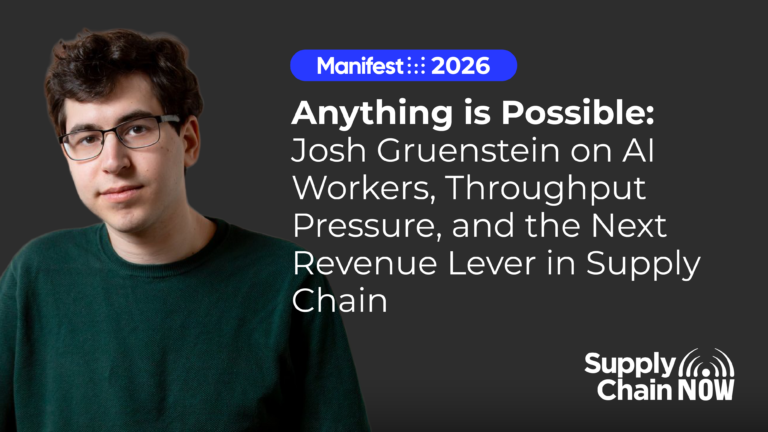
Anything is Possible: Josh Gruenstein on AI Workers, Throughput Pressure, and the Next Revenue Lever in Supply Chain
At Manifest 2026, Scott Luton spent time with Josh Gruenstein, Co-Founder and CEO of Tutor Intelligence, to talk about a future that’s no longer theoretical: AI-powered robot workers operating inside America’s warehouses and factories. And this isn’t a science experiment. It’s already happening.
From MIT to the Warehouse Floor
Gruenstein and his team came out of MIT’s Computer Science and AI Lab with a bold idea: build AI-powered robot workers that can handle the manual labor people don’t want to do.
“We build physical robots,” Gruenstein explained. “We build AI models that enable robots to perceive their environments, and then we deploy those robots into factories and warehouses across the United States to do manual labor that people don’t want to do.”
Unlike traditional automation projects that require massive capital outlays, Tutor Intelligence operates on a robots-as-a-service model. Companies can engage a Tutor robot for roughly $14–$18 an hour, creating a flexible, scalable path to automation without multimillion-dollar implementation risk.
Automation Isn’t New. AI Is Changing the Playbook.
When asked about dominant supply chain themes, Gruenstein pointed to a constant drumbeat: automation. But 2026 feels different.
“Automation is obviously a constant theme,” he said. “What really seems different this year is people are understanding where that automation is going to come from and what are the technological drivers.”
AI is no longer a buzzword floating above the show floor. Leaders are beginning to understand how it directly drives productivity and throughput on the warehouse floor.
And that matters, because supply chain leaders are facing an increasingly difficult mandate.
Higher Throughput. Lower Cost. Same Margin?
One of the top challenges Gruenstein sees in customer conversations is the classic squeeze:
Deliver more throughput.
Deliver it faster.
Deliver it cheaper.
“We definitely see people being asked to deliver the throughput at lower cost,” he said. “How do you square that circle?”
Traditional automation often requires significant capital investment and long payback cycles. That risk (and occasional failure), especially when combined with less-than-focused leadership direction when it comes to technology, has contributed to considerable heartburn in supply chain organizations; including AI fatigue.
Gruenstein is candid about it.
“We’ve seen this in automation for years. People spend millions of dollars. It doesn’t work out. And now it’s, ‘robots don’t work.’”
But the issue isn’t the technology itself.
“It’s not about the AI. It’s about: can you build solutions that improve productivity and efficiency? The proof is in the pudding.”
Seeing real productivity gains on the warehouse floor, not just slides in a boardroom, is what cuts through fatigue and drives action.
From Cost Center to Revenue Driver
Perhaps the most intriguing insight from the conversation wasn’t about labor savings; it was about revenue opportunity.
Robots don’t get tired. They don’t slow down on complex orders. They don’t care how heavy a box is.
If a 3PL can deploy robots that operate at a predictable flat rate, fulfillment complexity becomes less volatile from a cost perspective.
“You’ve suddenly doubled or tripled your margin on your fulfillment to your customer,” Gruenstein noted.
In that model, robotics isn’t just reducing operating expense; it’s unlocking new pricing strategies and competitive advantage. Automation becomes a growth engine.
A Strategic Shift from 3PL Leaders
One of Gruenstein’s biggest takeaways from Manifest wasn’t about technology at all. It was about the people leading supply chain transformation.
“The proactivity and level of strategic thinking that we’re seeing from business leaders is really cool to see,” he said.
There’s both a push and a pull happening in the industry. Technology companies are pushing innovation forward, but supply chain practitioners are pulling in solutions with sharper intent, evaluating what actually delivers productivity, flexibility, and margin improvement.
That strategic maturity may be the biggest shift of all.
The Art of the Possible
Tutor Intelligence now has a 85-person team in Boston, including PhDs and supply chain veterans working side-by-side to turn AI robotics into practical, deployable solutions.
The bigger picture? The art of the possible is expanding rapidly.
Automation is no longer limited to static conveyor systems or million-dollar builds. AI-powered robots can now be deployed incrementally, flexibly, and affordably.
And in an environment where leaders are asked to do more with less, that combination may be exactly what the industry needs.
Because if throughput must rise while costs fall, something has to change. For Gruenstein, that “something” is already rolling across warehouse floors.
Where to Learn More
Connect with Josh Gruenstein with Tutor Intelligence here on LinkedIn. We invite you to check out the company’s website, where you can review current products, as well as big upcoming announcements: https://tutorintelligence.com/
More Blogs

Uncovering Hidden Costs in Supply Chain Planning: Tom Moore of ProvisionAI on What Companies Miss