Share:

The Geopolitics of Junk

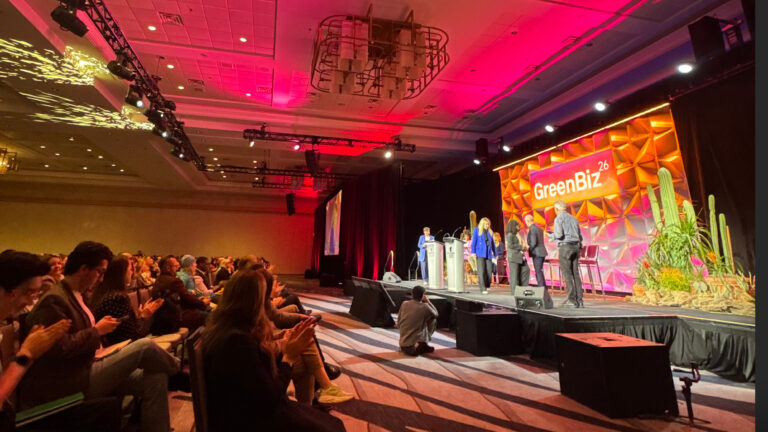
written by Deborah Dull, on site at GreenBiz 2026


I spent today in a room full of people who think about waste for a living. And the word that kept coming up had nothing to do with recycling. It was sovereignty.

Here is the situation. The United States imports 95% of its critical mineral supply. Lithium, cobalt, rare earth elements, the stuff inside every battery, every semiconductor, every electric motor. We do not make it, we do not mine much of it, and we do not control the supply chain that delivers it. That is not an energy policy problem. That is a national security problem.

Now here is the part that should make you put down your coffee. A ton of smartphones contains dramatically more gold than a ton of mined ore. We are talking about concentrations that make urban mining look like a gold rush compared to digging in the ground. And yet the recovery rate for those materials, once a phone leaves its first owner, drops to around 13%. We are losing roughly 80% of the value sitting in devices right now, in drawers, in closets, in landfills.

E-waste is also the fastest growing waste stream in the world, at 2% per year. We are not catching up. We are falling further behind every single year we delay building the systems to recover these materials.

What I kept hearing today, from people running battery recycling operations, from state economic development officers, from supply chain professionals, is a reframe that matters. Urban mining is not a recycling program. It is a domestic supply chain strategy. The materials are already refined. They are already concentrated. They already exist inside products we made and sold. The only part missing is the infrastructure to get them back and the policy environment that makes it worth doing.

There are some promising signals. The federal government put $100 million toward critical mineral recovery through Project Vault. A critical mineral ministerial just launched. States like New Mexico are directing sovereign wealth fund capital toward exactly this kind of industry. The appetite is real.

But appetite without direction goes to the people who already have the relationships. That is not cynicism, that is just how procurement works. The question for everyone working in this space right now is whether we can get specific enough, fast enough, to shape where that money actually goes.

The materials are not buried in a mountain somewhere waiting on a 20-year permitting process. They are in your junk drawer. They are in the back of your office supply closet. They are in the decommissioned equipment sitting in a warehouse three miles from here.

We just need to stop treating them like trash and start treating them like inventory.

More Blogs

ESG performance
Blogs
June 11, 2026

The Sustainability Voice Missing From Most Boardrooms

Companies spend enormous amounts of time debating sustainability strategy. They invest in emissions reduction. They launch environmental initiatives. They publish ESG reports. They set ambitious goals. Yet many overlook a simpler question: Who is helping shape those decisions in the boardroom? Recent research published in the Journal of Business Logistics suggests that board composition may influence environmental performance in ways that executives do not fully appreciate. The study examined more than 2,000 firm year observations across 306 publicly traded business-to-business companies. The researchers explored whether having a customer or supplier represented on the board of directors affected a firm’s environmental performance. The answer was yes. But not in the way many executives might expect. Most discussions about board diversity focus on demographics, functional expertise, or independence. This research points to another form of diversity that may be equally important: where directors sit within the supply chain. A customer and a supplier can look at the same sustainability decision and see very different priorities. Those priorities often shape the choices firms ultimately make. The researchers found that companies with customer affiliated directors generally achieved stronger environmental performance. Customer representatives appeared to bring market knowledge and external stakeholder expectations into board discussions.…
MODEX 2026
Blogs
May 26, 2026

From Cartonization to Control: How Packaging Intelligence Is Evolving

At MODEX 2026 in Atlanta, Scott Luton reconnected with James Malley, Co-Founder and CEO of Paccurate, for a conversation that blended humor, operational insight, and a fresh perspective on where warehouse technology is headed. While the discussion included everything from Disney World to hot dog bun conspiracies, the core message was serious: supply chain organizations are entering a new phase where control, visibility, and operational simplicity matter more than flashy technology demos.   MODEX 2026: Less Hype, More Optimization After nearly a decade of attending MODEX events, Malley sees a clear shift in this year’s show floor dynamic. “I notice in some years at MODEX, there will be all kinds of wild technology that’s kind of futuristic. And in other years, the vibe seems to focus more on the maturation of technology in very established categories,” he explains. “This year is more of the latter.” In other words, the industry appears to be moving from experimentation toward optimization. Rather than chasing the next shiny object, many supply chain leaders are focusing on getting more value from the systems and automation they already have in place. Deeper analytics, better visibility, and operational refinement are becoming bigger priorities than headline-grabbing robotics demonstrations.…